While scholarship abounds on the diplomatic and security aspects of the Cold War, very little attention has been paid to military planning at the operational level. In Blueprints for Battle, experts from Russia, the United States, and Europe address this dearth by closely examining the military planning of NATO and Warsaw Pact member nations from the end of World War II to the beginning of détente. Informed by material from recently opened archives, this collection investigates the perceptions and actions of the rival coalitions, exploring the challenges presented by nuclear technology, examining how military commanders' perceptions changed from the 1950s to the 1960s, and discussing logistical coordination among allied states. The result is a detailed study that offers much-needed new perspectives on the military aspects of the early Cold War.
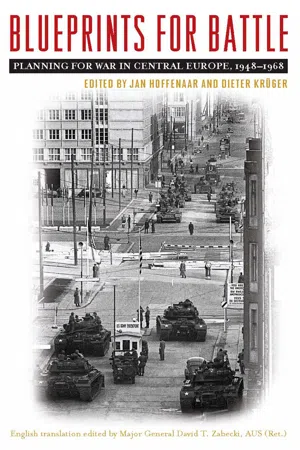
eBook - ePub
Blueprints for Battle
Planning for War in Central Europe, 1948-1968
- 304 pages
- English
- ePUB (mobile friendly)
- Available on iOS & Android
eBook - ePub
Blueprints for Battle
Planning for War in Central Europe, 1948-1968
About this book
Information
1
Strategic Problems and the Central Sector, 1948–1968
An Overview
Lawrence S. Kaplan
Western Europe’s vulnerability to a Soviet thrust from East Germany was arguably the most pressing concern of the five powers that signed the Brussels Pact in March 1948. It was the most persuasive reason for the European allies to seek an American commitment to their defense. While the Soviet threat was not France’s most visible worry in this period, the danger from a potential Soviet attack, coupled with a concomitant Communist internal uprising, was sufficient to convince the military and political elites of all but the Gaullist non-Communist parties to subsume their fears of a revived Germany under the greater fear of Soviet aggression. It was the nightmare of Communist hordes overwhelming a relatively defenseless West as they quickly marched across the North German plain to the English Channel or through the Fulda Gap in Hesse to split West Germany in half. British field marshal Sir Bernard Law Montgomery’s often-quoted remark during his service as commander of the Western Union Defense Organization (WUDO) in 1948 that all the Soviets needed to reach the Channel was an adequate supply of shoe leather created an image that was difficult to eradicate.1
It did not matter that the Soviets in the Stalin era may have had no intention of invading the West; they still had expectations of the collapse of the capitalist societies through their internal weaknesses, abetted by active Communist parties in such countries as France and Italy. What did matter in 1948 was the perceived need by the British and French foreign ministers, Ernest Bevin and Georges Bidault, to lure the United States into the new Western Union. Only an assured American role in the defense of the West would calm European nerves and provide the psychological as well as military basis for the economic recovery promised under the Marshall Plan. The creation of WUDO under the leadership of Field Marshal Montgomery with French general Jean de Lattre de Tassigny as his subordinate commander of the land forces was consciously designed to show the Americans that Europe was doing its part by rearming and integrating its forces—but not much more. In 1948 WUDO was waiting for the completion of the North Atlantic Treaty that would incorporate its activities in an enlarged organization.2
While the Soviet Union’s view of the West in the early Cold War years was not a mirror image, there were elements of the same suspicions that were found among the future Atlantic allies. Despite Communist expectation of the impending doom of all capitalist nations, the Soviets anticipated aggressive actions against them before their demise. Communist control of Eastern Europe, including Czechoslovakia after the coup of February 1948, was not sufficient to ensure security in the face of the West’s hostility.
When the United States and the United Kingdom combined their occupation zones in 1948 to help restore the German economy, the Soviets were convinced that this was a prelude to the creation of a dangerous Germany intent on reclaiming its lost territories. To forestall such an eventuality they encouraged subversive activities among the Communist parties in Western Europe and instituted a blockade of the Western allies’ access to the portions of Berlin assigned under the Yalta agreements of 1945. The Soviet Union failed to prevent either the formation of NATO or a unified West German state, but continued to present itself in the 1950s as the champion of a unified Germany freed from U.S. occupation.3
Whether NATO provided the security Europe demanded in 1948—and afterward—is a question not easily answered. Whether it was necessary in light of the continuing debate over Soviet capabilities as well as intentions is also a question for historians to answer. But in the matter of perceptions there was a transatlantic conviction in 1948 and 1949 that Europe was in peril and that only the United States could redress the imbalance by joining Europe not as an observer or as cheerleader, but as a participant in the process.
The immediate aftermath of the creation of NATO inspired some confidence on the erroneous assumption that U.S. B-29s based in Omaha, Nebraska, and armed with atomic weapons would provide a sufficient deterrent to Communist aggression as the Soviet armies hovered over Western Europe. The Soviet explosion of an atomic device in August 1949 dissolved that illusion. But the American short-range defense plan in that year would have removed U.S. forces to Europe’s periphery in the event of an attack, until the Anglo-American allies were prepared to liberate the Continent once again. Discontent with this plan led to NATO’s acceptance of a medium-term defense plan that put the defense line at the Rhine and IJssel Rivers rather than at Gibraltar or Britain. This decision in March 1950 at least embraced France but left the Netherlands east of the Rhine and IJssel and West Germany and Denmark outside its scope. Nevertheless, it was a step in the right direction.4
The combination of the Soviet acquisition of an atomic bomb, the loss of China to Communism, and the Korean War in 1950 only intensified European insecurity. The possibility that the United States might abandon its new allies to meet its more traditional concerns with Asia and the Pacific was quickly resolved in favor of Europe in 1950 and 1951 in the aftermath of the Korean War. The reorganization of the alliance’s organization from regional planning groups into a military machine prepared to respond to aggression with sufficient force either to inhibit such action or to repel it was evidence of this determination. The Brussels meeting of the North Atlantic Council in December 1950, six months after the North Korean invasion, established a Supreme Allied Command in Europe—under the leadership of General of the Army Dwight D. Eisenhower, the West’s most trusted general—in which the central sector of defense, West Germany, was the major focus of NATO’s concern. The commitment of four divisions to those already in place in Europe was an additional assurance of deepening U.S. involvement. The most dramatic illustration of the alliance’s intentions came in February 1952 at the Lisbon meeting of the council when plans for fifty divisions were made.
Over the span of the next few years, allied confidence in the deterrent effect as well as the defense capabilities of the NATO build-up underwent considerable strain. The most immediate, and in some ways the most sensitive, issue was France’s resistance to German rearmament, even when couched in a carefully framed context. This should not have been a surprise. Even before NATO came into being there was a bond between the Soviets and the French over limiting German sovereignty, whether the issue at hand was German control of the Ruhr or the ultimate creation of a West German government in Bonn. Nothing was more divisive in French relations with Anglo-Americans than the latter’s pressure to reconstruct Germany. It took clear demonstrations of Communist malevolence to push France into acceptance of a limited German sovereignty in the form of the Basic Law creating the Federal Republic one month after the North Atlantic Treaty was signed.5
The Korean War made the use of German resources and manpower even more imperative. If the war in a divided Korea was a prelude to a war in a divided Germany, as many in the West feared, then there was no choice but to bring West Germany into the alliance in one way or another. To postpone facing this reality as long as possible, France agreed to a German role in Europe’s defense, under special and stringent circumstances and then only after intense American pressure. The initial effort in the Pleven Plan in the fall of 1950 was to allow the creation of German military units in battalion strength in a European army that would be incorporated into an integrated NATO force. Authorship was attributed to Premier René Pleven in October, but like the Schuman Plan establishing a Franco-German coal and steel community, it was the brainchild of French economist Jean Monnet. Unlike the practical Schuman Plan, the Pleven idea was an act of desperation, designed to stave off U.S. efforts for immediate German rearmament. To soften the impact of such a German contribution, the United States would offer more troops itself and lead an integrated military command in Europe, as arranged in the Brussels meeting of the North Atlantic Council in December 1950.
In the short run France succeeded in winning for Europe American troops and American generals in a NATO command, while managing to hold off the German role through a European Defense Community (EDC) that would include twelve German divisions. NATO would be in control, and there would be thirty divisions drawn from the other members of the EDC.
France bought time to adjust to changes. While the United States fulfilled its end of the bargain immediately, French demands for additional guarantees from the Anglo-Americans who did not participate in the EDC led to seemingly unending delays in putting the EDC into action. The treaty establishing the community was signed in May 1952, but France’s ratification was postponed until August 1954 after the allies rejected the latest protocols demanded by France. The French National Assembly nominally defeated the treaty on a procedural issue, but it was more likely because of concern about the loss of an independent army. French national pride was at stake. This was arguably more important at that moment than the long-standing reluctance to accept a German role in the defense of the West. The Federal Republic did join the alliance less than a year later with French approval under an arrangement wherein the Western Union was enlarged to include West Germany, and that country would agree to refrain from producing nuclear, biological, or chemical weapons.6
That the defense of German territory would be the most important NATO concern was implicit in Supreme Allied Commander Eisenhower’s geographic division of forces in 1951 into northern, central, and southern sectors. The southern flank created the most difficulties because of British expectations of holding that command. The British did have an admiral as commander-in-chief, Allied Forces Northern Europe (CINCNORTH), but this did not compensate for their failure to win command of the Mediterranean area, which had always been regarded as a British lake, their link to their empire beyond Suez. An American admiral was appointed commander-in-chief, Allied Forces Southern Europe (CINCSOUTH), largely because the U.S. Sixth Fleet was the most significant entity in that area. But it was more significant if less controversial that Eisenhower himself initially retained overall control of the Central Sector. Soviet forces were massed along the Inner-German Border. This was where deterrence was vital.
But in the period between 1950 and 1954 the anticipated German contributions to NATO were in abeyance even as “the year of maximum danger” was moved from 1954 to 1952. Opposition to German participation in the alliance was not confined to France. From Germany itself there were protests from Left and Right. The Social Democrats may not have been in power, but they were articulate in expressing their concern that joining NATO would put Germany back on the path of militarism and a revival of Nazism. From the Far Right came the conviction that a NATO connection would foreclose opportunity for reclaiming territories lost in World War II. Their spokesmen lacked faith in the West’s interest in reunification. Chancellor Konrad Adenauer himself, an ardent believer in incorporating West Germany into the West, appeared on occasion to play the East against the West in advancing Germany’s progress toward full sovereignty.7
Further undermining the promise of the Lisbon decisions of 1952 was an early recognition on the part of the transatlantic allies that the build-up of fifty divisions in Europe was impossible to achieve. When Eisenhower took office as U.S. president in 1953 he acted on an assumption that he must have recognized earlier as NATO’s supreme allied commander in Europe, that the fifty divisions envisioned in 1952 would not materialize. Eisenhower’s exhortations to Europeans notwithstanding, the allies would not risk the fragile economic recovery achieved through the Marshall Plan being undercut by a military build-up. Nor would the United States be willing to do more than had already been pledged. Given the stalemate in 1953 with respect to a German contribution, the Eisenhower administration initiated a “New Look” defense policy that would see tactical nuclear weapons as a substitute for troops on the ground. Should the Soviets fail to be impressed, there was also the deterrent pressure of massive retaliation against any Soviet act of aggression.8
The nuclear strategy did not fully substitute for troops on the ground to face the formidable 175 divisions that the adversary presumably could bring to bear. NATO’s intention in the event deterrence failed was to keep the enemy as far east as possible in a defense along the Inner-German Border. West Germany’s entry into the alliance made a stand at the East German border vital if only for domestic reasons. The function of ground forces then was to hold on just long enough for America’s nuclear power to be deployed. Such was the thinking of the NATO Military Committee’s force-planning document MC-70. By the mid-1950s thirty divisions were as much as the alliance could put together and were considered an adequate minimum at the time.9
How credible was this strategy in the eyes of the allies as they contemplated its effect on the Warsaw Pact adversaries? True, West Germany was now part of the alliance and its manpower presumably would make a difference. Yet there were too many factors subverting the defense plans in the Central Sector. The principal partners—Britain, France, and Germany—each raised unsettling issues. Britain in financial distress proposed in 1956 to withdraw one-third of the British Army of the Rhine, which if implemented would be a psychological as well as military blow to defense planners. A compromise was devised whereby some forces in Britain would, if necessary, be earmarked for NATO, which postponed further withdrawals. France’s reasons for failing to meet troop commitments were more pressing and more rigid. This time it was not fighting in Indochina but insurrection in Algeria that diverted French resources; five divisions were reassigned from Europe to North Africa. And the twelve German divisions whose addition to NATO forces had been long promised were delayed when domestic opposition forced Adenauer’s government to postpone the introduction of conscription. Adenauer’s problems were not helped by the impact of the NATO air exercise CARTE BLANCHE in June 1955, which estimated that 1.3 million Germans would be killed in a surprise Soviet air attack.
The inability of the allies to meet their force goals in the mid-1950s was complicated by the continuing Communist campaign to paint NATO as a disrupter of European peace. The Soviet Union’s acceptance of the Federal Republic’s membership in NATO, the arrangement for Austrian neutrality in the Cold War, and the creation of the Warsaw Pact in 1955 all seemed to indicate a softer policy toward the West. In fact, the model of the Warsaw Pact presumably was NATO itself. The purpose in promoting a conference in Geneva was to set in motion an all-European security treaty that would drive American troops from Europe. The Soviet view seemed to have won support from such prominent figures as George Kennan, who had deplored the militarization of NATO in a widely publicized radio speech in 1957. The allies were encouraged by Soviet premier Nikita Khrushchev’s unilateral troop cuts of one million men in 1956.
In these circumstances it was unlikely that NATO could achieve even the modest build-up of conventional forces that had been the goal of the Eisenhower administration. The nuclearization of NATO as the organization’s main deterrent seemed inevitable. Still, the addition of German troops, the deployment of tactical nuclear weapons, and the assumption that sufficient conventional forces were available to provide a credible shield gave some sense of confidence about confronting the Soviets on relatively equal terms by 1957.
But by the end of that year the Soviet launching of Sputnik, an earth satellite, shattered this fragile sense of security as it implied Soviet superiority in the mastery of intercontinental ballistic missiles (ICBMs). Sputnik raised fears in Europe and the United States that the Soviet Union would dominate the world from outer space. Instantly, America’s invulnerability was challenged, with serious implications for the security of its European allies. Would the United States maintain its commitment to Europe if its own territory was subject to attack? This was the kind of question that General Charles de Gaulle, president of France in the Fifth Republic, asked the NATO allies as well as his countrymen. The United States did its best to calm its allies by accelerating its own ICBM program, by establishing nuclear weapon stockpiles in Europe, and by planning deployment of intermediate-range nuclear missiles in countries that would accept them—Turkey, Italy, and Britain. The supreme allied commander, Europe ...
Table of contents
- Cover
- Title Page
- Copyright
- Contents
- Foreword
- Preface
- A Note on the English Edition
- List of Abbreviations and Common Terms
- Introduction: The Plans of the Warsaw Pact and NATO
- 1. Strategic Problems and the Central Sector, 1948–1968: An Overview
- 2. Aims and Realities: NATO’s Forward Defense and the Operational Planning Level at NORTHAG
- 3. Soviet and Warsaw Pact Military Strategy from Stalin to Brezhnev: The Transformation from “Strategic Defense” to “Unlimited Nuclear War,” 1945–1968
- 4. Waiting to Be Kissed? NATO, NORTHAG, and Intelligence
- 5. East German Military Intelligence for the Warsaw Pact in the Central Sector
- 6. Waste and Confusion? NATO Logistics from the Dutch Perspective
- 7. The Logistics System of the Soviet and Warsaw Pact Armed Forces in the 1950s and 1960s
- 8. Soviet Union Military Planning, 1948–1968
- 9. War Games in Europe: The U.S. Army Experiments with Atomic Doctrine
- 10. Fighting for the Heart of Germany: German I Corps and NATO’s Plans for the Defense of the North German Plain in the 1960s
- 11. The German Democratic Republic
- 12. The British Army of the Rhine and Defense Plans for Germany, 1945–1955
- 13. The Dutch Contribution to the Defense of the Central Sector
- 14. Concluding Remarks: Warfare in the Central Sector
- List of Contributors
- Index
Trusted by 375,005 students
Access to over 1.5 million titles for a fair monthly price.
Study more efficiently using our study tools.
Frequently asked questions
Yes, you can cancel anytime from the Subscription tab in your account settings on the Perlego website. Your subscription will stay active until the end of your current billing period. Learn how to cancel your subscription
No, books cannot be downloaded as external files, such as PDFs, for use outside of Perlego. However, you can download books within the Perlego app for offline reading on mobile or tablet. Learn how to download books offline
Perlego offers two plans: Essential and Complete
- Essential is ideal for learners and professionals who enjoy exploring a wide range of subjects. Access the Essential Library with 800,000+ trusted titles and best-sellers across business, personal growth, and the humanities. Includes unlimited reading time and Standard Read Aloud voice.
- Complete: Perfect for advanced learners and researchers needing full, unrestricted access. Unlock 1.5M+ books across hundreds of subjects, including academic and specialized titles. The Complete Plan also includes advanced features like Premium Read Aloud and Research Assistant.
We are an online textbook subscription service, where you can get access to an entire online library for less than the price of a single book per month. With over 1.5 million books across 990+ topics, we’ve got you covered! Learn about our mission
Look out for the read-aloud symbol on your next book to see if you can listen to it. The read-aloud tool reads text aloud for you, highlighting the text as it is being read. You can pause it, speed it up and slow it down. Learn more about Read Aloud
Yes! You can use the Perlego app on both iOS and Android devices to read anytime, anywhere — even offline. Perfect for commutes or when you’re on the go.
Please note we cannot support devices running on iOS 13 and Android 7 or earlier. Learn more about using the app
Please note we cannot support devices running on iOS 13 and Android 7 or earlier. Learn more about using the app
Yes, you can access Blueprints for Battle by Jan Hoffenaar, Dieter Krüger, David T. Zabecki, Jan Hoffenaar,Dieter Krüger,David T. Zabecki in PDF and/or ePUB format, as well as other popular books in History & Military & Maritime History. We have over 1.5 million books available in our catalogue for you to explore.