Tradition, community, and pride are fundamental aspects of the history of Appalachia, and the language of the region is a living testament to its rich heritage. Despite the persistence of unflattering stereotypes and cultural discrimination associated with their style of speech, Appalachians have organized to preserve regional dialects—complex forms of English peppered with words, phrases, and pronunciations unique to the area and its people. Talking Appalachian examines these distinctive speech varieties and emphasizes their role in expressing local history and promoting a shared identity.
Beginning with a historical and geographical overview of the region that analyzes the origins of its dialects, this volume features detailed research and local case studies investigating their use. The contributors explore a variety of subjects, including the success of African American Appalachian English and southern Appalachian English speakers in professional and corporate positions. In addition, editors Amy D. Clark and Nancy M. Hayward provide excerpts from essays, poetry, short fiction, and novels to illustrate usage. With contributions from well-known authors such as George Ella Lyon and Silas House, this balanced collection is the most comprehensive, accessible study of Appalachian language available today.
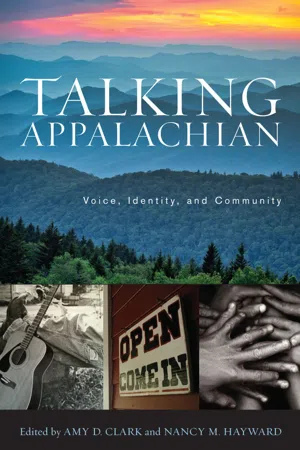
eBook - ePub
Talking Appalachian
Voice, Identity, and Community
- 274 pages
- English
- ePUB (mobile friendly)
- Available on iOS & Android
eBook - ePub
Talking Appalachian
Voice, Identity, and Community
About this book
Information
Publisher
The University Press of KentuckyYear
2014Print ISBN
9780813147437
9780813140964
eBook ISBN
9780813140971
Part I
Varieties, Education, and Power in Appalachia
The Historical Background and Nature of the Englishes of Appalachia
Michael Montgomery
The historical background of the English language in Appalachia and its ongoing change reveal a heritage shared across the region in many ways today. Yet at the same time these fundamental realities fully justify the plural designation Appalachian Englishes, to indicate its diversity. The overarching label Appalachian can be useful to make qualified generalizations about speech and many other things, to suggest commonalities between places that are distant on the map, or to identify affinities that people in the mountain states of the eastern United States share. However, in practice, local or subregional identities rank first and trump the broad one of Appalachian on the ground.1 Ask me where I’m from, and as a reflex I say, “East Tennessee.” While in Abingdon a few years ago, people adamantly told me that they were from “southwest Virginia” (leaving me no doubt where they were from). There are good reasons to believe that localness has long been primary to people, especially those of European extraction whose families have been in the same area of Appalachia for up to three centuries. If this is so, can one talk about “Appalachia” at all?
Yes, but only with care. Appalachia is a place as well as places, people as well as peoples. The more closely one examines the region, the more complex it becomes. The features and usages of its English are shared not only across many states but also with areas farther afield, such as the Ozarks or even Texas.2 Equally, there is immense variation from place to place and from one community of practice to another; for example, compare the English of a group of quilters with that of a group of NASCAR fans. No matter how small the place, there are social differences in the use of English within it—there probably always have been and will be. Admonitions to younger people “not to get above their raising” (i.e., their elders) in the way they talk and behave are nothing new, yet they cannot prevent differences between generations from being the most prevalent of all, especially in terms of vocabulary.
This essay discusses how we can talk about Appalachian Englishes in the realm of history, especially with regard to settlement and migration in the region. Here the eighteenth century is the most crucial time, for the region was gradually populated by Europeans from about 1730 (south-central Pennsylvania) to the 1830s (north Georgia).3 If one were to choose a label for relic usages lingering in the region in the late twentieth century (e.g., holp ‘helped’ or waiter ‘wedding attendant’), the best one would be “colonial” or “eighteenth century.” This colonial heritage may come as a surprise to the many Americans who have heard that “Elizabethan” or “Shakespearean” English is (or was, until not long ago) spoken somewhere in the mountains and that the region’s linguistic ancestry can be traced back that far—four centuries or more.4 However, historians and other researchers have shown that such is the case for language and many other facets of culture. The history of settlement and migration points to the primary importance of Pennsylvania and the secondary importance of the Lower South. As we will see, arguments that mountain English is Elizabethan falter on several grounds, including an implausible explanation of how it could have gotten to Appalachia.
The foundational migration of Europeans into Appalachia occurred in a widening corridor from central Pennsylvania’s Cumberland Valley westward to Pittsburgh and the Ohio Valley and southwestward into Virginia during the eighteenth century. The storied movements into Virginia, predominantly (but far from exclusively) by Germans and Scotch-Irish (from Ulster),5 have been frequently recounted since at least Theodore Roosevelt’s The Winning of the West more than a century ago: how many of these settlers followed the Shenandoah River and its forks, traveled along the Great Wagon Road into and through the Valley of Virginia, and followed the Great Valley of the Tennessee into North Carolina (i.e., into what would become the state of Tennessee), while others trekked through the Cumberland Gap, into what would become Kentucky.6 This narrative of migration and settlement was incorporated by renowned historian Frederick Jackson Turner into his Frontier Thesis, which represented the largest truly American epic to his time.7 Players in this drama of “conquering” the frontier included the larger-than-life Daniel Boone and the Overmountain Men, who in lightning fashion descended from the valley of the Holston and Clinch to defeat Loyalist forces at King’s Mountain, South Carolina, on October 7, 1780, an engagement that turned the tide of the Revolutionary War and led to British capitulation the following summer. Such figures and compatriots left behind oral accounts, correspondence, and incipient legends used by later researchers to reconstruct the period. Interestingly, it is due largely to the efforts of one individual that these stories and documents were gathered and preserved for posterity. Lyman Copeland Draper (1815–1891) from upstate New York was the indefatigable librarian who scoured the interior of the country beginning in the 1830s to collect and copy thousands of pages still in private hands and transcribe reminiscences that would become essential building blocks for later historians.
The backdrop just sketched provides some order to our discussion, but the settling and history of the Appalachian region—and the planting and development of its Englishes—requires a weaving back and forth chronologically as well as time exposures of specific places. Generalizations about history, language, or anything else are surely desirable, but they must always be assessed for mistaken impressions, assumptions, and gaps. For example, it is a fact that the arduousness of overland travel before the advent of modern roads prevented many in Appalachia from contact with mainstream society, but describing the region as a whole as “isolated” (as many, including linguists, have done) is misleading at best.8 Such a description may have some validity for individual communities, but it would involve specific people usually having a specific ancestry, specific contact with outsiders, and certain psychological and economic traits. The caveat about judging a community to be isolated based on the difficulty of access is nowhere better illustrated than in the seemingly less accessible coal mining areas of Kentucky and West Virginia, where eastern and central Europeans as well as African Americans settled and then often left in the early twentieth century.9 It is well known that language has a life of its own and is always subject to change. Given this reality, the purported isolation of localities should logically produce increasing differences in speech rather than uniformity. Ironically, however, many linguists and social scientists have often applied the all-encompassing label “Appalachian” to research conducted in a single small area, thereby considering it typical, whether this is acknowledged or not. Small differences in language (or the belief in their existence) are so much a part of local identity that people not uncommonly claim that they can distinguish residents of communities five miles apart by their speech or that they can tell just by hearing someone talk whether that person is from their own neck of the woods. Such claims involve tiny details of rhythm and intonation that others cannot detect, and though they may not be demonstrable or testable, they are nevertheless believed because they are part of what defines localness.
Another element of local identity is consciousness of local history and topography, both of which are important to linguists tracing how people migrate and how language varies and changes. For example, from time to time one finds it stated that people from the east and north, including those following the routes outlined earlier, migrated into or settled the “Appalachian Mountains” or even “migrated down the ridges of Appalachia.” In truth, the paths were nearly always valleys. People followed watercourses and constructed farmsteads, forts, stockades, and other buildings usually adjacent to them or to bluffs along them. They built stores, churches, and inns near water and whatever roads existed. However inconstant the tides and navigation might be, rivers and streams often surpassed roads as a means of travel. Settlements formed at the forks of streams and rivers, and some of them grew in time into towns and then cities (Knoxville, Pittsburgh). Settlers eyed stable homesteads and the most productive land they could make their own; they knew farms would be poorer and less tenable in higher elevations. Assessment of the land’s fertility led many to skirt eastern Kentucky in favor of the Bluegrass. It prompted a vanguard of Virginians and North Carolinians to found Nashville in 1780, several years before Knoxville. The latter was a more secure and, for a time, more substantial settlement, but one with a less fertile hinterland. This tendency was often replicated elsewhere, and the interplay of valley and ridge became what is still a constant. Outside of county seats and other towns, communities in much of the region were often loose and highly dispersed, bearing scarce resemblance to villages elsewhere in early America. In much of Appalachia, uplands were settled a generation after the bottomlands as the population grew and spread. In the higher or more rural areas of Appalachia, communities were called settlements well into the twentieth century. Even so, that term is misleading, because migration and population fluidity have also been constants. It was through southern Appalachia that much of the southern half of the country was populated, ultimately all the way to California.
Although the English language called Appalachian is often believed to be the most distinctively regional variety in America and is often referred to as if it were a single homogeneous entity, the region does not have just a single dialect. The population’s ancestry is quite mixed, and in many ways, the English of Appalachia represents a microcosm of American English; its speakers have both preserved forms that are no longer used in most of the rest of the country and innovations of others. Educator and social researcher John C. Campbell’s famous observation in 1921 about Appalachia being “a land . . . about which, perhaps, more things are known that are not true than of any part of our country,” pertains particularly well to the English spoken there.10
The speech of Appalachia has captivated journalists, travelers, and educators for the better part of two centuries. One early commentator was Anne Royall (1769–1851...
Table of contents
- Cover
- Half title
- Title
- Copyright
- Contents
- Preface
- Introduction
- Part I: Varieties, Education, and Power in Appalachia
- Part II: Voices from Appalachia
- Acknowledgments
- List of Contributors
- Permissions
- Index
Trusted by 375,005 students
Access to over 1.5 million titles for a fair monthly price.
Study more efficiently using our study tools.
Frequently asked questions
Yes, you can cancel anytime from the Subscription tab in your account settings on the Perlego website. Your subscription will stay active until the end of your current billing period. Learn how to cancel your subscription
No, books cannot be downloaded as external files, such as PDFs, for use outside of Perlego. However, you can download books within the Perlego app for offline reading on mobile or tablet. Learn how to download books offline
Perlego offers two plans: Essential and Complete
- Essential is ideal for learners and professionals who enjoy exploring a wide range of subjects. Access the Essential Library with 800,000+ trusted titles and best-sellers across business, personal growth, and the humanities. Includes unlimited reading time and Standard Read Aloud voice.
- Complete: Perfect for advanced learners and researchers needing full, unrestricted access. Unlock 1.5M+ books across hundreds of subjects, including academic and specialized titles. The Complete Plan also includes advanced features like Premium Read Aloud and Research Assistant.
We are an online textbook subscription service, where you can get access to an entire online library for less than the price of a single book per month. With over 1.5 million books across 990+ topics, we’ve got you covered! Learn about our mission
Look out for the read-aloud symbol on your next book to see if you can listen to it. The read-aloud tool reads text aloud for you, highlighting the text as it is being read. You can pause it, speed it up and slow it down. Learn more about Read Aloud
Yes! You can use the Perlego app on both iOS and Android devices to read anytime, anywhere — even offline. Perfect for commutes or when you’re on the go.
Please note we cannot support devices running on iOS 13 and Android 7 or earlier. Learn more about using the app
Please note we cannot support devices running on iOS 13 and Android 7 or earlier. Learn more about using the app
Yes, you can access Talking Appalachian by Amy D. Clark, Nancy M. Hayward, Amy D. Clark,Nancy M. Hayward in PDF and/or ePUB format, as well as other popular books in Languages & Linguistics & North American History. We have over 1.5 million books available in our catalogue for you to explore.