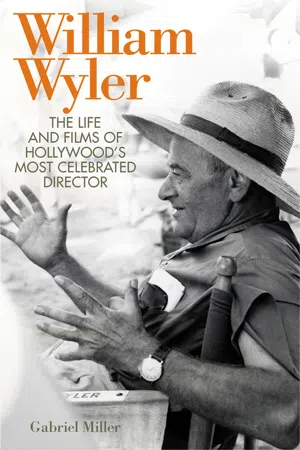
During his forty-five-year career, William Wyler (1902–1981) pushed the boundaries of filmmaking with his gripping storylines and innovative depth-of-field cinematography. With a body of work that includes such memorable classics as Jezebel (1938), Mrs. Miniver (1942), Ben-Hur (1959), and Funny Girl (1968), Wyler is the most nominated director in the history of the Academy Awards and bears the distinction of having won an Oscar for Best Director on three occasions. Both Bette Davis and Lillian Hellman considered him America's finest director, and Sir Laurence Olivier said he learned more about film acting from Wyler than from anyone else. In William Wyler, Gabriel Miller explores the career of one of Hollywood's most unique and influential directors, examining the evolution of his cinematic style. Wyler's films feature nuanced shots and multifaceted narratives that reflect his preoccupation with realism and story construction. The director's later works were deeply influenced by his time in the army air force during World War II, and the disconnect between the idealized version of the postwar experience and reality became a central theme of Wyler's masterpiece, The Best Years of Our Lives (1946). None of Wyler's contemporaries approached his scope: he made successful and seminal films in practically every genre, including social drama, melodrama, and comedy. Yet, despite overwhelming critical acclaim and popularity, Wyler's work has never been extensively studied. This long-overdue book offers a comprehensive assessment of the director, his work, and his films' influence.
- 520 pages
- English
- ePUB (mobile friendly)
- Available on iOS & Android
eBook - ePub
About this book
Information
Subtopic
Film et vidéo1
Discovering a Vocation and a Style
The Shakedown (1929), The Love Trap (1929), Hell's Heroes (1930), A House Divided (1931)
William Wyler grew up with the movies. He came to America from Mulhouse (Mulhausen), Alsace-Lorraine, in 1920 at the invitation of his mother's first cousin, Carl Laemmle, who was the founder and head of Universal Studios. Laemmle's young cousin would soon eclipse his fame in the industry that would come to dominate American culture.
Laemmle himself had arrived in his adopted country in 1884, joining his older brother in Oshkosh, Wisconsin, where he became a branch manager for a successful midwestern clothier. When he was thirty-nine, Laemmle moved to Chicago, seeking to become his own boss. A chance stroll past a movie theater on State Street aroused his curiosity, and he paid the ten cents admission to watch the film being shown there. Three weeks later, he owned his own nickelodeon. That was in 1906. Within a decade, Laemmle would have a chain of movie theaters throughout the Midwest. By 1910, he had become a film producer and had founded Independent Moving Pictures, which later became Universal Pictures. Laemmle also introduced the star system to Hollywood when he lured Mary Pickford away from the Biograph Company by offering her more money and prominent billing. Prior to that innovation, actors’ names were not revealed to the moviegoing public.
Laemmle vacationed in Europe every summer, and when Wyler's mother, Melanie, learned that her famous cousin would be traveling through Switzerland, she wrote to Carl about her son. He responded by inviting them to meet him at a hotel in Zurich. Laemmle offered the young man a job at Universal's New York office that paid $25 a week, from which $5 would be deducted until the cost of the transatlantic trip on the Aquitania had been reimbursed. Known for bringing ambitious young men to America, Laemmle already had more than a dozen relatives on his payroll. Indeed, his penchant for nepotism was legendary, even prompting an Ogden Nash couplet: “Uncle Carl Laemmle / has a large faemmle.” Many years later, however, critic Charles Affron would note, “Wyler's career is an excellent argument for nepotism.”1
William Wyler turned out to be an ambitious kid. Within a year, he asked to be transferred to California, and by 1922, just two years after arriving in America, he was working, in his words, as a “gofer” on The Hunchback of Notre Dame starring Lon Chaney (some sources list him as an assistant director). By 1925, shortly after his twenty-third birthday, he was directing his first two-reel western, making him the youngest director on the Universal lot. That first “mustang” two-reeler (twenty-four minutes long) was Crook Buster. Over the next two years, he directed twenty-one mustang films and also worked on MGM's Ben-Hur (1925). On that film, he was one of sixty assistant directors assigned to control the chariot race scene, for which the studio had hired thousands of extras and built a Circus Maximus. In 1926, Wyler graduated to his first five-reeler, Lazy Lightning, a “blue streak” western. He would direct five more through 1927.
The first film to offer intimations of what would become Wyler's distinctive mise-en-scène was The Shakedown (1929), which was released in both silent and sound versions and cost around $50,000 to make. Wyler's brother Robert discovered the story. He had spent the previous two years at Universal learning the business and preparing to become a producer, and he also had a hand in writing the script, along with Charles A. Logue and Clarence Marks. Robert would be associated with a number of his brother's films in the future, but his contributions to The Shakedown were uncredited.
The story concerns a crooked boxer, Dave Hall (James Murray), who is involved in a shakedown ring that travels from town to town, where the bosses arrange fixed fights and encourage the locals to bet on the outcome. After establishing his identity in one town and provoking a fight with Battling Rolf, a professional fighter, Dave, who has become the local favorite, loses the fight, and the townspeople who have bet on him lose their money. Dave then moves on to establish himself in another town and set up another shakedown. Most of the film takes place in Boonton, where Dave works in the oil fields; there, he falls in love with a waitress, Marjorie (Barbara Kent), and adopts an orphan, Clem (Jack Hanlon), whose life he saved. Dave is beginning to feel at home there. When his associates come to town to set up his fight with Rolf, he wants to run away, but Clem convinces him to stay, fight, and redeem himself. Dave wins the fight and presumably will settle down with Marjorie and Clem.
The Shakedown is an early example of Wyler's artistry in evoking the American way of life, introducing, in embryonic form, what would become his signature combination of social observation and an entertaining story that appeals to the audience. As an early example of the gangster narrative (which would become a seminal genre just two years later), The Shakedown still resembles many silent films featuring gangster protagonists, in that its generic signs are basically unformed and sublimated to the melodramatic elements of the story. The emphasis here is on redemption—that of a corrupted hero rehabilitated by a saintly heroine and (for good measure) an engaging orphan—rather than the traditional gangster's dramatic fall from prominence and belated moment of bitter recognition.
The film opens in a bar with a pool table—a locale that would soon become iconic in gangster films. Some of Wyler's most impressive camera work follows, as he introduces Boonton, an oil town. He first shows Dave working on an oil well, where he is framed by its wooden scaffolding; in the background, a long line of wells dominates the landscape. Then, in a virtuoso sequence, Wyler situates his camera below the well while Dave, mounted on a pulley, is hauled up to the top. When the scene shifts to the café where Marjorie works, Wyler gives the frame a double perspective, combining the cozy interior of the hometown eatery with the wells looming in the background—a fusion of the old, rural America and the booming economic energy of the new.
Here, Wyler introduces a tension that will be developed with more complexity in his mature work, characterizing the twentieth century as a site of conflict involving the individual's relation to the emerging industrialized society—particularly the opposition between traditional social forms (the café and the incipient family unit) and the gangster figure, who represents the fragmentation of tradition and the potential for anarchy created by new patterns of consumption and the corresponding emergence of new and more liberating lifestyles.2 As noted earlier, Wyler at this point still sublimates this thematic culture clash to the exigencies of the melodramatic plot, concentrating on Dave's evolving relationships with Clem and Marjorie and his decision to quit the shakedown gang.
The Shakedown also contains some early examples of Wyler's staging strategies, the most interesting of which is his use of deep focus early in the film. The story opens in a saloon, where Dave wins a pool game. The gang organizer then puts Dave's winnings under a napkin and challenges anyone to try to take them as Dave stands on the napkin. This is Battling Rolf's cue to join the sting. Wyler places Rolf in the foreground of the frame, where he is seated at the bar, while Dave seems to disappear in the rear amid a group of patrons who nearly blot him out. Further in the distance, the buildings of the town are visible through a doorway. The crowd disperses, but Wyler maintains his composition in depth by continuing to focus on Rolf in the foreground, while Dave is framed against the exterior setting. The director seems to be indicating that his protagonist is not a bad man and has the potential to move into the townspeople's world and embrace their traditional values.
Universal loved the film. The internal reports on The Shakedown called it “Another Willie Wyler Winner.” Another raved, “Mr. Wyler comes through 100%.” A third seemed to predict where the young director was heading: “Willy Wyler's direction should be highly recommended. He is developing like a million dollars and his picture shows a sense of realism and pace and endows every little incident in it with charm and entertainment value.”3 The studio's enthusiasm, however, was not reflected in the film's reviews; most critics found it bland and a bit saccharine.
In the spring of 1929, Wyler agreed to direct a bedroom comedy, The Love Trap, starring Laura La Plante, one of Universal's biggest stars. The film's budget exceeded that of The Shakedown by some $25,000, and it had a longer shooting schedule. Although the plot falters, especially at the end, Wyler manages to demonstrate, very early in his career, the capacity to move almost effortlessly from genre to genre. In The Love Trap, he does best in the darker sections that dominate the first part of the film, exploring the often dangerous, desperate world of the single woman, whose plight in this case is exacerbated by the loss of her job and her home. Wyler is ruthless in exposing the divide between the classes, which, despite the “happy ending,” is never really breached.
The story follows the fortunes of Evelyn Todd (La Plante), a recently fired chorus girl who is invited by a friend to go to a party thrown by a wealthy bachelor, Guy Emory (Robert Ellis), where she can make $50.4 Although Evelyn is presented as a sympathetic character, she knowingly puts herself in a risky situation by attending this party. Her theatrical background and her access to women who know their way around the party circuit invest her with a backstory that is more risqué than that of the comic heroines who would dominate 1930s social comedies. Evelyn gets herself into a sexually compromising position but manages to extricate herself and leaves the party, only to find that she is homeless and her furniture has been thrown out on the street. Evelyn, we soon learn, is a virginal young woman who is only trying to get along as best she can. She is picked up by the wealthy Paul Harrington (Neil Hamilton), who is being driven home in a cab. In a lame bit of comic business, he arranges to have three additional cabs pick up her furniture, and all the drivers head south. The two fall in love and get married shortly after this meeting, but trouble begins when Evelyn is rejected by Paul's mother and sister. Complicating the situation is Paul's uncle, Judge Harrington (Norman Trevor), who met Evelyn at Guy Emory's party and considers her unfit for his nephew. The judge tries to buy her off, but in an awkward comic sequence that dominates the last part of the film, Evelyn maneuvers the judge into a compromising situation, exposes him to Paul, and saves her marriage.
The first part of the film shows Wyler's strengths as a director and as a social observer. The early scenes at Guy Emory's party anticipate the techniques he will use to depict high society in Dodsworth, Jezebel, The Heiress, and Carrie. As he did in The Shakedown, Wyler continues to explore the framing strategies that will distinguish his mature work.
After Evelyn is fired from the chorus line, she returns to the dressing room and stares into the mirror while her friend, sitting to her left, tells her about Emory's party and the chance to earn $50 “just for looking pretty.” Evelyn is thus framed within a frame as she decides whether to negotiate the dangerous party scene, anticipating the way Wyler later frames Fran Dodsworth, Julie Marsden, and Carrie Meeber as they decide whether to embark on equally treacherous courses. Evelyn is, of course, part of a comic universe, and her likely fate is not as dire as that of the others, but because Wyler does not stage the party in a comic style, he is freer to explore the scene in ways that are more suited to his temperament.
When she is first seen at the party, Evelyn is part of a crowd around the bar, where she tries to prove that she is an experienced drinker. Wyler squeezes her in the frame with a group of guests, as he later does with Fran Dodsworth when her husband finally decides to leave her. Evelyn is introduced to Judge Harrington, whom her friend describes as having “blue blood and green bucks.” Evelyn's attempts to flirt with the judge are so awkward that her friend sends her away, pointing her in Guy Emory's direction, while the friend takes on the judge herself. Guy immediately gives Evelyn $50, and Wyler cuts away to the friend putting her own money in her stocking. Obviously, Evelyn has placed herself in a compromising position, and Wyler is giving his audience a glimpse into the darker and seamier side of high society. In an attempt to get Evelyn upstairs, Guy spills a drink on her dress, which gives Wyler a chance to employ the expressive imagery of a staircase for the first time. He uses it here to achieve tension by shifting among the spatial structures inherent in the set—the downstairs public area of the party and Guy's private space upstairs. It also allows him to visually fill the frame vertically and in depth.
Guy leads Evelyn upstairs, and while she is in the bedroom taking off her wet dress, Wyler cuts to Guy on the landing in a modified low-angle shot that emphasizes his unsavory desire as he looks down on the dancers below. Guy then surprises Evelyn by walking in on her while she is in her slip. Wyler again captures the action in a mirrored shot, matching the one in the dance hall, but this time including Guy. As the scene in Guy's bedroom plays out, Wyler's fondness for vertical lines and in-depth framing is apparent: he frames Evelyn between the bed curtains, a prisoner of Guy's lust, and then frames Guy himself in the window as he airs out the wet dress. When he lets it drop to the street below, Wyler's camera seeks out Evelyn in the rear, where she is again framed by the bed curtains. Sensing danger, she flirts with Guy and beckons to him, but then punches him and flees the house. Her resourcefulness in making this escape anticipates her ability to manipulate Judge Harrington in the film's final sequence.
Wyler again uses the staircase, but this time for comic purposes, in the first scene of Evelyn and Paul after their marriage. Returning home, Paul finds Evelyn waiting on the staircase landing, where she assumes Guy's position from the earlier scene. In a comic variation on that scene, however, Paul climbs onto a desk to greet her on the stairs and takes her hand. Paul's mother and sister soon arrive to meet his bride, and Paul is seen greeting them in the living room. Wyler then cuts to Evelyn in the bedroom, where she is getting ready to meet her new family. That room, with the bed in the background, is now her safe haven—Wyler's pictorial repetition brings the two sequences together, emphasizing the contrast between them.
Next, Evelyn tries to make a grand entrance by descending the staircase, but she slips and falls on her bottom. This inauspicious debut anticipates her failure to impress Paul's family, who look down on her lack of social standing. Here, Wyler anticipates his staging of the confrontation in These Three, as Martha and Karen try to defend themselves against the accusations of Mary Tilford. When Paul's family members distance themselves from Evelyn, Wyler isolates her in the frame. He cuts liberally throughout the scene, using shot–reverse shots and compositions that seclude Evelyn while the Harrington women, soon joined by the judge, join forces against her. Wyler will repeat this strategy seven years later, visually isolating his heroines in These Three as the forces of repression gather against them.
The Love Trap was made in both a silent version and a 25 percent sound version. The latter features a musical score and synchronized sound in the final sequences, including the overly long confrontation between Evelyn and the judge. Because of the actors’ evident difficulty in making the transition to sound, what is supposed to be a comic sequence seems even more melodramatic, which, unfortunately, magnifies Wyler's struggle to keep the scene light and comic.
Following the completion of The Love Trap, Wyler was asked to shoot some special scenes of La Plante in Spanish for a film exposition in Barcelona. Then Carl Laemmle Jr. (known as Junior), who was now the general manager of his father's studio, asked Wyler to direct an installment of The Cohens and the Kellys in Scotland, which he refused to do because he did not like the story. This was just the first of many times that Wyler stood up to a producer when he disliked the material he was offered. In a letter to his parents, he was already displaying the temperament of an artist: “I probably would be considered of the large army of ingrates who got their starts with Carl Laemmle and then left him. But I don't want to sacrifice my future for the past.”5
Wyler's refusal to listen to Junior almost cost him his next project, Hell's Heroes—a film that would display Wyler's considerable gifts and allow him to impose his own vision on the material. Fortunately, Junior decided to sublimate his anger for the good of a project he had great confidence in. Recognizing that Wyler had brought a touch of class to both The Shakedown and The Love Trap, he decided to assign The Cohens and the Kellys to William Craft and let Wyler direct Hell's Heroes. It would not be the last time the director's intransigence netted him superior material.
Hell's Heroes was a coup for Wyler, since it was to be Universal's first all-sound film and would require considerable outdoor location filming. Wyler later recalled the complications involved in making the film:
It was made under tremendous difficulties because the camera had to be muffled in the padded booth with a soundproof window in front and a padded door in the back. Of course, George Robinson, the cameraman, was stuffed into the booth with the camera. Since the story had the men fleeing or trying to reach salvation, I couldn't very well have them stop all the time to declaim.
They were fugitives and had to move even when they spoke. So, we had to devise moving shots with dialogue. That meant putting the padded boxes on rails. Just imagine a dozen guys pushing this padded shack on rails in Death Valley in August in absolute silence. Microphones were concealed in cactus and sagebrush every ten feet or so.6
The film was based on a novel, The Three Godfathers (1913), by Peter B. Kyne, a writer of popular fiction whose work appeared regularly in magazines such as Collier's, the Saturday Evening Post, and Sunset. The novel, a retelling of the Gospel according to Matthew set on the nineteenth-century American frontier, had already been filmed twice before in silent versions—in 1916 by Edward J. Le Saint (starring Harry Carey) and in 1919 by Wyler's friend John Ford as Marked Men (also starring Carey). It would be remade twice after Wyler's version—by Richard Boleslawski in 1936 (starring Chester Morris, Walter Brennan, and Lewis Stone) and by Ford again in 1948, in Technicolor, as Three Godfathers (starring John Wayne, Pedro Armendariz, and Harry Carey Jr.; Carey Sr. had died a year earlier). Later in their careers, Ford would often joke that it was now Wyler's turn to remake The Three Godfathers.
Kyne's novel begins with four outlaws holding up a bank in Arizona. As they flee, one is killed and another, Tom Gibbons, is wounded. The three survivors manage to make it to California, and after resting, they decide their best course is to head for a water hole known as Terrapin Tanks. But when they reach their destination, they discover that the water hole is dry. Then they find a woman in a wagon (with no horses) who is about to give birth. A baby boy is born in the evening, and before she dies, the mother names the child after the three men, asking them to be her baby's godfathers and to save him. Bob Sangster, the leader, agrees to her request, and all three men commit themselves to the well-being of the child. Having lost their horses, they must walk through the desert, taking turns carrying the child. Gibbons, because of his wound, is the first to die. Wild Bill Kearny dies soon after of thirst and madness, but not before telling Sangster ...
Table of contents
- Cover Page
- Title Page
- Copyright Page
- Dedication Page
- Contents
- Introduction
- 1. Discovering a Vocation and a Style: The Shakedown (1929), The Love Trap (1929), Hell's Heroes (1930), A House Divided (1931)
- 2. Coming into his Own: Counsellor-at-Law (1933)
- 3. First-Class Pictures: These Three (1936)
- 4. The Wyler Touch: Dodsworth (1936)
- 5. A Concoction: Come and Get it (1936)
- 6. The Street where they Live: Dead End (1937)
- 7. Gone with the Plague: Jezebel (1938)
- 8. Home on the Moors and the Range: Wuthering Heights (1939), The Westerner (1940), the Letter (1940)
- 9. Bette Davis and the South Redux: The Little Foxes (1941)
- 10. War Films: Mrs. Miniver (1942), Memphis Belle (1944), Thunderbolt (1945)
- 11. The Way Home: The Best Years of Our Lives (1946)
- 12. The American Scene I: The Heiress (1949)
- 13. The American Scene II: Carrie (1952)
- 14. The House Un-American Activities Committee: Detective Story (1951), Roman Holiday (1953), the Desperate Hours (1955), the Children's Hour (1961)
- 15. The Pacifist Dilemma: Friendly Persuasion (1956), the Big Country (1958), Ben-Hur (1959)
- 16. Final Projects: The Collector (1965), how to Steal a Million (1966), Funny Girl (1968), the Liberation of L. B. Jones (1970)
- Acknowledgments
- Filmography
- Notes
- Selected Bibliography
- Index
Trusted by 375,005 students
Access to over 1.5 million titles for a fair monthly price.
Study more efficiently using our study tools.
Frequently asked questions
Yes, you can cancel anytime from the Subscription tab in your account settings on the Perlego website. Your subscription will stay active until the end of your current billing period. Learn how to cancel your subscription
No, books cannot be downloaded as external files, such as PDFs, for use outside of Perlego. However, you can download books within the Perlego app for offline reading on mobile or tablet. Learn how to download books offline
Perlego offers two plans: Essential and Complete
- Essential is ideal for learners and professionals who enjoy exploring a wide range of subjects. Access the Essential Library with 800,000+ trusted titles and best-sellers across business, personal growth, and the humanities. Includes unlimited reading time and Standard Read Aloud voice.
- Complete: Perfect for advanced learners and researchers needing full, unrestricted access. Unlock 1.5M+ books across hundreds of subjects, including academic and specialized titles. The Complete Plan also includes advanced features like Premium Read Aloud and Research Assistant.
We are an online textbook subscription service, where you can get access to an entire online library for less than the price of a single book per month. With over 1.5 million books across 990+ topics, we’ve got you covered! Learn about our mission
Look out for the read-aloud symbol on your next book to see if you can listen to it. The read-aloud tool reads text aloud for you, highlighting the text as it is being read. You can pause it, speed it up and slow it down. Learn more about Read Aloud
Yes! You can use the Perlego app on both iOS and Android devices to read anytime, anywhere — even offline. Perfect for commutes or when you’re on the go.
Please note we cannot support devices running on iOS 13 and Android 7 or earlier. Learn more about using the app
Please note we cannot support devices running on iOS 13 and Android 7 or earlier. Learn more about using the app
Yes, you can access William Wyler by Gabriel Miller in PDF and/or ePUB format, as well as other popular books in Médias et arts de la scène & Film et vidéo. We have over 1.5 million books available in our catalogue for you to explore.