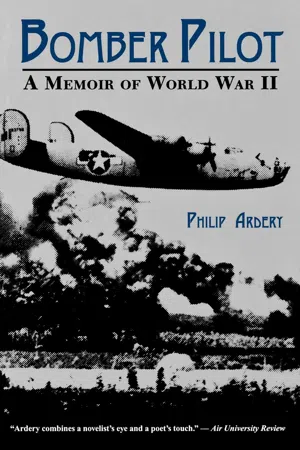
" Winner of the Best Aeronautical Book Award from the Reserve Officers Association of the United States "The sky was full of dying airplanes" as American Liberator bombers struggled to return to North Africa after their daring low-level raid on the oil refineries of Ploesti. They lost 446 airmen and 53 planes, but Philip Ardery's plane came home. This pilot was to take part in many more raids on Hitler's Europe, including air cover for the D-Day invasion of Normandy. This vivid firsthand account, available now for the first time in paper, records one man's experience of World War II air warfare. Throughout, Ardery testifies to the horror of world war as he describes his fear, his longing for home, and his grief for fallen comrades. Bomber Pilot is a moving contribution to American history.
- 280 pages
- English
- ePUB (mobile friendly)
- Available on iOS & Android
eBook - ePub
About this book
Information
Publisher
The University Press of KentuckyYear
2013Print ISBN
9780813108667
9780813113791
eBook ISBN
9780813143422
1
The Gadget
In the summer of 1940 I was a lawyer in active practice, twenty-six years old, two years out of Harvard Law School, and five years out of the University of Kentucky. My parents’ home was in Bourbon County, just outside of Paris, Kentucky, on the road to Lexington. That was where I had lived most of my life. I went some forty miles west of my home to Frankfort to hang out my shingle. I chose Frankfort because it was nearby, it was a small town, it was the state capital, filled with politics, and at that time it didn't seem quite so overcrowded with lawyers as other small towns in the Bluegrass. I had almost no clients for six months. But things slowly began to change, until by that summer of 1940 I had quite a practice. It was about three-fourths charitable, but quantitatively it stood fair comparison to the practices of several other lawyers in town.
I was a reserve officer on the active list and had been presented with orders to attend the Second Army maneuvers in Wisconsin. I had received a commission as a second lieutenant, Infantry Reserve, along with my bachelor of arts degree from the University of Kentucky in 1935. I had kept up my training and in the summer of 1940 was a first lieutenant. I was young, healthy, and unmarried, and in the forefront of those called to the maneuvers. It was evident America was perking up a bit to the sounds of war in Europe. France had fallen that spring. In about a month the air blitz of London would begin.
And so I went to Wisconsin in July. It rained every day except one during the maneuvers. The confusion and general awkwardness of our war machine just beginning to unlimber itself were frustrating. Beer cans were used as simulated mortar ammunition and stovepipes as simulated mortars. During the height of maneuvers trucks dashed about carrying signs which read TANK or PROPELLED GUN. We sat in the mud and rain not knowing whether the spectacle was tragic or funny. In the downpour of rain beans floated over the side of my messkit before I could eat them. Between battle problems I tried futilely to rest on a cot in my one-man pup tent. The level of water almost reached the point where I lay, and more water dripped dismally from the roof. I blamed what I didn't like about those maneuvers on the Infantry.
I had always wanted to fly. A friend who owned a Cub airplane had been trying to sell me flying lessons for a long time. I didn't have the time or the money for flying lessons, and so I had declined. Now it crept into the back of my mind that I might learn to fly at government expense and at the same time break clear of the Infantry. In war the men of the Air Corps got back to warm beds and hot meals, if they got back at all. The men of the Air Corps didn't have to stand out in the rain all day counting the beans that floated out of their messkits. The men of the Air Corps stood around big open fireplaces singing, with glasses in their hands, and when they stopped singing they turned and broke their glasses in the fire. I was twenty-six and the age limit for student pilots was twenty-seven. I wrote out my application for pilot training and sent it off.
When I got home from maneuvers I found a letter notifying me to come to Fort Knox to take a physical exam for the Air Corps. I took the exam immediately and returned to Frankfort. I was trying to get ready for the September term of Circuit Court, and at the same time trying to visualize what it might be like to cover the shingle for a couple of years and be off to the Air Corps. Everything seemed a maze of important detail until two weeks later when the news came that I had passed the physical and would soon receive assignment to a class in flight training. I scurried around making an effort to leave the affairs of my clients in proper hands.
Within an hour of the time the mail arrived bearing the notice ordering me to flight training I was packing my Ford convertible. My orders were to report to Fort Knox for induction and then to Lincoln, Nebraska, for primary flying school. I would miss Frankfort, but I hoped I would soon be coming back to take up where I had left off when I might be secure in the knowledge that I could concentrate the rest of my life on law.
I took my belongings to the home of my parents. Mother was away at the time visiting her sister in Virginia, which gave me a pang of conscience about her. I hadn't told her I was hoping to go into the Air Corps because I had felt there was such a strong chance I would be rejected. Now I realized it was a bad conclusion. My father was surprised. “There are some hazards a man can't escape,” I told him. “I have a commission and I must choose what I want now or lose my chance to choose.” He nodded sadly but understandingly and waved as I got in the car and drove off.
I arrived in Lincoln, Nebraska, on a Friday night. It was a fairly large town, comparable to Louisville but newer and laid out in a more orderly fashion on ground as flat as the country around it. I questioned a policeman and was directed to a small building on the edge of town toward Omaha. It was a house currently rented by the Lincoln Airplane and Flying School, a private institution conducting primary flight training under contract to the Air Corps. I went in and found a bed. I was delighted to discover that the upper-class cadets lived downtown in the YMCA, so I would not see much of them except at the flying line.
Next day I woke early, dressed and breakfasted, and was first in line waiting for the bus to take us to the field. Already I could see I was going to like the life of a flying cadet. The meals were good, the beds were soft, we even had maid service to give us the same freedom from chores that we might expect as officers. I was quite conscious of the fact that I was no longer a first lieutenant Infantry, but a flying cadet. As such my status was that of an enlisted private.
Our airport's huddle of buildings appeared to be temporary structures. The big hangar had Lincoln Airplane and Flying School painted across the top of its doors. That morning as we drove up, what first caught our attention was the line of parked airplanes. They were brilliantly painted Stearman PT13As. There must have been twelve or fifteen of them lined up wingtip to wingtip on the ramp facing the hangar. They were two-seater biplanes with yellow wings and blue fuselages and looked as warlike as anything I had ever seen outside of the movies. I walked up to the end airplane. It had a big Lycoming radial engine which I had been told developed 225 horsepower and it obviously weighed three times as much as the Cub I knew back in Kentucky. Just as I was inspecting the ship, the upperclassmen came piling out of the flight room donning their flying gear. They scattered themselves among the planes and in a moment engines were sputtering and props were sending little whirlwinds of dust back under the wings.
Our class was called into the flight room, lined up according to height, and broken up into groups of three. Two fellows named Steinemann and Jensen, blond Nordic men, were put with me, and all of us were presented to an instructor. He was a rather tough-looking, stubby, blond fellow named Lowe, and I learned that he had been an old-time barnstormer. He looked the part and talked in an offhand manner slightly out of the corner of his mouth, his eyes glittering like a bird's. Lowe chatted a minute or two about inconsequential things, and then disappeared into the flying instructors’ room. I hoped I would like Lowe and that Jensen and Steinemann wouldn't excel as pilots, which might cause me to get washed out.
In the bus on our way back to town we had a loud discussion about flying and why we were in the Air Corps. I don't think I said why I was in the Air Corps, but I do remember many of the fellows saying that they were confident there wasn't going to be a war. The United States was just concentrating on national defense to prevent war. Most of my classmates declared they were taking pilot training to be of use if the need ever arose, but they were confident it never would. They wanted to get pilot training and then get good jobs with the airlines. That theme was so predominant it surprised me, though an expansion of the airlines appeared certain. The air blitz of London was beginning, but the ocean between us and London made it seem far away.
When I got back to the house I had lunch in the cadets’ big dining room. While I was eating I saw a car outside the house with a Kentucky license plate bearing a number from Jefferson County. After lunch I found the owner, a cadet named John S. Petot, Jr., and introduced myself. John was a blond, wavy-haired fellow with the sort of smooth look of an operator who knew his way about. I was convinced he did when he suggested that we set out to explore the town for college girls. He thought we might drop by the Kappa Kappa Gamma house for a call.
We headed toward the campus of the University of Nebraska, drove up to the sorority house, and went in. In the front room were two pretty girls seated at a table playing double solitaire. Before they could jump and run John slid quietly into one of the extra chairs at the table and I into the other. He picked up a new deck, quickly dealt out a hand of bridge, and bid. The whole maneuver was so quick that the girls’ possibility of withdrawal seemed cut off, and without much comment the game proceeded. We played bridge for an hour or so and then persuaded our companions to accept a dinner invitation. Our evening was quite enjoyable and at the early hour of collegiate curfew John and I delivered the girls back to their sorority and went home.
We drove back to our quarters in a high state of amusement over apparently having succeeded in “going college” again. As we walked up the steps to the cadet house we were shouting out the supposedly tender notes of “I Love You Truly, K.K.G.” Though the lights were out we gave no thought to the noise we were making until a bull-necked, pajama-clad figure appeared in the hallway to growl at us. We recognized Cadet Chester Tucker, our section marcher. Tucker sharply ordered us to shut up and go to bed. John faced our interrupter with complete calm. He realized that in numbers we were an even 100 percent stronger than Tucker. “Listen, Tucker,” he said. “I suggest you forget the point you just made and go back to bed before you get batted right between those beady eyes of yours.” Tucker growled again and went to bed.
On Monday flying began. I had been up a number of times before and so the sensation wasn't exactly new, yet there was enough novelty to be exciting. I had a feeling of freedom as the plane cleared the ground, and I recall turning around in the rear seat to look back at the field and seeing the rudder move slowly, like the tail of a fish, as we climbed a few hundred feet. We flew around the area where we were to confine our training activity and Lowe pointed out the checkpoints of the boundaries. Every little while he would ask me to point out the direction back to the field, which I did with some difficulty.
After the first flight I found myself almost immediately in the thick of flying. The troublesome thing was that my progress in those early stages seemed so terribly slow I could hardly see any improvement at all. I was told to do “coordination exercises” by the hour. These were rolling movements of the ship from one side to the other which were accomplished by simultaneous pressure on stick and rudder first in one direction and then in the other. When the exercise was done properly the ship would roll from a little less than a vertical bank in one direction to the same amount of bank in the other direction. The nose of the plane theoretically should remain centered on the same spot on the horizon. I then had serious doubt about the value of this maneuver, and after five thousand flying hours I still do. But it may help a new pilot to get the “feel” of an airplane.
We also did gentle, medium, and steep turns, climbing and gliding turns, and stalls. Precision in turns comes slowly to a beginner and certainly did to me. The very idea of unbounded freedom of movement on all sides seems to militate against precision. The traction of automobile tires holds a car in one exact course. But an airplane has no such traction to give it exactitude. And yet my instructor seemed to think that exactness and precision could be and should be attained. He felt I should be able to make a steep turn to the right, roll the plane into a certain degree of bank, hold exactly that degree of bank all the way around, and roll out smoothly to level flight on precisely the same level at which I had begun the turn. If a steep turn is done perfectly and without gain or loss of altitude, a second or two after rolling out the ship will hit an air bump formed by the “propwash” or turbulence laid down during the turn. Hitting that bump is supposed to indicate the turn completed was nearly perfect. But in reality it is possible to hit an air bump after rolling out of a turn even though the altitude has been varied during the maneuver if the airplane enters and leaves the turn at the same altitude.
I was told the stalls I practiced were for the purpose of teaching me how to land the plane. Maybe they were. At that time I practiced stalls because I was told to do them, not because I could see much connection with landings. Later, of course, I did see that a landing includes a stall—that is the transition stage between the time air control is lost and ground control is acquired as the wheels of an airplane touch the ground. It is in that transition that real piloting ability shows up in good landings.
My landings, though safe, weren't good. My instructor seemed to feel a good deal more confidence in my flying than I did. I wasn't satisfied with momentary successes which I could neither understand nor be sure of repeating. But after I had about seven hours of flying time my instructor decided I was ready to solo. I shall never forget that day.
A number of other students of my class were up for their first solo flights. You could cast one glance at the field and see that there were a bunch of “dodos” up for their first solos. Just before I went up Lowe tried to solo Jensen, who at least started out with a good takeoff. He flew the traffic pattern around and made his approach for landing. Initially it looked good, but after a few seconds with his wheels on the ground one wing went down and the ship spun around violently in what is commonly known as a “ground loop.” Jensen walked away from the landing and the plane wasn't damaged much. I learned then that the Army didn't take the simple view that the test of a good landing is whether the pilot is able to walk away from it.
When my turn came Lowe was already visibly disturbed by Jensen's experience—as, indeed, I was. Lowe and I were in the airplane together. We had made one or two dual landings which were not particularly good, but which he appeared to consider satisfactory. He told me to taxi the ship over to the center part of the field, where he got out.
I taxied out into position, checked everything carefully, and gave the plane the throttle. In a moment I was speeding down the field. In another I was in the air. The front cockpit looked horribly vacant. I realized with something of a shock that either I was flying this airplane or it was flying itself, and my lack of confidence was appalling. I thought it would be the greatest accident of the age if I were to come down to a good landing. Then I remembered that these ships land so slowly and are so safe that there is little danger of a pilot hurting himself no matter what he does wrong, but I was very worried that a mistake now might cause me to be washed out.
I climbed two hundred feet and made my first turn. So far so good. I kept climbing until I reached five hundred feet and leveled out. Then I turned again to fly a reciprocal heading to the direction of takeoff, known as the “downwind leg.” In a few more seconds I turned onto the “base leg” and then cut throttle. Then I turned from the “base leg” into the “final approach.” I established a pretty good glide, which the instructors say is 75 percent of a good landing. Just as I was picking my spot to set her down, a cadet in a parked airplane—a “dodo” also out for his first solo—gave his ship the throttle and taxied right in front of me. One always should go around for another try when in doubt, but as a beginner would, I decided not to. It appeared the ship on the ground was going to get clear of my landing approach before I touched down.
Had I concentrated on my landing I don't think I would have had any trouble. But my mind was occupied with thoughts about the need to avoid the other airplane and to get my own ship on the ground. Just as my wheels touched, the other plane cleared across in front of me. I had unconsciously given a little rudder to get away from the obstructed spot, causing my ship to set down a little crosswind. It touched down easily the first moment I felt the ground, but I failed to make the proper correction on the rudder to straighten out the forward roll. The little airplane spun to the left with the force of a carnival crack-the-whip. The outside wing went down and dug into the ground, causing the plane to reverse action suddenly and start spinning to the right. It turned out I had committed the prize boner of the day.*
When I came to a stop I couldn't see much visible damage to the plane but couldn't understand why not. I looked to the side of the field where the instructors were standing. Most of them were laughing at me, but Lowe had thrown his helmet on the ground and was stomping on it. Finally he waved me over to where he stood. I taxied over and picked him up. He taxied the ship up to the hangar, killed the engine, and got out. “Write up in the form one you ground-looped and drug a wing,” he said disgustedly. Jensen was there with a camera to take my picture getting out of the cockpit as I managed a silly grin.
For several days after my disastrous attempt at solo flying the weather was bad. I didn't get a chance to make up for that terrible day and I was nervous about it. I was facing my first and most serious check ride, and it was entirely possible that it would come before I had a chance to get the thing straightened out in my mind. Several days later I saw on the board in the flight room that I was up for the all-important check ride, and to make matters worse I was up for a violation of hours from the evening before.
John Petot had been having trouble with his flying, too. We had discussed what we would do in case we were eliminated. We both decided Canada was in greater need of pilots than the United States. Consequently, their standards of training must be lower, and so we would go to Canada. From that decision I took some comfort. But when I looked to see who was to be my check pilot grim despair closed in on me. I was assigned the toughest one of the lot.
The only way I could get my spirits up at all was to say to myself: “You're already washed out. There is just a matter of form to be accomplished—so worrying about how you do is absolutely needless. You've already made up your mind to go to Canada; therefore you might profit something from this ride if you try to get as much out of it as you can.”
With that thought in mind I got into the airplane relaxed and almost completely at ease. Following the direction of the instructor I taxied into position and took off. It was a smooth, straight, almost perfect takeoff. I saw the check pilot in the front seat raise his right hand and join his thumb with his forefinger in a circle indicating he thought it was okay. And I knew I was going to fly the wings off the airplane. We went out some distance from the field and at his direction I went through my stalls, spins, and turns, and then returned to enter the traffic pattern. I made a fairly good entry into traffic, turned on the base leg, cut the throttle and made a gliding turn into my final approach for landing. The glide was good. Just before it seemed the wheels were about to touch I came back firmly on the stick. As the nose of the ship rose and the tail settled we floated just an instant within inches of the ground and then touched down as gently as a feather. “Keep on flying it,” I said to myself. I watched the nose for the slightest tendency to veer off course and corrected with the rudder carefully and quickly to keep my ship rolling straight ahead. It rolled to a stop, and I felt better than I had since my arrival at flying school. Proudly, I taxied into the line and cut the engine. I hopped out and waited while my instructor slowly got out of the front seat and jumped off the wing. He stood and smiled at me a minute and said, “I bet that was the first good landing you've made.” I nodded. “Damn good time to make it,” he said and walked away.
From that time on flying went along much easier. I did my first really successful solo flight and progressed through several “accuracy stages.” These were tests of precision landings which gave me the first real confidence I had about flying. My good friend Petot fared otherwise. His instructor said he “lacked coordination.” Whenever an instructor felt a student wasn't material to go on—for any reason whatever—the reason always given was that he “lacked coordination.” Petot was on his way out. He made application to navigators’ school, as others had done. I knew he would stick around for ten days or so until his application could be passed on, and then he would be gone.
With my newly found security in flying school, and enjoying the last days of a good companionship with John, my life became gayer than before. I took dinner out nearly every night and even made a couple of trips to Omaha, where I went to see Katheryn “Kak” Hosford. Kak was a naturally beautiful girl and the smartest in appearance I had seen in many a day. Two days before the final withdrawal of the departing Petot, we made one last trip to Omaha. Our day seemed filled with political arguments. I was for Roosevelt, and John and Kak were for Willkie. Kak did have a good sense of humor and told a story I liked. One of her sister Junior Leaguers, braving a pair of tight shoes on hot pavements all day to give out Willkie buttons, accosted a l...
Table of contents
- Cover
- Title
- Dedication Page
- Copyright Page
- Contents
- Foreword
- Acknowledgments
- Prologue: On the Shoulders of the Dead
- 1. The Gadget
- 2. The Merry-Go-Round
- 3. Ted's Flying Circus
- 4. Ploesti and the Circus Ends
- 5. The Air War of Western Europe
- 6. The Wing
- 7. Something to Believe in
- Index
Trusted by 375,005 students
Access to over 1.5 million titles for a fair monthly price.
Study more efficiently using our study tools.
Frequently asked questions
Yes, you can cancel anytime from the Subscription tab in your account settings on the Perlego website. Your subscription will stay active until the end of your current billing period. Learn how to cancel your subscription
No, books cannot be downloaded as external files, such as PDFs, for use outside of Perlego. However, you can download books within the Perlego app for offline reading on mobile or tablet. Learn how to download books offline
Perlego offers two plans: Essential and Complete
- Essential is ideal for learners and professionals who enjoy exploring a wide range of subjects. Access the Essential Library with 800,000+ trusted titles and best-sellers across business, personal growth, and the humanities. Includes unlimited reading time and Standard Read Aloud voice.
- Complete: Perfect for advanced learners and researchers needing full, unrestricted access. Unlock 1.5M+ books across hundreds of subjects, including academic and specialized titles. The Complete Plan also includes advanced features like Premium Read Aloud and Research Assistant.
We are an online textbook subscription service, where you can get access to an entire online library for less than the price of a single book per month. With over 1.5 million books across 990+ topics, we’ve got you covered! Learn about our mission
Look out for the read-aloud symbol on your next book to see if you can listen to it. The read-aloud tool reads text aloud for you, highlighting the text as it is being read. You can pause it, speed it up and slow it down. Learn more about Read Aloud
Yes! You can use the Perlego app on both iOS and Android devices to read anytime, anywhere — even offline. Perfect for commutes or when you’re on the go.
Please note we cannot support devices running on iOS 13 and Android 7 or earlier. Learn more about using the app
Please note we cannot support devices running on iOS 13 and Android 7 or earlier. Learn more about using the app
Yes, you can access Bomber Pilot by Philip Ardery in PDF and/or ePUB format, as well as other popular books in History & Military Biographies. We have over 1.5 million books available in our catalogue for you to explore.