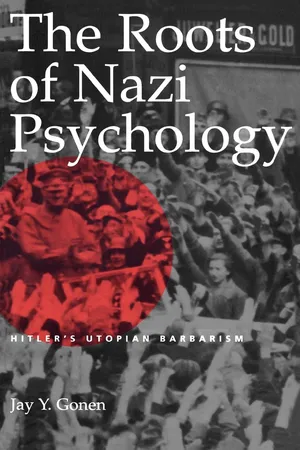
" Was Hitler a moral aberration or a man of his people? This topic has been hotly argued in recent years, and now Jay Gonen brings new answers to the debate using a psychohistorical perspective, contending that Hitler reflected the psyche of many Germans of his time. Like any charismatic leader, Hitler was an expert scanner of the Zeitgeist. He possessed an uncanny ability to read the masses correctly and guide them with ""new"" ideas that were merely reflections of what the people already believed. Gonen argues that Hitler's notions grew from the general fabric of German culture in the years following World War I. Basing his work in the role of ideologies in group psychology, Gonen exposes the psychological underpinnings of Nazi Germany's desire to expand its living space and exterminate Jews. Hitler responded to the nation's group fantasy of renewing a Holy Roman Empire of the German nation. He presented the utopian ideal of one large state, where the nation represented one extended family. In reality, however, he desired the triumph of automatism and totalitarian practices that would preempt family autonomy and private action. Such a regimented state would become a war machine, designed to breed infantile soldiers brainwashed for sacrifice. To achieve that aim, he unleashed barbaric forces whose utopian features were the very aspects of the state that made it most cruel.
- 240 pages
- English
- ePUB (mobile friendly)
- Available on iOS & Android
eBook - ePub
About this book
Information
Publisher
The University Press of KentuckyYear
2013Print ISBN
9780813190464
9780813121543
eBook ISBN
9780813143682
1
The Role of Ideologies
Political discussion is, from the very first, more than theoretical argumentation; it is the tearing off of disguises—the unmasking of those unconscious motives which bind the group existence to its cultural aspirations and its theoretical arguments.
Ideas, forms of thought, and psychic energies persist and are transformed in close conjunction with social forces. It is never by accident that they appear at given moments in the social process.
—Karl Mannheim, Ideology and Utopia
The resonance which Hitler's words evoked among many Germans in the period between the two world wars has been of great interest to Germans and non-Germans alike. The basic premise of this study is that the Nazi success in mobilizing the masses was not due merely to the deliberate use of fear and terror but primarily to the Nazi ideological messages that fell right on target.
Any progress in fathoming the underlying causes of this responsiveness, which characterized the interaction between the leader and the masses during the Nazi era, could advance our understanding of the fateful course of events in the first half of the twentieth century. And in this respect it is of paramount importance to try and shed as much light as possible on the underlying dynamics of the German response to the humiliation and defeat of World War I, which escalated into unleashing a new world war and perpetrating a holocaust. An analysis of Hitler's ideology, its manifest content as well as its underlying psychology, is therefore indispensable for gaining a better understanding of why so many horrible and seemingly incomprehensible things could have happened. The application of psychoanalytic models in this study relies on Freudian rather than Jungian postulates. It should be borne in mind, however, that essentially what psychoanalytic concepts provide is a metaphorical language.
At the point of contact between leaders and followers reside ideologies. The term “ideology” is used here in quite a loose sense. It refers to any idea or set of ideas that provides a prescriptive view of life. The term is therefore not confined to lengthy doctrines that are systematized in the form of a tract or a dissertation, since ideologies may also be expressed by short slogans. Moreover, they can be loaded with different layers of meaning. They can consist of a formalized and presumably conscious worldview that includes many parts. But they can equally well be comprised of unconscious shared group fantasies, which have the power to charge up the entire group with sufficient energy to trigger unified mass action. Consequently they frequently include myths while their promoters engage in the selling of those myths. Moreover, slogans, catch phrases, enticing ideas, poignant jokes, stirring songs but also a variety of visual images that appear on posters, placards, and walls as well as in illustrations and cartoons published by newspapers and magazines may all represent small bits or chunks of ideologies. Whatever form they take, whether it is one picture that is worth more than a thousand words or an uplifting short slogan, these bits and chunks of ideology encapsulate succinct and rather unidimensional views of the world or of national life. What is more, they may be widely dispersed and “float in the air.” When that happens, the ideological prescriptions frequently express themselves through aphorisms. A current American example would be the saying “winning isn't everything, it's the only thing.” An earlier German example which is taken from a Nazi marching song would be the lines “For today Germany belongs to us and tomorrow the whole world.” As can be seen, such small ideological segments, which prescribe what to expect from life, ride on a variety of “carriers.” That is why they may frequently be lifted from songs, plays, jokes, drawings or paintings, political speeches and similar layers of the cultural repository. They are embedded in the culture but their drawing power fluctuates according to the position they happen to occupy in the particular Zeitgeist, or spirit of the time. The Zeitgeist is a concept that denotes the ripening of a cultural image or idea to the point where its time has arrived. It also connotes a notion of movement where ideas float to the foreground when their time comes or sink to the background when their time is gone. The issue of when an ideology's time for action has arrived is largely determined by changes within the Zeitgeist that reflect an altered emotional climate and the shifting winds of public mood.
Sometimes, when a very forceful theme or even a whole constellation of highly energized themes emerges in the life of the collective to dominate the Zeitgeist, one encounters the phenomenon of shared group fantasies. These are the shared psychological basic assumptions that dictate the group identity. Not only do they determine for the members who they are by virtue of their group identity, they also instill expectations concerning what future life would be like, for good or bad, because of this group belonging. These fantasies are therefore dynamically charged, include large unconscious elements, and also function as psychological defenses. Consequently the images they present of both self and world tend to be distorted because they filter reality through an intricate grid of defense mechanisms. Thus, failures become rationalized, blame projected, self-fulfilling prophecies adopted, affect reversed, and contradictions maintained by separating them into walled-off mental compartments (the mechanism of isolation). Then expectations are tailored to fit the preexisting basic assumptions concerning the life of the group. All this means that nothing less than reality itself is being distorted. Yet reality stands in the way between wish and wish fulfillment. And a cardinal wish of individuals and groups is to preserve their distinct continuity and to maintain a gratifying self-image devoid of narcissistic wounds, i.e., emotional injuries that are destructive of self-esteem. This is why shared group fantasies modify, distort, and even fabricate reality in a highly defensive fashion.
It is important to emphasize that the occurrence of group fantasies is not confined to any particular national group although different groups can have specific fantasies. In earlier works concerning Jewish psychohistory, I have illustrated the operation of shared group fantasies such as the Israeli illusion of omnipotence following the Six Day War (Gonen 1978) and the suicidal Masada Complex (Gonen 1975, 213–36). After the 1967 lightening Israeli victory over three Arab states, there was a collective Israeli illusion that mideastern regional conflicts could be solved by massive military power. But soon afterward the Israelis also experienced renewed fears that they were on the verge of reenacting the old Masada scenario: in 73 A.D., the Jewish defenders of Masada committed mass suicide rather than surrender to the Romans. These two fantasies became part of an interrelated network of shared group fantasies, which, on the one hand, were based on the legacy of Jewish history but, on the other hand, distorted it. Some of these fantasies had even included reactions to the Holocaust in which the victims themselves were blamed. This inappropriate condemning attitude was an outcome of the desperate need to draw a sharp distinction between the nonfighting Jews of yesteryear and the fighting Israelis of today. So horrendous was the reality of the Holocaust that it became deeply ingrained in the Jewish psyche as a prototype for what Jews should expect and what could always happen. Hitler has now joined the other biblical and timeless enemies of Israel such as Amalek or Haman while Jews continued to torment themselves with the question of why they allowed themselves to be led like sheep to the slaughter. Thus at this shared fantasy level the Six Day War, in which victorious Israelis wished that the murdered European Jews could see them now, clearly was a response to the Holocaust demonstrating that Jews can fight and are not predestined to passively accept extermination. Yet because of such a long history of victimization, this switch from holocaustal impotence to victorious omnipotence triggered a new obsession with the Masada Complex, reevoking fears that even fighting Jews can meet their death either on the battlefield or by their own hand, in order to avoid being captured alive. It can be seen from even these brief illustrations that group fantasies can be psychodynamically interconnected and collectively shared.
This last point can be confusing. In what exact sense could group fantasies be collectively shared? The concept may evoke images of a group mind or a collective mind, which can easily be misunderstood. The concept of a collective mind is not meant to deny the obvious fact that only individuals have brains. Nor is it meant to imply extrasensory processes or parapsychological methods of communication connecting individual brains. What it does imply is the easy availability and reach of a variety of prototypical or dominant themes within a given group. These themes are able to evoke similar reactions in most group members who embrace them because of their common history and shared cultural background. Moreover, these themes are inculcated by the culture as the particular sacred lore is fed into individuals since early childhood. The sacred lore includes not just religious texts, but all art or literature that traditionally denotes what it is like to be a member of the group. This shared cultural repository makes it possible for group members to experience common themes whenever they rise to dominance. But even when a group fantasy is being activated, not every person down to the last group member has perforce adopted it. The implication of a group mind as reflected in shared fantasies was never meant to be that literal and all inclusive. There is no one “group brain” that commands, so to speak, all the individual brains. This was not true even with a select group and on very special occasions such as the annual Nazi party rallies, although it almost seemed to be the case.
The emergence of shared group fantasies, out of current interplays of themes competing for Zeitgeist dominance, is a highly dynamic process. The concept of a Zeitgeist implies a public recognition of and a readiness to accept certain ideas as both valid and timely. In the case of the highly emotionally charged group fantasies, this timeliness, which surfaces out of the interaction of competing ideas, feelings, and the unfolding of current events, can even generate public pressure and a clamoring to transform the fantasy into reality. This is why the Zeitgeist is frequently the outcome of the interactions of psychological forces with historical developments that are very subtly “negotiated” between followers and leaders. And this elusive gamesmanship is being conducted under a psychohistorical law of supply and demand, which on the surface mandates that the leaders do the selling while the masses do the buying. Yet just under the surface it is the masses who signal, both knowingly and unknowingly, which ideas now have a magic impact on them and can therefore mobilize them. It is the charismatic leader—the expert scanner of the Zeitgeist—who for some reason has an uncanny ability to read the masses correctly; he guides them with his illuminating “new” ideas that, in truth, are borrowed from the ones he leads.
All this points to a fascinating meeting between psychobiography and group psychohistory. The point of intersection is where a significant individual (be it a political leader or an artist or a man of ideas) and the group at large interact. This interaction is likely to create a joint reinforcement of underlying psychological drives and motives. Erik Erikson (1962, 254) once described that point of intersection as the interdependence of individual aspiration and societal strivings for optimal psychological states. The interdependence that Erikson alluded to can assume an even more crucial importance when both the individual's and the society's psychological state is pathological. In such instances the interdependence can be expected to result in mutual reinforcement of pathologies. And if the individual happens to be a supreme political leader who controls the state's power, then the reinforced pathologies are likely to be acted out en masse.
A major stride in this line of enquiry was made by the psychohistorian Rudolph Binion (1979). As we shall see further along in this work, Binion explicated a double-track theory of Hitler's aims consisting of solving the imaginary Jewish problem as well as the imaginary problem of inadequate living space. In this connection he demonstrated how the interdependence of the two tracks as well as the interaction between the leader and the led was mutually reinforcing with catastrophic results. Yet while it lasted, this interaction provided the leader with ongoing opportunities to repeat earlier personal traumas. One was the trauma of his mother's death from a cancer, which in Hitler's fantasy was seemingly inflicted by her Jewish physician; the other trauma was a war injury, which reinforced the earlier one. At the very same time, however, the interaction between leader and led also provided the masses with similar opportunities to replay the national trauma of defeat and territorial loss in World War I at the hand of the allies. Through the wide embrace of a shared group fantasy, this stunning defeat was “explained” as due to Jewish machinations and treachery. Binion consequently subscribed to the basic notion that beneath the historical plays of current events unfolded a drama of psychohistorical replays of the group. And as the basic ingredient of the drama happened to be trauma, the replays and their variations were bound to produce replicas in their compulsive repetition of the central emotions and impulses. Because of the remarkable accuracy of the repetitions, the results were also doomed to be once again a total failure in mastering the trauma. Therefore, the new defeat that results from each current reliving of the unresolved trauma keeps the shock as alive and as intense as ever and sets the stage up for the inevitable next replay, which would be equally doomed to failure.
The psychohistorian Helm Stierlin has, quite justifiably, emphasized Hitler's ability to weld together the art of power politics or political stagecrafting with the art of mythmaking or, better, myth selling. Therefore, Hitler in the political field came to resemble Richard Wagner, who in the artistic field created the Gesamtkunstwerk or total art work (Stierlin 1976, 74). It is well established indeed that Hitler, who prided himself on being an artist, elevated politicking into a new art form in which he controlled and enchanted his national audience as if in a theater. But even more than his theatrical skill, the key for his success was the selling of the right myths. If we are to combine Stierlin's underscoring of myth selling with Binion's emphasis on repetition of traumas, then our conclusion would be that Hitler's highly successful myth selling was due to the peddling of those psychological goods that happened to be in highest demand—repetitions of traumas. If unconscious repetitions of traumas have indeed been the German psychological malaise, then what Hitler offered was a perfect solution to the German problem—a solution that consciously promised redemption but actually courted disaster. In other words, it seemingly offered a new utopia but inevitably led to the new catastrophe. In accordance with this emphasis, the aim of our present enquiry would therefore be to explain as well as possible the psychological significance of that which Hitler sold. The psychological loadings which permeate various components of his ideology will be identified and related to each other. Possible implications of these psychological factors for German history will sometimes be suggested. But the immediate focus of this study will remain the uncovering of the underlying psychology of Hitler's ideology. To what degree the results accord with Hitler's life and with the German heritage is a judgment that this author primarily leaves to other scholars.
Identifying the major psychological ingredients of Hitler's ideology and exploring their full meaning is of vast importance because they struck such a responsive chord among many Germans. This responsiveness alone suggests not only the likely involvement of unconscious motivation, but also that an older history may have created a receptivity and even cravings and yearnings for certain myths and mottoes. This can be well illustrated by “the stab in the back” theory as an explanation for the defeat in the First World War. Germans were led to believe almost until the end that they were winning the war and were therefore stunned by the apparently sudden and seemingly treacherous surrender. Ernst Nolte (1969, 388–89) averred that, in the propagation of this lie, Germany's very downfall has been used as a proof in an argument to turn a lie into a so-called truth. And this truth was useful in blaming anything that looked like a weakness, especially remnants of the tradition of civil liberty. And it was in its most primitive form that this legend had the greatest appeal to the masses. Nolte was right, but there was even more to it than the clever turning of the reality of defeat into a myth of betrayal for use against political opponents. The fact that there was a need for such a myth to begin with (for without a myth the defeat could remain inexplicable) in itself suggests that the defeat was unacceptable and simply could not be swallowed. It represented not a shock, which was somehow coped with, but rather a trauma which was not assimilated and which became an object of obsession that could lead to compulsive repetition. But a symbol for an unassimilated traumatic defeat does not necessarily have to be “a stab in the back.” That this particular symbol was adopted by many Germans and exploited by Hitler probably was due to an already existing cultural heritage that included the Nibelungenlied and Richard Wagner's operas, and which played on the theme that the unconquerable Siegfried could only be killed by a stab in the back. In like fashion, it was imagined that German soldiers during the First World War had been courageous and invincible, so that nothing but a stab in the back could possibly explain their subsequent defeat.
The choice of the imagery of a stab in the back to “explain” the indigestible defeat suggests that this imagery had, in the past, already stood for unassimilated psychic elements. It could have even represented a traumatic verdict concerning a fatal flaw in the German character and notion of peoplehood. It may have been the notion that the Achilles heel of the German folk, or people, which accounted for their geographic divisions and political retardation, was the failure to watch themselves against surprise blows by undetected external as well as internal enemies, and that this failure could spell their undoing. If it were an external enemy, then the fatal flaw might have been inadequate borders. If it were an internal enemy then the fatal flaw could be either the existence of a fifth column, comprised of a foreign element, or a dreadful defect in the German character itself, which made each German his own worst enemy. And if it were all of the above, then the implications were that new ways should be found to reverse the present unacceptable outcome in such a fashion as to supposedly guarantee that the new, yet old, trauma will never again repeat itself. In sum, in the German heritage of both history and myths, an emotional disposition or psychological expectation has already been built up for despicable treachery as the explanation for the defeat of unblemished German heroes.
Another example of such a psychological expectation was the grim warning to be forever on the alert against evildoers who cleverly disguise themselves. The prototype for this image can be found in medieval notions concerning the cleverly disguised devil who does his harm by fooling the people. But this theme of ominous disguisability received an added reinforcement in the nineteenth century in the famous collection of fairy tales by the brothers Grimm. Ranke (1966, xviii–xix) emphasized that the tales of the brothers Grimm included vilifications of Jews, and he underscored the fact that the Nazis reintroduced the original version of the tales which included bloodletting and violence. Waite (1977, 262–63) provided a few telling examples of bizarre physical and psychic cruelty in the tales. Yet the tales were extremely popular. Consequently almost every German child came to know, for instance, that in “The Wolf and the Seven Kids” the mother goat's warning to her seven children not to open the door of their house to the wolf was to no avail. The children were fooled just the same because the scoundrel wolf cleverly disguised himself as their own mother. With this preexisting prototype already embedded in German culture, Hitler's labeling the Jews as masters of disguise was bound to be an effective ploy.
As mentioned earlier such national myths as the stab in the back or the disguised Jews are referred to in the field of psychohistory as shared group fantasies. These shared fantasies are capable of setting the stage to new psychohistorical replays of old historical issues and foster great receptivity to new ideologies so long as the latter tap into the existing public pool of emotional dispositions and psychological expectations. Whenever that happens, the new ideologies are capable of reactivating the old myths so as to channel their energy potential into the mobilization of the masses. Those particular ideological themes that promise newness while connecting to powerful old stuff are the very ones that prove to be effective energizers of the masses. The promised newness can be offered under the banners of change, revolution, messianism and utopia, but in all its attires the newness remains essentially a promised reversal of the status of any of a number of old psychocultural prototypes or myths, such as a stab in the back, that stand for an unacceptable psychological condition.
By the same token, ideological themes such as respect for authority that promise a future that would be the same as an idealized past are also most powerful. In this case, the potent current mottoes, which evoke highly charged psychocultural prototypes of the past, play to conservatism, fear of change, and even ruthlessness in preserving the status quo against unacceptable and traumatizing threats. The common denominator of these mottoes is the ultimate protection of all that is precious in the past and present from destructive changes that seem to emanate from the present and future.
It matters not, however, whether the available mottoes promise a future that reinstates the past or a future that breaks with the past, although the latter carries a greater revolutionary aura. Either way the consequences are the same. Powerful ideological themes that hover within the Zeitgeist now need only mounting public pressure to achieve dominance and exert the power of myths. It is therefore a good psychohistorical bet that whenever a leader's ideological mythmaking and myth selling resonate among the followers, it is likely that he is selling something old yet new or vice versa. If that which is old can be packaged as new, while that which is new can be clothed with past tradition, the success of the myth-selling job will be phenomenal—so long as the ideological mottoes represent highly charged themes that already exist in the cultural repository. Indeed, Hitler's great success in his selling job suggests that the psychological factors with which his ideology was loaded represented the kind of timeless mythic elements whose recurrent visibility and cultural prominence is timed by the elusive Zeitgeist. As a side note, it is interesting to observe that when Hitler entered the German Workers’ Party in September 1919 as an Army spy, he gave his profession as “salesman.” (Here was a disguise that suited him!)
Hitler expounded his ideology in the two volumes of his famous book Mein Kampf, which were published in 1925 and 1926 (Hitler 1943). He also preached his ideas in his speeches (de Roussy de Sales 1941...
Table of contents
- Cover
- Title
- Copyright
- Dedication
- Contents
- Acknowledgments
- 1 - The Role of Ideologies
- 2 - The Jewish Danger
- 3 - The Leadership Principle
- 4 - The Expansion of the Living Space
- 5 - The Folkish State
- 6 - Ideology as Psychology
- Bibliography
- Index
Trusted by 375,005 students
Access to over 1.5 million titles for a fair monthly price.
Study more efficiently using our study tools.
Frequently asked questions
Yes, you can cancel anytime from the Subscription tab in your account settings on the Perlego website. Your subscription will stay active until the end of your current billing period. Learn how to cancel your subscription
No, books cannot be downloaded as external files, such as PDFs, for use outside of Perlego. However, you can download books within the Perlego app for offline reading on mobile or tablet. Learn how to download books offline
Perlego offers two plans: Essential and Complete
- Essential is ideal for learners and professionals who enjoy exploring a wide range of subjects. Access the Essential Library with 800,000+ trusted titles and best-sellers across business, personal growth, and the humanities. Includes unlimited reading time and Standard Read Aloud voice.
- Complete: Perfect for advanced learners and researchers needing full, unrestricted access. Unlock 1.5M+ books across hundreds of subjects, including academic and specialized titles. The Complete Plan also includes advanced features like Premium Read Aloud and Research Assistant.
We are an online textbook subscription service, where you can get access to an entire online library for less than the price of a single book per month. With over 1.5 million books across 990+ topics, we’ve got you covered! Learn about our mission
Look out for the read-aloud symbol on your next book to see if you can listen to it. The read-aloud tool reads text aloud for you, highlighting the text as it is being read. You can pause it, speed it up and slow it down. Learn more about Read Aloud
Yes! You can use the Perlego app on both iOS and Android devices to read anytime, anywhere — even offline. Perfect for commutes or when you’re on the go.
Please note we cannot support devices running on iOS 13 and Android 7 or earlier. Learn more about using the app
Please note we cannot support devices running on iOS 13 and Android 7 or earlier. Learn more about using the app
Yes, you can access The Roots of Nazi Psychology by Jay Y. Gonen in PDF and/or ePUB format, as well as other popular books in History & German History. We have over 1.5 million books available in our catalogue for you to explore.