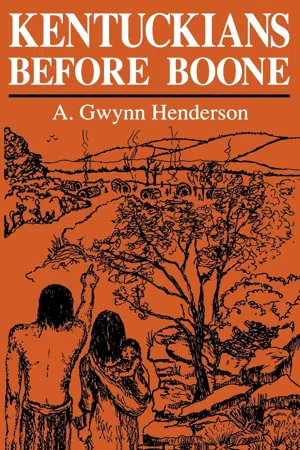
This is an account of a Native American family in central Kentucky in the year 1585. Fishes-With-Hands, his wife She-Who-Watches, and their family grind corn, make cooking pots, and build their homes while in their summer village. In autumn, they attend the funeral and mourning feast of Masked-Eyes. Then they move to their winter hunting camp, where they process nuts, make arrows, and hunt and butcher animals in preparation for the winter. Readers will soon realize that their lives and experiences in many ways parallel those of this family from Kentucky's not-so-distant past.
- 64 pages
- English
- ePUB (mobile friendly)
- Available on iOS & Android
eBook - ePub
Kentuckians Before Boone
About this book
Trusted by 375,005 students
Access to over 1.5 million titles for a fair monthly price.
Study more efficiently using our study tools.
Information
Summer Village
Picture in your mind’s eye a cool late summer morning in prehistoric Kentucky. It’s the kind of morning that signals fall is right around the corner. The sun rose just a short time ago. A thick mist is rising from the river, but it will soon be burned away. The smell of burning wood mixes with the odor of cooking corn, drying meat, tobacco smoke, and garbage.
The village is beginning to stir. Over 500 people live in this village. Their 25 rectangular, bark-covered houses are scattered along the river bank. Large trees stand next to some of the houses, shading them as the sun rises. Corn fields surround the village. Beyond the fields is the forest.
Since these people make their living mainly by farming, they built their village near fertile, well-drained soils. But they also fish and gather freshwater mussels. Over long distances they travel by canoe, and they need fresh water for drinking. For these reasons they also built their village along the river’s edge.

The summer village.
Near the village center, one house is much larger than the others. It is the house of the village chief and his family. It serves as a meeting place for the village leaders, too. There they discuss politics, marriages, trade, and other important matters that touch their lives.
Next to the chief’s house is the open area where the villagers hold important ceremonies. The earth is so hard that no grass grows there. It has been packed down by the hundreds of people who have danced there for the past five years. The women sweep this area clean of garbage and debris before and after each ceremony.
House size varies. The largest ones measure 70 by 30 feet, while the smallest ones measure 50 by 18 feet. The houses are not arranged in any regular pattern within the village. The doors are large pieces of elm bark or bearskin. There are no windows. Smoke curls upwards from the roofs of some houses. It is the smoke from last night’s fire escaping through the central smoke hole in the roof.
Between 15 and 25 people live in each house and make up a household. Each household is made up of several families. The people of each household are most closely related to the people who live in the nearby houses. This is because they belong to the same clan. Several clans live in this village. The clans are known by animal names: Snake, Turtle, Raccoon, Turkey, Hawk, Deer.
Men cannot marry women of their own clan. When couples marry, the wife comes to live with her husband. When children are born, they belong to their father’s clan. And when people die, they are buried in shallow graves in the clan’s special burial area at the village edge.
Each house is surrounded by an open area that is mostly bare ground. This open area is largest in front of each house. The villagers do most of their work in this open area, except on the rainiest days.
Today is turning into a beautiful day. The sun has burned the mist away. The river sparkles. A gentle breeze blows across the water into the village.
Although it is still early, most members of the nearest house are gathered in front of it. This is the home of Fishes-With-Hands, the brother of the village chief, and She-Who-Watches, his wife. Their two unmarried daughters and their youngest son live with them. So do their three married sons, their wives, and their nine children. The men and their children are members of the Raccoon clan. Their wives are members of the Hawk or Deer clan.
The women and older girls have already eaten and are busy with their household chores. The men and older boys discuss the upcoming harvest ceremony as they eat.
Most of their clothing is made of deerskin. The women wear wrap-around skirts, and the men wear short aprons or breechcloths. Their feet are bare. The women wear their dark hair long and braided. The men’s hair is cut shoulder length. Most of the men wear headbands. One or two feathers are tied to a few of the older men’s headbands. Everyone wears some kind of jewelry. Ornaments made from bone are tied into their hair. Around their necks hang pierced elk teeth, beads made of birds’ wing-bones, or disk-shaped shell beads.
Flies-Alone, the wife of the eldest son, is working close to the front door of the house. She tends a stew pot that rests on a small mound of dirt in the center of the cooking fire. The stew is made from corn kernels, beans, and squash boiled with strips of deer and elk meat, and chunks of squirrel. She stirs the stew with a long wooden spoon.
A short distance away lies her flat sandstone grinding slab. It has a wide groove down its center, worn down from much use. She kneels down next to the slab. Taking a hard stone in both hands, she bends forward over it. She begins to grind dried corn kernels into a coarse corn meal.
Corn is her people’s main food. She and the other women of the village fix it in a number of different ways. This morning she will make a kind of bread by mixing boiled beans with corn meal. She will make this mixture into small cakes and then will bake these cakes under the ashes.
A large pot full of dried, whole corn kernels sits to one side of the fire. This corn is soaking in a mixture of wood ashes and water. Eventually the kernels will swell and burst from their skins. Then Flies-Alone will pound or grind the kernels into hominy meal.
Her sister-in-law, Rabbit-Catcher, and her almost-grown niece are working some distance from the house. They are making a new drying rack. As they work, their bracelets of bone and shell beads slide up and down on their arms. The women are building this rack from straight branches cut from young trees. Yesterday they stripped the bark from the branches. Today they are tying the branches together with cord made from slippery elm bark. When it is finished, they will set this rack, along with several others, around the drying fire.
Flies-Alone’s other sister-in-law, High-Jumper, is working near the drying fire. She is preparing meat to hang on the racks. Yesterday, her eldest son brought part of a deer back to her from the hunt. One leg was roasted in the fire and eaten at once. Just before nightfall, she finished skinning the other leg. Now she is cutting the meat away from the bone and making thin strips. She will hang these strips of meat over the poles of the racks to dry.
An old woman steps out of the house. She is called She-Who-Watches, and she is Flies-Alone’s mother-in-law. She squints into the sunshine. Her braided white hair shines in the morning sun. A shawl of woven silk grass covers her stooped shoulders. Around her ankles are strings of tiny shells. Her sons brought them back to her from their last trading trip. She pulls back the skin door of the house and hooks one corner back so the door stays open. Then she turns and goes back inside.
The house is dark. The sunlight that streams in through the door casts her shadow sharply on the floor. The floor is made of dirt, packed hard from being walked on by many feet.
Her shadow moves across the floor and falls on an inside wall. This wall divides her house into a small room and a much larger room. The household uses the small room as a storage place and the larger room for sleeping.
In the storage room, gourds and clay jars line the walls. Many hold dried corn from the early harvest. A few contain the last of the parched acorns from last winter or hickory nut oil. Several ropes of corn hang from the rafters. Small dried salt cakes, made at the nearby salt lick, are stacked in a corner. Other household items, such as baskets and fishing nets, hang from pegs along the walls. Dried bunches of smartweed and sumac branches also are tied to pegs. Smartweed is a peppery-tasting herb the women add to stews. The women use the leaves, berries, and stems of sumac in teas and medicines.

Rabbit-Catcher makes a basket.
Chert river rocks are piled in one corner. Skin bags hold the tools her husband and sons use to make arrowheads and scrapers. The bags hang on pegs over the pile.
She-Who-Watches walks through the storage room into the larger sleeping room. A shaft of light from the smoke hole in the roof falls on the floor below. This light is filtered by the smoke rising from the central fireplace. The dim sunlight and the glow from the few remaining coals of last night’s fire are the only source of light. Personal items hang from the rafters or from pegs along the walls.
The women of this household built their house in the spring about five ...
Table of contents
- Cover
- Title
- Copyright
- Contents
- Foreword
- Preface
- About the Author
- Picture the Past
- The Natural World
- Summer Village
- Trade in Salt and Shell
- Death
- Winter Camp
- To Step Back in Time …
- Glossary of New Words
Frequently asked questions
Yes, you can cancel anytime from the Subscription tab in your account settings on the Perlego website. Your subscription will stay active until the end of your current billing period. Learn how to cancel your subscription
No, books cannot be downloaded as external files, such as PDFs, for use outside of Perlego. However, you can download books within the Perlego app for offline reading on mobile or tablet. Learn how to download books offline
Perlego offers two plans: Essential and Complete
- Essential is ideal for learners and professionals who enjoy exploring a wide range of subjects. Access the Essential Library with 800,000+ trusted titles and best-sellers across business, personal growth, and the humanities. Includes unlimited reading time and Standard Read Aloud voice.
- Complete: Perfect for advanced learners and researchers needing full, unrestricted access. Unlock 1.5M+ books across hundreds of subjects, including academic and specialized titles. The Complete Plan also includes advanced features like Premium Read Aloud and Research Assistant.
We are an online textbook subscription service, where you can get access to an entire online library for less than the price of a single book per month. With over 1.5 million books across 990+ topics, we’ve got you covered! Learn about our mission
Look out for the read-aloud symbol on your next book to see if you can listen to it. The read-aloud tool reads text aloud for you, highlighting the text as it is being read. You can pause it, speed it up and slow it down. Learn more about Read Aloud
Yes! You can use the Perlego app on both iOS and Android devices to read anytime, anywhere — even offline. Perfect for commutes or when you’re on the go.
Please note we cannot support devices running on iOS 13 and Android 7 or earlier. Learn more about using the app
Please note we cannot support devices running on iOS 13 and Android 7 or earlier. Learn more about using the app
Yes, you can access Kentuckians Before Boone by Phillip Henderson in PDF and/or ePUB format, as well as other popular books in History & North American History. We have over 1.5 million books available in our catalogue for you to explore.