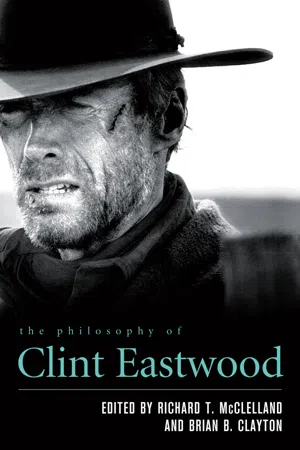
Famous for his masculine swagger and gritty roles, American cultural icon Clint Eastwood has virtually defined the archetype of the tough lawman. Beginning with his first on-screen appearance in the television series Rawhide (1959–1965) and solidified by his portrayal of the "Man with No Name" in Sergio Leone's "Dollars" trilogy (1964–1966), he rocketed to stardom and soon became one of the most recognizable actors in Hollywood. The Philosophy of Clint Eastwood examines the philosophy and psychology behind this versatile and controversial figure, exploring his roles as actor, musician, and director. Led by editors Richard T. McClelland and Brian B. Clayton, the contributors to this timely volume discuss a variety of topics. They explore Eastwood's arresting critique and revision of the traditional western in films such as Unforgiven (1992), as well as his attitudes toward violence and the associated concept of masculinity from the Dirty Harry movies (starting in 1971) to Gran Torino (2008). The essays also chart a shift in Eastwood's thinking about the value of so-called rugged individualism, an element of many of his early films, already questioned in Play Misty for Me (1971) and decisively rejected in Million Dollar Baby (2004). Clint Eastwood has proven to be a dynamic actor, a perceptive and daring director, as well as an intriguing public figure. Examining subjects such as the role of civil morality and community in his work, his use of themes of self-reliance and religious awareness, and his cinematic sensibility, The Philosophy of Clint Eastwood will provide readers with a deeper sense of Eastwood as an artist and illuminate the philosophical conflicts and resolutions that drive his films.
eBook - ePub
The Philosophy of Clint Eastwood
- 274 pages
- English
- ePUB (mobile friendly)
- Available on iOS & Android
eBook - ePub
The Philosophy of Clint Eastwood
About this book
Information
Topic
PhilosophySubtopic
Film & VideoFROM SOLITARY INDIVIDUALISM TO POST-CHRISTIAN STOIC EXISTENTIALISM
Quests for Community, Moral Agency, and Transcendence in the Films of Clint Eastwood
David H. Calhoun
The characters in Clint Eastwood’s films are famously associated with rugged individualism and violent directness. The films early in Eastwood’s popular success, such as the spaghetti Westerns directed by Sergio Leone, the Dirty Harry series, and films such as Hang ’Em High (1968) and Kelly’s Heroes (1970)—notably, films that Eastwood did not himself direct—highlight characters that are solitary, brutal, and resourceful. These Eastwood characters are loners, even when they team up with others, as when Eastwood’s Schaffer is the sole American in a British special-ops team in Where Eagles Dare (1968); masters of their circumstances, even when facing challenges and temporary setbacks, as in Coogan’s Bluff (1968); subject to no law other than that which they impose on themselves in order to survive in a hostile environment. The stories set tasks before these figures, the characters resourcefully tackle the tasks, and viewers enjoy the vicarious pleasure of seeing the task successfully completed.1
Even after Eastwood began producing and directing films in the early 1970s, memorable characters carried forward the theme of violent and solitary individualism, in the continuation of the Dirty Harry franchise and films such as High Plains Drifter (1973), The Eiger Sanction (1975), and The Gauntlet (1977). The characters of these films, along with those of Eastwood’s earlier work, are those that largely define Eastwood’s public and cinematic persona. The American Film Institute Desk Reference biography of Eastwood finds continuity in Eastwood’s screen character: “His persona, then and now, is tough, laconic, and towering.”2 Even where critics discern different phases of Eastwood’s character, they typically find them variations on a single theme, emphasizing solitude, action, and cynicism.3
Given the canonical status of Eastwoodian solitary individualism, Eastwood’s directorial debut, Play Misty for Me (1971), offers a striking contrast. The dramatic energy of the story is driven by the increasing perplexity and helplessness of radio host David Garver (Eastwood) in the face of stalking by an unhinged admirer, Evelyn (Jessica Walter). Garver is no isolated loner; the film explores his faltering attempts to build a relationship with his girlfriend, Tobie (Donna Mills), and it is his appetite for one-night stands that exposes him to Evelyn’s stalking. Indeed, the film assigns partial responsibility for Evelyn’s actions to Garver, to the extent that he willingly initiates a relationship with her, hesitates in acting to end it, and deceives others to evade responsibility as events spin out of control. This is clearly a different moral universe than that inhabited by Dirty Harry.
While his films are multidimensional in plot, setting, and affect, Misty marks the introduction of a set of themes that characterize the stories Eastwood has brought to the screen as a director and producer. First, Eastwood has shown a persistent interest in exposing the limitations of isolated individualism and tentatively exploring themes of community and human connection. Concomitantly with attention to community, Eastwood’s stories highlight the moral complexity of human situations. Romantic pairings, families, surrogate family associations, and friendships form the nexus within which moral choices are made concrete. In different ways, The Outlaw Josey Wales (1976) and Bronco Billy (1980) herald the emergence of this theme, as both stories depict the voluntary gathering of groups that function as surrogate families. Even when the characters portrayed in the films are deeply flawed, the films themselves create a moral framework that highlights both their humanness and the implications of their choices and actions. As I will argue, this linkage of community and moral agency is evocative of classical Stoicism, with its emphasis on deliberate moral agency within a wider moral community.
Second, Eastwood’s films confront characters not with discrete plot problems to solve, but with crises that demand deliberate moral agency. Often the stakes of the crisis are amplified by some mortal threat, such as the quarry who becomes the stalker in Tightrope (1984) or the twin dangers of urban violence and diseased old age in Gran Torino (2008). In all cases, however, the common factor is the existential quest for a meaningful vocation, the challenge to answer the question “How do I live?” Thus Eastwood’s characters find themselves in what Catholic novelist Walker Percy has called “the search,” which is “what anyone would undertake if he were not sunk in the everydayness of his own life. . . . To become aware of the possibility of the search is to be onto something. Not to be onto something is to be in despair.”4 The contrast to the search is everydayness, the condition that Kierkegaard called “despair” and Nietzsche called “herd thinking,” zombielike immersion in self-alienated identification with established social practices and beliefs in such a way that obscures human agency and the most pressing human concerns.5
Third, Eastwood’s characters find themselves in a world where religious and spiritual symbols are at best ambiguous in their import and at worst drained of meaning. Characters pray and attend church, priests and pastors appear in the plots, and biblical stories and themes are referenced, but in the end these resources provide little guidance or comfort. Josey Wales recites words of scripture as a prayer over the grave of his murdered family, but the wooden cross with which he marks their grave cannot bear the weight of his grief or vengeful anger. The existential crises of Eastwood’s characters thus occur in the shadow of what Nietzsche called “the death of God,” the cataclysmic collapse of traditional Christianity.6
Eastwood’s films reflect the post-Christian milieu of late modernity, but they also offer hints of transcendence, a sense that the quest for community and exercise of moral agency cannot be rooted in or exhausted by the immediate goals and choices of a solitary individual. Sometimes the intimations of transcendence are religious or supernatural, sometimes not, but they widen the moral context of the choices and actions the characters pursue.
I propose to explore this set of themes in Eastwood’s films. I will begin by sketching out the stereotypical individualist Eastwood persona, in order to provide a foil for the richer view of the human condition that emerges in his later films. Next, I will argue that there is a coherent structure to the themes of community, moral agency, cultural collapse, and transcendence, which I will refer to as post-Christian Stoic existentialism, appealing to A Perfect World (1993) to exhibit how these themes are treated by Eastwood. After constructing a general interpretive frame, I will explore how these themes concretely appear in five representative Eastwood films: Pale Rider (1985), where the themes emerge clearly, albeit ambivalently, for the first time; Unforgiven (1992), which juxtaposes justice denied with the faint hope of grace; Bridges of Madison County (1995), in which passionate impulse is contrasted to lifelong relational commitment; Million Dollar Baby (2004), which explores the potential discontinuity between love and theological-ethical principles; and Gran Torino (2008), where the decay of a Detroit neighborhood forms the backdrop for the possibility of re-created community.
The “Eastwood Persona”: Violent Solitary Immediacy
The essential atmosphere of Eastwood’s early films is anonymity. Director Sergio Leone especially uses the Western landscape to depict the lonely brutality of the human contexts and characters of the films. In the opening sequence of For a Few Dollars More (1965), for example, the wide shot of the empty Western landscape sets the stage for faceless violence. The wide camera shot allows us to see from a great distance the approach of a lone horseman, and then to witness his apparent killing by an offscreen rifleman.7 We do not know the shooter—is it Monco (Eastwood), Colonel Mortimer (Lee Van Cleef), or someone else? In a way, it doesn’t matter, because the point is that in a hostile environment such as this, death can come suddenly, unexpectedly, in ways that seem arbitrary, even pointless. The Good, the Bad, and the Ugly (1966) likewise begins with a desolate Western landscape, but after a split second the face of a killer swivels into view, with the ensuing murderous mayhem punctuated only by coyote howls and the whistling wind of the high desert.
The lonely anonymity of the landscape heralds the sterility of the characters that inhabit it. Blondie (Eastwood) and Tuco (Eli Wallach), the eponymous Good and Ugly, alternate in employing the harsh desert landscape as a weapon against one another. When an unexpected turn of events gives a barely alive Blondie a clue to the location of hidden gold, Tuco, who has nearly murdered Blondie by exposure, tries to wheedle the location of the gold with a grotesque parody of sympathy: “You’re very lucky to have me so close when it happened. Think if you’d been on your own. Look, I mean when one is ill, it’s good to have somebody close by—friends or relations. . . . I have you, you have me. Only for a little while, I mean.” Blondie’s reply drips with sarcasm: “I’ll sleep better knowing my good friend is by my side to protect me.”8
As this episode illustrates, the sole community established by Eastwoodian loners is temporarily alliance between suspicious enemies, or at best indifferent acquaintances. This is true not only of the roles Eastwood plays under direction by others, but those roles that carry forward the isolated individualism of his early work.9 As bail bond enforcer Tommy Nowak (Eastwood) says in Pink Cadillac (1989), “I’m not much of a joiner.”
While the landscapes these characters inhabit are expansive and anonymous, the moral context for their actions is governed by a narrowly cramped horizon. Nothing stands beyond the payoff for serving as a hired gun, finding the gold treasure, catching the bad guy, or delivering the witness alive to the courthouse. There is little character development. There is sufficient plot to drive the action of the narrative, but no more. Put another way, stories are offered, but those stories insufficiently reflect the true complexity of human community and human agency. Rugged individualism is a perennially appealing American theme, but as we will see, it is one that Eastwood has increasingly left behind.
From Solitary Individualism to Post-Christian Stoic Existentialism: A Perfect World (1993)
The loner characters of Eastwood’s early film success can reasonably be described as “stoic” in the colloquial sense: solitary, emotionless, unaffected by hardships. But the trajectory of Eastwood’s films evokes the far richer form of autonomy and moral rigor found in classical Stoicism, with its synthesis of austere self-governance and recognition of the demands of a wider moral community. To be sure, the Victorian homage to Stoicism by William Ernest Henley that provides the film title and personal inspiration for Nelson Mandela (Morgan Freeman) in Invictus (2009) is perhaps the only explicit Stoic reference in Eastwood’s work. Even here, however, we see individual responsibility and obligation to a community placed in a rich dialectic. While the poem celebrates autonomy and self-mastery, and provided bracing inspiration for Mandela to survive his harsh imprisonment, Eastwood uses the poem (in a voice-over by Freeman) to illustrate the effect that understanding Mandela’s experience has on South African rugby team captain Francois Pienaar (Matt Damon). This reframes the individualism of the poem in a way that reflects the classical Stoic notion that self-control does not enclose one in individual solitude but draws one into the community formed by all human beings. Emotional reserve does not imply indifference to others, even if it does involve a deep sense of the fragility of human life.10 This is the path of engaged, autonomous, cosmopolitan moral rigor, living by the code articulated by Marcus Aurelius: “Hour by hour resolve firmly, like a Roman and a man, to do what comes to hand with correct and natural dignity, and with humanity, independence, and justice.”11
Closely related to the notion of a moral community is the idea of a transcending moral order. Consider the famous dramatic analogy of the Stoic Epictetus: “Remember that you are an actor in a play, which is as the playwright wants it to be: short if he wants it short, long if he wants it long. If he wants you to play a beggar, play even this part skillfully, or a cripple, or a public official, or a private citizen. What is yours is to play the assigned part well. But to choose it belongs to someone else.”12 The notion of “playing a role” has obvious application to the film context, but Epictetus’s outlook is even more directly relevant to Eastwood. The Stoics famously balanced the idea of a broadly deterministic universe with severe demands of self-control.13 While the Stoics worked out with technical precision those things that were subject to human agency and those that were not, Eastwood’s films offer a less technical variant of fixed circumstances and free choices.
Consider Eastwood’s character study A Perfect World (1993). We gradually come to understand that prison...
Table of contents
- Cover
- Half title
- Title
- Copyright
- Dedication
- Contents
- Introduction: Eastwood as Philosopher
- From Solitary Individualism to Post-Christian Stoic Existentialism: Quests for Community, Moral Agency, and Transcendence in the Films of Clint Eastwood
- Hereafter and the Problems of Evil: Clint Eastwood as Practical Philosopher
- The Smile and the Spit: The Motivational Polarity and Self-Reliance Portrayed in The Outlaw Josey Wales and the Dollars Trilogy
- The Representation of Justice in Eastwood’s High Plains Drifter
- Bad Men at Play: On the Banality of Goodness in Unforgiven
- Aristotle, Eastwood, Friendship, and Death
- Giving up the Gun: Violence in the Films of Clint Eastwood
- Eastwood, Romance, Tragedy
- The Use of Silence in Hereafter: A Study in Neurocinematics
- The Mortal Hero: Two Inductions on the Meaning of Loss
- Eastwood’s Dream: The Philosophy of Absence in Hereafter
- Desperate Times Call for Existential Heroes: Eastwood’s Gran Torino and Camus’s The Plague
- Acknowledgments
- List of Contributors
- Index
Trusted by 375,005 students
Access to over 1.5 million titles for a fair monthly price.
Study more efficiently using our study tools.
Frequently asked questions
Yes, you can cancel anytime from the Subscription tab in your account settings on the Perlego website. Your subscription will stay active until the end of your current billing period. Learn how to cancel your subscription
No, books cannot be downloaded as external files, such as PDFs, for use outside of Perlego. However, you can download books within the Perlego app for offline reading on mobile or tablet. Learn how to download books offline
We are an online textbook subscription service, where you can get access to an entire online library for less than the price of a single book per month. With over 1.5 million books across 990+ topics, we’ve got you covered! Learn about our mission
Look out for the read-aloud symbol on your next book to see if you can listen to it. The read-aloud tool reads text aloud for you, highlighting the text as it is being read. You can pause it, speed it up and slow it down. Learn more about Read Aloud
Yes! You can use the Perlego app on both iOS and Android devices to read anytime, anywhere — even offline. Perfect for commutes or when you’re on the go.
Please note we cannot support devices running on iOS 13 and Android 7 or earlier. Learn more about using the app
Please note we cannot support devices running on iOS 13 and Android 7 or earlier. Learn more about using the app
Yes, you can access The Philosophy of Clint Eastwood by Richard T. McClelland, Brian B. Clayton, Richard T. McClelland,Brian B. Clayton in PDF and/or ePUB format, as well as other popular books in Philosophy & Film & Video. We have over 1.5 million books available in our catalogue for you to explore.