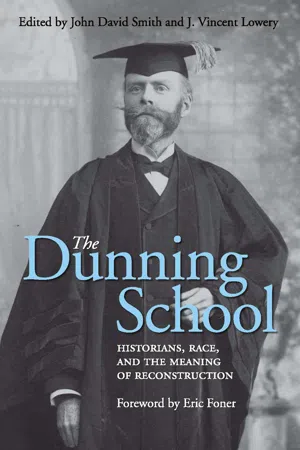
From the late nineteenth century until World War I, a group of Columbia University students gathered under the mentorship of the renowned historian William Archibald Dunning (1857–1922). Known as the Dunning School, these students wrote the first generation of state studies on the Reconstruction—volumes that generally sympathized with white southerners, interpreted radical Reconstruction as a mean-spirited usurpation of federal power, and cast the Republican Party as a coalition of carpetbaggers, freedmen, scalawags, and former Unionists. Edited by the award-winning historian John David Smith and J. Vincent Lowery, The Dunning School focuses on this controversial group of historians and its scholarly output. Despite their methodological limitations and racial bias, the Dunning historians' writings prefigured the sources and questions that later historians of the Reconstruction would utilize and address. Many of their pioneering dissertations remain important to ongoing debates on the broad meaning of the Civil War and Reconstruction and the evolution of American historical scholarship. This groundbreaking collection of original essays offers a fair and critical assessment of the Dunning School that focuses on the group's purpose, the strengths and weaknesses of its constituents, and its legacy. Squaring the past with the present, this important book also explores the evolution of historical interpretations over time and illuminates the ways in which contemporary political, racial, and social questions shape historical analyses.
eBook - ePub
The Dunning School
Historians, Race, and the Meaning of Reconstruction
- 338 pages
- English
- ePUB (mobile friendly)
- Available on iOS & Android
eBook - ePub
The Dunning School
Historians, Race, and the Meaning of Reconstruction
About this book
Information
1
John W. Burgess, Godfather of
the Dunning School
One cannot fully understand the Dunning School without a working knowledge of John W. Burgess’s life, career, and publications. Part of an earlier generation, he taught William A. Dunning and helped build the foundations on which the school stood. Burgess published “scientific” scholarship that was in line with the highest international standards, and his views on the Teutonic “race” not only supported but gave intellectual credibility to a wide variety of racist views in Reconstruction histories. Hardly obsessed with race, however, he was interested in topics as diverse as international political science, national reunification, Hegelian philosophy, Germany, and educational reform. His reputation was impressive. Burgess was a founding father of graduate education in the United States and led the transformation of Columbia University into a leading institution in political science and history. Bolstered by a German pedigree, he set the standard for academic rigor at Columbia, and his scholarship was at the cutting edge in Western academia. His theories of political capability, governmental responsibility and limits, social progress, the process of civilization, and world history, and his validations of colonialism, scientific racism, immigration limits, and restricted voting, had a wide following. More specifically, Burgess contributed a number of works in political science and history that profoundly influenced the Dunning School scholars, elevating both their level of scholarship as well as their racist rhetoric.
Born in 1844 in middle Tennessee to a Presbyterian, Whig, and Unionist slave owner originally from Rhode Island, Burgess remembered “intelligent, proud, and courageous slave barons,” “ignorant, slovenly, poor white trash,” and the “vast mass of African slaves.” His was an explicitly rosy view of slavery, dimmed only by the rare brutality of overseers and common whites. Masters fed and clothed their property well, and slaves “worked short hours and never knew what a strenuous effort meant.” Like his father, Burgess grew to view slavery as an untenable institution and blacks as an inferior race. The state’s “insane secessionists” brought on a violent “reign of universal hate born of misunderstanding and jealousy” under which the Burgess family suffered the Confederacy’s “tyranny over opinion” and “reign of terror.” These searing experiences led Burgess to lose “faith in the wisdom and goodness of the mass of men” and gain a fierce nationalism, an appreciation of constitutional law, and a fear of the “democratizing of society.” The desires to promote domestic peace, stave off mob rule, and promote reconciliation would become driving forces in his career. After a brief stay at nearby Cumberland University, Burgess joined the United States Army in 1862. His harrowing military service inspired his “life’s work”—“teaching men how to live by reason and compromise instead of by bloodshed and destruction.” War’s footprint inspired Burgess to teach nationalism over states’ rights, and order and constitutional law over chaos and revolution. Burgess fled the South in the fall of 1864 and followed friends to Amherst, Massachusetts.1
Amherst College offered another formative experience. The Hegelian L. Clark Seelye shaped Burgess’s appreciation for “universal reason as the real substance of all things,” and his duty to promote rationality in “the rules of thought and conduct, law and policy.” Edward P. Crowell related ancient Rome’s politics and law to “the present,” and Burgess later declared, “I laid the groundwork of my study of history in the reading of Tacitus with him.”2 This reference to the Roman historian is especially significant in light of Burgess’s subsequent worship of all things German, his belief in the Teutonic germ theory, and his views on race in America. Burgess subscribed to the nineteenth-century vogue of using Tacitus and his Germania to create and justify racial and national hierarchies. In addition, he seems to have reinforced the lessons of his Civil War experiences—as a southern Unionist and federal soldier—with Tacitus’s references to the allegedly free and orderly society within Teutonic tribes.
After graduating from Amherst in 1867, Burgess passed the Massachusetts bar in 1869. He believed legal knowledge to be a prerequisite to mastering political science. Without such a foundation for America’s leaders, he later wrote, society would tend toward “systems of absolutism in government” and the “undervaluation of individual liberty.” Following a brief stint teaching at Knox College in Galesburg, Illinois, Burgess visited Reconstruction Tennessee before leaving for an academic tour of Germany in 1871. He found his family and friends in a state of “distress and poverty,” suffering in an era in which “respectable and intelligent white people” had lost status and the vote while blacks and carpetbaggers “ruled and plundered the land.” Although Tennessee’s experience was hardly the most severe for slaveholding whites, Burgess concluded that during Reconstruction “neither property nor life nor chastity was safe, and men and women of the better sort longed to be laid at rest.” Burgess’s brush with Congressional Reconstruction inspired rededication to “the work of substituting reason for passion” in politics and diplomacy, but it also left him with a lasting negative perspective of the era.3
The newly united Germany made a lasting positive impression on Burgess. Drawn to German universities by their notions of Lehrfreiheit (the freedom to pursue research) and Lernfreiheit (the freedom to attend multiple universities), Burgess took classes for two years at the University of Göttingen, the University of Leipzig, and Berlin University before returning to join Amherst’s faculty in the summer of 1873. At Berlin, Burgess was taken with the teaching style and the scientific method of the historian Theodor Mommsen. The German model of political science, Staatswissenschaft, encouraged skepticism and criticism and aspired to scientific accuracy; for Burgess this was an inspiring contrast to the ethically and didactically anchored version taught to American undergraduates. Soon to become one of the leading American educators of the late nineteenth century, he made study in Europe a recommended part of his students’ education. Burgess also fell in love with German culture, geography, history, and government. His visit coincided with an exceptionally exciting time in German history, but also a time with an undercurrent of intense racial nationalism. His German tour was a seminal experience, one to which he would often refer and that shaped his intellectual development.4
Unable to form a permanent graduate school at Amherst, Burgess reluctantly allowed himself to be lured to Columbia College in 1876 to teach political science, international law, and history. He soon began to transform the “small old-fashioned college” into a true university and himself into an educational reformer and a founding father of political science in America. Borrowing from French and German models, he became the driving force behind Columbia’s School of Political Science, the Political Science Quarterly (PSQ), the Academy of Political Science, and a monograph series. He was a crusader for the “scientific” method, what he described as “free and untrammeled individual research and complete freedom of instruction” for scholars who questioned “what was considered the established truth” in order to foster the “progressive development of truth.” He also sought to prepare men for public service in what he believed was the superior form of government, the democratic nation.5
Burgess enjoyed an impressive academic career, but his reputation began to decline with the creation of the American Political Science Association in late 1903. He had no role in its creation, and although he continued to publish in PSQ, he lost relevance in a discipline shifting away from its European heritage and undergoing a thorough process of “Americanization.” The new generation had multiple excuses to regard Burgess as a relic, and he, in turn, had ample reasons to regard the younger scholars as parochial. As his career faded, he maintained a strong bond with Germany and sought to encourage good relations between the United States and Germany throughout the rest of his life. As the Roosevelt Professor at the University of Berlin during 1906–7, Burgess gave several lectures to, and socialized with, the emperor and other influential officials. Teutonic unity between the people of Germany and America was a consistent theme in these lectures, and he was “disturbed and distressed” by the United States’ entrance into World War I against his adopted nation. With his reputation already fading, but his scholarly significance well entrenched, Burgess died in 1931.6
Burgess’s scholarly career included a twenty-six-year span that produced numerous books and articles. In his most important scholarly work, the two-volume Political Science and Comparative Constitutional Law (1890, 1893), Burgess attempted a comprehensive and “scientific” analysis of sovereignty, liberty, and government, and he emphasized the most “civilized” nations—the United States, Germany, Great Britain, and France. Friends later published a consolidated version titled The Foundations of Political Science (1933). Though Burgess’s struggles to discover and define universal truths about nations, states, governments, and their peoples were heroic if ultimately futile, his biases for “Teutonic” nations and peoples are glaring to the modern reader. Burgess assumed that only “Teutonic political genius” could “solve the problem of political civilization” and that the “manifest incapacity” of non-Teutonic peoples rendered them all but helpless in this pursuit. Teutonic nations, Burgess argued, needed to restrict non-Teutonic immigration and have active colonial policies for the good of “civilization.” When analyzing the Fourteenth Amendment and the Slaughterhouse Cases, Burgess largely ignored the latter’s negative effect on African American civil rights. The nationalist Burgess concluded the first volume with the judgment that the United States was “far ahead of Europe in the domain of civil liberty.”7
Burgess’s most important historical endeavor was a four-volume constitutional analysis of America between 1817 and 1876. Born and raised in the South during slavery and war, and a political science and constitutional law professor at a northern university, Burgess believed that the time was right for “a more complete reconciliation” and a “juster appreciation of the views on both sides.” He took up the task of writing the “correct scientific point of view” as “a sacred duty to my country.” In The Middle Period, 1817–1858 (1897), he avoided secondary sources, indulged his own “Northern point of view,” and declared that the South needed to admit its “error” in order to restore “national cordiality.” In this “truthful record, connection, and interpretation,” he analyzed the period chronologically by political subject. Chapters on various topics such as nullification reveal Burgess’s political approach, and chapters on slavery, abolition, the Fugitive Slave Law, and Dred Scott offer examples of his opinions on race. Burgess’s next book, the two-volume Civil War and the Constitution, 1859–1865 (1901), begins with profiles of Jefferson Davis, Stephen Douglas, and Abraham Lincoln, ends with the last battles and “international complications,” and focuses on analysis of the Constitution. Admiring Lincoln’s “real conservatism,” Burgess believed the president to be “the master both of Davis and of Douglas upon the ground of positive law and constitutional history, as well as upon the ground of public morality.” Like his antebellum work, the war books reveal Burgess’s views on racial hierarchies. Concluding a chapter on southern feelings about slave revolts and Harper’s Ferry, Burgess declared that though a “sound philosophy will undoubtedly hold that there is a plan of world civilization,” the ends of John Brown’s raid did not justify the means. Burgess’s Reconstruction and the Constitution, 1866–1876 (1902) completed the trilogy by blazing the trail of “scientific” history on Reconstruction. Seeking to balance his analysis of this still-controversial era, Burgess argued that, just as he had in The Middle Period called on the South to admit its “error” and “failure” in seceding, so too should the North acknowledge the same for Reconstruction. Giving freedpeople political power was a colossal mistake, which the Rutherford B. Hayes administration rightfully, according to Burgess, began to reverse.8 As will be discussed later, Burgess’s Reconstruction had a significant effect on the development of the Dunning School.
After his retirement in 1912 and despite a declining reputation, Burgess continued to publish. In 1915 he produced The Reconciliation of Government with Liberty, an effort to analyze the development of all known governments in the world, focusing on “Germania,” the “Anglo Saxon State” in England, the United States up to 1898, and then the “New” United States—a response to recent political developments. Clearly an admirer of Rutherford B. Hayes, Burgess extended his analysis begun in Reconstruction in The Administration of President Hayes (1916). He more fully developed his concerns about the state of American government in his final book, Recent Changes in American Constitutional Theory (1923).9
Burgess also published numerous articles, book reviews, and speeches, most of which were devoted to the latest political skirmishes. His interests were wide-ranging, from the United States’ ongoing relations with Germany to the popular election of U.S. senators, and he saw himself as an authority on contemporary world issues such as colonialism and Germany’s intentions. Burgess occasionally veered into the realm of history, but he always emphasized the philosophic, comparative, and political aspects. In the pages of PSQ and other journals he pushed for a more interdisciplinary, and therefore a more “scientific,” approach to scholarship. In an article entitled “Political Science and History,” published in the American Historical Review (AHR), Burgess attempted to compare and clarify his vie...
Table of contents
- Cover
- Half title
- Title
- Copyright
- Dedication
- Contents
- Foreword
- Introduction
- 1. John W. Burgess, Godfather of the Dunning School
- 2. William Archibald Dunning: Flawed Colossus of American Letters
- 3. James Wilford Garner and the Dream of a Two-Party South
- 4. Ulrich B. Phillips: Dunningite or Phillipsian Sui Generis?
- 5. The Steel Frame of Walter Lynwood Fleming
- 6. Ransack Roulhac and Racism: Joseph Grégoire de Roulhac Hamilton and Dunning’s Questions of Institution Building and Jim Crow
- 7. Paul Leland Haworth: The “Black Republican” in the Old Chief’s Court
- 8. Charles W. Ramsdell: Reconstruction and the Affirmation of a Closed Society
- 9. The Not-So-Strange Career of William Watson Davis’s The Civil War and Reconstruction in Florida
- 10. C. Mildred Thompson: A Liberal among the Dunningites
- Acknowledgments
- List of Contributors
- Index
Trusted by 375,005 students
Access to over 1.5 million titles for a fair monthly price.
Study more efficiently using our study tools.
Frequently asked questions
Yes, you can cancel anytime from the Subscription tab in your account settings on the Perlego website. Your subscription will stay active until the end of your current billing period. Learn how to cancel your subscription
No, books cannot be downloaded as external files, such as PDFs, for use outside of Perlego. However, you can download books within the Perlego app for offline reading on mobile or tablet. Learn how to download books offline
Perlego offers two plans: Essential and Complete
- Essential is ideal for learners and professionals who enjoy exploring a wide range of subjects. Access the Essential Library with 800,000+ trusted titles and best-sellers across business, personal growth, and the humanities. Includes unlimited reading time and Standard Read Aloud voice.
- Complete: Perfect for advanced learners and researchers needing full, unrestricted access. Unlock 1.5M+ books across hundreds of subjects, including academic and specialized titles. The Complete Plan also includes advanced features like Premium Read Aloud and Research Assistant.
We are an online textbook subscription service, where you can get access to an entire online library for less than the price of a single book per month. With over 1.5 million books across 990+ topics, we’ve got you covered! Learn about our mission
Look out for the read-aloud symbol on your next book to see if you can listen to it. The read-aloud tool reads text aloud for you, highlighting the text as it is being read. You can pause it, speed it up and slow it down. Learn more about Read Aloud
Yes! You can use the Perlego app on both iOS and Android devices to read anytime, anywhere — even offline. Perfect for commutes or when you’re on the go.
Please note we cannot support devices running on iOS 13 and Android 7 or earlier. Learn more about using the app
Please note we cannot support devices running on iOS 13 and Android 7 or earlier. Learn more about using the app
Yes, you can access The Dunning School by John David Smith, J. Vincent Lowery, John David Smith,J. Vincent Lowery in PDF and/or ePUB format, as well as other popular books in History & Teaching History. We have over 1.5 million books available in our catalogue for you to explore.