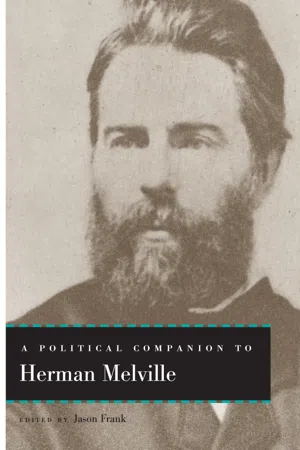
Herman Melville is widely considered to be one of America's greatest authors, and countless literary theorists and critics have studied his life and work. However, political theorists have tended to avoid Melville, turning rather to such contemporaries as Ralph Waldo Emerson and Henry David Thoreau to understand the political thought of the American Renaissance. While Melville was not an activist in the traditional sense and his philosophy is notoriously difficult to categorize, his work is nevertheless deeply political in its own right. As editor Jason Frank notes in his introduction to A Political Companion to Herman Melville, Melville's writing "strikes a note of dissonance in the pre-established harmonies of the American political tradition." This unique volume explores Melville's politics by surveying the full range of his work—from Typee (1846) to the posthumously published Billy Budd (1924). The contributors give historical context to Melville's writings and place him in conversation with political and theoretical debates, examining his relationship to transcendentalism and contemporary continental philosophy and addressing his work's relevance to topics such as nineteenth-century imperialism, twentieth-century legal theory, the anti-rent wars of the 1840s, and the civil rights movement. From these analyses emerges a new and challenging portrait of Melville as a political thinker of the first order, one that will establish his importance not only for nineteenth-century American political thought but also for political theory more broadly.
- 456 pages
- English
- ePUB (mobile friendly)
- Available on iOS & Android
eBook - ePub
A Political Companion to Herman Melville
About this book
Information
1
Who Eats Whom?
Melville’s Anthropolitics at the Dawn of Pacific Imperialism
Kennan Ferguson
In no respect does the author make pretension to philosophic research.
—Herman Melville, Omoo
“From where?” asks Melville, in story and novel. What is the source of justice, of desire, of revenge, of human experience? When someone arrives at a new destination, what brought him (for the narrator is always male) there? How do we attempt to escape our pasts and how does their return compromise us? The role of the past in the present and the demand for causation and those resistances to that demand constitute both literature and humanity within Melville’s corpus.
But the question should be asked of Melville himself as well. From where did his authorship arise? What dynamics of literature made him the famed writer who by the twentieth century was considered one of the greatest American novelists? Surprisingly to some, the answer lies not in the United States, but in the South Pacific. Long before Melville’s posthumous fame as the writer of Moby-Dick, before his brief and suggestive novellas and short stories that make Billy Budd and Bartleby familiar names, he came to the literary world’s attention as a writer of putatively autobiographical nonfiction. Focusing on sailors and savages, civilization and cannibalism, he emerged not as a literarily canonical figure but as an author of adventure. In his first two works, Typee and Omoo, Melville operated as an anthropological narrator, a sympathetic captive, and a possible fabulist.
Both books tell of adventures in the South Pacific. The first describes how Tommo, the narrator and stand-in for Melville, jumps ship to escape the drudgery of civilization and finds himself captured by a tribe of Marquesans. These Taipis, called “Typees” by Melville, he first thinks to be cannibals, but after living among them for a while, he ultimately comes to admire their life and culture, even though he still desires escape.1 The second follows the same narrator (now, revealingly, called “Typee” by his new shipmates) to Tahiti, where he observes the mostly pernicious effects that colonial administration has on the indigenous islanders. The political content, genre trouble, and imperial outlook of these works have drawn the attention of today’s critics, but they were far more popular in Melville’s day than any of his subsequent posthumously canonized work. These books formed the basis for Melville’s fame, and for the tropes that his later writing would draw out and develop.2 In each case, the narrator comes to doubt his own knowledge: appearances are subverted, assumptions are disproved, surfaces mislead. In his later work, Melville would extend these doubts to much of nineteenth-century American existence.
Melville gave the Anglophone world an imaginary of the South Seas, especially the islands of the Marquesas and of Tahiti, as powerful as that developed a generation later in France by Paul Gauguin. Melville did so in the middle of the nineteenth century, in a time of imperial expansion, when the relationships between the United States, England, and France—among other imperial powers—were being contested on the lands and bodies of Pacific peoples. In the stories narrated in these two tales (many of which depended on—were even plagiarized from—others’ works), Melville presented scientific knowledge, cultural study, adventure, and narrative ambiguity in the form of reportage.
His anthropolitical imaginary presents the Pacific Islanders as a beguiling mixture of savagery and wisdom, populating islands of beauty and danger. Unlike his fellow white sailors, Melville sees the indigines as justified in their violence both against one another and against foreign invaders, and he views the intrigues between island chieftains and queens as equivalent to those of their European counterparts. He reports on their clothing, food, toilette, and traditions with a benignant eye, noting that his admiration for their culture opens him to a charge of being sympathetic with cannibals. The admiration he feels for the “native damsels” hints at an erotic freedom, one embodied in the emblematic figure of his lover, the girl Fayaway. But these admiring glances mix with a simultaneous narration of civilization and savagery that dislocates Pacific Islanders into the realm of pure nature, a narration that undermines a simple interpretation of Melville as an anti-imperialist. Telling of his own capture, Melville emphasizes the danger of the warlike tribes. When he discusses his own travels, he highlights the distances involved. And when he explains the practices of “natives,” he underscores their strangeness and inhumanities. The Typee and the Tahitians are not peoples to be emulated, even if they are to be admired, for the civilized man should never aspire to such a lack of society.
The Pacific thus became for his readers a manifold and complex place: a location of primitive but beguiling cultures, one threatened by the currents of colonization overwhelming them but also of delights and conquests for the courageous traveler. Melville wrote “the mythopoetic source for a wide variety of literary conventions which have been used to dramatize the culture clash between Western civilization and the primitive world.”3 For many, Melville’s experience with and generosity toward Pacific Islanders mark him as a critic of American imperialism, and indeed he strongly criticized the missionary work, consular power, and sailorly ignorance he found. But in its place he introduced an idea of indigenes as people to be visited, experienced, and investigated: a scientific, zoological approach to such cultures. In doing so, Melville created a new template of imperialism for the American imaginary, one that holds itself as protecting cultures from foreign influence while manipulating them to its own ends; as saving peoples from the vagaries of international capital while using them as a touristic destination; as valuing encounters with alterity while ultimately remaining unmarked by the experience. Typee and Omoo taught America how to be an empire. This would be an empire of cultural zookeepers and armchair anthropologists who mobilized difference for imperial ends rather than the more familiar and more violent European models of English colonization and Belgian work camps, but an empire nonetheless.4
The Anthropologist’s Eye
The respective narrators of the books, Tommo and Typee, both come across as travelers with a greater-than-average knowledge of history, discernment regarding situation, and sympathy for their island interlocutors. They are not normal sailors, in other words, but interlopers in work in the Pacific that began in earnest before their arrival. Because of the claims to facticity and verity that begin each work, each narrator stands in for Melville more overtly than do most others for their authors.
They thus serve not only as adventurers but also as what we would today call theorists. Melville overtly denied that what he was doing was theory, which his period associated with European decadence, precisely because he did not want to be seen as presenting merely an updated Rousseau. In an intellectual milieu that perceived theory as bloodless, abstract, and divorced from reality, Melville’s philosophy, even his political philosophy, would emerge not from a Kantian investigation into first principles but from the lived experience of explorers, natives, and seamen. It would be empirical, descriptive, scientific, and, most of all, adventurous. It was only by actively grappling with the complexities of the world, especially the diversity of its peoples and their cultures, that one could begin to discover one’s own self. If philosophy embodied dead thinking, adventure promised embodied living.
These are also books of anthropology and history. In the course of Tommo’s and Typee’s adventures, they describe not only their own dangers and excitements, but also the practices, living conditions, and language of Marquesans, Tahitians, and sailors. Experiencing these worlds as outsiders and naïfs, they nonetheless quickly become proficient in important procedures of understanding and action. What a sailor sees as savagery they see as justified; what a missionary sees as incomprehensible they see as cultural; what a native sees as a local outrage they see as part of a complex system of emergent colonial power.
This insightfulness comes in part from these narrators’ ability to understand native languages with superhuman alacrity, so that they can know a fairly complex lingua (or at least its pidgin version) with an authorial omniscience. It comes also from their location outside the presumed narrative timeline—they speak of access to research materials and documents consulted after the fact of the experience being recounted. Perhaps most tellingly, this discernment also comes from the ability to make connections—between English captains, Maori harpooners, Tahitian chieftains, and American readers. All combine to explore the emergent complexities of the Pacific, to be surprised by its myriad peoples, languages, and events. As creators of these connections, they become anthropologists of cultures: they explain histories and practices with an eye to appreciating their complexities, authors who teach why and how these far-flung islands are intriguing and useful to an emergent American power.
A retelling of a simple encounter with a farmer became, for Melville, an opportunity to generalize for two chapters about all “Farming in Polynesia.”5 The second of those chapters digresses further, explaining the history of cattle raising and hunting in Hawai‘i. Critics have read similar excurses in Moby-Dick (concerning kinds of whales, for example) as everything from a temporal narrative device designed for slowing the plot to an engagement about nature with contemporary Romantic authors. The similarity of these divagations in Typee and Omoo shows their roots in Melville’s anthropological impulse: the author provides the important social, political, and historical contexts so that the reader understands not just that cows existed in Tahiti, but how and when they came to be there.
Hogs and sailors and cows and whale oil: all are taken from one place and put in another, and the author and reader alike find these changes and juxtapositions worth figuring out. When the Typee take Tommo prisoner, he soon discerns out that they are not the savage, vicious, disorganized warriors of the sailors’ nightmares, but instead a complexly organized society dedicated to protecting itself from conquest, both militarily and symbolically. Tommo’s realization that their life revolves not around warfare and cannibalism but instead around making tapa cloth, gathering fruits and raising pigs, swimming in shaded pools, and fishing, allows him to question why one tribe has a reputation for friendliness while another is feared. He discovers that reputation serves a purpose, that it could effectively serve to protect a group from the predations of the ships that appear on their shores and make demands on them.
The Europeans, he noted, engaged in “unprovoked atrocities” against natives who originally welcomed them: “The instinctive feeling of love within their breasts is soon converted into the bitterest hate.”6 Both books overflow with stories of captains whose ships require aid (water, food, sex, or shelter) and who presume that their need translates into obligations on the part of native groups. If those demands are not properly met, they turn to vengeance; to teach the savages lessons in propriety, the European sailors kill, burn, rape, poison, and steal.7 Their lives, lands, and possessions, the narrators note, are constantly at risk from the whites and from other tribes, and part of their reputations and external practices is meant to signal to these outsiders that their ferocity knows no limits, even alongside the pleasures and relaxations of their quotidian lives.8
Melville’s proto-anthropology, then, looked not only to describe native practices (a classic subject of travelogue), but also to examine these in relation to causes and effects, structures of power and war, which explain external reputations and rumors.9 Tommo constantly fears the specter of cannibalism; he is almost convinced by his fellow captive, Toby, that a suckling pig he is being fed is actually a human baby, and he repeatedly worries that the Typee’s hospitality merely covers a larger desire to fatten him up for a feast. Failing to see evidence of cannibalism over the course of his capture, he begins to suspect that it was merely a rumor the Typee spread to appear fierce to their enemies. (Ultimately, when he sees a member of the Happar tribe captured and presumably killed, Tommo gathers as much evidence as possible to prove that the Happar had been eaten. This serves both to convince him to attempt his ultimately successful escape and to reinforce the idea of the ferocious Typee) (Typee, 270–277).
Melville’s descriptions of these foreign practices were not entirely his own. In truth, much of his representation of Pacific cultures was literally unoriginal. Not content merely to borrow insights from previous write...
Table of contents
- Cover
- Half title
- Title
- Copyright
- Dedication
- Contents
- Series Foreword
- Introduction: American Tragedy: The Political Thought of Herman Melville
- 1. Who Eats Whom? Melville’s Anthropolitics at the Dawn of Pacific Imperialism
- 2. “The End Was in the Beginning”: Melville, Ellison, and the Democratic Death of Progress in Typee and Omoo
- 3. Chasing the Whale: Moby-Dick as Political Theory
- 4. Ahab, American
- 5. “Mighty Lordships in the Heart of the Republic”: The Anti-Rent Subtext to Pierre
- 6. Melville and the Cadaverous Triumphs of Transcendentalism
- 7. Language and Labor, Silence and Stasis: Bartleby among the Philosophers
- 8. Melville’s “Permanent Riotocracy”
- 9. What Babo Saw: Benito Cereno and “the World We Live In”
- 10. “Follow Your Leader”: Benito Cereno and the Case of Two Ships
- 11. The Metaphysics of Indian-Hating Revisited
- 12. Melville’s War Poetry and the Human Form
- 13. The Lyre of Orpheus: Aesthetics and Authority in Billy Budd
- 14. Melville’s Law
- Acknowledgments
- Selected Bibliography
- List of Contributors
- Index
Trusted by 375,005 students
Access to over 1.5 million titles for a fair monthly price.
Study more efficiently using our study tools.
Frequently asked questions
Yes, you can cancel anytime from the Subscription tab in your account settings on the Perlego website. Your subscription will stay active until the end of your current billing period. Learn how to cancel your subscription
No, books cannot be downloaded as external files, such as PDFs, for use outside of Perlego. However, you can download books within the Perlego app for offline reading on mobile or tablet. Learn how to download books offline
Perlego offers two plans: Essential and Complete
- Essential is ideal for learners and professionals who enjoy exploring a wide range of subjects. Access the Essential Library with 800,000+ trusted titles and best-sellers across business, personal growth, and the humanities. Includes unlimited reading time and Standard Read Aloud voice.
- Complete: Perfect for advanced learners and researchers needing full, unrestricted access. Unlock 1.5M+ books across hundreds of subjects, including academic and specialized titles. The Complete Plan also includes advanced features like Premium Read Aloud and Research Assistant.
We are an online textbook subscription service, where you can get access to an entire online library for less than the price of a single book per month. With over 1.5 million books across 990+ topics, we’ve got you covered! Learn about our mission
Look out for the read-aloud symbol on your next book to see if you can listen to it. The read-aloud tool reads text aloud for you, highlighting the text as it is being read. You can pause it, speed it up and slow it down. Learn more about Read Aloud
Yes! You can use the Perlego app on both iOS and Android devices to read anytime, anywhere — even offline. Perfect for commutes or when you’re on the go.
Please note we cannot support devices running on iOS 13 and Android 7 or earlier. Learn more about using the app
Please note we cannot support devices running on iOS 13 and Android 7 or earlier. Learn more about using the app
Yes, you can access A Political Companion to Herman Melville by Jason Frank in PDF and/or ePUB format, as well as other popular books in Politics & International Relations & North American Literary Criticism. We have over 1.5 million books available in our catalogue for you to explore.