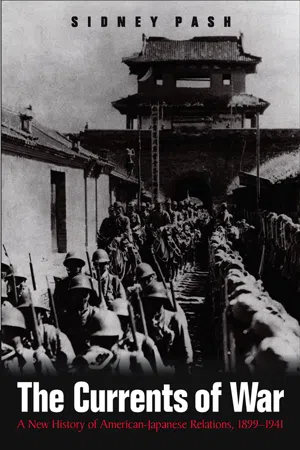
From 1899 until the American entry into World War II, U.S. presidents sought to preserve China's territorial integrity in order to guarantee American businesses access to Chinese markets—a policy famously known as the "open door." Before the Russo-Japanese War in 1904, Americans saw Japan as the open door's champion; but by the end of 1905, Tokyo had replaced St. Petersburg as its greatest threat. For the next thirty-six years, successive U.S. administrations worked to safeguard China and contain Japanese expansion on the mainland. The Currents of War reexamines the relationship between the United States and Japan and the casus belli in the Pacific through a fresh analysis of America's central foreign policy strategy in Asia. In this ambitious and compelling work, Sidney Pash offers a cautionary tale of oft-repeated mistakes and miscalculations. He demonstrates how continuous economic competition in the Asia-Pacific region heightened tensions between Japan and the United States for decades, eventually leading to the attack on Pearl Harbor on December 7, 1941. Pash's study is the first full reassessment of pre–World War II American-Japanese diplomatic relations in nearly three decades. It examines not only the ways in which U.S. policies led to war in the Pacific but also how this conflict gave rise to later confrontations, particularly in Korea and Vietnam. Wide-ranging and meticulously researched, this book offers a new perspective on a significant international relationship and its enduring consequences.
eBook - ePub
The Currents of War
A New History of American-Japanese Relations, 1899-1941
- 372 pages
- English
- ePUB (mobile friendly)
- Available on iOS & Android
eBook - ePub
About this book
Chapter 1
The Foundations of Containment
Behold, I have set before thee an open door and no man can shut it.
—Rev. 2:8 (AV)
Japan professed belief in the open door policy…but the time…has come when Japan can disclose her real policy, that of exclusion.
—George Bronson Rea (1916)
George Bronson Rea made a living off the Open Door. First, in 1905, as the founder of the Far Eastern Review, he championed American access to the China market. Later, as an adviser to the government of the Japanese puppet state of Manchukuo, he championed Tokyo's dominance in Northeast Asia. While Rea clearly abandoned his allegiance to the Open Door, America never did.
During the Progressive Era, long before Rea turned apologist for the Japanese, his career and America's defense of the Open Door paralleled one another. Rea launched his Far Eastern Review in 1905, the same year that Theodore Roosevelt inaugurated the American containment of Japan. A decade later, he penned his essay “Closing the Open Door,” which highlighted Japan's wartime expansion and challenged America to defend China and its rights there. While Rea correctly drew attention to the threat that Japan posed to both China and America, he need not have worried about America's commitment to the Open Door.1
By 1916, three very different presidents had worked to contain Japanese expansion and protect China. Theodore Roosevelt nurtured the balance of power and employed diplomacy and deterrence in near equal measure, while Taft relied primarily on America's financial clout. While Wilson abhorred both military deterrence and dollar diplomacy, his search for a means to contain Japan eventually led him to embrace economic coercion, Roosevelt's policy of diplomatic engagement, and Taft's investment diplomacy.
These differing approaches to limiting Japanese expansion were no doubt conditioned by these presidents’ more general approach to American diplomacy and their particular conception of Japan. Whereas Roosevelt did not flinch from projecting American power and using it to bend weaker states to America's will, Taft abhorred the use of force and instead preferred the rule of law and the power of the dollar. Wilson, who sought to chart a nobler course for American diplomacy, encountered both the greatest obstacles and in the end the most profound disillusionment. Roosevelt laid the groundwork for America's containment of Japan and possessed a view of that nation shaped by reality but not warped by unreasonable fear. He recognized that, while Japan had arrived on the international stage late, it was a regional power and therefore possessed, as did the Russians, English, and French, a clearly defined, if not openly acknowledged, sphere of influence. This realism contributed to Roosevelt's successful containment. Neither extreme fear nor extreme prejudice shaped Taft's view of Japan, yet the strains of commercial competition led him to see Japan as an adversary that like the other great powers in Asia could legitimately be forced from its sphere by American capital. For these reasons, neither containment nor Japanese-American relations fared particularly well during his tenure. For Wilson, Japan was a particularly troublesome adversary in that Tokyo was both a commercial and a military rival that also opposed the president's American-led diplomatic revolution. Despite the chaos that engulfed the world during Wilson's two terms, his containment of Japan was remarkably successful.
Despite their profound differences, all three leaders accepted the inherited wisdom of the nineteenth century, which emphasized that the United States must preserve the Open Door to China. Each administration searched for the Open Door's exact meaning as well as the best means for protecting it, but neither Roosevelt nor Taft nor Wilson ever seriously questioned the long-term mission of containing Japanese expansion on the Asian mainland.
Theodore Roosevelt and the Origins of Containment
Theodore Roosevelt laid the foundation for the successful containment of Japan in the midst of the 1904–1905 Russo-Japanese War, while Tokyo's modern armed forces laid waste to Russian military power. Following the American-brokered Portsmouth Treaty, which ended the war, the traditionally amiable Japanese-American relationship suddenly turned adversarial as Americans saw Japan replacing Russia as the primary threat to the Open Door. After Portsmouth, Roosevelt the peacemaker now worked to contain Japan. During the remainder of his second term, the president successfully limited Japanese expansion by nurturing the balance of power and employing a combination of military deterrence and diplomatic engagement. Virulent racism, the machinations of imperial Germany and junior American diplomats, and the growing politicization of Japanese-American relations complicated his task, but, when Roosevelt left the White House in 1909, he bequeathed a record that his successors would have been fortunate to equal.
Part of Roosevelt's success was rooted in the common admiration and respect that the president and his closest associates had for Japan. In the early years of the twentieth century, many policymakers held Japan in uniquely high esteem, and this mind-set unconsciously, almost reflexively, helped maintain amicable Japanese-American relations even as Washington sought to limit Tokyo's territorial, political, and commercial expansion in China. When Japan attacked Russian forces at Port Arthur prior to declaring war, Tokyo's ardent admirer Secretary of War Elihu Root declared: “The way the Japs began the fight [was] bully.” Just as avowed Anglophiles willingly overlooked British excesses during the Boer War, Root and others eagerly approved Japan's preemptive strike at Port Arthur. The president's personal relationships with Japanese statesmen, meanwhile, paralleled those he had with English leaders. During the war, for example, the British diplomat Cecil Spring Rice, then serving as secretary of the British embassy in St. Petersburg, conferred as regularly with Roosevelt as did Baron Kentaro Kaneko, the president's friend and Harvard University classmate and the former Japanese minister of justice.2
The Russo-Japanese War was a fight that, at least on paper, Japan should not have won. Victories over the Russians in Korea and then in Manchuria, the destruction of Russia's Far Eastern Fleet at Port Arthur, and the staggering annihilation of its Baltic Fleet in the May 1905 Battle of the Tsushima Straits assured Japan victory and forced Tsar Nicholas II to accept American good offices in the summer of 1905. Before the summer ended, Russia and Japan made peace, and, despite profound public disapproval of the Portsmouth Treaty, Tokyo gained a great deal. Russia recognized Japanese control over Korea, agreed to withdraw all troops from Manchuria except a limited number of railway guards, and ceded to Japan the Liaotung Peninsula and South Sakhalin Island. While Japan failed to gain an indemnity from Russia, Portsmouth nonetheless provided the solid defense perimeter that it had sought for over a decade.3
As it turned out, the Portsmouth Treaty was no less important in protecting America's Far Eastern interests, and in retrospect it is clear that America's long and largely successful effort to contain Japanese expansion in Asia began in the summer of 1905. Roosevelt, the avowed Anglophile, sought at Portsmouth to create in Northeast Asia the very balance of opposing powers that British strategists had long sought in Europe.
At the war's outset, Roosevelt believed that a Japanese victory would protect the Open Door, but Russia's disastrous defeats quickly led him to question whether a victorious Japan might threaten China every bit as much as St. Petersburg. By the end of 1904, the specter of a victorious Japan turning on America concerned the president, as did the possibility of some future Russo-Japanese rapprochement followed by a division of Northeast Asia. Roosevelt understood that, while US military power could not protect the Open Door, a balance of opposing power could. He also recognized that, the longer the war continued, the less chance he had of achieving this balance, especially if revolution destabilized Russia. The new American ambassador to St. Petersburg, George V. L. Meyer, who arrived at his post in the final months of the conflict, closely monitored the growing antitsarist furor that swept Russia in the summer of 1905. On July 3, he cabled the president that, while he still considered revolution unlikely, “should Japan refuse an armistice [and] inflict a defeat to the Russian Army” events might get out of hand. As if this was not enough to give the president fits, Roosevelt also worried that prolonged hostilities would shatter the Anglo-French-Russian containment of imperial Germany, which, with its recently acquired sphere in Shantung Province, also threatened the Open Door. Finally, Roosevelt feared that a prolonged war could reawaken latent Japanese xenophobia.4
American mediation proved critical in restoring peace and a semblance of the balance of power in Northeast Asia. In August, Meyer, along with Roosevelt and Germany's Kaiser Wilhelm II, convinced the tsar to compromise over Sakhalin Island and strike a deal while he still could. The Portsmouth Treaty served Washington's ends by securing Russian and Japanese pledges to respect China's territorial integrity and the equality of commercial opportunity. The combatants had in effect endorsed the Open Door. Most importantly, this American-imposed peace, which came prior to the complete destruction of either combatant, meant that the rivals for control of Northeast Asia now faced one another across what the historian Raymond Esthus so aptly termed a “line of friction…in Manchuria.” After Portsmouth, Roosevelt worried that defeat and revolution had so weakened Russia that it could no longer contain Japan, yet by the end of 1906 conditions had stabilized, and the Russian military had recovered enough that the president told Edward Grey, the British foreign secretary, that Japan might one day be “overwhelmed in Manchuria.”5
Roosevelt built containment's next pillar, diplomatic engagement, gradually and in response to a series of crises that threatened Japanese-American, and by extension Anglo-American, relations following the outbreak of war between Japan and Russia. In 1905, while in Tokyo on Roosevelt's behalf, Secretary of War William Howard Taft successfully concluded a secret executive agreement with the Japanese government that “served as America's recognition of Japan's position in Korea and Manchuria” in return for Tokyo's recognition of American control in the Philippines. Taft informed the president that Japan had no intention of challenging the United States in the Philippines and that he had agreed to both Japanese control in Korea and an informal Anglo-Japanese-American alliance. The secretary of war had some concern that he had exceeded his authority, but the president assured him that he agreed with everything Taft had told Katsura. In truth, none of Taft's statements were terribly astonishing in that Washington had given up Korea at the outset of the war and that Roosevelt had worked for closer Anglo-American cooperation for years. In the near term, Taft-Katsura helped define the respective Japanese and American spheres in Asia. However, in the long run, the agreement probably did more harm than good. Because the accord remained secret, most Americans did not know that Washington had once more agreed to grant Japan a free hand in Korea. Its flaws notwithstanding, the agreement showed that diplomatic engagement strengthened containment and safeguarded peace.6
The Roosevelt administration's engagement with Japan, and Taft's personal diplomacy on the president's behalf, did not end with the Taft-Katsura agreement. Two years later, when nagging immigration problems contributed to the first of many Japanese-American war scares, Roosevelt again diverted the Philippines-bound Taft to Tokyo. This time, the president needed him to work out the details of proposed Japanese immigration restrictions, and on his arrival the secretary of war held a series of meetings with senior Japanese officials. Taft soon secured a pledge from Foreign Minister Tadasu Hayashi to voluntarily restrict emigration to the continental United States, which, given the comparatively large remittances that Japanese expatriates regularly sent home, was no small concession.7
While his use of personal diplomacy during the California crises deserves kudos, the realism that Roosevelt applied to the problem of Manchuria is a far greater, though largely unappreciated, accomplishment. After Portsmouth, Manchuria quickly became a source of friction between Japan and the United States because, for both nations, the region had become the vital western frontier. As early as 1895, Foreign Minister Munemitsu Mutsu sought to incorporate into the Shimonoseki Treaty the Chinese cessation of South Manchurian ports, and, while Prime Minister Katsura attempted a Manchuria-for-Korea agreement with Russia prior to 1904, neither he nor Foreign Minister Jutaro Komura stopped hoping for a Japanese foothold north of the Yalu River. In the aftermath of the First Sino-Japanese War, Manchuria's strategic and economic importance to Japan continued to grow, and, in the midst of the Russo-Japanese War, Japanese intellectuals began refining the basic outline of a Japanese-dominated Greater East Asia Co-Prosperity Sphere in which Manchuria loomed large.8
Meanwhile, the critical search for markets and investment outlets and support for an expanded Open Door naturally led Americans to look to Manchuria. As was the case with Japan, American interest in Manchuria also dated back to the late nineteenth century. At a time when the worst economic depression in its history, accompanied by violent clashes between capital and labor, convulsed the Republic, the United States led all industrialized nations in exports to Manchuria. Those economists who recognized that both overproduction and a corresponding lack of viable export markets for capital were the root causes of the 1893 panic saw the Far East as key to ridding America of its unwanted abundance. Indeed, Washington based its support for Tokyo in 1904 on the assumption that Japanese troops were keeping the Manchurian door open for American trade and investment. Not surprisingly, when they heard the rickety hinges of the Manchurian Open Door begin to close, Americans turned their ire on Japan.9
As Americans widely suspected, Tokyo's postwar Manchurian policy sought to promote Japanese economic supremacy in the region. Foreign Minister Komura had decided that Japan could not religiously follow the Open Door because the policy penalized nations that were not as industrially advanced as either the United States or Great Britain. Acting on this belief, and in an effort to neutralize an American foothold in Manchuria, Komura successfully blocked an initiative by Japan and an American investment syndicate headed by E. H. Harriman—an initiative that Tokyo initially approved—for the joint ownership of the South Manchuria Railway and its accompanying coal mines. The Harriman plan, which may well have originated with then American ambassador Lloyd Griscom, promised a closer Japanese-American relationship through the joint development of Manchuria.10
Despite the decision to depart from the Open Door in Manchuria and block the Harriman syndicate, Japan did not systematically violate the tenets of Hay's policy. Initially, Hay recognized that spheres of influence existed and that American investment opportunities within these spheres were limited at best. Japanese officials did, however, sometimes violate the commercial clauses of the Open Door, which Hay had intended to apply within the various powers’ spheres of influence, but these violations were not systematic and probably did not adversely affect American trade. US officials in Tokyo and Peking agreed that the Japanese were not using the military occupation of South Manchuria to thwart foreign commerce, and William Rockhill, then minister to Peking, argued that economic conditions in Manchuria, rather than Japanese violations of the Open Door, were responsible for the decline in American exports. In the end, Roosevelt succeeded, albeit only in the near term, in removing Manchuria as a source of friction when he reached an agreement with Tokyo that placed the region within the Japanese Empire.11
Well before the 1908 Root-Takahira agreement, the Western powers helped Roosevelt pursue this pragmatic approach to Manchuria by recognizing Japanese control in the region in a series of agreements that Washington apparently supported. In 1907, the US ambassador to Japan, Thomas O'Brien, unmistakably signaled American recognition of Japanese control there when he informed Foreign Minister Hayashi that he equated Manchuria with Korea, then a Japanese protectorate, and Formosa, then a Japanese colony. The following year, the Root-Takahira agreement once again unequivocally signaled Washington's recognition of Japanese dominance in Manchuria.12
The agreement began as a private initiative undertaken by Japan's ambassador to the United States, the Viscount Shuzo Aoki, who in October 1907 proposed that Washington and Tokyo improve bilateral relations through a mutual guarantee of Pacific Ocean commerce, respect for the status quo in Asia, and adherence to the Open Door. While President Roosevelt seriously considered Aoki's proposal, Foreign Minister Hayashi did not, and, consequently, the initiative foundered.13
Almost a year to the day after Aoki approached Roosevelt, the Japanese government formally introduced a remarkably similar proposition. From late October through mid-November 1908, Secretary of State Root and Ambassador Kogoro Takahira hammered out an agreement whereby both sides pledged to respect one another's Pacific trade and Asian territories, the Open Door, and the status quo and to consult in the event the status quo was threatened. The most critical aspect of the new executive agreement—meaning that only Roosevelt, not his successors, was bound by it—concerned the fate of Manchuria. Did the president once again place this vital region within the Japanese sphere? England, France, and Russia recognized that the status quo in Asia meant Japanese control over South Manchuria, but did Roosevelt?14
The preponderance of evidence suggests that he did. Recognizing Tokyo's control over Manchuria would, as the president hoped, focus Japanese attention toward Manchuria and away from the Philippines. Moreover, it seems unlikely that, during his several weeks of negotiations with Takahira, Root failed to see that the agreement might appear to place Manchuria somehow outside the Open Door. While his is not the last word on the subject, A. Whitney Griswold persuasively demonstrates in his magisterial The Far Eastern Policy of the United States “that in return for a Japanese pledge to respect the security of the Philippines, the United States had given Japan a free hand in Manchuria.”15
While Roosevelt deserves praise for laying the foundation for two of containment's most constructive pillars, maintenance of the balance of power and diplomatic engagement, his administration also oversaw containment's early militarization. Prior to 1905, when Russia appeared the greatest threat to the Open Door, Japan consistently appeared as either an ally or a friendly neutral in American war plans for Asia. War plans envisioned, for example, a joint Japanese-American defense against Russian attacks as well as a combined Japanese and American offensive in Siberia. All this changed after the Russo-Japanese War, and not long after Portsmouth the American military drew up revised war plans that, for the first time, designated Japan as a hypothetical enemy.16
Containment's militarization accelerated in 1907 when the Army-Navy Joint Board recommended both sending the fleet to the Far East and deploying additional ships and troops to the Philippines. Rather than reject this suggestion as needlessly provocative, the president embraced the idea as an instrument of deterrence. By the time the fleet arrived in ...
Table of contents
- Cover
- Title
- Copyright
- Dedication
- Contents
- Preface
- Introduction
- 1. The Foundations of Containment
- 2. The Rise and Fall of the Washington Conference System
- 3. Into the Abyss
- 4. Containment at High Tide
- 5. Sinners in the Hands of an Angry Department
- 6. The Revolutionary Summer
- 7. Rollback
- 8. All or Nothing
- Conclusion
- Acknowledgments
- Notes
- Bibliography
- Index
Trusted by 375,005 students
Access to over 1.5 million titles for a fair monthly price.
Study more efficiently using our study tools.
Information
Publisher
The University Press of KentuckyYear
2014Topic
HistoryPrint ISBN
9780813144238
Subtopic
Japanese HistoryeBook ISBN
9780813144245
Index
HistoryFrequently asked questions
Yes, you can cancel anytime from the Subscription tab in your account settings on the Perlego website. Your subscription will stay active until the end of your current billing period. Learn how to cancel your subscription
No, books cannot be downloaded as external files, such as PDFs, for use outside of Perlego. However, you can download books within the Perlego app for offline reading on mobile or tablet. Learn how to download books offline
Perlego offers two plans: Essential and Complete
- Essential is ideal for learners and professionals who enjoy exploring a wide range of subjects. Access the Essential Library with 800,000+ trusted titles and best-sellers across business, personal growth, and the humanities. Includes unlimited reading time and Standard Read Aloud voice.
- Complete: Perfect for advanced learners and researchers needing full, unrestricted access. Unlock 1.5M+ books across hundreds of subjects, including academic and specialized titles. The Complete Plan also includes advanced features like Premium Read Aloud and Research Assistant.
We are an online textbook subscription service, where you can get access to an entire online library for less than the price of a single book per month. With over 1.5 million books across 990+ topics, we’ve got you covered! Learn about our mission
Look out for the read-aloud symbol on your next book to see if you can listen to it. The read-aloud tool reads text aloud for you, highlighting the text as it is being read. You can pause it, speed it up and slow it down. Learn more about Read Aloud
Yes! You can use the Perlego app on both iOS and Android devices to read anytime, anywhere — even offline. Perfect for commutes or when you’re on the go.
Please note we cannot support devices running on iOS 13 and Android 7 or earlier. Learn more about using the app
Please note we cannot support devices running on iOS 13 and Android 7 or earlier. Learn more about using the app
Yes, you can access The Currents of War by Sidney L. Pash in PDF and/or ePUB format, as well as other popular books in History & Japanese History. We have over 1.5 million books available in our catalogue for you to explore.