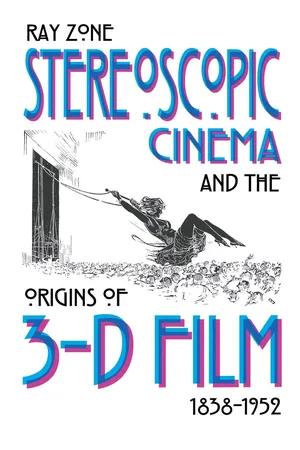
From stereoview cards to large-format IMAX films, 3-D technology's heightened realism and powerful visual allure have held audiences captive for over a century and a half. The technology, known as stereoscopy, creates an illusion of depth by presenting two slightly different images to the eye in print or on-screen. The advent of stereoscopic film technology excited both filmmakers and audiences, as a means of replicating all of the sounds, colors, movement, and dimensionality of life and nature for the first time. The origins of 3-D film are often linked with a proliferation of stereoscopic films in the 1950s. By the time films like Man in the Dark and House of Wax was attracting large crowds, however, the technology behind this form of filmmaking was already over a century old. Stereoscopic Cinema and the Origins of 3-D Film, 1838–1952, examines this "novelty period" of stereoscopic film, charting its progression from Charles Wheatstone's 1938 discovery of 3-D to the 1952 release of Arch Oboler's innovative film, Bwana Devil. Stereoscopic specialist Ray Zone argues that the development of stereoscopic film can best be understood through a historical analysis of the technology rather than of its inventors. Zone examines the products used to create stereoscopic images, noting such milestones as David Brewster's and Oliver Wendell Holmes's work with stereoscopes, the use of polarizing image selection, and the success of twin-strip 3-D films, among others. In addition, Zone looks at the films produced up to 1952, discussing public reception of early 3-D short films as well as longer features such as Power of Love in single-strip anaglyphic projection in 1922 and Semyon Ivanov's 1941 autostereoscope Robinson Crusoe. He integrates his examination of the evolution of 3-D film with other cinematic developments, demonstrating the connection between stereoscopic motion pictures and modern film production. Stereoscopic Cinema and the Origins of 3-D Film, 1838–1952, is an exhaustive study of not only the evolution of 3-D technology and the subsequent filmmaking achievements but also the public response to and cultural impact of 3-D movies. Zone takes the reader on a voyage of discovery into the rich history of a field that predates photography and that continues to influence television and computer animation today.
- 232 pages
- English
- ePUB (mobile friendly)
- Available on iOS & Android
eBook - ePub
Stereoscopic Cinema and the Origins of 3-D Film, 1838-1952
About this book
Information
Subtopic
Film Direction & ProductionTable of contents
- Cover
- Title Page
- Copyright Page
- Contents
- Foreword
- Acknowledgement
- Prologue
- 1. Stereography Begins
- 2. The Peep Show Tradition
- 3. Motion Pictures Begin
- 4. Stereoscopic Projection
- 5. Cinema’s Novelty Period
- 6. Public Exhibition of 3-D Films Begins
- 7. A Wave of Stereo
- 8. Essaying Utopia
- 9. Stereoscopic Cinema Proves Itself
- 10. The Stereoscopic Overture Finishes
- Epilogue
- Notes
- Index
Trusted by 375,005 students
Access to over 1.5 million titles for a fair monthly price.
Study more efficiently using our study tools.
Frequently asked questions
Yes, you can cancel anytime from the Subscription tab in your account settings on the Perlego website. Your subscription will stay active until the end of your current billing period. Learn how to cancel your subscription
No, books cannot be downloaded as external files, such as PDFs, for use outside of Perlego. However, you can download books within the Perlego app for offline reading on mobile or tablet. Learn how to download books offline
Perlego offers two plans: Essential and Complete
- Essential is ideal for learners and professionals who enjoy exploring a wide range of subjects. Access the Essential Library with 800,000+ trusted titles and best-sellers across business, personal growth, and the humanities. Includes unlimited reading time and Standard Read Aloud voice.
- Complete: Perfect for advanced learners and researchers needing full, unrestricted access. Unlock 1.5M+ books across hundreds of subjects, including academic and specialized titles. The Complete Plan also includes advanced features like Premium Read Aloud and Research Assistant.
We are an online textbook subscription service, where you can get access to an entire online library for less than the price of a single book per month. With over 1.5 million books across 990+ topics, we’ve got you covered! Learn about our mission
Look out for the read-aloud symbol on your next book to see if you can listen to it. The read-aloud tool reads text aloud for you, highlighting the text as it is being read. You can pause it, speed it up and slow it down. Learn more about Read Aloud
Yes! You can use the Perlego app on both iOS and Android devices to read anytime, anywhere — even offline. Perfect for commutes or when you’re on the go.
Please note we cannot support devices running on iOS 13 and Android 7 or earlier. Learn more about using the app
Please note we cannot support devices running on iOS 13 and Android 7 or earlier. Learn more about using the app
Yes, you can access Stereoscopic Cinema and the Origins of 3-D Film, 1838-1952 by Ray Zone in PDF and/or ePUB format, as well as other popular books in Media & Performing Arts & Film Direction & Production. We have over 1.5 million books available in our catalogue for you to explore.