Eastern Kentucky University (EKU) in Richmond, Kentucky, was originally established as a normal school in 1906 in the wake of a landmark education law passed by the Kentucky General Assembly. One hundred years later, the school has evolved into a celebrated multipurpose regional university that is national in scope.
The school was built on a campus that had housed Central University, a southern Presbyterian institution. In its early years, EKU grew slowly, buffeted by cyclical economic problems and the interruptions of two world wars. During that time, however, strong leadership from early presidents Ruric Nevel Roark, John Grant Crabbe, and Herman L. Donovan laid the groundwork for later expansions.
President Robert. R. Martin oversaw the rapid growth of the institution in the 1960s. He managed an increase in enrollment and he had additional facilities built to house and educate the growing student population. A savvy administrator, he was at the forefront of vocational education and initiated programs in nursing and allied heath and in law enforcement education. His successor, J.C. Powell, built on Martin's work and saw EKU mature as a regional university. He reorganized its colleges to better balance the needs of general and technical education students and kept educational programs going despite decreases in state funding.
In addition, Powell's years were a magical time for EKU's sports programs, as the Colonels captured national football championships in 1979 and 1982 and finished second in 1980 and 1981. Today, EKU continues to offer students a quality education and strives to meet the diverse needs of its student body. Three Eastern campuses, as well as distance learning programs through the Kentucky Telelinking Network, offer more options to students than ever before as EKU prepares them for the challenges of a new century.
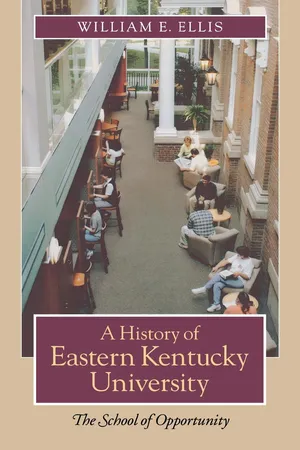
In A History of Eastern Kentucky University, William E. Ellis recounts the university's colorful history, from political quandaries surrounding presidential administrations and financial difficulties during the Great Depression to its maturing as a leading regional university. Interviews with alumni, faculty, staff, and political figures provide a personal side to the history of the school. Reflecting on the social, economic, and cultural changes in the region during the last century, Ellis's examination of the growth and development of EKU is an essential resource for alumni and for those interested in the progression of public higher education in Kentucky and the region.
- 324 pages
- English
- PDF
- Available on iOS & Android
eBook - PDF
About this book
Information
Topic
EducationSubtopic
Higher EducationTable of contents
- Cover
- Half-title
- Title
- Copyright
- Contents
- Foreword
- Preface
- 1. Center of a Storm: Kentucky Presbyterians, Central University, and American Higher Education
- 2. "The Best Is Hardly Good Enough": Founding a Normal School, 1906–1916
- 3. From Normal School to Teachers College, 1916–1928
- 4. The Donovan Years: Prosperity, Depression, and the Shadows of War, 1928–1941
- 5. Trials of War and Peace: The O'Donnell Years, 1941–1960
- 6. Robert R. Martin: "A Vision of Greatness," 1960–1976
- 7. J. C. Powell: The Maturing Years, 1976–1984
- 8. "To Make a Good University a Better One": The Funderburk Years, 1985–1998
- 9. Change, Controversy, and Continuity, 1998–Present
- Notes
- Index
Trusted by 375,005 students
Access to over 1.5 million titles for a fair monthly price.
Study more efficiently using our study tools.
Frequently asked questions
Yes, you can cancel anytime from the Subscription tab in your account settings on the Perlego website. Your subscription will stay active until the end of your current billing period. Learn how to cancel your subscription
No, books cannot be downloaded as external files, such as PDFs, for use outside of Perlego. However, you can download books within the Perlego app for offline reading on mobile or tablet. Learn how to download books offline
Perlego offers two plans: Essential and Complete
- Essential is ideal for learners and professionals who enjoy exploring a wide range of subjects. Access the Essential Library with 800,000+ trusted titles and best-sellers across business, personal growth, and the humanities. Includes unlimited reading time and Standard Read Aloud voice.
- Complete: Perfect for advanced learners and researchers needing full, unrestricted access. Unlock 1.5M+ books across hundreds of subjects, including academic and specialized titles. The Complete Plan also includes advanced features like Premium Read Aloud and Research Assistant.
We are an online textbook subscription service, where you can get access to an entire online library for less than the price of a single book per month. With over 1.5 million books across 990+ topics, we’ve got you covered! Learn about our mission
Look out for the read-aloud symbol on your next book to see if you can listen to it. The read-aloud tool reads text aloud for you, highlighting the text as it is being read. You can pause it, speed it up and slow it down. Learn more about Read Aloud
Yes! You can use the Perlego app on both iOS and Android devices to read anytime, anywhere — even offline. Perfect for commutes or when you’re on the go.
Please note we cannot support devices running on iOS 13 and Android 7 or earlier. Learn more about using the app
Please note we cannot support devices running on iOS 13 and Android 7 or earlier. Learn more about using the app
Yes, you can access A History of Eastern Kentucky University by William E. Ellis in PDF and/or ePUB format, as well as other popular books in Education & Higher Education. We have over 1.5 million books available in our catalogue for you to explore.