The Civil War and Reconstruction were characterized by two lasting legacies—the failure to bring racial harmony to the South and the failure to foster reconciliation between the North and South. The nation was left with a festering race problem, as a white-dominated society and political structure debated the +proper role for blacks. At the national level, both sides harbored bitter feelings toward the other, which often resulted in clashes among congressmen that inflamed, rather than solved, the race problem. No Congress expended more energy debating this issue than the Fifty-First, or "Billion Dollar," Congress of 1889-1891. The Congress debated several controversial solutions, provoking discussion far beyond the halls of government and shaping the course of race relations for twentieth-century America.
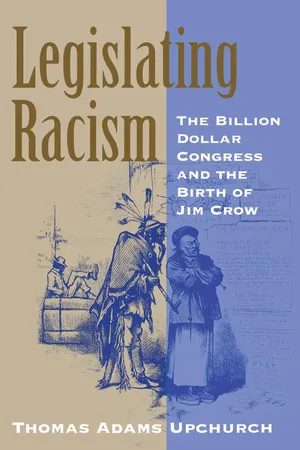
Legislating Racism proposes that these congressional debates actually created a climate for the first truly frank national discussion of racial issues in the United States. In an historic moment of unusual honesty and openness, a majority of congressmen, newspaper editors, magazine contributors, and the American public came to admit their racial prejudice against not only blacks, but all minority races. If the majority of white Americans—not just those in the South—harbored racist sentiments, many wondered whether Americans should simply accept racism as the American way. Thomas Adams Upchurch contends that the Fifty-First Congress, in trying to solve the race problem, in fact began the process of making racism socially and politically acceptable for a whole generation, inadvertently giving birth to the Jim Crow era of American history.
eBook - PDF
Legislating Racism
The Billion Dollar Congress and the Birth of Jim Crow
- 320 pages
- English
- PDF
- Available on iOS & Android
eBook - PDF
About this book
Information
Table of contents
- Cover
- Half-title
- Title
- Copyright
- Dedication
- Contents
- List of Illustrations
- Preface
- Introduction: The Grand Old Party Faces the Grand Old Problem
- Chapter 1. To Empty a Running Stream: The U. S. Senate Considers the Butler Emigration
- Chapter 2. To Drain the Infinite Oceans: The Swan Song of the Once-Great Blair Education Bill
- Chapter 3. Charting New Waters: The Race Problem and the "Reed Rules" in the House of Representatives
- Chapter 4. The Very Insanity of Democracy: The Federal Elections Bill and the Return to Reconstruction in the House of Representatives
- Chapter 5. Judging the Insanity: Public Reactions to the Inflammatory "Force Bill" and the Tyranny of the Majority
- Chapter 6. The Stormy and Turbulent Sea of Democratic Freedom: The Senate's Epic Struggle for Control of the Nation's Racial Destiny
- Chapter 7. Showdown on Capitol Hill: The Filibuster, the Cloture Rule, and the Defeat of the Federal Elections Bill
- Chapter 8. Silver, Sectionalism, Sioux Indians, and Sinophobia: Why Many Westerners Opposed the Federal Elections Bill
- Chapter 9. The "Peculiar Situation" of African Americans and Ethnic Minorities in the United States: How Racism Became Fashionable in the 1890s
- Conclusion: Assessing the Billion Dollar Congress and Its Effects on American History and Race Relations
- Notes
- Bibliography
- Index
Trusted by 375,005 students
Access to over 1.5 million titles for a fair monthly price.
Study more efficiently using our study tools.
Frequently asked questions
Yes, you can cancel anytime from the Subscription tab in your account settings on the Perlego website. Your subscription will stay active until the end of your current billing period. Learn how to cancel your subscription
No, books cannot be downloaded as external files, such as PDFs, for use outside of Perlego. However, you can download books within the Perlego app for offline reading on mobile or tablet. Learn how to download books offline
Perlego offers two plans: Essential and Complete
- Essential is ideal for learners and professionals who enjoy exploring a wide range of subjects. Access the Essential Library with 800,000+ trusted titles and best-sellers across business, personal growth, and the humanities. Includes unlimited reading time and Standard Read Aloud voice.
- Complete: Perfect for advanced learners and researchers needing full, unrestricted access. Unlock 1.5M+ books across hundreds of subjects, including academic and specialized titles. The Complete Plan also includes advanced features like Premium Read Aloud and Research Assistant.
We are an online textbook subscription service, where you can get access to an entire online library for less than the price of a single book per month. With over 1.5 million books across 990+ topics, we’ve got you covered! Learn about our mission
Look out for the read-aloud symbol on your next book to see if you can listen to it. The read-aloud tool reads text aloud for you, highlighting the text as it is being read. You can pause it, speed it up and slow it down. Learn more about Read Aloud
Yes! You can use the Perlego app on both iOS and Android devices to read anytime, anywhere — even offline. Perfect for commutes or when you’re on the go.
Please note we cannot support devices running on iOS 13 and Android 7 or earlier. Learn more about using the app
Please note we cannot support devices running on iOS 13 and Android 7 or earlier. Learn more about using the app
Yes, you can access Legislating Racism by Thomas Adams Upchurch in PDF and/or ePUB format, as well as other popular books in History & North American History. We have over 1.5 million books available in our catalogue for you to explore.