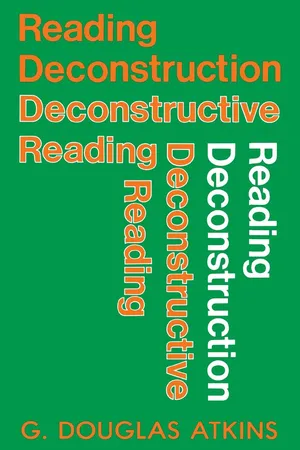
Deconstruction—a mode of close reading associated with the contemporary philosopher Jacques Derrida and other members of the "Yale School"—is the current critical rage, and is likely to remain so for some time. Reading Deconstruction / Deconstructive Reading offers a unique, informed, and badly needed introduction to this important movement, written by one of its most sensitive and lucid practitioners. More than an introduction, this book makes a significant addition to the current debate in critical theory.
G. Douglas Atkins first analyzes and explains deconstruction theory and practice. Focusing on such major critics and theorists as Derrida, J. Hillis Miller, and Geoffrey Hartman, he brings to the fore issues previously scanted in accounts of deconstruction, especially its religious implications. Then, through close readings of such texts as Religio Laici, A Tale of a Tub, and An Epistle to Dr. Arbuthnot, he proceeds to demonstrate and exemplify a mode of deconstruction indebted to both Derrida and Paul de Man. This skillfully organized book, designed to reflect the "both/ and" nature of deconstruction, thus makes its own contribution to deconstructive practice. The important readings provided of Dryden, Swift, and Pope are among the first to treat major Augustan texts from a deconstructive point of view and make the book a valuable addition to the study of that period.
Well versed in deconstruction, the variety of texts he treats, and major issues of current concern in literary study, Atkins offers in this book a balanced and judicious defense of deconstruction that avoids being polemical, dogmatic, or narrowly ideological. Whereas much previous work on and in deconstruction has been notable for its thick prose, jargon, and general obfuscation, this book will be appreciated for its clarity and grace, as well as for its command of an impressively wide range of texts and issues. Without taming it as an instrument of analysis and potential change, Atkins makes deconstruction comprehensible to the general reader. His efforts will interest all those concerned with literary theory and criticism, Augustan literature, and the relation of literature and religion.
- 172 pages
- English
- PDF
- Available on iOS & Android
eBook - PDF
Reading Deconstruction/Deconstructive Reading
About this book
Information
Publisher
The University Press of KentuckyYear
2014Print ISBN
9780813101651
9780813114934
eBook ISBN
9780813158341
Table of contents
- Cover
- Half-title
- Title
- Copyright
- Dedication
- Contents
- Preface
- Introduction
- Part One: Reading Deconstruction
- Part Two: Reading Deconstruction Becomes Deconstructive Reading
- Part Three: Deconstructive Reading
- Notes
- Index
Trusted by 375,005 students
Access to over 1.5 million titles for a fair monthly price.
Study more efficiently using our study tools.
Frequently asked questions
Yes, you can cancel anytime from the Subscription tab in your account settings on the Perlego website. Your subscription will stay active until the end of your current billing period. Learn how to cancel your subscription
No, books cannot be downloaded as external files, such as PDFs, for use outside of Perlego. However, you can download books within the Perlego app for offline reading on mobile or tablet. Learn how to download books offline
Perlego offers two plans: Essential and Complete
- Essential is ideal for learners and professionals who enjoy exploring a wide range of subjects. Access the Essential Library with 800,000+ trusted titles and best-sellers across business, personal growth, and the humanities. Includes unlimited reading time and Standard Read Aloud voice.
- Complete: Perfect for advanced learners and researchers needing full, unrestricted access. Unlock 1.5M+ books across hundreds of subjects, including academic and specialized titles. The Complete Plan also includes advanced features like Premium Read Aloud and Research Assistant.
We are an online textbook subscription service, where you can get access to an entire online library for less than the price of a single book per month. With over 1.5 million books across 990+ topics, we’ve got you covered! Learn about our mission
Look out for the read-aloud symbol on your next book to see if you can listen to it. The read-aloud tool reads text aloud for you, highlighting the text as it is being read. You can pause it, speed it up and slow it down. Learn more about Read Aloud
Yes! You can use the Perlego app on both iOS and Android devices to read anytime, anywhere — even offline. Perfect for commutes or when you’re on the go.
Please note we cannot support devices running on iOS 13 and Android 7 or earlier. Learn more about using the app
Please note we cannot support devices running on iOS 13 and Android 7 or earlier. Learn more about using the app
Yes, you can access Reading Deconstruction/Deconstructive Reading by George Douglas Atkins in PDF and/or ePUB format, as well as other popular books in Literature & Literary Criticism. We have over 1.5 million books available in our catalogue for you to explore.