To fully comprehend the Vietnam War, it is essential to understand the central role that southerners played in the nation's commitment to the war, in the conflict's duration, and in the fighting itself. President Lyndon B. Johnson of Texas and Secretary of State Dean Rusk of Georgia oversaw the dramatic escalation of U.S. military involvement from 1965 through 1968. General William Westmoreland, born and raised in South Carolina, commanded U.S. forces during most of the Johnson presidency. Widely supported by their constituents, southern legislators collectively provided the most dependable support for war funding and unwavering opposition to measures designed to hasten U.S. withdrawal from the conflict. In addition, southerners served, died, and were awarded the Medal of Honor in numbers significantly disproportionate to their states' populations.
In The American South and the Vietnam War, Joseph A. Fry demonstrates how Dixie's majority pro-war stance derived from a host of distinctly regional values, perspectives, and interests. He also considers the views of the dissenters, from student protesters to legislators such as J. William Fulbright, Albert Gore Sr., and John Sherman Cooper, who worked in the corridors of power to end the conflict, and civil rights activists such as Martin Luther King Jr., Muhammad Ali, and Julian Bond, who were among the nation's most outspoken critics of the war. Fry's innovative and masterful study draws on policy analysis and polling data as well as oral histories, transcripts, and letters to illuminate not only the South's influence on foreign relations, but also the personal costs of war on the home front.
eBook - ePub
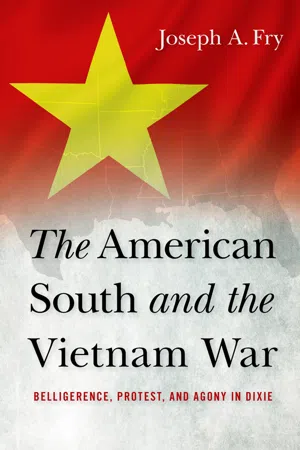
The American South and the Vietnam War
Belligerence, Protest, and Agony in Dixie
- 456 pages
- English
- ePUB (mobile friendly)
- Available on iOS & Android
eBook - ePub
About this book
Information
1
Regionalism, Southerners, and US Foreign Relations, 1789–1973
As southerners turned their attention to the American war in Vietnam in the two decades after 1953, they did so with a long history of responding to US foreign relations from a distinctly regional perspective. From the adoption of the Constitution in 1789 until at least the mid-1970s, the South was the nation’s most coherent and most self-conscious region. Over this span of nearly two centuries, southerners periodically exercised a significant, even decisive, influence over policy formation and implementation, while at other times, they served as the dissenting minority in the domestic negotiation of foreign policy. Southern influence was instrumental during the Jefferson-Jackson years, the Wilson administration, and the Johnson presidency, and in the nation’s decisions for war in 1812, 1846, 1917, and 1939–1941. Southerners adopted a largely oppositional posture during the 1790s and from 1865 through 1912.
The South, like other American regions, has exercised its greatest influence on US foreign policy formation during periods of one-party political dominance. In his political history of the South, Michael Perman has demonstrated convincingly that for most of the nation’s first 180 years Dixie persistently sought political “unity” rather than “competition between contending parties.” Only during the period from the late 1830s to the early 1850s did a viable two-party system exist, with the Whigs opposing the Jacksonian Democrats. Perman asserts that this largely solid political South functioned not just as a region but also as a “self-conscious interest group” until the mid-1970s. One-party dominance ensured repeated reelection for southern congressmen and senators. Their long and potentially more influential careers made southerners the majority congressional contingent, first with the Jeffersonians and then with the Democratic Party into the 1960s, and further augmented the South’s influence within a committee system that rewarded seniority. Dixie brought this same political leverage to bear on both foreign and domestic policy.1
Although white southerners exercised varying degrees of influence over US foreign policy at different historical junctures and never presented a completely united sectional perspective, they acted from a consistent set of regional assumptions and interests. These concerns and objectives included the fear of being a minority section and the defense of personal and regional independence; the protection of southern racial institutions, first slavery and after 1865 segregation and black disfranchisement; the pursuit of regionally beneficial economic interests, trade policies, and defense spending; a heightened sense of honor, manhood, and patriotism; the proclamation and practice after the Civil War of an increasingly emotional and evangelical religious faith; and the advancement of partisan political goals. By the eve of US entry into Vietnam, these regional assumptions and interests led the South to favor a unilateral and often interventionist foreign policy that was aggressively anticommunist, decidedly supportive of the military and the pursuit of peace through strength, and more inclined than other American regions to solve international problems through the use of force rather than diplomacy.
Southern African Americans added another important dimension to the South’s response to US foreign policy. Beginning with the Spanish-Cuban-American War of 1898, southern blacks pointedly noted the contradiction between the oppression of minorities at home and US foreign policies ostensibly devoted to the promotion of freedom and democracy abroad. Given their primary focus on domestic issues and post-1945 identification with people of color abroad, who were often seeking to escape from colonial control, African Americans were less rigidly anticommunist and less enthusiastic about US Cold War military interventions than their white neighbors.
As southerners joined other Americans in forming the new nation after 1776, they acted from an acute concern for individual, sectional, and ultimately national liberties. During the colonial period, southerners had equated political “liberty” with local control and had effectively established that control by expanding the powers of the lower houses of their colonial assemblies at the expense of British authorities. Dixie’s antebellum economic development reinforced the commitment to personal and regional autonomy. From the 1600s through the Civil War, the South emphasized the production and export of staple crops rather than the development of a more diverse and sophisticated industrial or technological infrastructure. This economic system left the South in a colonial relationship with the North and Great Britain—a relationship whose irritations were intensified by the experience of coping with the burden of debt and vagaries of international markets.2
Racial beliefs and the institution of slavery were intrinsically tied to the South’s staple agricultural economy and by extension to the determination to resist personal and regional dependence. From the 1790s until the Civil War, African American slaves constituted one-third of the South’s population and provided much of the labor crucial to Dixie’s agricultural prosperity. Owning slaves was widely identified with upward social mobility, and sectional well-being was tied to the institution’s westward expansion. Given the centrality of slavery to the southern economy and social system, defending the peculiar institution, often via the vehicle of states’ rights, commanded a high priority among southern leaders. According to Kenneth S. Greenberg, “From 1776 to 1860 the liberty white southerners celebrated always included the freedom to preserve the slavery of blacks.” Indeed, slavery, the mirror of image of liberty, the “condition most cherished by Southerners,” embodied a constant, graphic reminder of the dangers of dependence, oppression, and loss of freedom.3
For southern white men, avoiding dependence was crucial to safeguarding their honor and manhood. Southerners harbored an ardent concern for honor and its relation to demonstrated manhood, personal bravery, and devotion to family, region, and country. Antebellum southern men acted from a strong need for both a sense of self-worth and recognition of that worth by others. Real or perceived insults to one’s family or region were intolerable if honor were to be properly maintained. Physical assaults and murder were more common in the South than the North, and the all-too-frequent duels most often occurred “because one antagonist cast doubt on the manliness and bearing of the other.” Southern concern with “courage as a social value” and the “most efficacious means for exhibiting and defending personal, family, regional, and national honor” elevated military service to the level of planter, lawyer, or doctor among southerners. Albeit in altered forms, this southern commitment to the “ethic of honor” and the “warrior ethic” has exercised ongoing influence into the twenty-first century.4
These political, economic, and social experiences and assumptions rendered southerners particularly receptive to the ideology of “republicanism” with its emphasis on the maintenance of civic virtue and protection of political liberty. According to the proponents of republicanism, civic virtue existed only if citizens possessed economic, social, and political freedom, and those conditions were in turn dependent upon widespread ownership of property within an agricultural society. The more urban, more industrialized societies in Great Britain and New England, which ostensibly produced greater income disparities, impoverished factory workers, and more extreme concentrations of wealth, constituted the undesirable alternative. To avoid these social and political calamities, southerners such as Thomas Jefferson, James Madison, John Calhoun, John Tyler, and James K. Polk advocated the acquisition of new agricultural lands and markets to prolong the nation’s status as an overwhelmingly agrarian republic. Working from this ideological perspective, southern republicans also argued that centralized governmental authority (unless under Dixie’s direction!), standing armies, public debt, and bloated bureaucracies similarly threatened cherished liberties.5
With the Constitution of 1787 came a geopolitical framework that reinforced the South’s republicanism and self-conscious regionalism. According to Peter Onuf, both “before and after independence, vigilant republicans sought to guard against dangerous concentrations of power.” With no “great metropolis, a privileged central place,” that dominated the nation’s wealth and power, fears of outside oppression were “conceptualized in spatial, geographical terms.” Southerners and other Americans feared that essential equality within the nation could be destroyed by “selfish politicians” promoting “the parochial concerns of one region at the expense of others.” Southerners looked north for such threats after 1789 and simultaneously identified themselves and their region with legitimate unionism and national interests. It was their liberty, equality, independence, and right to own slaves that were synonymous with a correct reading of the Constitution, a healthy political economy, and a viable foreign policy. Domestic opponents and their alleged allies from abroad were all viewed as “foreigners” threatening southern, and by extension national, welfare.6
During the antebellum period, these ideological, racial, and economic perspectives and the resulting fear of dependence led Dixie’s leaders to champion aggressive territorial and commercial expansion and to denounce obstacles, either domestic or foreign, that impeded adding land and markets. Since Great Britain, given its domination of international trade and credit and its post-1783 military occupation of US territory and overtures to Native Americans, embodied the principal foreign obstacle, Anglophobia constituted another of the South’s guiding assumptions. And when Alexander Hamilton promoted a more urban, industrial, and pro-northern political economy, lobbied for a pro-British foreign policy, and organized the Federalist Party to realize these goals, southerners made partisan politics one of their ongoing foreign policy considerations. From the early 1790s through 1824, these political calculations led a decisive majority of southerners to back the Jeffersonian Republicans and their foreign policies.
Over the six decades from the ratification of the Constitution until the formation of the Confederacy, these collective southern perceptions and interests drove Dixie’s responses to US foreign policy. The search for markets and their crucial connection to building a viable political economy and securing true and honorable national independence led the Jeffersonians to war with Britain in 1812. Following several futile economic attempts to coerce the British into treating the United States more equitably, Madison and his party deemed war the only way to safeguard unrestrained American commerce and thereby safeguard national honor and independence. Congressman John Clopton of Virginia characteristically declared that the British “system of aggression” reached far beyond “certain rights of commerce” and raised the “question . . . whether the U. States are really an independent nation.” Secretary of State James Monroe agreed that since only “unconditional submission” would satisfy the British, “the only remaining alternative, was to get ready for fighting, and to begin as soon as we were ready.” Southerners were only too ready to fight. Exhibiting their typical “ideas of honor and the warrior ethic,” they rallied to the cause, as would subsequently be the case in 1846, 1861, 1898, 1917, 1941, 1950, and 1964–1965.7
Southerners also aggressively pursued landed expansion and with it the extension of slavery. Jefferson’s purchase of Louisiana epitomized this facet of a Dixie-based foreign policy. Most immediately Jefferson and residents of what would become the Deep South sought to ensure use of the Mississippi, Mobile, Pearl, and Tombigbee Rivers and access to markets through the Gulf of Mexico. In addition to furthering the agrarian pursuit of export markets, the vast expanse of territory seemed to guarantee a virtually unlimited supply of land for the maintenance of personal independence and the agrarian republic. Ironically, the construction of what Jefferson called the “empire for liberty” came at the expense of both Native Americans and African American slaves. Against a backdrop of precarious national strength and sovereignty in Kentucky, Tennessee, Georgia, and what would become the states of Alabama, Louisiana, and Mississippi, the Jefferson administration encouraged migration to establish a viable “American presence”; pushed for the displacement of Indians and began the “conversion of millions of acres” of their land into “marketable real estate”; and aided in the expansion and protection of slavery. The policies toward both Native Americans and slavery came in response to demands from southern whites, who exercised strong “local” influence over national policy in these areas where “federal authority remained contested.” Similar motives prompted Republican efforts to annex Florida, which was accomplished in 1819 under President James Monroe. A Mississippi editor summarized Dixie’s perspective nicely. Adding Florida, he said, “rounds off our southern possessions and for ever precludes foreign emissaries from stirring up Indians to war and negroes to rebellion, whilst it gives the southern country important outlets to the sea.”8
Significantly, Florida’s annexation occurred against the backdrop of General Andrew Jackson’s ruthless campaign to suppress Native Americans in the Southeast and, thereby, remove them as obstacles to the westward movement of the “Cotton Kingdom.” First as a military leader and subsequently as president, Jackson seized approximately 150 million acres from the Cherokees, Chickasaws, and Choctaws; forced some forty-six thousand Native Americans to move beyond the Mississippi River; and opened the lands to Anglo ownership, settlement, and cultivation. A similar imperial dynamic ensued in Arkansas and Texas from the 1830s through the mid-1870s at the expense of the Caddos, Wichitas, Commanches, and Kiowas.9
Since more than twice as many Native Americans lived in the South than in the North in 1815, these southern developments set the tone for US Indian policy. White southerners justified their territorial acquisitions with the racial argument that the allegedly inferior Indian savages were incapable of using the lands productively. As with Louisiana, these new territories also fit nicely into the republican ideological construct, which required new agricultural lands for sustaining the agrarian political economy and forestalling the growth of an industrial one. And southerners were fully cognizant of the potential political gains that could come from states organized in Mississippi, Alabama, Louisiana, Arkansas, and Texas. The editor of the Charleston Southern Patriot asserted that northern opposition to Indian removal derived from the recognition that it would “give the Southern and Southwestern states . . . an influence in the councils of the Nation which they do not now possess, while their territory is inhabited by savages.”10
Sectional political influence was at the heart of the debate in 1819–1820 over Missouri’s entry into the Union. The controversy arose when New York congressman James Tallmadge Jr. offered amendments aimed at blocking Missouri’s admission as a slave state. Northerners condemned slavery on humanitarian and moral grounds. They also objected to Dixie gaining greater political power in Congress, and, in so doing, challenged southern economic and political interests. For the first time since the American Revolution, territorial expansion threatened to come at the South’s expense. If a stronger federal government could bar slavery from Missouri, might the peculiar institution be banned from the remainder of the Louisiana Purchase and the states to be formed in the wake of Indian removal? But more than Dixie’s economic and political welfare was at stake. Southern honor and liberty were also imperiled. In the midst of this “rhetorical civil war,” Freeman Walker of Georgia warned, “To expect such submission from the free born sons of America, upon whose birth the genius of liberty smiled, . . . ’Tis to expect from freemen the conduct of slaves.” Although the crisis was resolved temporarily by the simultaneous admission of Maine as a free state and Missouri as a slave state, there followed a forty-year “imperial competition” between the North and South over control of the New West—a competition that in many ways embodied dueling foreign policies regarding slavery.11
Although slavery moved to the forefront of Dixie’s foreign policy calculations after 1820, southerners had consistently assessed the institution’s well-being while responding to diplomatic issues after 1789. Among southern objections to the Jay Treaty of 1795 was its failure to secure compensation for slaves confiscated or freed by the British during the Revolutionary War. Protecting slavery had augmented southern enthusiasm for acquiring Louisiana. Madison explained that an ongoing French presence on the nation’s western border would have created “inquietude . . . in the Southern States, whose numerous slaves [had] been taught to regard the French as patrons of their cause.” Stifling black slaves’ aspirations for freedom also prompted Dixie’s hostile response to the successful revolt in Santo Domingo (later renamed Haiti) by former black slaves against French colonial control in 1791. President George Washington found it “lamentable to see such a spirit of revolt among the Blacks” and worried that the revolt could “prove not a very pleasing or agreeable example” for bondsmen in the South. Congressman John W. Epps of Virginia stated flatly, “The Negro government should be destroyed.” Yet another invidious example of free black people on Dixie’s border augmented the southern quest to acquire Florida, since its annexation would eliminate the “underground railroad” that enabled runaway slaves to take refuge among the Seminoles.12
Both slavery and the ideology of republicanism figured prominently in ...
Table of contents
- Cover
- Half title
- Title
- Copyright
- Dedication
- Contents
- List of Abbreviations
- Introduction
- 1. Regionalism, Southerners, and US Foreign Relations, 1789–1973
- 2. Southerners and the Vietnam Commitment, 1953–1964
- 3. Southerners and the Decisions for War, 1965–1966
- 4. Southern Soldiers
- 5. Southerners and the Debate over the War’s Conduct, 1967
- 6. Southerners and the Decisions to Withdraw from Vietnam, 1968–1970
- 7. Southern College Students
- 8. Southerners and the End of the Vietnam War, 1971–1973
- Acknowledgments
- Notes
- Bibliographic Essay
- Index
Trusted by 375,005 students
Access to over 1.5 million titles for a fair monthly price.
Study more efficiently using our study tools.
Frequently asked questions
Yes, you can cancel anytime from the Subscription tab in your account settings on the Perlego website. Your subscription will stay active until the end of your current billing period. Learn how to cancel your subscription
No, books cannot be downloaded as external files, such as PDFs, for use outside of Perlego. However, you can download books within the Perlego app for offline reading on mobile or tablet. Learn how to download books offline
Perlego offers two plans: Essential and Complete
- Essential is ideal for learners and professionals who enjoy exploring a wide range of subjects. Access the Essential Library with 800,000+ trusted titles and best-sellers across business, personal growth, and the humanities. Includes unlimited reading time and Standard Read Aloud voice.
- Complete: Perfect for advanced learners and researchers needing full, unrestricted access. Unlock 1.5M+ books across hundreds of subjects, including academic and specialized titles. The Complete Plan also includes advanced features like Premium Read Aloud and Research Assistant.
We are an online textbook subscription service, where you can get access to an entire online library for less than the price of a single book per month. With over 1.5 million books across 990+ topics, we’ve got you covered! Learn about our mission
Look out for the read-aloud symbol on your next book to see if you can listen to it. The read-aloud tool reads text aloud for you, highlighting the text as it is being read. You can pause it, speed it up and slow it down. Learn more about Read Aloud
Yes! You can use the Perlego app on both iOS and Android devices to read anytime, anywhere — even offline. Perfect for commutes or when you’re on the go.
Please note we cannot support devices running on iOS 13 and Android 7 or earlier. Learn more about using the app
Please note we cannot support devices running on iOS 13 and Android 7 or earlier. Learn more about using the app
Yes, you can access The American South and the Vietnam War by Joseph A. Fry in PDF and/or ePUB format, as well as other popular books in History & North American History. We have over 1.5 million books available in our catalogue for you to explore.