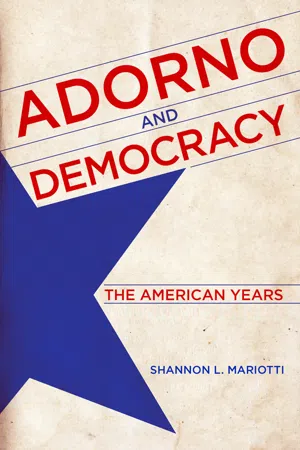
German philosopher and social critic Theodor Adorno (1903–1969) is widely regarded as one of the twentieth century's most influential thinkers. A leading member of the Frankfurt School, Adorno advanced an unconventional type of Marxist analysis in books such as Dialectic of Enlightenment (1944), Minima Moralia (1951), and Negative Dialectics (1966). Forced out of Nazi Germany because of his Jewish heritage, Adorno lived in exile in the United States for nearly fifteen years. In Adorno and Democracy, Shannon Mariotti explores how this extended visit prompted a concern for and commitment to democracy that shaped the rest of his work.
Mariotti analyzes the extensive and undervalued works Adorno composed in English for an American audience and traces the development of his political theory during the World War II era. Her unique study examines how Adorno changed his writing style while in the United States in order to directly address the public, which lay at the heart of his theoretical concerns. Despite his apparent contempt for popular culture, his work during this period clearly engages with a broader public in ways that reflect a deep desire to understand the problems and possibilities of democracy as enacted through the customs and habits of Americans. Ultimately, Adorno advances a theory of democratic leadership that works through pedagogy to cultivate a more robust and meaningful practice of citizenship.
Mariotti incisively demonstrates how Adorno's unconventional and challenging interpretations of US culture can add conceptual rigor to political theory and remind Americans of the normative promise of democracy. Adorno and Democracy is an innovative contribution to critical debates about contemporary US politics.
- 234 pages
- English
- ePUB (mobile friendly)
- Available on iOS & Android
eBook - ePub
About this book
Information
Topic
PhilosophySubtopic
Political Philosophy1
Seeing the Large-Scale System
The Pathologies of Modern America and Pseudo-Democracy
The American attack on democracy usually takes place in the name of democracy.
—Adorno, The Psychological Technique of
Martin Luther Thomas’ Radio Addresses
Martin Luther Thomas’ Radio Addresses
Scholars have struggled over how best to characterize Adorno’s complicated relationship with the United States, an area of research that has gained increased attention in recent years.1 Adorno is best known for his sharp criticisms of the alienation, reification, monopolization, commodification, and homogenization defining American culture under modern capitalism. After returning to Germany, however, he had more positive things to say about American democracy.2 Scholars have not yet found a good way to account for these mixed messages. A sense still lingers that Adorno ultimately presents two very different visions of America: one early and one late, one positive and one negative, one developed during his time in the United States and one expressed after the return to Germany.3 Even when students of Adorno emphasize the dialectical aspects of his time in America and Germany and the interconnected nature of his writings on these two countries, they generally do not explain the relationship between the starkly negative statements he makes about totalitarianism, modernity, and the culture industry in the United States and the surprisingly positive comments he makes about the democratic spirit of everyday customs and substantive democratic forms in this country.4 As Claus Offe says, “As far as I am aware . . . Adorno never made a single statement casting light on this complete turn-around in his perceptions of America.”5 There may not be one single statement that captures the complexity of Adorno’s thoughts on democracy in America. Indeed, it may take a whole book to do that: this one attempts to provide just that kind of broad and deep analysis to help us fully understand his attitude toward and relationship with the United States.
This book situates Adorno’s writings on the United States within his (interrelated) thoughts on negative dialectics and democracy and shows how his early and late writings on America represent different moments of the same overall critique. But to see this larger picture, we need to piece together a diverse body of writings that are relevant to democracy and written in America. We can take in the whole picture, in its consistency, only when we parse it out moment by moment. This book, chapter by chapter, undertakes that project, piecing together the constellation of concepts that runs throughout Adorno’s writings. Ultimately, as Adorno and Democracy illustrates, we see the sympathies between his seemingly diverse writings only when we appreciate them as different moments in his overarching project: a plan for democratic leadership in the form of democratic pedagogy.
This chapter takes up the first moment of Adorno’s critique. Here he discusses the de-democratizing forces in World War II–era America that impoverish citizens’ practice of autonomy, describing the problems his political project will address and seek to work against. This chapter gives a sense of how Adorno portrayed the landscape of the United States to its own citizens, writing in English in a more accessible register, to explore the forces undermining meaningful democracy in an ostensibly democratic nation. All the writings I focus on here to lay out the forces working against American democracy in the postwar era—Current of Music, The Psychological Technique of Martin Luther Thomas’ Radio Addresses, and The Stars Down to Earth—are also analyzed in the final chapter, where I show how Adorno draws from these same texts to illuminate other forces working for American democracy. The first and the last chapter of the book, then, operate as bookends to each other: this one draws from Adorno’s American texts to lay out the “problem,” whereas the final chapter draws from the same texts to describe his “solution.”
But here I explore only Adorno’s discussions of de-democratizing factors, to set the stage for the later chapters and to give a sense of the particular problems that his project for democratic leadership in the form of democratic pedagogy works to address. Focusing only on the negative parts of Adorno’s descriptions of life in America, this chapter presents a portrait of him that is far more familiar than the picture that will be sketched out in the subsequent chapters. The descriptions of American pathologies found here are not novel, but, in most ways, they mirror the portraits of late capitalist modernity that we see in Minima Moralia: Reflections from Damaged Life and Dialectic of Enlightenment, both of which were also composed during Adorno’s years in the United States and meditate on the surrounding culture.
The key difference between the texts analyzed here, though, and works like Dialectic of Enlightenment concerns language and audience. The writings I study in this chapter were all composed in English, written in a more accessible style, and seem to be directed toward a broader cross-section of American readers, whereas Minima Moralia and Dialectic of Enlightenment were composed in German, directed toward a primarily German audience, and written in a more explicitly theoretical and academic register. And though all Adorno’s writings quite consistently practice the same method of negative dialectics, sometimes in a nascent form, his English-language compositions are notable because of how they amplify and elaborate on the productive and positive moments of his critique. This is understandable given his audience: Adorno is explicitly seeking to critique and inform the practice of American democracy in a more immediate way.
In each of the three texts I analyze here, Adorno, despite focusing on different cultural objects of analysis, gives the same general diagnosis of the social, political, and economic landscape of the United States. Various aspects of modern life in America, ranging from capitalism to liberalism to the culture industry, combine to make individuals feel small, disempowered, dependent, like passive objects who must adapt and accommodate to existing social molds and forms rather than being active subjects who feel that they have the agency to participate in shaping the patterns of their own lives. Though Adorno’s unique conception of democracy will be developed throughout the coming chapters, here it is important to note that he measures its vitality and authenticity in relation to the lived experience of citizens. Democracy, for Adorno, is defined in terms of how robustly ordinary people are willing and able to think and feel against the conditions they are given as natural and inevitable. This change in perception fosters a way of experiencing the world that is more autonomous, critical, and compassionate and—ideally—works toward building alternative forms of collective life that better reflect these values and more truly fulfill the promises of self-government, popular sovereignty, and empowering the people.
Adorno explores the de-democratizing factors of World War II–era America through an analysis of specific cultural objects. He sees the form of radio, the content of radio, and a weekly astrology column as ordinary, everyday objects that, like monads, reflect the larger tendencies of the social whole. So he analyzes these specific things with a microscopic gaze to draw wider conclusions about the patterns and dynamics of everyday life in the United States. But he undertakes this study to draw out the tensions, contradictions, and antagonisms that reside within these particular cultural objects. Fractures in the seemingly smooth surface of the world we are given testify that it contains alternative possibilities that may be amplified through critical analysis. Adorno’s method focuses on highlighting these contradictions and drawing out the productively disruptive qualities that can work to unsettle the problematic status quo. As he says, “We do not want to systematize what may be disorderly. We do not want to harmonize what may be discordant. Our set of categories may contain contradictions, but we hold . . . that these contradictions in the categories express contradictions in the subject matter itself and, in the last analysis, contradictions in our society.”6 This method of drawing out tensions and antagonisms that testify to alternative possibilities is part of the practice of negative dialectics. Later chapters will focus more on the productive countertendencies that Adorno identifies within his chosen cultural objects, whereas this chapter centers on painting a portrait of the pathological aspects of what Adorno elsewhere calls “damaged life” and “wrong life,” with a particular focus on the obstacles they pose to his ideal of democracy.
Radio and Current of Music
“The Radio Generation”
In his writings on radio, Adorno draws a picture of modern capitalism that emphasizes several familiar critiques. He expresses concern about how commodities and profits outweigh satisfying human wants and needs and how the fruits of production are kept private instead of being made available for common benefit. Standardization, monopolization, and the concentration of capital make the market anything but free. Production forces and capabilities are “fettered” by the profit-oriented relations of production, which create contradictions and “antagonisms” in the economic as well as the cultural sphere, “where they are less easily recognized.”7 Modern capitalism is also characterized by the ever-extending reach of the market. Even something as “ethereal and sublime” as music—which Adorno describes as “a human force”—has become part of the capitalist mode of production: it is commodified, standardized, and “consumed like other consumer goods.” Indeed, he notes that “ethereal and sublime” have become “trademarks.”8
Modern capitalism also forces individuals to adapt to its demands, to become dependent objects rather than autonomous subjects in the various spheres of their lives. Employees must fit themselves into the rhythms and logics of the job. The workplace “no longer permits ‘practice’ or ‘experience’ in the old sense,” but, rather, a “single path leads from the conveyer belt via the office machine to the ‘capturing’ of spontaneous intellectual acts through reified, quantified processes.”9 In other words, any nonidentical elements that the individual initially brings to his or her work that don’t fit into the mechanics of the workplace are soon tamed anyway, smoothed out, forgotten, left behind.
People must adapt to the workplace but also to their “objects of action,” to their “everyday devices.”10 The objects we use, Adorno says, shape how we move through our days, how we operate our bodies, and—given the strong connections between body and mind that Adorno asserts—they also shape how we feel and how we think. Commodities that were created on the basis of a profit motive in the first place come to have a power over us, exert agency, and demand accommodation. We become the tools of our tools, as Thoreau would say, or our commodities become like a fetish, as Marx would say.
But even when we clock out, we don’t leave behind this system that forces us to adapt, to fit ourselves into its premade forms. Given the way the culture industry works, the patterns and practices that characterize capitalism also shape leisure pursuits. For example, Adorno characterizes listening to popular music as “a perpetual busman’s holiday.”11 A busman’s holiday is a vacation that follows the pattern of one’s regular job, in which one essentially does the same things one does while one is at work: a bus driver also rides a bus when he or she goes on vacation. Leisure activities, such as listening to popular music, are supposed to be a break from “work.” But popular music appeals to the kind of consumer that capitalism has created. It reaches out to individuals who are in a “distracted” and “inattentive” frame of mind, which it then feeds and reinforces. The “whole sphere of cheap commercial entertainment” is “patterned and pre-digested,” making people passive consumers instead of active participants in ways that reflect larger political and economic trends, while also providing an “escape from the boredom of mechanized labor.”12 This may just seem like “giving people what they want,” but from Adorno’s perspective, their very desires are constructed by the dominant mode of production. People are “kneaded” by the same mode of production that inculcates them with a desire for the products that create profits for industry. In this way, music is part of the dominant ideology, “social cement” that adjusts people until they fit into the “mechanisms” of everyday life.13
All these tendencies toward standardization, commodification, consumption, adaptation, and reification that characterize modern capitalism generally and are evident in the cultural monad of radio also, of course, shape the development of the self. Indeed, Adorno sees the radio as so strongly reflective of dominant strains of World War II–era culture in the United States that he speaks of “a new type of human being” and dubs it “the radio generation.” He is concerned especially with all the ways that this culture issues imperatives for adaptation, adjustment, and accommodation, with the ways people are being made into what Marcuse called “one-dimensional” beings, adjusting to the mold of mainstream culture without even the internal struggle against civilization that Freud assumed (and saw as the root of our neuroses). Adorno worries that people are actually not neurotic enough any more, because neuroses are formed through the tensions and antagonisms that are developed through resistance to social imperatives, and that resistance is waning. Instead, as Adorno describes in Minima Moralia and as I discuss in greater depth in chapter 3, the unique form of alienation that characterizes postwar America is not experienced in terms of sadness or anxiety, but as a compulsory happiness, a determined cheerful normality. For the radio generation, “happiness consists mostly in integrating, in having the abilities that everyone has and doing what everyone does.”14 The elements of the self that could resist “what is” are weakened from disuse and are in danger of atrophying. The individual of the radio generation does not have direct, immediate experiences of life, but “rather lets the all-powerful, opaque social apparatus dictate all experiences to him, which is precisely what prevents the formation of an ego, even of a ‘person’ at all.”15
Society molds the individual directly and even the family fades into the background and no longer operates as a mediating force separating the individual from society. But the “dwindling” of the authority of the family is not figured as progress or liberation. Rather, “the immediately palpable domination of the individual by society, without any intermediary, is so profound that in a deeper layer of its consciousness, the child growing up ‘authority-less’ is probably even more fearful than it ever was in the good old days of the Oedipus complex.”16 If you don’t even recognize an authority as authority, how can you question it? Adorno is worried that members of the radio generation just unblinkingly accept their conditions as ...
Table of contents
- Cover
- Half title
- Title
- Copyright
- Dedication
- Contents
- Preface
- Introduction: Another Adorno
- 1. Seeing the Large-Scale System: The Pathologies of Modern America and Pseudo-Democracy
- 2. Experience as a Precondition for Meaningful Democracy: Sensory Perception, Affect, and Materialism
- 3. Critique and the Practice of Democracy: Negative Dialectics, Autonomy, and Compassion
- 4. Democratic Leadership: Egalitarian Guidance and a Plan for Empowering the People
- 5. Democratic Pedagogy: Resistance and an Alternative Model for Civic Education
- 6. Seeing Small-Scale Resistance: Turning Countertendencies into Vaccines to Strengthen Democratic Practice
- Conclusion: Adorno and A Postcapitalist Politics
- Acknowledgments
- Notes
- Bibliography
- Index
Trusted by 375,005 students
Access to over 1.5 million titles for a fair monthly price.
Study more efficiently using our study tools.
Frequently asked questions
Yes, you can cancel anytime from the Subscription tab in your account settings on the Perlego website. Your subscription will stay active until the end of your current billing period. Learn how to cancel your subscription
No, books cannot be downloaded as external files, such as PDFs, for use outside of Perlego. However, you can download books within the Perlego app for offline reading on mobile or tablet. Learn how to download books offline
Perlego offers two plans: Essential and Complete
- Essential is ideal for learners and professionals who enjoy exploring a wide range of subjects. Access the Essential Library with 800,000+ trusted titles and best-sellers across business, personal growth, and the humanities. Includes unlimited reading time and Standard Read Aloud voice.
- Complete: Perfect for advanced learners and researchers needing full, unrestricted access. Unlock 1.5M+ books across hundreds of subjects, including academic and specialized titles. The Complete Plan also includes advanced features like Premium Read Aloud and Research Assistant.
We are an online textbook subscription service, where you can get access to an entire online library for less than the price of a single book per month. With over 1.5 million books across 990+ topics, we’ve got you covered! Learn about our mission
Look out for the read-aloud symbol on your next book to see if you can listen to it. The read-aloud tool reads text aloud for you, highlighting the text as it is being read. You can pause it, speed it up and slow it down. Learn more about Read Aloud
Yes! You can use the Perlego app on both iOS and Android devices to read anytime, anywhere — even offline. Perfect for commutes or when you’re on the go.
Please note we cannot support devices running on iOS 13 and Android 7 or earlier. Learn more about using the app
Please note we cannot support devices running on iOS 13 and Android 7 or earlier. Learn more about using the app
Yes, you can access Adorno and Democracy by Shannon L. Mariotti in PDF and/or ePUB format, as well as other popular books in Philosophy & Political Philosophy. We have over 1.5 million books available in our catalogue for you to explore.