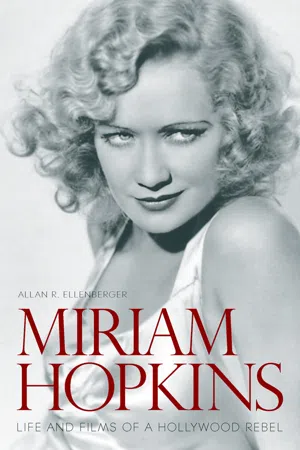
Miriam Hopkins (1902–1972) first captured moviegoers' attention in daring precode films such as Dr. Jekyll and Mr. Hyde (1931), The Story of Temple Drake (1933), and Ernst Lubitsch's Trouble in Paradise (1932). Though she enjoyed popular and critical acclaim in her long career—receiving an Academy Award nomination for Becky Sharp (1935) and a Golden Globe nomination for The Heiress (1949)—she is most often remembered for being one of the most difficult actresses of Hollywood's golden age. Whether she was fighting with studio moguls over her roles or feuding with her avowed archrival, Bette Davis, her reputation for temperamental behavior is legendary.
In the first comprehensive biography of this colorful performer, Allan R. Ellenberger illuminates Hopkins's fascinating life and legacy. Her freewheeling film career was exceptional in studio-era Hollywood, and she managed to establish herself as a top star at Paramount, RKO, Goldwyn, and Warner Bros. Over the course of five decades, Hopkins appeared in thirty-six films, forty stage plays, and countless radio programs. Later, she emerged as a pioneer of TV drama. Ellenberger also explores Hopkins's private life, including her relationships with such intellectuals as Theodore Dreiser, Dorothy Parker, Gertrude Stein, and Tennessee Williams. Although she was never blacklisted for her suspected Communist leanings, her association with these freethinkers and her involvement with certain political organizations led the FBI to keep a file on her for nearly forty years. This skillful biography treats readers to the intriguing stories and controversies surrounding Hopkins and her career, but also looks beyond her Hollywood persona to explore the star as an uncompromising artist. The result is an entertaining portrait of a brilliant yet underappreciated performer.
- 424 pages
- English
- ePUB (mobile friendly)
- Available on iOS & Android
eBook - ePub
About this book
Information
Subtopic
Social Science Biographies1
“From a Fine Old Family”
Miriam Hopkins’s elitist ancestral legacy wasn’t as important to her as it was to her self-admitted southern belle mother, Ellen Dickinson Cutter Hopkins. Mrs. Hopkins spent years of arduous work in the Bainbridge, Georgia, and New York chapters of the United Daughters of the Confederacy. Also, she was a member of the Dixie Club and the Society of Virginia Women. But try as she might, no amount of persuasion could get Miriam to those meetings. Miriam never argued; she just didn’t show up.
Mrs. Hopkins admitted that aside from her genuine love for these organizations, she had another motive for wanting Miriam to attend: to establish the southern background of her daughter-the-actress and to show her to the public as a real person, with a heritage she could feel the greatest pride in. But none of that mattered to Miriam.
So, Mrs. Hopkins took it upon herself to enhance Miriam’s publicity, or at least try to. Going to the mogul himself, Mrs. Hopkins enlightened Paramount’s Adolph Zukor about her family’s southern heritage—she, for example, was a trained singer and pianist—and added that she was from a “fine old family” and, as Miriam recalled, other “such rubbish!”
At last, Miriam had had enough. She told her mother that if she ever darkened Paramount’s door again—on either coast—she would stop paying her monthly stipend. But it was of no consequence. Mrs. Hopkins called Miriam “an unnatural daughter,” asserting “God would take care” of her.
“I wish to Christ he would,” Miriam muttered.1
Truthfully, Miriam—between shouting matches with reporters and being a no-show for interviews—cared little about her publicity. According to whether she selected her most picturesque past residence, she would say her birthplace was either Bainbridge or the actual city of her birth, Savannah. But even then, the facts would get muddled.
She once claimed that she was “born in Savannah in a brick house on Gordon Street”—the same type of house as those “charming old brownstone fronts” in New York—facing a park. Miriam did indeed live in a brick house on Gordon Street—221 East Gordon Street overlooking Calhoun Square—but she was not born there. The Gordon Street house was the last of several in Savannah that her relatives occupied before she moved to the town of Bainbridge in southern Georgia in 1912, with her mother, sister, and grandmother.2
Miriam was born at 307 East Jones Street, four short blocks away from the Gordon Street house. On that eventful day, October 18, 1902, Savannah’s tree-lined streets of hanging moss shook as a moderate earthquake, centered along the east side of Rocky Face Mountain in North Carolina, rumbled across the Southeast. The sharp jolt rattled a few nerves, much as Miriam Hopkins would during her lifetime.
As a young girl, her parents divorced, and in her father’s absence, her dominant mother and grandmother raised her and her older sister, Ruby. Despite that, or maybe because of it, family duty—and not love of family—ruled her life, be it out of responsibility, pride, or some unfathomable instinct.
Decades later, in a moment of insight, Miriam would admit her true feelings. Author George Eells recalled that as she looked back on her life, it seemed that all her “nonstop talking, all her achievements as an actress, all the houses she had bought and furnished” had been unconscious attempts to “show Daddy what a marvel she was” and to bring the family together again. However, by then it was too late. The damage was done.3
Miriam Hopkins’s maternal lineage goes back to Londoner Charles Dickinson and his three sons, Walter, Henry, and John. The three brothers immigrated to America in 1653, settling in Carolina County, Virginia, and Talbot County, Maryland. Miriam is descended from Walter, whose great-grandson was John Dickinson, a distinguished figure in the American Revolution, a signer of the Constitution, and the writer of the petition to King George III urging redress of grievances for the colonies (for those who remember their high school history).
James Edward Dickinson, Miriam’s great-grandfather, was born at Berry Plain, Virginia, in 1822. His wife, Ellen Carmichael Middleton, of Fredericksburg, Virginia, was a descendant of Arthur Middleton, a signer of the Declaration of Independence. While serving in the Civil War as a Confederate major, Dickinson fell in love with the Georgia countryside. Once the war ended, he left his home, “Moon Mount,” on Virginia’s Rappahannock River, and built a large house in Bainbridge, the county seat of Georgia’s Decatur County. In 1867, he was elected as the city’s fourth mayor, and he held that office for two terms.4
Five Dickinson children survived to adulthood. Miriam’s grandmother, Mildred Middleton Dickinson, was the eldest. Born in Fredericksburg in 1847, she was twenty years old when she married George Wilmer Hines, a prominent Bainbridge lawyer. Their son, future writer and drama critic, George Jr., was born in 1872 and grew up with the nickname Dixie. Seven weeks after his birth, his father was killed in a freak accident, leaving Mildred a widow. Six years later, she married Yale-educated attorney Ralph Hastings Cutter.5
The family of the Kentucky-born Cutter, Miriam’s maternal grandfather, made their fortune distilling J. H. Cutter Old Bourbon, an incredibly popular brand of whiskey. At age fourteen, Cutter returned with his family to their New England roots at Hollis, New Hampshire. There, bouts of depression and anxiety plagued Cutter throughout his teenage years, landing him in asylums.
In adulthood, Cutter graduated from Yale and passed the bar. He spent several months in Boston before moving to Bainbridge, where he opened a law practice. Not long after, he met the widow Mildred Hines, and they married on February 21, 1878, at St. John’s Episcopal Church.
That autumn, Cutter accepted a law partnership in Barnesville, Georgia, a town two hundred miles north of Bainbridge. There, on November 29, 1878, Mildred gave birth to twins: John Hastings Cutter and Ellen Dickinson Cutter, Miriam’s mother. Five months later, the Cutters returned to Bainbridge, where Ralph resumed his law practice.
To pass the time during Cutter’s repeated absences, Mildred wrote and had published several books of poetry and edited a poetry page for the nation’s first mass-market magazine, Munsey’s Weekly. While Cutter’s visits to Bainbridge were infrequent, the couple found time to conceive daughters Raymonde and Ruby Hollis. Ruby Hollis died at the age of two, in 1886. Deeply affected by her death, Cutter committed himself to a hospital in Pepperell, Massachusetts.6
Between his bouts of depression and melancholia, Cutter functioned normally, practicing law at locations in the South and New England, while Mildred and the children lived quietly in Bainbridge. She continued her writing endeavors, as their son John engaged in mercantile work and Ellen grew into a lovely young woman. Gifted with a beautiful voice, Ellen attended Boston’s New England Conservatory of Music for one semester.7
Before returning to Bainbridge, Ellen visited her half-brother Dixie in Savannah, where he was a partner in an insurance agency with Homer Ayres Hopkins, a young man he had met on a train some time earlier. A Pennsylvania-born Yankee, Homer was the son of Isaac Hopkins, a foundry worker from Clearfield County and a former Union Army soldier, and Mary Ann Glenn, a young woman of French descent.8
Homer was fond of this attractive, blue-eyed, southern belle. After a short engagement, the couple married on December 28, 1898, in Savannah’s historic Christ Church. Several months after the April 1, 1900, birth of their first daughter, Ruby, named after Ellen’s deceased youngest sister, Homer sold his share of the agency back to Dixie and was employed by an insurance company in Jacksonville, Florida.9
That city was not what Homer expected. Also, Ellen was both pregnant and homesick. After a brief stay in Jacksonville, the Hopkins returned to Savannah and moved in with Mildred at 212 East Gaston Street. Within days, Homer was working as a clerk for the local office of the New York Life Insurance Company.
Once they were financially stable, they rented the house on East Jones Street, sharing it with Ellen’s twin brother, John, and their younger sister, Raymonde. It was here that Ellen Miriam Hopkins was born. She was baptized at Savannah’s St. John’s Church.
By all outward appearances, the Hopkins were a happy, loving family, but Ellen’s domineering nature was chipping away at their marriage. Many believed the arrival of the new baby would bring them closer. Their arguments centered on money: the lack of it and the necessity of living in a crowded brownstone with Ellen’s siblings. After each fight, Ellen, her mother, and sometimes her sister would sweep the girls off to Bainbridge. After a cooling off period, they would return to Savannah.
As for Ralph Cutter, he didn’t attend his daughter’s wedding, nor was he there for the births of his two granddaughters. By 1898, Cutter was a patient at the Foxboro State Hospital in Massachusetts, where they treated psychiatric disorders. There, doctors diagnosed him with “nervous dyspepsia and involution melancholia,” which today would be the same as advanced anxiety and depression. By then, Mildred and the children had abandoned him. When questioned for the 1900 census, Mildred gave her marital status as “widowed”; to her, Ralph was dead. In the late nineteenth century, the stigma of an institutionalized relative was tremendous, and most traditional southern families did not acknowledge them.10
As the new century began, Cutter’s doctor transferred him to Massachusetts’s infamous Taunton Lunatic Hospital, where Cutter died from complications of a stroke on February 20, 1904. They sent his body not to the Dickinson plot in Bainbridge but to Hollis, where his brothers buried Ralph next to his parents.11
As a child, Miriam, whom they called Mims, was like a miniature version of her mother: petite, with curly, platinum blonde hair, blue eyes, and a peaches-and-cream complexion. To her older sister, Ruby, she was her “private doll … so cunning-looking the other kids would pull her curls and things,” and if another child touched her, Ruby would knock them down. Because of these brawls, the other parents no longer allowed their children to play with Ruby and insisted she go to reform school. Ellen, nonetheless, blamed everything on Miriam. Ruby maintained that her mother was at fault for dressing “Mims in all those dainty dresses with sashes and bows like that.”12
Savannah, Georgia’s oldest city, held many childhood memories. Some were pleasant, such as sitting on the banks of the yellow Savannah River, gazing at the ships coming in and at the workers sitting on bales of cotton on their decks. Others were less so.
When she was six years old, Miriam developed a cold and sore throat during an unusually bitter winter. Ellen thought little of it at the time, attributing it to common childhood afflictions. The sickness came on abruptly and soon worsened. Miriam developed chills and swollen joints; within thirty-six hours, she was rushed to the hospital and diagnosed with rheumatic fever. Recuperation took several months, but her health had been severely affected. Doctors told her parents the disease had weakened the young girl’s heart and could have an impact on her well-being for the rest of her life.
As Miriam healed, life at the Hopkins’s household returned to normal—at least what was normal to them. However, by the time Miriam was seven, Homer and Ellen’s arguing had reached its limit. Homer received a job offer from an insurance company in Dallas, but Ellen refused to leave Georgia for that “God-forsaken wasteland.” She filed for divorce.13
Unable to provide for his family in Savannah, Homer had to go on his own. Once he was settled in Dallas, he sent for the girls to visit, but their stays were short-lived. On their last time with their father, Ellen insisted that Miriam and Ruby be sent home early. In a moment of desperation, Homer fled with his daughters across the border to Mexico, where he planned to raise them. Realizing it would be impossible, he returned to Dallas and put them on the train to Savannah.
Over the months, he wrote to them daily, but Ellen intercepted and destroyed his letters. When he telephoned, she would say the girls were napping or playing outside. Finally discouraged, Homer stopped writing and had no further communication with Miriam for a quarter of a century.
With Homer gone, Mildred moved Ellen and the girls from a wooden row house on the southwest corner of Whitaker and Thirty-Third Streets to the house on Gordon Street, because of the education they would get at nearby Massie School (227 East Gordon Street), where Miriam made the honor roll.
Bitter from the divorce and inspired by her mother’s actions a decade earlier, Ellen told the 1910 census taker that she was “widowed.” She would never see, communicate with, or talk about her former husband again. Even so, her strict Episcopalian beliefs would keep her from remarrying.14
In September 1912, Ellen left Savannah and returned to her childhood home on the northwest corner of Shotwell and Scott Streets at what was then the edge of Bainbridge—in Miriam’s words, “one of those Georgia towns where old-fashioned houses, often white, sit back in gardens, where magnolias and Japonicas and azaleas and honeysuckle seem always to be in bloom.”15
Ellen found a job as a milliner at...
Table of contents
- Cover
- Half title
- Title
- Copyright
- Dedication
- Contents
- Prologue
- 1. “From a Fine Old Family”
- 2. Broadway Bound
- 3. Billy
- 4. Of Paramount Importance
- 5. Hollywood
- 6. “An Expensive Leading Woman”
- 7. The Lubitsch Touch
- 8. Sutton Place
- 9. Goldwyn
- 10. Tola
- 11. West Hollywood to Burbank
- 12. “Perfect Little Bitches”
- 13. All This, Jack Warner, and Bette Davis, Too
- 14. Angels Battle in Boston
- 15. “This Is Pure Hopkins”
- 16. To New York and Back
- 17. “A Little Off-Center”
- 18. “They Are Sure Reds”
- 19. “How Many Times Can You Come Back?”
- 20. The Final Years
- 21. “If I Had to Do It Over Again”
- Epilogue
- Acknowledgments
- Appendix
- Notes
- Bibliography
- Index
Trusted by 375,005 students
Access to over 1.5 million titles for a fair monthly price.
Study more efficiently using our study tools.
Frequently asked questions
Yes, you can cancel anytime from the Subscription tab in your account settings on the Perlego website. Your subscription will stay active until the end of your current billing period. Learn how to cancel your subscription
No, books cannot be downloaded as external files, such as PDFs, for use outside of Perlego. However, you can download books within the Perlego app for offline reading on mobile or tablet. Learn how to download books offline
Perlego offers two plans: Essential and Complete
- Essential is ideal for learners and professionals who enjoy exploring a wide range of subjects. Access the Essential Library with 800,000+ trusted titles and best-sellers across business, personal growth, and the humanities. Includes unlimited reading time and Standard Read Aloud voice.
- Complete: Perfect for advanced learners and researchers needing full, unrestricted access. Unlock 1.5M+ books across hundreds of subjects, including academic and specialized titles. The Complete Plan also includes advanced features like Premium Read Aloud and Research Assistant.
We are an online textbook subscription service, where you can get access to an entire online library for less than the price of a single book per month. With over 1.5 million books across 990+ topics, we’ve got you covered! Learn about our mission
Look out for the read-aloud symbol on your next book to see if you can listen to it. The read-aloud tool reads text aloud for you, highlighting the text as it is being read. You can pause it, speed it up and slow it down. Learn more about Read Aloud
Yes! You can use the Perlego app on both iOS and Android devices to read anytime, anywhere — even offline. Perfect for commutes or when you’re on the go.
Please note we cannot support devices running on iOS 13 and Android 7 or earlier. Learn more about using the app
Please note we cannot support devices running on iOS 13 and Android 7 or earlier. Learn more about using the app
Yes, you can access Miriam Hopkins by Allan R. Ellenberger in PDF and/or ePUB format, as well as other popular books in Media & Performing Arts & Social Science Biographies. We have over 1.5 million books available in our catalogue for you to explore.