![]()
Part 1
Bosnia
Shuttle Diplomacy
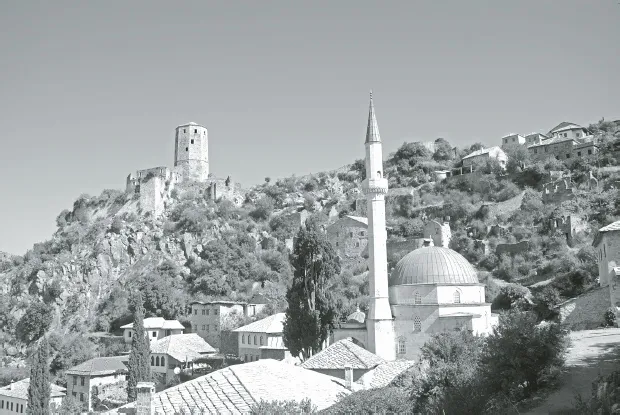
Old town Pocitelj, Bosnia-Herzegovina. (Shutterstock.com)
![]()
1
Welcome to the Balkans
The blast outside our apartment building jolted us awake. Someone had blown up an empty guard shack in front of our building in Izmir, Turkey, one night in early 1980. Kathy and I quickly sheltered the kids in the back of the apartment until the police arrived. At the time, I was a major in the US Army assigned to the US mission in the North Atlantic Treaty Organization (NATO) headquarters in Izmir. In Turkey in 1980, the political system was disintegrating, and political violence was common. A Turkish military coup was on the horizon. The blast in Izmir was my first direct exposure to political violence in the region. It would not be my last.
Twenty-two years later, in 2002, at a dinner at the residence of the Bulgarian ambassador in northwestern Washington, DC, Bulgarian guests around the table described the turbulent life of their new prime minister, Simeon Saxe-Coburg Gotha. The US Senate had just confirmed me as the US ambassador to Bulgaria, and the Bulgarian ambassador was hosting the dinner for Kathy and me before we left for Sofia.
The Bulgarians at the table discussed the book Crown of Thorns, which tells the story of Simeon’s family.1 His father, Boris, was czar of Bulgaria during World War II. Czar Boris resisted sending Bulgarian Jews to the extermination camps even though Bulgaria was an ally, albeit an unenthusiastic one, of Nazi Germany. Hitler summoned Boris to Berlin for a discussion. Shortly after returning to Bulgaria, Boris died under mysterious circumstances, generating widespread conspiracy theories of a Nazi assassination. He was buried at the Rila Monastery, and his six-year-old son, Simeon, assumed the Bulgarian throne.
Soviet sympathizers deposed young Czar Simeon in 1947 in favor of a Communist regime. The Communists dug up his father’s body from the monastery and reburied it on the grounds of his palace near Sofia. Simeon spent most of his life in exile, first in Egypt, then Spain. When communism collapsed, Simeon, the last czar of the twentieth century, returned to Bulgaria as prime minister of an elected democratic government. Boris’s body was never found, but his heart was recovered in the Bulgarian Academy of Science and reburied at Rila Monastery.
From 1995 until 2002, Kathy had kept a stable home in the Virginia suburbs for our sons as I bounced around the Balkans as a US official, engaged in the wars first in Bosnia, then in Kosovo, and finally in Macedonia.
“Nazis, czars, assassinations, Soviets, a body dug up from a monastery, a heart found in a science academy? What have you gotten me into this time?” Kathy said as we walked back to the car after the Bulgarian dinner.
“Welcome to the Balkans,” I said.
From the Tides of Empires
The history of the Balkans is mingled with the history of the great powers of Western civilization. In fact, no other area in Europe has been exposed more to the ebb and flow of great powers important to the history of Western civilization than the Balkans.
It is the land of ancient Greek and Thracian cultures, of Phillip and Alexander the Great, and of Slavic tribes who came south across the Danube centuries ago. Rome expanded its empire into the region in the second century BCE. Trajan’s magnificent triumphal column in the forum in Rome commemorates Rome’s conquest of the Dacians in what is modern-day Romania. Roman emperor Constantine, born in Nis in today’s Serbia, established the capital of the Eastern Roman Empire in Constantinople, now Istanbul. Byzantine armies occupied the Balkans and converted most of the population to Christianity.
After Constantinople fell to the Ottomans in 1453, Ottoman sultans gained control of the region and marched their armies from Istanbul through the captured territories in failed campaigns to seize Vienna. For centuries, the Balkans served as a transportation corridor between empires and a strategic buffer between East and West.
Russia liberated much of the region in the late nineteenth century when it pushed the weakened Ottoman Turks back toward Istanbul. Later, the Austria-Hungarian Empire exerted its influence on the region. Two regional wars were fought early in the twentieth century, and the area was drawn into both World War I and World War II, an involvement that included occupation by Nazi Germany. Large areas of the Balkans fell under the Soviet sphere of influence after 1945.
Each of the empires that occupied the Balkans left behind bits and pieces of its art, mythology, architecture, politics, and ethnic identity as its influence receded from the region. Today, festivals with roots in pagan ceremonies can be found in local villages. Monasteries, temples, churches, and mosques—some built on the remains of pagan temples—exist across the land. Ancient Roman ruins, Byzantine fortress walls, and Ottoman bridges and clock towers are interspersed around the Balkans as remnants of previous occupiers. Communities with clear links to Austro-Hungarian influences are common, and Communist architecture from the Soviet era can be found everywhere in old Soviet-dominated areas.
On a human level, villages, towns, and larger regions are populated by clusters of Turks, Bulgarians, Greeks, Orthodox Christians, Slavic Muslims, Roman Catholics, Serbs, Roma, Montenegrins, Jews, Albanians, Romanians, and many more groups. Despite periodic efforts to associate ethnic groups with specific geography, these diverse groups intermingle throughout the area.
As foreign occupations waxed and waned, each of the various cultural groups clung fiercely to its common cultural traditions, language, and histories as the core of its identity. For the group members, cultural identity was critical to the survival of the community when confronted by outsiders. For many, to compromise on ethnic or cultural identity was to put community survival at risk.
Yugoslavia
The Paris Peace Conference in 1919 created modern Yugoslavia when the leaders of the victorious powers in World War I defined the future of much of postwar Europe. In the deliberations, the conference accepted a Serb and Croat initiative to form a confederation of the region’s ethnic groups into Yugoslavia, a power-sharing arrangement of mostly southern Slavs.2 Two decades later, during World War II, Nazi Germany occupied the region despite the armed resistance by several nationalist insurgent groups. Marshall Joseph Tito, a Croat-Slovene by birth and a famous Communist partisan leader during the war, had the popular legitimacy to lead a unified postwar Yugoslavia. However, his leadership and his ability to suppress ethnic nationalism were personal. Tito’s death in 1980 set the stage for the breakup of Yugoslavia; the end of Soviet communism accelerated the process.3
The World Changes
The wars, near wars, and human tragedies in the former Yugoslavia from 1991 to 2008 began at a time of historic upheaval in the international order as Russia discarded Soviet communism. In this period, the revolutionary changes in Russia, eastern Europe, and Eurasia were fraught with uncertainty for Washington and other Western capitals.
The fall of Soviet communism gave the United States during the 1990s an historic level of national power. But American leaders in the period had no concrete vision of America’s role in the world after the doctrine of containment was no longer relevant.4
I was a “Cold Warrior” for the United States for most of my career, first as an armored cavalry platoon leader guarding West Germany’s border with East Germany in 1966. Later, as director of foreign intelligence on the Army General Staff in Washington, I watched the Berlin Wall come down and the Soviet system disintegrate in eastern Europe.
Suddenly the Cold War was over. The international system that had been the focus of Western foreign and national security policy since 1945 had dissolved. The threat from the Warsaw Pact—the standard measure for US military strategy, force development, doctrine, and planning for almost fifty years—ceased to exist. Yugoslavia, where conflicts broke out as nationalist movements pressed for independence two years after the Berlin Wall came down, was a major exception to the mostly peaceful end to Soviet communism in eastern Europe.
The set of international crises in the former Yugoslavia from 1991 to 2008 took place on the Balkan fault lines between East and West. They were a clash of gods, of history, of national identity, of idealism, and of shameless ambition. Ultimately, only active US and international engagement in the former Yugoslavia could restore peace and stability to the Balkans. This engagement also would help define the nature of seven new nations and influence the character of international relations into the future.
![]()
2
Fools and Madmen
Fools and madmen are drawn easily to war—all glory and bravado in the beginning, tragedy and disaster at the end. Slobodan Milosevic, the president of the Republic of Serbia, in his military adventures in the former Yugoslavia overlooked one of the most important lessons of history: wars are easy to start, but once started they often take an unpredictable path.1 Wars are almost never as short as expected. They generally cost more in lives and treasure than originally believed, and those who start wars are often consumed by them.
The end of communism in Yugoslavia set off a chain of violence that threatened the stability of the entire region. These ethnic conflicts in the Balkans killed tens of thousands of people and displaced millions more as Yugoslavia broke apart.
A Narrow Vision
The lack of vision by local leaders for a democratic, European future was a primary cause of the violence in the Balkans. Very few leaders in the post-Communist Yugoslavia could see beyond their local political ambitions and personal cultural identity to foresee their country as a modern European democracy. They had few models in their personal experience to draw from. These local political leaders viewed the solution of every political question as a zero-sum competition with other ethnic groups. Compromise, except under very specific—almost mathematical—conditions, was not their tradition.
The people of the region also shared the blame. The various populations in the region generally supported Milosevic and other nationalist leaders who chose war to pursue their objectives. I cannot recall one serious peace movement in any of the regions of the former Yugoslavia that placed restraints on leaders who favored war from 1992 to 2008.
People learned about life and politics as youngsters listening to stories at the feet of parents and grandparents and at local celebrations in their communities. In the Balkans, every group had been a victim of repression by some dominant master at some point in its history. This psychology of victimhood colored each group’s outlook toward outside groups, even if they all had lived as neighbors for generations. Geography reinforced the narrow vision. The Balkan region was isolated from the European mainstream by geography, and in its isolation local ethnic identity was strong.
What Yugoslavia’s unification effort failed to solve was how to integrate society into a national political culture in which the nation is the source of personal, political, economic, and legal identity. When Belgrade lost its grip and the political bands holding Yugoslavia together snapped with the fall of communism, Yugoslavia almost immediately fractured along ethnic lines.
Political Conversion
Self-interest is a powerful motivation for conversion. By 1989, many Communist leaders saw what was coming and began to change from ardent Communist bureaucrats to committed democrats and market capitalists, often stealing the nation’s wealth in the process of conversion. Their primary political strategy to win and hold power was to stress extreme ethnic nationalism among their constituent populations.
Slobodan Milosevic was one such leader. In 1989, Milosevic was a successful Communist Party leader married to a woman with strong leftist credentials dating back to the Communist partisans of World War II.
For Milosevic, the conversion was rapid. In a series of speeches in Kosovo beginning in 1987, he called for unity among Serbs and declared never to give up Kosovo and to defend Serbs against violence.2 He discovered that fear fuels hate and that fear and hate are potent political forces. As he transformed himself from Communist apparatchik to Serbian nationalist leader, his popularity grew among Serbs. Through his nationalist appeal as a Serb, Milosevic consolidated power when he became president of Serbia in 1990 and never looked back.
Religion and Politics—the Unholy Temptation
Political conversion was not the only personal transformation. After years of communism, many leaders in the region suddenly and conveniently discovered God.
Despite fifty years of Communist rule and religious repression, religion remained deeply ingrained in the people’s cultural identity, but not so much in their faith. In general, Croats and Slovenes were historically Roman Catholic, and Serbs, Montenegrins, and ethnic Macedonians were Orthodox Christians. European Muslims, converted to Islam during the Ottoman period, formed the overwhelming majority population in Kosovo, the largest single group in Bosnia, and roughly one-third of the people in Macedonia.
As Yugoslavia broke apart, resurgent religion in the Balkans became an important political tool for ambitious leaders. Meanwhile, religious leaders, subservient to the Communist political establishment for decades, seemed happy to oblige.
I was raised a Southern Baptist in Arkansas, so I knew something about religious hypocrisy, and it was everywhere in post-Communist Yugoslavia. After communism fell, local leaders who had been atheists as good Communists suddenly flipped to become Christians of various types or Muslims when it suited their political ambitions. Down came the pictures of Lenin, up went religious symbols and pictures in political offices throughout the region. The clergy had access to the local leaders, and the latter appeared at religious ceremonies when it suited their ambition.
The mutual attraction of religion and politics is dangerous to any democracy. Rather than compete for believers without government help, religious leaders in post-Communist Yugoslavia could not resist the attraction of political power as a means to influence and sustain the faith. Likewise, political leaders wrapped themselves in a cloak of faith as an easy source of authority and legitimacy in their respective ethnic groups. In fact, the integration of religion and government corrupts both institutions, and when faith becomes a justification for war, the result can be particularly brutal and destructive. Such was the case in post-Communist Yugoslavia.
There were,...