Hollywood films have been influential in the portrayal and representation of race relations in the South and how African Americans are cinematically depicted in history, from The Birth of a Nation (1915) and Gone with the Wind (1939) to The Help (2011) and 12 Years a Slave (2013). With an ability to reach mass audiences, films represent the power to influence and shape the public's understanding of our country's past, creating lasting images—both real and imagined—in American culture.
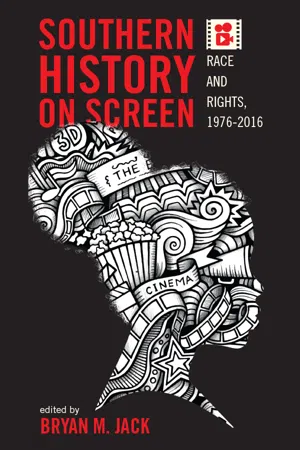
In Southern History on Screen: Race and Rights, 1976–2016, editor Bryan Jack brings together essays from an international roster of scholars to provide new critical perspectives on Hollywood's relationships between historical films, Southern history, identity, and the portrayal of Jim Crow–era segregation. This collection analyzes films through the lens of religion, politics, race, sex, and class, building a comprehensive look at the South as seen on screen. By illuminating depictions of the southern belle in Gone with the Wind, the religious rhetoric of southern white Christians and the progressive identity of the "white heroes" in A Time to Kill (1996) and Mississippi Burning (1988), as well as many other archetypes found across films, this book explores the intersection between film, historical memory, and southern identity.
- 242 pages
- English
- ePUB (mobile friendly)
- Available on iOS & Android
eBook - ePub
About this book
Information
Subtopic
North American History1
“It’s Now That Counts”
The South in Hollywood’s Sixties Films
Gulf Oil, Albertsons, Wendy’s, Video Paradise—a chaotic arrangement of billboards punctures the landscape on all sides as Donnie (Timothy Hutton) and Leslie (Patricia Clarkson) make their first stop in Louisiana. “Here it is, the Old South, just the way you described it to me, Professor,” Leslie quips, an advertisement for “old fashioned” hamburgers looming to her right. “Show a little reverence, will you,” Donnie replies. “We’re on hallowed ground here.” And, gesturing toward a sign announcing a new tower block development, he informs her that this was where the Grey Ghost Inn used to stand. For Donnie, as for so many Louisianans in the sports-themed historical drama Everybody’s All American (1988), the inn was both a memorial to football success and a testament to southern glories gone by. The establishment was once presided over by legendary running back Gavin Grey (known to all as “The Grey Ghost”); its demise is indicative of this hero’s fading from the public imagination and the passing of an old way of life.
From the 1950s to the 1980s, Everybody’s All American pits its main characters against the turbulent ebb and flow of late twentieth-century American history. As the civil rights movement stands up to official white supremacy in the South and shifting gender, family, and economic relationships bring a new way of thinking to the region, Donnie, Gavin, and their peers are forced to confront a changed world. The inn’s demolition is but one act in a film replete with historical metaphors intended to evoke the South’s sharp vicissitudes of fortune. Everybody’s All American was part of a broader cycle of Hollywood historical films meditating on such issues. Indeed, when examining the South’s role in conflicts of the recent past, cinematic representations have time and again evoked specters of “America’s second Civil War.” In particular, these films invest the 1960s with dramatic thrust and ideological resonance. Less a contained decade, 1960–69, than a loose collection of ideas and events spanning from the mid-1950s to the mid-1970s, this “long sixties” has established itself as a central piece of US public memory. Since the late 1970s, politicians and filmmakers alike have debated the legacy of the civil rights and feminist movements, the counterculture and Vietnam War. Such debates continue to echo in the twenty-first century.1
This essay examines Hollywood representations of the sixties South. If much has been written on filmic engagements with the civil rights movement as it appears in pictures such as Mississippi Burning (1988), The Long Walk Home (1990), and The Help (2011) among others, Hollywood’s multifarious portrayals of the South at this time remains underexamined.2 Whether taking the form of an explicit southern setting or simply evoking ideas and issues by way of southern characters transplanted to other parts of the United States, so pervasive is the region in cinematic portrayals that one might say it has become a character unto itself. I begin with a discussion of the emergence of the South as a politically charged trope in popular culture of the late 1960s, and its place in high-profile sixties commemoration in the 1970s and 1980s. While public remembrance often focuses on a region defined by brutal racism, one also detects what Tara McPherson has in another context called a “cultural schizophrenia about the South … at once the site of the trauma of slavery and also the mythic location of a vast nostalgia industry.”3 Using an analysis of Everybody’s All American as a base from which to explore familiar characters and conventions of Hollywood’s sixties South, I consider the ways cinema negotiates between these competing legacies. I conclude with a focus on twenty-first-century representations, in particular the James Brown biopic Get on Up (2014) and its engagement with the South as a political and cultural phenomenon.
“The Evil Was Down There”: Hollywood’s Sixties South
Many of the conventions that would come to define public memory of the sixties South were shaped during the 1960s themselves. Its status as “eye of the civil rights hurricane,” argues Sharon Monteith, ensured the “‘savage South” became a stand in “for larger social concerns, notably the nation’s obsession with the fiction of racial purity.”4 At the time and in retrospect, through images of racist violence, state-sanctioned discrimination, and vicious law enforcement filmmakers used the region as historical shorthand for all of America’s racial conflicts. As Deborah Barker and Kathryn McKee put it regarding the history of film portrayals, “the color line” is conspicuously placed “below the Mason-Dixon line.”5 On the streets of Montgomery, Greensboro, Birmingham, and Selma, a quasi-Manichean battle has unfolded on cinema screens. Paying little heed to the complexities of American race relations, the movies have offered a roll-call of unproblematic “heroes” and “villains.” Central to this dichotomy is the status ascribed to black and white characters. “According to the movies,” writes Allison Graham, “the southern problem has never been white people.” Rather, it has “always been social class.” If African Americans provided the civil rights movement’s driving force, films, barring the occasional exception, tend to focus on the significant acts of white characters. Whether appearing as noble lawyers in works such as To Kill a Mockingbird (1962) and Ghosts of Mississippi (1996), “reborn lawmen” in Mississippi Burning, or politically and spiritually transformed women in Heart of Dixie (1989) and Love Field (1992), the upstanding white citizen is cast as a symbol of southern heroism.6
Such characters often find their nemeses in another prominent archetype. Crucial to the South’s negative identity is the figure of the “cracker” or “redneck.” Into this working-class, white, uneducated, and aggressively racist male is poured a nation’s moral outrage. In this way, the blame for American racism is not laid at the feet of social and political institutions but leveled at the white working class. Graham notes the connections between the redneck and broader political conflicts over the Vietnam War. Hollywood liberals have frequently conflated aberrant racism with support for the war, charging the “uneducated rural white man” with being on the wrong side of history on both counts.7 Thus are versions of the redneck found not only in civil rights dramas but also in films about the sixties counterculture and Vietnam War: the trigger-happy killers of Wyatt (Peter Fonda) and Billy (Dennis Hopper) in Easy Rider (1969), the rapists that haunt Joe Buck’s (Jon Voight’s) memories in Midnight Cowboy (1969), the misogynist country-and-western singers in The Rose (1979) and the war-loving, anti-counterculture “evil” Sergeant Barnes (Tom Berenger) of Platoon (1986), for example.
More generally, one might say that the South’s racial conflicts have become entangled with a host of related issues and ideas pertaining to the sixties. In the vast literature of memoirs written by those involved in the era’s political uprisings, the South serves as both political and moral battleground, and symbolic baptism of fire for a generation of young activists. In his 1988 memoir Reunion, cofounder of Students for a Democratic Society Tom Hayden described the “southern civil rights experience”—the marches, voter registration drives, and inevitable spells in prison—as “both a necessary moral act and a rite of passage into serious commitment.”8 Harrowing descriptions of violence in the early 1960s suggested, according to Annie Gottlieb, that “the evil was down there in the South” and encouraged a generation of young white liberals to join the movement.9 In these texts, going South becomes both a moral imperative and an “adventure” for young men and women looking to leave their mark on the world. As in stories of the Wild West or the Civil War, the chaos and conflict of the South is a spur for a kind of generational bildungsroman, launching its protagonists on narratives of personal enlightenment. In many ways, it is the perceived “backwardness” of the South—“the region’s image as not only ‘behind’ the rest of the nation but also reluctant to keep pace”—that has, conversely, enabled it to become so pervasive an icon in stories of sixties change and transformation.10 Images of sunbaked landscapes, quaint rituals, and people stuck in the past have provided dramatic fodder for tales of the era’s most significant conflicts: progress versus stasis, the past versus the future, and prejudice versus tolerance.
If the above-noted writers present the South as the crucible of their own coming-of-age, Hollywood representations often flip this on its head, transplanting “backward” southerners to the North and West and chronicling the sixties’ impact on their lives. Forrest Gump (1994) is perhaps the most famous representation to derive its drama from a southern naïf’s engagement with phenomena such as the counterculture and antiwar movement. It was, however, but one in a long line of similar portrayals. The same year as Easy Rider brought its murderous rednecks to the silver screen, two quintessential sixties representations introduced characters that prefigured this trend. Medium Cool and Midnight Cowboy (both 1969) were significant to the extent that they focused on migrant southerners affected by the political and cultural developments of the sixties. The former explores events surrounding the Democratic National Convention of 1968. John Cassellis (Robert Forster) is an ambitious, Chicago-based news cameraman swept up in both the political disarray of the period and in a relationship with West Virginian woman Eileen (Verna Bloom). While happy to talk journalistic ethics with fellow reporters, Cassellis remains detached from his subject matter. Little distinction is made between the real and the fictional; Eddie Adams’s famous photograph Saigon Execution hangs on his apartment wall as if it were a poster; a large portrait of Jean Paul Belmondo, darling of the French New Wave, sits on the wall adjacent. When he first meets Eileen, he is quick to offer a tasteless impersonation of an Appalachian man unable to buy “tobacco on [food] stamps.”
If Cassellis’s actions suggest a man disconnected from the world around him, Eileen serves as Medium Cool’s symbol of authenticity. Leaving West Virginia after her husband is drafted, she joins the Appalachian community of uptown Chicago. The decrepit apartment blocks and dated interiors speak to the impoverishment of this part of the city. A stark counterpoint to Cassellis, with his comfortable, detached existence, Eileen is at the heart of Chicago’s social strife. She has a poster of Robert F. Kennedy on her apartment wall, though by this stage in the film the senator’s death has been announced. The presence of this sixties “martyr” only emphasizes her helplessness. Cassellis might fetishize the dramatic scenes of protestors fighting police on the city streets, but Eileen is dragged unwillingly into this political thunderstorm. This is manifested visually in Medium Cool’s famous footage of the protests outside the Democratic National Convention. In search of her son, Eileen wanders into the crowds of demonstrators and is caught up in the chaos. Eventually she locates Cassellis, and the two make it to his car, only to suffer a crash in which Eileen is killed. The very people the protestors should be helping—the poor and disenfranchised—continue to suffer on the streets of America just as they are dying on the battlefields of Vietnam. Eileen’s death here becomes symbolic of an unfinished class struggle. Though events of 1968 made for good political theater, the clashes and protests did not necessarily translate into lasting social change.
Midnight Cowboy follows Joe Buck, a homespun fantasist from Texas, who travels to New York City to seek his fortune as a prostitute. His turbulent, and ultimately tragic, experiences symbolize the den of alienation that this film presents as modernity. In dress and mannerisms, Buck affects the trappings of a cowboy. He sees this mythic American archetype as an icon of virility and thus his meal ticket when he reaches New York. But Buck is no hard-bitten sentimentalist cut from the John Wayne cloth. Rather, he combines superficially identifiable western traits with a naïveté that this film associates with the South. The region emerges in different forms throughout Midnight Cowboy. Ghostly recollections of his grandmother singing him the traditional southern lullaby “Hush, Little Baby,” scenes of Buck as a young boy undergoing immersion baptism, and images of rape at the hands of rednecks haunt his waking hours. These flashbacks are tinged with a surreal patina, thanks to the disconcerting cinematography: extreme low angles (as present in the baptism scenes) and dissolves (Buck’s first recollection of his grandmother as he stares into a shop window). It is also notable that Buck ends the film in Florida. Like the antiheroes of Easy Rider, he and his partner in crime for much of the narrative, Enrico “Ratso” Rizzo (Dustin Hoffman), dream of relocating to the Sunshine State. Though Florida’s diverse communities are, as Marlisa Santos points out, “not often characterized as Southern,” in terms of typical understandings of the region’s identity it is interesting the extent to which this, geographically one of the most southern states, appears as a narrative trope in sixties films.11 Here and in later productions, it can serve as both the promise of a dream life and as the site of death and destruction. Appearing in Ratso’s feverish hallucinations, images of Florida offer little more than a touristic trailer, complete with cloying jingle. Bingo and cocktails are the order of the day (the Florida of Ratso’s imagination seems decidedly stuck in a 1950s time loop) as he and Buck ca...
Table of contents
- Cover
- Half title
- Title
- Copyright
- Contents
- Introduction
- 1. “It’s Now That Counts”: The South in Hollywood’s Sixties Films
- 2. History without a Capital H: Violence, Commodification, and the Perpetuation of the Postmodern Condition in Django Unchained
- 3. You’re Not the South: The Outlaw Josey Wales, Ride with the Devil, and Confederate Guerrillas in Modern Films
- 4. Reconstruction on Film: Free State of Jones and the Historical Memory of Reconstruction
- 5. From Griffith to Parker: The Representation of African Americans and the US South in The Birth of a Nation 1915–2016
- 6. Roots Reimagined
- 7. The South as a Space/Place of Reclamation of Black Fe/Male Inheritance
- 8. Hollywood’s Southern Strategy: Portraying White Christianity in Late Twentieth-Century Civil Rights Melodramas
- 9. Lesbian Invisibility Continued: The “Straight-Washing” of Southern Women in The Color Purple and Fried Green Tomatoes
- 10. Intergenerational Struggle and Racial Progress in The Help and The Butler
- Acknowledgments
- Contributors
- Index
Trusted by 375,005 students
Access to over 1.5 million titles for a fair monthly price.
Study more efficiently using our study tools.
Frequently asked questions
Yes, you can cancel anytime from the Subscription tab in your account settings on the Perlego website. Your subscription will stay active until the end of your current billing period. Learn how to cancel your subscription
No, books cannot be downloaded as external files, such as PDFs, for use outside of Perlego. However, you can download books within the Perlego app for offline reading on mobile or tablet. Learn how to download books offline
We are an online textbook subscription service, where you can get access to an entire online library for less than the price of a single book per month. With over 1.5 million books across 990+ topics, we’ve got you covered! Learn about our mission
Look out for the read-aloud symbol on your next book to see if you can listen to it. The read-aloud tool reads text aloud for you, highlighting the text as it is being read. You can pause it, speed it up and slow it down. Learn more about Read Aloud
Yes! You can use the Perlego app on both iOS and Android devices to read anytime, anywhere — even offline. Perfect for commutes or when you’re on the go.
Please note we cannot support devices running on iOS 13 and Android 7 or earlier. Learn more about using the app
Please note we cannot support devices running on iOS 13 and Android 7 or earlier. Learn more about using the app
Yes, you can access Southern History on Screen by Bryan M. Jack in PDF and/or ePUB format, as well as other popular books in Media & Performing Arts & North American History. We have over 1.5 million books available in our catalogue for you to explore.