eBook - ePub
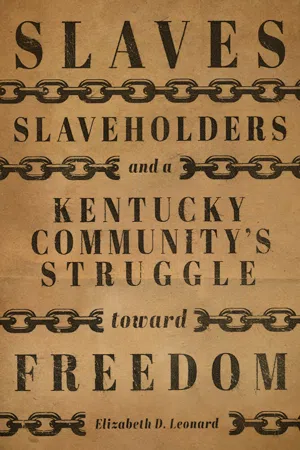
Slaves, Slaveholders, and a Kentucky Community's Struggle Toward Freedom
- 196 pages
- English
- ePUB (mobile friendly)
- Available on iOS & Android
eBook - ePub
Slaves, Slaveholders, and a Kentucky Community's Struggle Toward Freedom
Trusted by 375,005 students
Access to over 1.5 million titles for a fair monthly price.
Study more efficiently using our study tools.
Information
PART ONE

Once a Slaveholder
The Journey of Joseph Holt
In the years before the American Civil War began, few could have predicted that Joseph Holt would become a key figure—judge advocate general—in President Abraham Lincoln’s War Department as well as an enthusiastic supporter of emancipation, black men’s military service to the Union, and black Americans’ civil, political, and human rights more generally. Most whites in the region of Breckinridge County, Kentucky, where Holt was born and raised and where most of his extended family continued to live, were dyed-in-the-wool secessionists, fiercely dedicated to Southern nationalism, white supremacy, and the defense of slavery. In contrast, Joseph Holt became one of the most resolute and influential allies of Lincoln, the Union cause, the United States Colored Troops, and black freedom. His manifold contributions to all of these have long been underestimated. Fortunately for modern-day students of the Civil War era, however, thanks to his racial identity, his superior education, and his social and political prominence, Joseph Holt left a robust the paper trail for us. Indeed, as will be seen, even less intellectually advantaged members of his white family bequeathed to scholars sufficient documentary evidence to enable us to map their lives and thought processes with relative ease.
Pulling Up Roots
Born in 1807 in a corner of Breckinridge County known as Holt’s Bottom, Joseph Holt grew up in a large and affluent slaveholding family, and by the time the war began he had been a slave owner, buyer, and seller in his own right for much of his life; he also married twice into substantial slaveholding families. Moreover, in 1861 Holt, already in his fifties, had always lived in places where slavery was woven tightly into the cultural fabric and most whites believed that human beings of African descent were destined to be their property to do with as they saw fit. Over the course of his antebellum professional life as an attorney and Democratic Party activist, Holt had also publicly defended the institution of slavery: during his legal training, in his practice, and in his political speeches. As a young man Holt had idolized Andrew Jackson, and he had come of age and to political prominence during the period when the Democratic Party was most closely identified with slavery’s perpetuation and expansion. His speeches and much of his work before the Civil War reflected the party’s values.1
It is also true, however, that since his youth Holt had occasionally displayed some ambivalence about slavery. While a student at Centre College in the mid-1820s, for example, Holt had encountered—probably for the first time—individuals like the Reverend Jeremiah Chamberlain, the school’s president, who considered slavery a sin and believed Kentucky should commit to gradual emancipation. Perhaps under Chamberlain’s influence, young Holt had given at least one speech at the college sharply critical of human bondage. Holt’s private correspondence, too, offers evidence that as a young man he was not irrevocably committed to the perpetuation of slavery in the United States. Indeed, in a no longer extant fall 1845 letter to his maternal uncle, Robert Stephens, Holt gave the distinct impression that he considered slavery a “social political or moral evil,” though he saw no obvious means at that time by which to safely abolish it. For his part, Uncle Robert vehemently challenged Holt’s negative characterization of the institution, at the same time expressing his concern that his nephew might some day “settle in a free state.” Should such a disaster take place, Uncle Robert wrote, he hoped that Holt would draw the line at becoming an abolitionist.2
Of course, any discomfort Joseph Holt felt about the institution of slavery in the prewar years must be measured against his overall acceptance. As late as July 1856, in a Frederick, Maryland, speech on behalf of Democrat James Buchanan’s presidential candidacy, Holt vigorously defended the right of states to manage their own affairs and protect their “domestic institutions.” He spoke at length about the threats to the Union that arose from growing sectional tensions over slavery and insisted, as Andrew Jackson had done before him, that the life of the Union must be preserved. It would be foolish beyond measure, Holt declared, to destroy the Union simply in order to destroy slavery. But for now he directed his anger at the abolitionists for stirring up trouble. For the last twenty years and more, he railed, they had consistently turned up the heat under Americans’ discussions about slavery. And now, he went on, the “Black Republicans” seemed bent on transforming the abolitionists’ rantings into law by means of the electoral process, perhaps demolishing the nation in the process.3
Holt’s 1856 speech in Frederick echoed many of his era’s most troubling ideas about slavery’s “blessings” for white Southerners, even as it also conveyed some uncertainty about the institution’s overall value. For Holt in 1856, slavery was “a problem” that had “long and painfully exercised the brightest intellects and the noblest hearts of the world” to no avail; an “excrescence” that had been “planted upon this continent, not by Americans, but by foreigners”; and a tumor that was “growing upon the body politic” and “twining [its] roots so closely above, beneath and around the very seat of life, that skillful surgeons when consulted, refuse to dissect them out, fearing lest death should ensue upon the operation.” At this point in time, then, Holt did not so much endorse slavery as revile its activist opponents; he was not unshakably eager to preserve slavery per se, but he clearly feared that the “cure” the abolitionists and “Black Republicans” proposed for it would prove far worse than the disease itself: rebellion, race warfare, perhaps even the nation’s collapse. With these perceived threats in mind, he strove to use his oratorical skills and fierce dedication to the party and the Union to promote cool-headed leadership as a corrective to hot-headed rabble-rousing of all sorts. At the same time, he worked to encourage patience and popular confidence in the virtues and ultimate justice of the electoral process. These things alone, Holt believed, would ensure national peace and the survival of America’s republican experiment. Slavery’s demise would have to wait.4
The year after he gave this speech, Holt and his second wife, Margaret Wickliffe Holt, left Kentucky for Washington, DC, when the newly elected Buchanan appointed him commissioner of patents. The move separated Holt by almost seven hundred miles from the family, community, and slave-based culture he had known for fifty years, and as he prepared for the move, the practical question of what to do about his and Margaret’s several slaves inevitably arose. As historian Marion Lucas notes, “Though slaves sometimes viewed moving with [an] owner or his relatives … as a personal tragedy,” there could be marginal benefits. Among other things, slaves who relocated with an owner could take some comfort that they were not being sold to someone else, “perhaps relieving anxiety regarding future treatment” and signaling “the possibility of continued contact with relatives and friends left behind.” As he pondered what to do about the men, women, and children he and Margaret held in bondage, Holt weighed a wide range of factors. Among others, he wondered how particular individuals would adjust to the bustling, cosmopolitan capital city so far from the quieter landscape and cherished family members and friends of Kentucky. It bears noting that the move would also bring a distinct change in the racial dynamics and demographics with which the Holts and any slaves who accompanied them were familiar. There were virtually no free blacks in Breckinridge County in the late 1850s, and about 16 percent of the county’s population was comprised of slaves. In contrast, both free and enslaved blacks had lived for a long time in the District of Columbia; by the late 1850s they made up approximately 30 percent of the District’s overall population. In both places, of course, black Americans were central to the area’s life, economic development, and prosperity.5
Also noteworthy is that Washington, DC, had a long history as a significant slave-trading center: “Slave dealers,” writes historian Elizabeth Clark-Lewis, “not only made the District their headquarters but also ‘used the federal jails freely to house their chattel in transit.’” But the proportion of the resident black population that was enslaved had dropped from about 50 percent in 1830 to roughly 22 percent by the time the Holts settled into their elegant home at 236 New Jersey Avenue SE, near Capitol Hill. Meanwhile, the overall number of black residents in the District continued to grow. That an increasing proportion of Washington’s blacks were “free” clearly does not mean that they were free in the same way that whites were. Like their counterparts across the South, free blacks in DC were subject to a host of legal constraints and indignities, not least the requirement that they carry their “free papers” at all times on penalty of arrest, possible imprisonment, even sale. Despite these constraints, however, Washington’s free black community had steadily established “many of the necessary social, educational, and religious institutions to sustain itself during the early decades of the nineteenth century.” Some individuals and families were even able to enjoy a measure of affluence.6
For Joseph Holt and any slaves he and Margaret chose to bring with them, Washington in 1857 would be a new experience. It is impossible to know precisely to what extent practicality, household budget, demographic realities, and his individual feelings about slavery each factored into Holt’s decision-making process with respect to how best to staff the new household. What is certain, however, is that the move became the occasion for him to transfer, either by sale or gift, all but one of the handful of people he still owned to the ownership of his younger brother Thomas in Holt’s Bottom. This decision pleased and benefited Thomas and his wife Rosina, whose commitment to slavery generally, and as a means for preserving the family’s homestead and wealth at Holt’s Bottom specifically, was unswerving.7
Joseph Holt showed little inclination to bring Margaret’s remaining human property to Washington, either; he preferred to hire local servants instead, as other whites in the capital frequently did. Once again, although his views were surely shaped to some extent by raw household economics, Holt also considered the question of how his wife’s bondsmen and bondswomen would adjust to the new environment, especially given the wrenching separations from family and friends they would have to endure. Regarding Margaret’s dining room “servant,” Holt wrote to his wife in April 1857, “I have had several chats with John.” John “says he is willing to go to Washington to live with you for a while,” but Holt added that “any attempt to retain him there, as a member of our household, would I am sure result in rendering him discontented & useless.” In the end, Holt persuaded Margaret they should replace John with a hired man.8
In this same letter Holt also reminded Margaret that they had agreed to leave Annie and her son William with Margaret’s family in Bardstown where William, he pointed out, would be more useful as a field hand than he could possibly be in urban Washington. Holt expressed particular concern about separating Margaret’s personal maid, Jane, from her son. Jane, he observed, was “very far from being destitute of the maternal instincts.” Alas, Margaret’s desire to have Jane with her in DC outstripped her sympathy, and Jane was forced to come along. When the District’s census taker came to the Holt house in 1860 he listed Jane Clark, age twenty-two, cook, as one of the household’s two black residents, along with a thirty-five-year-old “hostler” (caretaker for horses) known as Alfred Semmes. Additional names appear in the historical record in connection with the Holts’ Washington household: members of the hired black staff who helped Jane and Alfred—now Joseph Holt’s sole remaining bondsman—keep the household running, tend the garden, and care for the Holts’ carriage, horses, and dogs.9
Joseph Holt had already demonstrated some philosophical ambivalence about slavery as a youth; the 1857 move to Washington, DC, occasioned his first decisive, practical steps away from the institution. He took these steps, perhaps not surprisingly, even as the national debate over slavery was reaching a new level of intensity. In the fall of 1859, abolitionist John Brown’s violent attack on Harpers Ferry pushed the question of slavery’s future and the stability of the nation itself to the brink. A year later, just weeks after Margaret died following a long period of declining health, and as pro-slavery and Southern nationalist sentiment increasingly gripped the bulk of his family and community members back in Breckinridge County, Holt took another important step, emancipating Margaret’s slave Jane. In his October 1860 statement manumitting the young woman Holt spoke with genuine warmth and appreciation of the “faithfulness and kindness” Jane had always shown to Margaret, and then declared her “henceforth free, manumitted, and discharged from all manner of servitude or service to me, my executors or administrators forever.” Soon after, he received a letter from a friend, fellow Kentuckian and longtime slaveholder James Speed of Louisville, who later became President Lincoln’s attorney general. Like Holt, Speed’s views on slavery were changing. “The case of the girl you liberated is really touching,” Speed wrote. “I am persuaded that this great evil, this terrible national sin, slavery, must die, but it will be in one of two ways: it will either go out in blood or perish because the master finds the slave has no value.” Following her emancipation, Jane remained with Holt in Washington for many years as a highly valued and trusted employee whose affection and loyalty to him were steadfast.10
Choosing Union over Slavery
Joseph Holt’s personal transformation from slave owner to committed emancipationist was well under way, then, by the fall of 1860. Still, for the time being his primary concern remained the preservation of the Union. Indeed, despite his recent emancipation of Jane, Holt’s speeches and letters from this period—he was now Buchanan’s postmaster general—ring with familiar criticism of the abolitionists who, he continued to insist, had been engaging in “incendiary agitation” for decades. They and the “Black Republicans” who supported them, Holt argued, posed the gravest danger to the Union. He urged white Southerners to remain calm in the face of such agitation because the Union still offered the best defense of all they held dear, including slavery.11
Holt pressed this case not only publicly but also in letters to his family, especially his brother Robert, to whom he was particularly close. Like most of Holt’s family and community back in Breckinridge County, Robert—now a successful lawyer and planter in Mississippi and the owner of thirty-eight slaves—was a diehard pro-slavery Southern nationalist. Indeed, he viewed Abraham Lincoln’s victory in the November 1860 presidential election as “a declaration by northern people individually & collectively through the ballot box of a purpose to emancipate the slaves of the South, and to involve Southern states in all the horrors which that event would plainly entail.” In Robert’s view, the time for secession—including the secession of Kentucky—had come, and he fervently hoped his oldest brother, whose ambivalence troubled him deeply, would remain true to his Southern roots and upbringing. “Your voice against us,” he warned, “would strike your Southern friends like a cold dagger in their bosoms.” As it happens, in the weeks following Lincoln’s election Robert’s doubts about Joseph Holt’s ultimate fealty to the slave South and its culture were confirmed. As he watched slaveholders, including most of his own family members, increasingly prioritizing their commitment to slavery over their commitment to the US Constitution and the federal government, Joseph Holt’s allegiance to his roots declined precipitously. “I feel a positive personal humiliation as a member of the human family in the events now preparing,” Holt confessed to Pennsylvania Democrat and federal judge John Cadwalader in late November. “If the Republic is to be offered as a sacrifice upon the altar of American servitude, then the question of man’s capacity for self-government is forever settled.”12
On December 20, 1860, South Carolina declared its independence from the United States, and less than two weeks later, with his cabinet collapsing around him, President Buchanan named Joseph Holt secretary of war. As he strove without success to stem the nation’s continuing dissolution, Holt’s resentment of the institution that was driving the rebellion increased dramatically, and Robert’s continued warnings about the potential hazards of betraying his Southern slaveholding roots only provoked him. “Providence,” Robert wrote on February 11, “has united the destiny of ourselves & our slaves, of our and their posterity forever.” For the first time in history, Robert continued, “the master holds in his hands the destiny of two races, the power of fixing for all time their relationship to each other, of framing the social and political institutions by which both are to be governed and beneath which each race is to work out its proper destiny.” Indeed, if one sought to identify the moment when Joseph Holt finally ...
Table of contents
- Cover
- Half title
- Title
- Copyright
- Dedication
- Contents
- Preface
- Part One: Once a Slaveholder: The Journey of Joseph Holt
- Part Two: Once a Slave: The Journey of Sandy Holt
- Part Three: War’s End and Returning to Kentucky
- Notes
- Bibliography
- Index
Frequently asked questions
Yes, you can cancel anytime from the Subscription tab in your account settings on the Perlego website. Your subscription will stay active until the end of your current billing period. Learn how to cancel your subscription
No, books cannot be downloaded as external files, such as PDFs, for use outside of Perlego. However, you can download books within the Perlego app for offline reading on mobile or tablet. Learn how to download books offline
Perlego offers two plans: Essential and Complete
- Essential is ideal for learners and professionals who enjoy exploring a wide range of subjects. Access the Essential Library with 800,000+ trusted titles and best-sellers across business, personal growth, and the humanities. Includes unlimited reading time and Standard Read Aloud voice.
- Complete: Perfect for advanced learners and researchers needing full, unrestricted access. Unlock 1.5M+ books across hundreds of subjects, including academic and specialized titles. The Complete Plan also includes advanced features like Premium Read Aloud and Research Assistant.
We are an online textbook subscription service, where you can get access to an entire online library for less than the price of a single book per month. With over 1.5 million books across 990+ topics, we’ve got you covered! Learn about our mission
Look out for the read-aloud symbol on your next book to see if you can listen to it. The read-aloud tool reads text aloud for you, highlighting the text as it is being read. You can pause it, speed it up and slow it down. Learn more about Read Aloud
Yes! You can use the Perlego app on both iOS and Android devices to read anytime, anywhere — even offline. Perfect for commutes or when you’re on the go.
Please note we cannot support devices running on iOS 13 and Android 7 or earlier. Learn more about using the app
Please note we cannot support devices running on iOS 13 and Android 7 or earlier. Learn more about using the app
Yes, you can access Slaves, Slaveholders, and a Kentucky Community's Struggle Toward Freedom by Elizabeth D. Leonard in PDF and/or ePUB format, as well as other popular books in History & American Civil War History. We have over 1.5 million books available in our catalogue for you to explore.