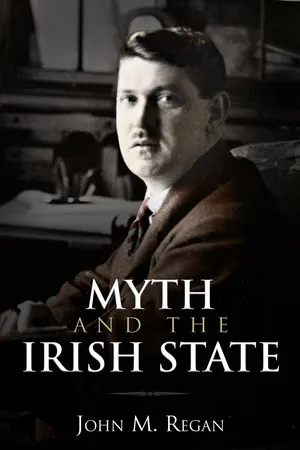
When we read a history we believe ourselves to be reading cold, hard, facts of the events that took place and how they occurred. But there is no real, truthful way to know the approach our historian has taken with the historical sources. This book deals with the uncertainty in writing history in the context of Irish history in particular. Regan argues in this book that the notion of elision, simply ignoring unhelpful evidence, threatens Irish history today. Regan believes that some historians have ignored unhelpful facts that perhaps do not further their point or perhaps contradict them altogether. Each chapter focuses on a period of Irish history that Regan believes to be inconsistent or incomplete in its facts. He asks the controversial questions about the period of history such as why do some historians deny or marginalise the British threat of war and re-conquest in 1922?, why do so many Irish historians describe Michael Collins as a constitutionalist or a democrat when the evidence argues otherwise? Was the Irish Civil War really fought between democrats defending the state, against dictators attempting its overthrow? Did the new state briefly experience a military-dictatorship under Collins in 1922? Thinking historically is not about learning history or accepting the past as it is presented to us it is, as Regan argues in his thought-provoking work, about developing the critical skills to interpret history for ourselves.
- English
- ePUB (mobile friendly)
- Available on iOS & Android
eBook - ePub
Myth and the Irish State
About this book
Information
Topic
HistoireSubtopic
Histoire de l'IrlandeCHAPTER 1
1922: The British Threat*
In a series of fascinating and brilliantly argued interconnecting essays Professor Tom Garvin has addressed the emergence of a democratic Irish state through the pivotal period of what he terms the long 1922: from the truce of July 1921 to the dumping of arms in May 1923 which marked the end of the Civil War. He places the emergence of democracy in its historical and comparative contexts tracing the dominant ideas which fomented the Irish revolution – nationalism, republicanism and democracy – from their origins in classical Greece through the Enlightenment, to their collision in the French and American revolutions and their impact on the development of Irish revolutionaries.
Tom Garvin is particularly concerned with explaining the conundrum of a successful Irish democracy – the only Catholic state in Europe to sustain its democratic institutions in the inter-war period – given a relatively weak economy and its emergence from revolutionary instability. All of which he argues confutes Seymour Lipset’s theory that a prerequisite of a stable democracy is the relative material well-being of its electorate. In addressing this anomaly, Garvin focuses on the role of key decision-makers in ensuring the establishment and survival of democracy in the Free State against the will of an undemocratic and pre-political, localised revolutionary guerrilla army: the IRA. In particular he identifies the crucial parts played by William T. Cosgrave, Kevin O’Higgins and Richard Mulcahy who, he argues, were ‘unconditional democrats, and they killed people for the nascent Irish democracy that they saw menaced by the anti-Treatyites’ (p.205). In addition he acknowledges the huge contribution made to the formation of state institutions by Kevin O’Shiel and Hugh Kennedy, legal advisors to the Free State government.
The decisions, sometimes ruthless, made by the key players, Garvin argues, were crucial in establishing both the rule of law and enduring state institutions which enabled democracy not only to survive the Civil War but also, crucially, the transfer of power from its victors to the vanquished in 1932. The triumph and achievement of the first governments of the new state, so youthful and inexperienced in their composition, remains a remarkable feat. In highlighting their achievement Garvin seeks to address a historiographical imbalance created by the ‘de Valera school of revisionism’ which has tended to ignore, in public at least, the moral, intellectual and physical bravery of the State’s founders.
Tom Garvin’s 1922 is one of heroes and villains – and ultimately democrats and dictators – and his standard is firmly placed behind Treatyite lines. This allegiance derives from his argument that the Treatyites’ position was underpinned by a legitimacy which was ‘decisively ratified’ in both the June 1922 general election and the general election of August 1923 (p.42, p.127). Garvin’s argument attempts to transcend the pro- and anti-Civil War politics debate and argues that the Irish electorate in what is termed the ‘Irish Thermidor’ rejected revolutionary politics and militarism and embraced democratic rule. Tom Garvin’s claims for these elections supports his thesis that the Treatyites, and the Free State they created, were clearly backed by a democratic mandate delivered in 1922, and reconfirmed in 1923. The corollary of this argument is that the anti-Treatyites adopted an essentially anti-democratic position in 1922 or at best were hopelessly pre-democratic.
In fact neither the 1922 ‘pact’ nor the 1923 general elections produced decisive electoral decisions for the Treaty or the establishment of democratic government under it in the new Free State. The results of both elections reflect a much more complex political situation than a reductive majoritarian argument implies. The May 1922 pact agreed that both pro- and anti-Treaty deputies would stand together on a joint panel and be returned to a third Dáil in the same numbers existing in the second Dáil. On Collins’ insistence and against the will of de Valera, as Garvin identifies, other parties were allowed to stand. This arrangement produced a complex and ill defined result in the first contested general election using proportional representation in Southern Ireland. While the pro-Treatyites vote was the single largest – 38.5 per cent as against 21.2 per cent for the anti-Treatyites – it is to stretch a point that it was a vote either exclusively for the Treaty, an endorsement of the Provisional Government or for the establishment of a democratic regime under the Treaty. Any vote for a panel candidate – with the exception of two constituencies where the pact collapsed – was a vote for the status quo ante: which in effect aimed to frustrate the democratic will of the electorate in the hope of regenerating unity within Sinn Féin. As Michael Gallagher has observed the election transfers between the two – theoretically diametrically opposed – wings of Sinn Féin were extremely strong. Labour, Farmers and Independents combined secured 39.8 per cent of the vote. Roughly two-thirds of the electorate voted for Sinn Féin’s right to frustrate the democratic will of the people and to thwart the movement towards civil war, and one third voted for non-panel candidates which, as more than one historian has argued, represented the electorate’s wish to ‘cry a plague on both pro- and anti-Treaty houses’. That this was an endorsement of the Treaty, Provisional Government, let alone the mandate Collins claimed it to be to wage a civil war is, to say the least, open to question. The assumption that the ‘pact’ general election result was a decisive result for all three is essential to Tom Garvin’s argument that the division in 1922 was a clear-cut one between those who accepted the sovereignty of the people and those who could not.
Like the Montagues and the Capulets – or perhaps more appositely here the Treatyite ‘Jets’ and the anti Treatyite ‘Sharks’ – neither had a monopoly on virtue or vice. Such was the confusion of 1922 there were elements of undemocratic political culture in both pro- and anti-Treaty factions at the start of the Civil War. As Garvin argues the IRA used widespread intimidation to assert its will over the electorate in 1922, and in particular to dissuade non-panel candidates from going forward in the pact election. This is undoubtedly true and his evaluation of the political culture of the IRA, or the ‘Public Band’ as it is termed, offers a refreshing and enlightening antidote to the Breen/Barry memoir genre.
While Garvin is right to debunk some of the myth of the risen Fianna of 1920, he plays down, where he does not remove altogether, the significance of the threat of British violence hanging over Ireland in 1922. The uncomfortable reality of 1922, which enhanced the ‘Public Band’s’ antipathy to parliamentary democracy, was the omnipresent threat of renewed British violence. The Irish electorate stood in its annus horribilis with its head held squarely at gun point by the small bore revolvers of the IRA on one side and the decidedly larger weaponry of the British imperial war machine on the other.
The threat of renewed British violence and the recommencement of executions of IRA prisoners in British goals subverted any possibility of a free election and this was central to the anti-Treatyites’ opposition to the holding of elections in 1922. Liam Mellows argued that support for the Treaty and the Provisional Government was ‘not the will of the people; it is the fear of the people’. The anti-Treatyites did fear an election, not because they would lose but because under duress from the British they could not hope to win. This was the argument put forward by Cathal Brugha at the Mansion House conference in April 1922 as the chief objection to an election and again by de Valera in the period which preceded. It could be argued that this was simply the losers of 1922 hiding behind the facade of democratic niceties or just another ploy plucked from the sophist’s bag of tricks to thwart the will of the people; or the will of a more practical man like Collins who was prepared to work under such constraints. The totality of evidence – the anti-Treaty argument when identified in 1922, their performance as they metamorphosed into Fianna Fáil in 1926, a constitutional opposition in 1927, and a constitutional government in 1932 – at least begs a reconsideration of the argument that they were devoid of constitutionality or democratic culture in 1922.
What separated the anti-Treaty and pro-Treaty sides was not necessarily the question of whether the electorate should be allowed to decide but whether or not they were to do so free of British interference. Tom Garvin is exactly right in identifying an anti-democratic culture within elements of the IRA and produces convincing evidence to support it. But there also existed within the anti-Treaty camp, most notably within its elite cadres, a fundamentalist or moral strain of democratic culture – analogous to its fundamentalist or moral republicanism – which dispensed with material considerations when it wished to assert the Irish nation’s right to self-determination. Such thinking would later be demonstrated by de Valera with the decision to withhold land annuities from the British government in the 1930s and, arguably, the policy of neutrality during the Second World War. The sum of the nationalist revolution had been the aspiration of self-determination, and this was exactly what was being denied to the Irish electorate in 1922 by the threat of renewed British violence. The anti-Treatyites’ response was not practical politics, it was arguably not even logical, but neither was it exclusively anti-democratic. Garvin might counter within his own thesis that the difference between the two was that of an anti-Treaty Rousseauian application of the general will against the will of the electorate as it then pertained. In other words de Valera was looking into his heart instead of into election statistics. In fact the conflict was much simpler and explains much of the political action of 1922. The division within revolutionary Sinn Féin was not over whether or not the people had the right to be sovereign, but whether they had the right to express their sovereignty freely and between the two there is a significant qualitative difference.
Collins was too practical and too ambitious a man to pass up an opportunity for either national or self advancement, least of all as he saw in the case of the Treaty and events of 1922 where the two coincided. Collins produced a blinding performance which may or may not have been framed by the ‘democratic instincts’ that are ascribed to him here by Garvin. He championed the Treatyite position created in the first instance, and driven by, the threat of renewed war and certain defeat by the British. The pact, as Tom Garvin identifies was a means of circumventing the IRA and holding an election which under the circumstances would give him a claim to a highly questionable mandate. He dropped the Free State constitution on the electorate on the morning of the plebiscite, abandoned the pact and prorogued the resulting parliament before it met on Saturday 1 July, thus giving himself the chance to strike at the opposition without being made accountable to a parliament which would have queried his ‘democratic mandate’ – politics was never sharper nor audacity blunter. What Collins understood better than de Valera was that democracy as a hard concept had no place in the revolutionary politics of 1922.
If the Treaty had a decisive mandate in June 1922, it had evaporated within a year. After IRA destruction in the anti-Treaty cause, Sinn Féin secured 290,000 votes (28 per cent of the total) in the August 1923 general election with perhaps as many as a further 20,000 of its supporters interned, on the run, emigrated, dead or dislocated. It was not a majority but as in 1922, it robbed the Treatyites (who polled 39 per cent) of a decisive victory. The division of 1922 was between competing interpretations of sovereignty, democracy, republicanism and national justice and on all three definitions the two sides were closer than is sometimes assumed. The triumph of Irish democracy was not borne of post-revolutionary conversions on the road to Damascus – or more accurately on the remarkably short Odyssey from the Four Courts of June 1922 to Leinster House in August 1927 – but from small adjustments to new conditions. The attraction, and the source of endless frustration when working on the disintegration of the Irish revolution, and Garvin argues this point in relation to cultural nationalism, is that its component parts refuse to fit into polemic models. Republicanism as much as democracy was not the preserve of either the pro- or anti-Treatyites, and it is an over simplification to ascribe either concept to just one grouping.
In an engaging and sparkling firefly style, Garvin confronts the reader with creative and original arguments, goading and challenging long-held assumptions along the way. The two chapters on local government and the establishment of order in the new state surpass anything that has been written on either subject to date. This is a study full of insights, observations, inversions and reflections on the nature and abundant anomalies of the Irish revolution and the culture of its perpetrators and successors. In singling out the commonplace and elevating it for the purposes of analysis Garvin identifies issues of huge importance to political activity and performance: the IRA taboo of shooting unarmed individuals which ensured the acceptance of the Civic Guards as a stabilising force within the new order; or the defining influence of women at local and national level within a machismo culture where extremism – political and military – was often equated with masculinity. The complexity of the thesis that is developed within the book reflects the complexity of the events and the ideas generated in the process of consolidating a revolution which never reached ideological maturity within a democracy. The Irish revolution has only recently begun to be addressed by historians and political scientists with the sophisticated analysis it demands. Within the framework of both disciplines Tom Garvin’s 1922 is a ground breaking study in terms of its use of original sources and the conceptualisation of the major issues and the ideas which generated them.
NOTE
*Tom Garvin, 1922: The Birth of Irish Democracy (Dublin: Gill and Macmillan, 1996) first published in History Ireland, 5/2 (Summer, 1997), pp. 54-6.
CHAPTER 2
Peter Hart and Meda Ryan: Problems with Sources*
Meda Ryan’s biography of the Irish guerrilla leader Tom Barry sits squarely in a nationalist historiography which still celebrates the violence of Irish state formation. Its primary thrust is to question recent revisionist interpretation of Barry’s war and notably that offered by Peter Hart in his widely acclaimed The IRA and its enemies (Oxford, 1998). In two provocative chapters Ryan challenges Hart’s interpretation of a small but for nationalists symbolically important ambush at Kilmichael in County Cork in November 1920, and Hart’s contention elsewhere, that IRA violence could be motivated by sectarianism.
While Ryan accepts Protestants were murdered by republicans in West Cork in April 1922, she argues the elimination of spies and informers was the main motive: their identities having been betrayed in a document left behind by departing British forces. Ryan’s interpretation is cogent but it only serves to illustrate a fundamental blind spot in the republican–nationalist interpretation of revolutionary violence. No doubt those doing the killing in April 1922 convinced themselves they were defending the ‘republic’ and not attacking a religious minority. However, this is to deny the inescapable logic that in Ireland from the seventeenth century religion and political identity are intertwined. Loyalism and Protestantism cannot be divorced from each other, though nationalists advocating either contemporary or retrospective use of violence to achieve ‘freedom’ have claimed otherwise. Were not such ‘traitors’ protected by a Truce in operation after 11 July 1921? Ethnic-inspired violence, in County Cork or on the streets of Belfast (which provided the ignored context for these outrages), did not care for the rules of war.
The fact that Ryan belongs to a republican–nationalist tradition does not mean her work, more importantly her engagement with historiography, can be either ignored or dismissed as nationalism with footnotes. Her work rests on four decades of research and is hewn from Barry’s substantial papers here documented for the first time. Whatever her bias, Ryan is expert in the field. Her response to Hart’s interpretation of the Kilmichael ambush and pointedly his claim that seventeen British Auxiliaries (a paramilitary police force consisting of ex-officers) were murdered after offering a false surrender is motivated by combinations of local pride, and, perhaps, a misplaced belief the IRA upheld codes of chivalry. Nevertheless, her counter-argument cannot easily be dismissed and she questions with meticulous logic Hart’s methodology. On the documentary evidence Ryan identifies inaccuracies and inconsistencies which question both the provenance and authorship of a ‘captured’ IRA document, ‘The Rebel Commandant’s Report’, essential to Hart’s reinterpretation of Kilmichael. Certainly, it seems unlikely Barry himself authored it and this challenges Hart’s proposition that there was no false surrender at Kilmichael, an execution was ordered, and Barry’s ‘lies and evasions’ simply justified the carnage long after the fact.
It is the use by Hart of oral evidence which raises the most intriguing questions from Ryan. Hart, as late as 1988 and 1989, was able to secure interviews with IRA veterans of the ambush one of whom, he notes, visited the site with him. Hart was indeed fortunate in finding survivors of the ambush alive and lucid nearly seventy years after the event. Moreover, he recorded their radically alternative interpretations kept private during the intervening decades. Sensitivity surrounding the alleged execution of prisoners remains so acute Hart took the precaution of anonymizing their testimony. Ryan (a native of West Cork) states only one veteran of the ambush was alive when Hart conducted interviews, but he was no longer compos mentis. The question pointedly raised is who did Ha...
Table of contents
- Cover
- Title Page
- Dedication
- Copyright
- Contents
- Acknowledgements
- Preface
- Introduction: Myth and the Irish State
- 1. 1922: The British Threat
- 2. Peter Hart and Meda Ryan: Problems with Sources
- 3. The Sectarian Underbelly of the Irish Revolution
- 4. Southern Irish Nationalism as a Historiographical Problem
- 5. Addressing the Dictatorship
- 6. Understanding Irish Nationalisms
- 7. Michael Collins, General Commanding-in-Chief, as a Historiographical Problem
- 8. Irish Public Histories as an Historiographical Problem
- 9. The ‘Bandon Valley Massacre’ as a Historical Problem
- 10. The History of the Last Atrocity
- 11. Irish Historians and ‘das Butterfieldproblem’
- 12. The ‘O’Brien Ethic’ as an Interpretative Problem
- Index
Trusted by 375,005 students
Access to over 1.5 million titles for a fair monthly price.
Study more efficiently using our study tools.
Frequently asked questions
Yes, you can cancel anytime from the Subscription tab in your account settings on the Perlego website. Your subscription will stay active until the end of your current billing period. Learn how to cancel your subscription
No, books cannot be downloaded as external files, such as PDFs, for use outside of Perlego. However, you can download books within the Perlego app for offline reading on mobile or tablet. Learn how to download books offline
Perlego offers two plans: Essential and Complete
- Essential is ideal for learners and professionals who enjoy exploring a wide range of subjects. Access the Essential Library with 800,000+ trusted titles and best-sellers across business, personal growth, and the humanities. Includes unlimited reading time and Standard Read Aloud voice.
- Complete: Perfect for advanced learners and researchers needing full, unrestricted access. Unlock 1.5M+ books across hundreds of subjects, including academic and specialized titles. The Complete Plan also includes advanced features like Premium Read Aloud and Research Assistant.
We are an online textbook subscription service, where you can get access to an entire online library for less than the price of a single book per month. With over 1.5 million books across 990+ topics, we’ve got you covered! Learn about our mission
Look out for the read-aloud symbol on your next book to see if you can listen to it. The read-aloud tool reads text aloud for you, highlighting the text as it is being read. You can pause it, speed it up and slow it down. Learn more about Read Aloud
Yes! You can use the Perlego app on both iOS and Android devices to read anytime, anywhere — even offline. Perfect for commutes or when you’re on the go.
Please note we cannot support devices running on iOS 13 and Android 7 or earlier. Learn more about using the app
Please note we cannot support devices running on iOS 13 and Android 7 or earlier. Learn more about using the app
Yes, you can access Myth and the Irish State by John M. Regan in PDF and/or ePUB format, as well as other popular books in Histoire & Histoire de l'Irlande. We have over 1.5 million books available in our catalogue for you to explore.