This report presents the results of a stocktake of national responses to Sustainable Development Goals 12, 14, and 15, and selected environment-related targets that have a direct relationship with responsible consumption and production, and sustainable marine and terrestrial ecosystems management, by 15 developing countries in Asia and the Pacific. The report was completed under the first phase of a technical assistance project by the Asian Development Bank, with the aim of understanding and helping its developing member countries address the issues and challenges behind effective integration of these goals and targets into national policies, plans, and programs.
- 94 pages
- English
- ePUB (mobile friendly)
- Available on iOS & Android
eBook - ePub
About this book
Information
1 Introduction
1.1 Background on the Report
This report presents the results of a survey of national responses to selected environment-related Sustainable Development Goals (SDGs) and targets in 15 Asian Development Bank (ADB) developing member countries (DMCs) from across Asia and the Pacific. The stocktake was completed under the first phase of an ADB technical assistance (TA) project on Supporting Implementation of Environment-Related Sustainable Development Goals in Asia and the Pacific.1 The TA project aims to help DMCs in the region strengthen their responses to the environmental dimensions of the SDGs, notably SDGs 12, 14, and 15,2 and selected environment-related targets determined as having a direct relationship with responsible consumption and production, and sustainable marine and terrestrial ecosystems management. It seeks to ensure the environmental dimensions of the SDGs are not left behind in Asia and the Pacific.
The main objectives of this report are (i) to take stock of progress on and identify challenges in implementing the environmental dimensions of the SDGs in Asia and the Pacific; and (ii) to make pragmatic recommendations on how DMCs in the region can enhance their capacities to overcome recurring barriers to integrating the environmental dimensions into their national policies, plans, and programs.
This chapter provides important background on the SDGs. It also discusses the growing need to take an integrated approach, setting the scene for a deeper review of challenges to integration of the environmental dimensions of the SDGs later in the report.
1.2 Background to the Sustainable Development Goals
The SDGs (Figure 1) were conceived in what was then the most inclusive intergovernmental process to date.3 Through a carefully designed set of deliberations and meetings following Rio+20 in 2012, a United Nations (UN) Open Working Group recommended 17 SDGs and 169 targets universal and globally applicable to all countries, irrespective of their level of development. The 2030 Agenda for Sustainable Development was adopted at the UN Sustainable Development Summit in September 2015 with these SDGs as its centerpiece. Subsequently, a set of 232 indicators to monitor the targets was developed by the Inter-agency and Expert Group on SDG Indicators and adopted at the UN General Assembly in July 2017.4
Figure 1: The Sustainable Development Goals
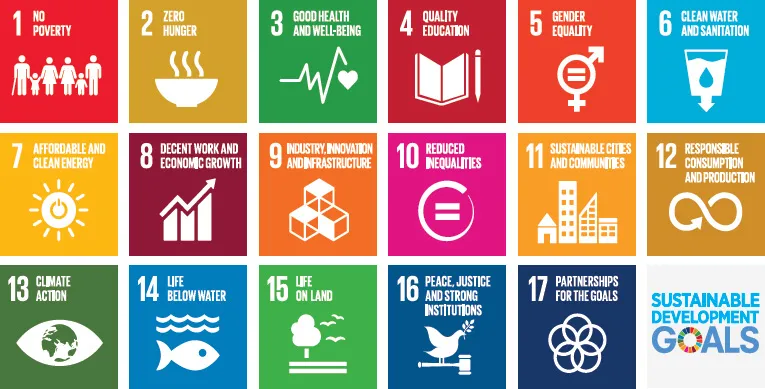
Source: United Nations. 2015. https://www.un.org/sustainabledevelopment/sustainable-development-goals/.
Beyond their inclusivity and universality, one of the more notable features of the SDGs and their 169 targets is that they place an equal emphasis on the economic, social, and environmental dimensions of sustainable development. To ensure equal weighting of priorities, countries are encouraged to treat the SDGs as an integrated framework for action, recognizing the role that the environment plays in socioeconomic development and vice versa. Nonetheless, there is a risk countries will struggle to integrate the SDGs’ environmental dimensions into their development plans. While many countries have made commitments to the environment, it is a challenge to translate these into meaningful action.
1.3 The Importance of an Integrated Approach
Over more than 4 decades, the environmental community has underlined the need for development that does not exceed the ecological limits of growth. Recent research shows the environment does not simply set limits on socioeconomic development. Rather, this is a dynamic relationship wherein “nested interdependencies” exist between the economic, social, and environmental dimensions of sustainable development (Figure 2).5 The failure to recognize the important role of the environment in development plans is already resulting in adverse effects on the health and well-being of populations, and could ultimately undermine other socioeconomic achievements. Nonetheless, the explicit integration of the environment in policy decisions could stimulate economies and address equity concerns. At an international level, three processes have contributed important lessons: (i) milestone international conferences and reports, (ii) multilateral environmental agreements (MEAs), and (iii) the Millennium Development Goals (MDGs).
Figure 2: Nested Interdependencies
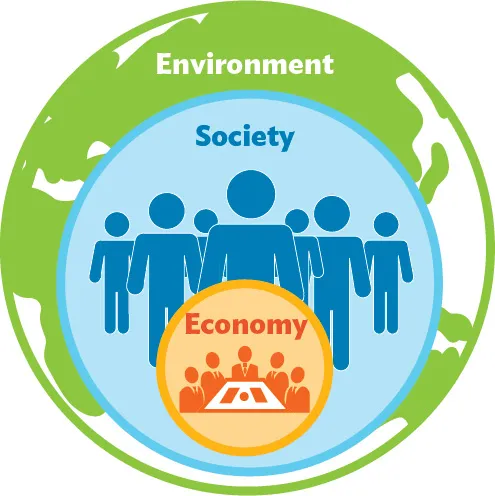
Source: D. Griggs et al. 2013. Policy: Sustainable Development Goals for People and Planet. Nature 495. No. (7,441).
Calls for integration in international environmental conferences have risen to prominence lately, but are far from new. These calls were voiced nearly every decade since the UN Conference on the Human Environment in 1972. They include statements from milestone documents, such as the 1987 Brundtland Report’s support for stronger integration across environmental and economic resources.6 They also came out of global sustainable development summits, such as, the 1992 Earth Summit in Rio de Janeiro, Brazil, where Agenda 21 pointed to four areas where environment and development could be integrated: policy, planning, and management levels; legal and regulatory frameworks; use of economic instruments; and environmental and economic accounting.7 Similar suggestions were articulated at the 2002 World Summit on Sustainable Development in Johannesburg, South Africa, with the Johannesburg Plan of Implementation.8 But these calls for greater support for integrating the environment, arguably, have lacked the targets and incentives provided by the MEAs.
The MEAs offer both positive and negative lessons for efforts to integrate the environment in development plans. For the positive lessons, most MEAs focus on a specific set of problems with a related reporting process and possible funding sources or other forms of technical support. Due to their issue-specific focus, some MEAs helped boost awareness of environmental problems that otherwise may have gone unnoticed, and generated action where momentum may have been lacking. In many cases, both reporting and awareness raising were encouraged by targets and incentives for implementation. But while the MEAs capitalized on these targets and incentives, many also failed to fully account for interlinkages with other environmental issues or socioeconomic development priorities.9
The MDGs offer another set of positive and negative lessons for ongoing efforts to integrate the environment. Some favorable lessons relate to the significant headway made by the MDGs in encouraging and tracking voluntary action on a select set of development areas, where past international development initiatives often failed. However, partially because the MDGs were conceived through an exclusive, closed-door process by a group of experts appointed by the UN Secretary-General, some issues did not receive sufficient levels of attention.10 This may have been the case with the one MDG on environmental sustainability (MDG 7), formulated in a hasty, ad hoc manner. As environmental sustainability was confined to a single goal, the MDGs took a rather sectoral approach that did not—or only weakly—recognized the links between the environment and development priorities.11
The question that arises is how the international community and countries can learn from the experiences with the MEAs and MDGs, while carrying forward the long-standing support for integration found in milestone international conferences and reports. In many ways, the SDGs provide the answer to this question. By their nature, the 17 SDGs and their 169 targets require integrated implementation strategies given the interlinkages within and between the goals. They also retain the emphasis on goal setting and (voluntary) reporting that proved helpful in the case of some of the MEAs and the MDGs. In total, the SDGs reflect the international communities’ commitment to integration, but with greater attention to goal setting, reporting, and financial and other means of implementation (MOI), which are more familiar to the ways the MEAs and MDGs helped spur action. The SDGs have already begun to integrate this combined commitment into several relevant processes at the global and regional levels (Box 1).
Box 1: Incorporating the Sustainable Development Goals into Regional Policy-Making Processes in Asia and the Pacific
The first Asia–Pacific Ministerial Summit on the Environment, jointly organized by the United Nations Economic and Social Commission for Asia and the Pacific (UNESCAP) and the United Nations Environment Programme (September 2017 in Bangkok, Thailand), focused on addressing the links between resource efficiency and pollution reduction, under the theme “towards a resource-efficient and pollution-free Asia–Pacific.” The Ministerial Declaration on Environment and Development for Asia and the Pacific, 2017, which was adopted as a key outcome of the summit, called for enhanced policy coherence and interlinkages between the three dimensions of sustainable development to accelerate the implementation of the Sustainable Development Goals and transition toward environmentally sustainable economies and societies for all. The declarationa also aligns with the recommendations of the Regional Road Map for Implementing the 2030 Agenda for Sustainable Developmentb adopted at the 4th Asia–Pacific Forum on Sustainable Development in March 2017. Both documents identified critical areas for joint environmental action, and addressed sustainable and efficient natural resource management and resource use, ecosystems conservation and rehabilitation, and climate action.
a UNESCAP. 2018. Ministerial Declaration on Environment and Development for Asia and the Pacific, 2017. https://www.unescap.org/commission/74/document/E74_10A1E.pdf.
b UNESCAP. 2017. Regional Road Map for Implementing the 2030 Agenda for Sustainable Development in Asia and the Pacific. https://www.unescap.org/publications/regional-road-map-implementing-2030-agenda-sustainable-development-asiaand-pacific.
Source: Authors.
1.4 Taking Advantage of the Sustainable Development Goals
The SDGs hold considerable promise to build on and extend beyond the achievements of past international processes. Their ultimate success will rest on responses from and action taken by national governments rather than trends in global agreements. The question is, are countries taking advantage of the SDGs in strengthening their environmental dimensions? At least on the surface, the answer seems to be yes.
Countries often refer to integration in public statements and planning documents. Moreover, the Voluntary National Reviews—developed for reporting requirements on the SDGs at the annual High-level Political Forum on Sustainable Development (HLPF)—show some efforts to align existing development plans and priorities with the SDGs and the 2030 Agenda for Sustainable Development. However, the view is less encouraging below these surface-level assessments. At a global level, SDG activities appear to be a rebranding or repackaging of existing activities, suggesting a lack of additional action on integrating the environmental dimensions.
Part of the challenge for countries is that the widespread adoption of an integrated approach involves explicitly acknowledging how environmental and socioeconomic issues affect each other across multiple stages of decision-making (from planning through implementation, to monitoring and review). Furthermore, supporting integration of the environment into multistage decision-making processes will necessitate strengthening at least four key areas: (i) institutional architecture and leadership; (ii) enabling policies and regulatory frameworks; (iii) finance, capacity, and other MOI; and (iv) indicators, data, and monitoring and evaluation, wh...
Table of contents
- Front Cover
- Title Page
- Copyright Page
- Contents
- Tables, Figures, and Boxes
- Abbreviations
- Foreword
- Acknowledgments
- Executive Summary
- 1. Introduction
- 2. Environmental Dimensions of the Sustainable Development Goals
- 3. Stocktake Objectives and Methods
- 4. Stocktake Findings
- 5. Conclusions and Recommendations
- References
- Appendixes
- Footnotes
- Back Cover
Trusted by 375,005 students
Access to over 1.5 million titles for a fair monthly price.
Study more efficiently using our study tools.
Frequently asked questions
Yes, you can cancel anytime from the Subscription tab in your account settings on the Perlego website. Your subscription will stay active until the end of your current billing period. Learn how to cancel your subscription
No, books cannot be downloaded as external files, such as PDFs, for use outside of Perlego. However, you can download books within the Perlego app for offline reading on mobile or tablet. Learn how to download books offline
Perlego offers two plans: Essential and Complete
- Essential is ideal for learners and professionals who enjoy exploring a wide range of subjects. Access the Essential Library with 800,000+ trusted titles and best-sellers across business, personal growth, and the humanities. Includes unlimited reading time and Standard Read Aloud voice.
- Complete: Perfect for advanced learners and researchers needing full, unrestricted access. Unlock 1.5M+ books across hundreds of subjects, including academic and specialized titles. The Complete Plan also includes advanced features like Premium Read Aloud and Research Assistant.
We are an online textbook subscription service, where you can get access to an entire online library for less than the price of a single book per month. With over 1.5 million books across 990+ topics, we’ve got you covered! Learn about our mission
Look out for the read-aloud symbol on your next book to see if you can listen to it. The read-aloud tool reads text aloud for you, highlighting the text as it is being read. You can pause it, speed it up and slow it down. Learn more about Read Aloud
Yes! You can use the Perlego app on both iOS and Android devices to read anytime, anywhere — even offline. Perfect for commutes or when you’re on the go.
Please note we cannot support devices running on iOS 13 and Android 7 or earlier. Learn more about using the app
Please note we cannot support devices running on iOS 13 and Android 7 or earlier. Learn more about using the app
Yes, you can access Strengthening the Environmental Dimensions of the Sustainable Development Goals in Asia and the Pacific by in PDF and/or ePUB format, as well as other popular books in Economics & Environmental Economics. We have over 1.5 million books available in our catalogue for you to explore.