- 224 pages
- English
- ePUB (mobile friendly)
- Available on iOS & Android
eBook - ePub
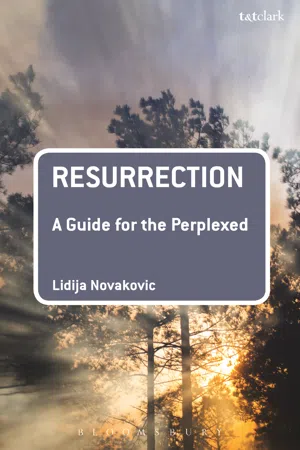
Resurrection: A Guide for the Perplexed
About this book
This volume examines what the followers of Jesus meant when they declared that he was raised from the dead. This claim, which lies at the core of Christian faith, is one of the most controversial topics in Christianity. Jesus' resurrection has no analogy in human history. Although many 1st-century Jews expected the resurrection of the dead at the end of time, the Christian claim that this had already happened to one individual within the realm of history was unprecedented. Moreover, an affirmation of Jesus' bodily resurrection contradicts the known laws of nature. Additional difficulty comes from the nature of the available evidence. The New Testament sources not only mirror the worldview of ancient authors but also differ with regard to who saw him alive, what was the nature of his risen body, and whether the empty tomb was a widespread knowledge or an assumption based on prior beliefs. Novakovic presents all these issues in a clear and methodical way. She examines the literary sources and addresses various questions related to historical investigations of Jesus' resurrection.
Information
1
Resurrection Hope in Second Temple Judaism
Belief in resurrection emerged as a specifically Jewish concept of afterlife. Its defining characteristic is the idea that some sort of embodied life will be restored after an interim period of ‘death-as-a-state’. Both aspects of this definition – restoration of the body and an interval between one’s death and one’s resurrection – are nicely articulated in the ingenious formulation coined by N. T. Wright, who describes resurrection as bodily ‘life after “life after death”’.1 Scholars customarily emphasize the difference between the Jewish idea of the resurrection of the body and the Platonic idea of immortality of the soul and other Hellenistic beliefs about afterlife, such as the shadowy existence of the dead in Hades. This distinction remains valid even if one considers various stories about reanimated corpses or people being taken bodily into a divine realm after death that were popular among lower classes – such ideas about post-mortem embodied life did not find wider acceptance. Plutarch’s comments on this subject are quite illustrative of the general attitude toward afterlife in the Greco-Roman world:
At any rate, to reject entirely the divinity of human virtue, were impious and base; but to mix heaven with earth is foolish. Let us therefore take the safe course and grant, with Pindar, that ‘Our bodies all must follow death’s supreme behest, but something living still survives, an image of life, for this alone comes from the gods.’ Yes, it comes from them, and to them it returns, not with its body, but only when it is most completely separated and set free from the body, and becomes altogether pure, fleshless, and undefiled. For ‘a dry soul is best’, according to Heracleitus, and it flies from the body as lightning flashes from a cloud. But the soul which is contaminated with body, and surfeited with body, like a damp and heavy exhalation, is slow to release itself and slow to rise towards its source. We must not, therefore, violate nature by sending the bodies of good men with their souls to heaven, but implicitly believe that their virtues and their souls, in accordance with nature and divine justice, ascend from men to heroes, from heroes to demi-gods, and from demi-gods, after they have been made pure and holy, as in the final rites of initiation, and have freed themselves from mortality and sense, to gods, not by civic law, but in very truth and according to right reason, thus achieving the fairest and most blessed consummation. (Plutarch, Rom. 28.6–8; Perrin, LCL)
In contrast to such adamant denial of any participation of the body in life after death, resurrection hope upholds the restoration of embodied life. The main difficulty in studying the concept of resurrection in Jewish literature, however, comes from the fact that the idea of embodiment does not provide a clear criterion for the selections of texts that should be considered. To begin with, the expectation of a restored embodied life is not identical to the expectation of the restoration of the same kind of physicality that characterizes pre-mortem existence. Reviving the dead, that is, bringing someone back to the same life he or she formerly had, is resuscitation, not resurrection. Such a person will, like everyone else, eventually die again. Resurrection refers to an embodied afterlife that is not characterized by mortality. There is thus a certain discontinuity between pre-mortem and post-mortem bodies. Moreover, while for many contemporary readers the idea of embodiment is related to the distinction between material and immaterial entities, for people in antiquity spiritual beings, even souls, were composed of some kind of material, or ‘stuff’, however ‘fiery’ or ‘airy’ it might be.2 How dense, then, should the post-mortem restored life be in order to be regarded as an embodied life? Finally, there is a problem of continuity between pre-mortem and post-mortem bodies. Second Temple Jewish texts are not unanimous with regard to the manner and the degree of the expected transformation of the decaying corpses into the new immortal bodies.
There are nevertheless certain elements that any working definition of resurrection should include, which can be used for identifying the passages that speak about resurrection hope: (1) reference to literal death; (2) revival of the dead after an interim period of lifelessness; and (3) a new embodied post-mortem life that stands in continuity but is not identical with pre-mortem existence. Whether a text contains the verbs ‘rise’, ‘arise’, ‘raise’ and the like is not decisive, though it is important. This procedure is, admittedly, to some degree circular. We are using the above criteria to distinguish the resurrection texts in order to learn from these texts what Jews in the Second Temple period believed about the resurrection of the dead. Without these preliminary definitions, however, we will not be able to distinguish between various conceptions of afterlife that can be found in the extant Jewish literature. These criteria are broad enough to allow the inclusion of a range of texts that refer to bodily resurrection, yet differ with regard to when this event will take place, what the characteristics of resurrected bodies are, how they are related to pre-mortem bodies and how individual identity is preserved. The first part of this chapter offers a survey of relevant passages in the Jewish Scriptures, while the second part contains a discussion of relevant passages in early Jewish writings that were not accepted into the Hebrew canon.3
1. The Idea of Resurrection in the Jewish Scriptures
Unlike Israel’s neighbours, who have shown considerable interest in the fate of the dead (e.g. the Egyptian cult of the dead and the Mesopotamian cult of ancestral veneration), the authors of the Jewish Scriptures do not reveal much interest in the questions of afterlife. This does not mean that the Hebrew Bible is completely silent on this subject, but only that the texts about afterlife are relatively sparse. Yet even this handful of texts betrays a surprising diversity. Some passages (Deut. 26.14; Isa. 14.9; 26.14; Ps. 88.11; 106.28; Prov. 2.18; 9.18; 21.16; Job 26.5–6) reveal a belief in Sheol as the abode of the shades of the departed, whereas other texts indicate that in some circles the notion of afterlife was completely rejected (Job 14.12–14; Sir. 17.28; 41.4; Eccl. 9.5–10). A more contested piece of evidence is found in certain psalms, such as Psalms 16.9–10 and 73.23–26, which is interpreted by some scholars as a longing for beatific vision after death and by others as merely a desire to remain continuously in God’s presence. The Greek translation of these psalms further complicates the matter, because several expressions, such as the assertion in Psalm 15.10 LXX (Ps. 16.10 in the Hebrew Bible), ‘you will not abandon my soul to Hades or give your devout to see corruption’, could be understood, in the opinion of some interpreters, as references to resurrection. Without denying the possibility that later readers, such as Luke’s portrayal of Peter in Acts 2.31, could have understood these formulations as evidence for resurrection hope, this interpretation remains doubtful in its original historical and literary setting.
There is a general agreement that Daniel 12.1–3 contains the clearest evidence for belief in resurrection in the Hebrew Bible. Before discussing this text, however, it would be helpful to review three scriptural passages that use the resurrection imagery in the context of the restoration of Israel: Ezekiel 37.1–14; Hosea 6.1–3 and possibly Isaiah 26.19. Even though they do not fulfil the criteria specified above, they use the language that became instrumental for the development of resurrection hope.
1.1. Ezekiel 37.1–14
The vision of the valley of dry bones that are revived by God’s spirit provides the most graphic description of the revival of the dead in the Hebrew Scriptures. The process of revivification consists of two major stages: (1) assembling of dry bones, followed by the gradual appearance of sinews, flesh and skin, and (2) reanimation of the restored corpses through the spirit of God.
The hand of the Lord came upon me, and he brought me out by the spirit of the Lord and set me down in the middle of a valley; it was full of bones. He led me all around them; there were very many lying in the valley, and they were very dry. He said to me, ‘Mortal, can these bones live?’ I answered, ‘O Lord God, you know.’ Then he said to me, ‘Prophesy to these bones, and say to them: O dry bones, hear the word of the Lord. Thus says the Lord God to these bones: I will cause breath to enter you, and you shall live. I will lay sinews on you, and will cause flesh to come upon you, and cover you with skin, and put breath in you, and you shall live; and you shall know that I am the Lord.’ So I prophesied as I had been commanded; and as I prophesied, suddenly there was a noise, a rattling, and the bones came together, bone to its bone. I looked, and there were sinews on them, and flesh had come upon them, and skin had covered them; but there was no breath in them. Then he said to me, ‘Prophesy to the breath, prophesy, mortal, and say to the breath: Thus says the Lord God: Come from the four winds, O breath, and breathe upon these slain, that they may live.’ I prophesied as he commanded me, and the breath came into them, and they lived, and stood on their feet, a vast multitude. (Ezek. 37.1–10)
The commentary that follows, however, clarifies that this vivid description of the revival of the dead merely functions as an allegory for the political restoration of Israel. The dryness of the bones stands for the loss of hope, the graves represent the exile and the restoration of life signifies the return of the exiles to their homeland.
Then he said to me, ‘Mortal, these bones are the whole house of Israel. They say, “Our bones are dried up, and our hope is lost; we are cut off completely.” Therefore prophesy, and say to them, Thus says the Lord God: I am going to open your graves, and bring you up from your graves, O my people; and I will bring you back to the land of Israel. And you shall know that I am the Lord, when I open your graves, and bring you up from your graves, O my people. I will put my spirit within you, and you shall live, and I will place you on your own soil; then you shall know that I, the Lord, have spoken and will act, says the Lord.’ (Ezek. 37.11–14)
Although these verses leave no doubt that – in its current literary context – the revival of dry bones refers to national restoration, this commentary was largely ignored by some later readers, both Jewish (Pseudo-Ezekiel; Gen. Rab. 14.5; Lev. Rab. 14.9; the Targum to Ezekiel) and Christian (Justin, 1 Apol. 52; Irenaeus, Haer. 5.15.1; Tertullian, Res. 29–30), who ‘decontextualized’ the first ten verses and read them as a prophecy of literal resurrection of the dead. This interpretative trajectory is not surprising, though. Fragmentation of a text was a common exegetical practice in early Jewish and Christian literature. It seems that Ezekiel’s vision of dry bones supplied the new imagery and vocabulary that contributed to the emergence of resurrection hope and enabled the readers who adopted this belief in life after death to express it in tangible and vivid terms.
1.2. Hosea 6.1–3
In this passage, the prophet implores the audience to repent after a period of crisis in the northern kingdom and promises national restoration that will follow the time of deep despair. Like Ezekiel, Hosea uses resurrection language to communicate his message of hope, but, unlike Ezekiel, he does not attach a clarifying commentary regarding the meaning of this text in its current historical and literary setting.
Come, let us return to the Lord; for it is he who has torn, and he will heal us; he has struck down, and he will bind us up. After two days he will revive us; on the third day he will raise us up, that we may live before him. Let us know, let us press on to know the Lord; his appearing is as sure as the dawn; he will come to us like the showers, like the spring rains that water the earth. (Hos. 6.1–3)
Two temporal expressions, ‘after two days’ and ‘on the third day’, communicate the sense of urgency of God’s intervention on Israel’s behalf. The second phrase frequently appears in the rabbinic writings, which routinely interpret Hosea 6.2 as a prophecy of the resurrection of the dead at the turn of the ages (y. Ber. 5.2; y. Sanh. 11.6; b. Sanh. 97a; b. Roš Haš. 31a; Gen. Rab. 56.1; 91.7; Deut. Rab. 7.6; Esth. Rab. 9.2; Pirqe R. El. 51 [73b–74a]; Midr. Pss. 22.5; the Targum to Hosea). In these texts, the phrase ‘on the third day’ functions either as a general reference to the day of salvation or as a specific reference to the resurrection of the dead. It is also likely that either one or both of these meanings lie behind the ‘third day’ motif that appears in the early Christian confession that Christ ‘was raised on the third day in accordance with the scriptures’ (1 Cor. 15.4). This interpretative tradition, which was prevalent in the third century ce (although it may have been current already in the first century ce), is similar to the interpretative tradition of Ezekiel 37.1–10; a text that employed resurrection imagery to convey hope for national restoration was later interpreted as a text that spoke of the literal resurrection of the dead.
1.3. Isaiah 26.19
This verse is frequently interpreted as evidence of an early belief in the resurrection of the dead: ‘Your dead shall live, their corpses shall rise. O dwellers in the dust, awake and sing for joy! For your dew is a radiant dew, and the earth will give birth to those long dead.’ This understanding of the text, however, remains controversial. As we have seen in Ezekiel 37 and Hosea 6, the use of resurrection language and imagery is in and of itself inconclusive. The decisive question is whether t...
Table of contents
- Guides for the Perplexed
- Dedication
- Title
- Contents
- Preface
- Introduction
- 1 Resurrection Hope in Second Temple Judaism
- 2 Non-Narrative Traditions about Jesus’ Resurrection
- 3 Narratives about the Discovery of the Empty Tomb
- 4 Narratives about the Appearances of the Risen Jesus
- 5 Jesus’ Resurrection and History
- 6 Jesus’ Resurrection and Theology
- Bibliography
- Index
- Copyright
Trusted by 375,005 students
Access to over 1.5 million titles for a fair monthly price.
Study more efficiently using our study tools.
Frequently asked questions
Yes, you can cancel anytime from the Subscription tab in your account settings on the Perlego website. Your subscription will stay active until the end of your current billing period. Learn how to cancel your subscription
No, books cannot be downloaded as external files, such as PDFs, for use outside of Perlego. However, you can download books within the Perlego app for offline reading on mobile or tablet. Learn how to download books offline
Perlego offers two plans: Essential and Complete
- Essential is ideal for learners and professionals who enjoy exploring a wide range of subjects. Access the Essential Library with 800,000+ trusted titles and best-sellers across business, personal growth, and the humanities. Includes unlimited reading time and Standard Read Aloud voice.
- Complete: Perfect for advanced learners and researchers needing full, unrestricted access. Unlock 1.5M+ books across hundreds of subjects, including academic and specialized titles. The Complete Plan also includes advanced features like Premium Read Aloud and Research Assistant.
We are an online textbook subscription service, where you can get access to an entire online library for less than the price of a single book per month. With over 1.5 million books across 990+ topics, we’ve got you covered! Learn about our mission
Look out for the read-aloud symbol on your next book to see if you can listen to it. The read-aloud tool reads text aloud for you, highlighting the text as it is being read. You can pause it, speed it up and slow it down. Learn more about Read Aloud
Yes! You can use the Perlego app on both iOS and Android devices to read anytime, anywhere — even offline. Perfect for commutes or when you’re on the go.
Please note we cannot support devices running on iOS 13 and Android 7 or earlier. Learn more about using the app
Please note we cannot support devices running on iOS 13 and Android 7 or earlier. Learn more about using the app
Yes, you can access Resurrection: A Guide for the Perplexed by Lidija Novakovic in PDF and/or ePUB format, as well as other popular books in Theology & Religion & Biblical Studies. We have over 1.5 million books available in our catalogue for you to explore.