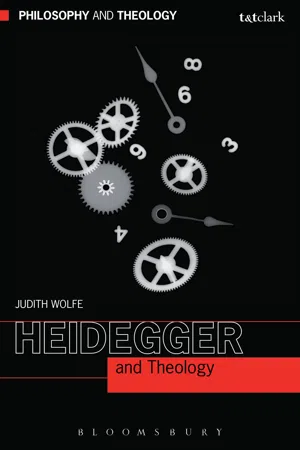
Martin Heidegger is the 20th century theology philosopher with the greatest importance to theology. A cradle Catholic originally intended for the priesthood, Heidegger's studies in philosophy led him to turn first to Protestantism and then to an atheistic philosophical method. Nevertheless, his writings remained deeply indebted to theological themes and sources, and the question of the nature of his relationship with theology has been a subject of discussion ever since.
This book offers theologians and philosophers alike a clear account of the directions and the potential of this debate. It explains Heidegger's key ideas, describes their development and analyses the role of theology in his major writings, including his lectures during the National Socialist era. It reviews the reception of Heidegger's thought both by theologians in his own day (particularly in Barth and his school as well as neo-Scholasticism) and more recently (particularly in French phenomenology), and concludes by offering directions for theology's possible future engagement with Heidegger's work.
- 256 pages
- English
- ePUB (mobile friendly)
- Available on iOS & Android
eBook - ePub
Heidegger and Theology
About this book
Information
Topic
PhilosophySubtopic
Philosophy History & Theory1
Heidegger’s Catholicism (1889–1915)
Heidegger’s home: Ultramontanism and anti-modernism
Martin Heidegger was born in 1889 in the small town of Messkirch in Baden, a semi-autonomous Grand Duchy in Southern Germany. His father was sexton and cooper at the local Roman Catholic church, and the Heidegger family lived in a Church-owned house near the parish church. This was a difficult time for Roman Catholics. Historically a Catholic state, Baden still had a predominantly Catholic population: two thirds – rising to more than nine tenths in rural districts – were Roman Catholics.1 However, the majority of Catholics were rural and other manual labourers who lived in villages and small towns away from the centres of power, and remained marginalized in the political and cultural life of the time. This marginalization also had to do with the resistance to current trends written into Roman Catholicism: the consolidation of the German Reich under Kaiser Wilhelm and Chancellor Bismarck did not sit well with traditional Catholic ultramontanism, that is, its general orientation towards the pope in Rome. Similarly, the liberalism of German Protestantism (which was also the driving force of national education and culture) went against the nineteenth-century Catholic resistance to modern trends. In the decades preceding Heidegger’s birth, the Catholic Church had tried to gain more independence from the increasingly overbearing influence of Protestant Prussia and of Baden’s own liberal Protestant cabinet, particularly by gaining or maintaining control of its denominational education and appointments. Although this Baden Kulturkampf was neither as drastic nor as hostile as Bismarck’s own Kulturkampf in Prussia, it resulted in an increasing sense of marginalization and oppression on the part of Catholics, and so stoked a political and intellectual backlash in which the young Martin became directly caught up.
In Messkirch, and especially in the sexton’s family, the ultramontanist and anti-modernist cause had a particularly high profile. In the decades before Martin’s birth, a majority of the Messkirch population had, for a time, joined the Old Catholic movement, relinquishing strict adherence to Rome in favour of a more autonomous and local Catholic life. From the 1870s until the re-establishment of Roman Catholicism in 1895, Martin’s father was among a small minority of ultramontanists, a commitment which incurred discrimination and even, for a while, the loss of the home (which belonged to the parish church).2
Martin could not fail to imbibe some of this entrenched religious commitment. The oldest son of the family, he was intended for the priesthood from an early age, and was sent to the (recently re-opened) episcopal schools in Constance and then in Freiburg from 1903 to 1909. The local community, once more rallied around Rome, also encouraged support for the ultramontanist cause by founding the Catholic daily Heuberger Volksblatt (1899). The ensuing (and locally famous) ‘Messkirch newspaper war’ between the Volksblatt and the liberal local daily Oberbadischer Grenzbote (founded 1872) continued until the demise of the Weimar Republic, and became the main local vehicle for carrying out the modernist controversy in Baden.3 The Volksblatt was both Heidegger’s first organ and one of our primary sources for his early public activities, which are often enthusiastically reported in its pages.
The dominant intellectual and cultural aspect of Heidegger’s Catholic milieu was its so-called anti-modernism. The First Vatican Council of 1870, with its formal declaration of papal infallibility, had established the Catholic Church as a fiercely counter-cultural and, to some extent, counter-political body. In the intellectual sphere, this opposition was directed against a wide range of trends which were seen as threats to a traditional Catholic understanding of existence, knowledge, faith and morality. In 1907, Pope Pius XI published an encyclical entitled Pascendi dominici gregis (‘Feeding the Lord’s flock’), in which he summarized these trends and threats under the term ‘modernism’, slated as ‘the synthesis of all heresies’.4 The term ‘modernism’ remained notoriously multivalent throughout the ensuing Modernismusstreit (modernist crisis), but was generally agreed to include methodical agnosticism (the use of secular methods in theology), vital immanentism (an understanding of religion as primarily a matter of feeling and experience), symbolism (the view that doctrines are only symbols of inner beliefs) and evolutionism (the view that authority and dogma undergo historical development).5
At home and in school, Heidegger imbibed a distinctly anti-modernist attitude.6 The pugnacious counter-cultural perfectionism of the anti-modernist movement suited his own temperament, and in his final school years, according to his headmaster’s graduation report of September 1909, he decided to seek admittance to the Jesuits, the most vocally anti-modernist society within the Church.7
Martin’s ‘passion for apologetics’8 soon came to public notice. On 6 September 1909, he presided over a 200th-anniversary celebration of Abraham a Sancta Clara (1644–1709), an Augustinian priest-orator from the nearby Kreenheinstetten. Abraham was revered as a patron by the literary circle surrounding the famous anti-modernist historian and writer Richard von Kralik,9 whose project of a cultural renewal based on Catholic principles strongly attracted the 20-year-old Heidegger. At the anniversary celebration, he encouraged all young people present to subscribe to Kralik’s journal Gral and ‘become its disciples’.10 The rival Catholic journal Hochland, Martin opined, should be shunned for ‘sailing more and more in the fairway of Modernism’.11 His speech was recorded enthusiastically in the Heuburger Volksblatt.
From 1909 to 1910, Heidegger also contributed directly to the ‘newspaper war’ by writing polemical pieces for the Volksblatt as well as several conservative Catholic journals, especially Der Akademiker and Allgemeine Rundschau.12 The rhetoric of these essays is typical of the anti-modernist literature of the period, but also reflects emphases and concerns that are distinctly and recognizably Heidegger’s. Modernist attitudes, in these short pieces, are to be despised because they emerge from and encourage weakness, delusion, and enslavement to the superficial, ephemeral and ‘low’. Similar emphases, though with very different philosophical and political backgrounds, will persist in his critique of ‘the crowd’ (das Man) in the late 1920s, and his short-lived support for National Socialism in the early 1930s.13
Heidegger’s earliest known publication is a lyrical short story about the dramatic conversion of a young atheist on All Souls Day, published in November 1909. It opens with a damning description of the urban ‘Moderns’, whose wilful confusion of their ‘passion [for] lust’ for ‘intelligence’ and ‘freedom’ has so deluded and sapped their strength that they can no longer distinguish the ‘dark, agonising night’ from sunlight, and ‘no longer hear the clangour’ of the ‘chains’ in which they ‘drag their tired, overwrought body through existence’.14 In evading the divine judgement call that sounds in the bells of All Souls’ morning, these ‘Moderns’ run away from ‘seriousness’, which ‘only befits the strong’: ‘The feeble soul, the dull, creeping soul flees from the redemptive seriousness of life which is eager to overcome; it shirks the self-reflection which is glad to make sacrifices.’15 In a book review in March 1910, Heidegger assimilates this contrast to Darwinist biology, which, during this period, he regards as a particularly fascinating corroboration of Christian belief.16 Just as all ‘higher life is predicated on the demise of the lower forms’, he argues in the review, so the higher, ‘spiritual life’ requires the ‘killing’ of ‘what is low’ in oneself.
In a May 1910 review of a work by the moral philosopher Friedrich Wilhelm Foerster, Heidegger transposes these concerns to a philosophical register.17 While the modernists demand free scientific enquiry and free thought, he argues after Foerster, true freedom of thought and joy of life require a habit of self-discipline: ‘Truly free thinking’, as Foerster puts it, ‘presupposes an heroic act of moral self-liberation’.18 Heidegger echoes this conviction almost verbatim elsewhere: ‘Strict logical thinking that hermetically seals itself off from all affective influences of the emotions, all truly presupposition-less scholarly work, requires a certain fund of ethical power, the art of self-collection and self-emptying.’19 Such self-liberation, however, according to Foerster, can only be achieved through obedience to the Catholic Tradition: ‘Not I should judge the highest Tradition from my perspective, but I should learn to evaluate myself in a wholly new way from its perspective: That is true emancipation, that is the service which firm objective authority can render the personal life.’20
Intellectual honesty or objectivity is here coextensive with personal truthfulness or ‘Wahrhaftigkeit’ (authenticity). Church doctrine is authoritative precisely because it contains not only factual truth but also the ‘light of truth’ that enables an authentic life. Heidegger echoes this idea in the conclusion of his Foerster review, borrowing the language of the Judeo-Christian Wisdom tradition. Here as ever after, Heidegger displays a remarkable sensitivity to the vision implicit in a particular language or semantic field; in this case, the fact that the biblical Wisdom genre inflects the classical ideal of knowledge with a specifically moral and spiritual emphasis culminating, for the Christian, in the Incarnation of the ‘Wisdom of God’ (1 Cor. 1.24):
To him who has never set foot on straying paths [cf. Ps 1.1; Prov 1.15, 2.18, 4.14] and has not been blinded by the deceptive dazzle of the modern spirit; who can dare to walk through life in the radiance of truth, in true, deep, well-grounded offering-up of self [cf. Wis 9.11]; to him, this book bears tidings of great joy [cf. Lk 2.10], and conveys again with startling clarity the high joy of possessing the truth.21
Several themes with which readers of Heidegger will be familiar from his later work are reflected in this brief review of his earliest writ...
Table of contents
- Cover-Page
- Half-Title
- Series
- Title
- Contents
- Note on the text
- Abbreviations
- Introduction
- 1 Heidegger’s Catholicism (1889–1915)
- 2 Heidegger’s Protestantism (1916–1921)
- 3 The emancipation of philosophy (1921–1929)
- 4 Theology in Being and Time
- 5 Heidegger between Hitler and Hölderlin (1930–1935)
- 6 The later Heidegger (1935 and beyond)
- 7 Heidegger among theologians
- 8 Heidegger in theology
- Bibliography
- Index
- Copyright
Trusted by 375,005 students
Access to over 1.5 million titles for a fair monthly price.
Study more efficiently using our study tools.
Frequently asked questions
Yes, you can cancel anytime from the Subscription tab in your account settings on the Perlego website. Your subscription will stay active until the end of your current billing period. Learn how to cancel your subscription
No, books cannot be downloaded as external files, such as PDFs, for use outside of Perlego. However, you can download books within the Perlego app for offline reading on mobile or tablet. Learn how to download books offline
We are an online textbook subscription service, where you can get access to an entire online library for less than the price of a single book per month. With over 1.5 million books across 990+ topics, we’ve got you covered! Learn about our mission
Look out for the read-aloud symbol on your next book to see if you can listen to it. The read-aloud tool reads text aloud for you, highlighting the text as it is being read. You can pause it, speed it up and slow it down. Learn more about Read Aloud
Yes! You can use the Perlego app on both iOS and Android devices to read anytime, anywhere — even offline. Perfect for commutes or when you’re on the go.
Please note we cannot support devices running on iOS 13 and Android 7 or earlier. Learn more about using the app
Please note we cannot support devices running on iOS 13 and Android 7 or earlier. Learn more about using the app
Yes, you can access Heidegger and Theology by Judith Wolfe in PDF and/or ePUB format, as well as other popular books in Philosophy & Philosophy History & Theory. We have over 1.5 million books available in our catalogue for you to explore.