The movement that is known as 'theological interpretation of Scripture' reminds us that the reading and exegesis of Scripture is an indispensable part of the theologian's work, not to be reserved to biblical scholars alone. This insight that the reading of Scripture is a theological responsibility is always at risk of being eclipsed by the modern disciplinary divisions between biblical studies, historical theology, and systematic theology.
Intended as a contribution to the theological re-engagement with Scripture, this book invites a range of high-profile systematic and constructive theologians to reflect on the role that the reading and interpretation of Scripture plays in their theological work, both professionally and more personally. Spanning a cross-section of theological perspectives contributors reflect on the role of tradition in their reading of Scripture, the company they view as indispensable in their engagement with the text, the place of historical critical study and biblical studies, and the significance of their context. The book will be valued by all those who care for the place of Scripture in theology and the life of the church, as well as those who want an insight into the state of contemporary theology.
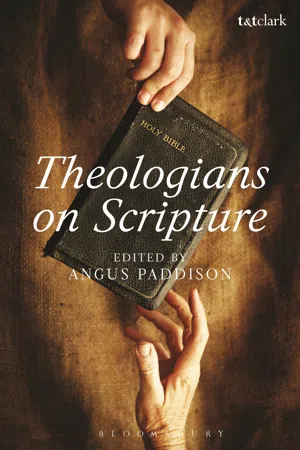
- 256 pages
- English
- ePUB (mobile friendly)
- Available on iOS & Android
eBook - ePub
Theologians on Scripture
About this book
Information
1
The gospel as an image of the kingdom: An Eucharistic reading of the Bible in the Orthodox tradition
Introduction
It is sometimes said that the Bible in the Orthodox Church is not so much read and studied, as it is venerated. And indeed, as is often the case with stereotypes, a first glance at the Orthodox tradition shows a relative lack of a sustained and deep engagement with the biblical material, at least at the research level. It is hard to find any substantial contribution to modern biblical scholarship from Orthodox researchers. Nevertheless, before we pass such a harsh judgement, it will be necessary to take a closer look at the way the gospel is read, received and used in the Orthodox tradition. For this however, we need to consider the wider use and the context of the reception of the Bible in the Orthodox world, both at the pastoral and at the scholarly level.
Perhaps it is useful to say here that I have been struggling with Scripture at both of these two levels of reference, pastoral work and scholarly research and teaching, as a priest and also as a university lecturer. The two directions are certainly distinct. They employ different methodologies, they have different aims, and they are addressed to different groups of people – the community of the faithful and the academic community. Nevertheless, I never felt that these two directions were pulling me towards contrary or incompatible directions, although it may certainly be the case for other pastors or scholars. The priest in me started with the presupposition that the gospel is a means of divine revelation that intends to lead the community of the people who are gathered in the name of the Lord, but this same impetus made it necessary for me to study and unlock the message of the Word, as much as possible. By the same token, the scholar in me made use of the several ways ancient, medieval and modern research has employed to study the content and the context of Scripture, but this also meant that the Bible could not be understood properly if it was simply seen as a text, separated from the community that wrote it and the context of faith that gave sense to it.
Likewise, as a writer, whether I was trying to concentrate on hard research in Patristic thought or in an explanation of a Christological doctrine aimed at a wider audience, I felt that the Bible had to be recognized as a foundation of Christian thought and to be used accordingly. One reason for this is that in the modern context of several Christian groups with their own traditions, doctrines and theological sensitivities, the Bible is perhaps the only common level of reference. An attempt towards an honest and sustained theological dialogue among them needs to start from the common basis they all share. If this dialogue shows that they do not all read the same material in the same way, perhaps the reasons for this divergence can be addressed, thus encouraging a truly ecumenical dialogue – one that that would try to face and investigate differences rather than to gloss over them.
Furthermore, the continuous deference to the Bible is not useful only as part of the ecumenical dialogue, but also for the way each community understands its own teachings and ways. To say this within a specifically Orthodox context (although it is also the case with every Christian denomination) many of the doctrines and the practices that are essential to Orthodox theology, such as the sign of the cross, the significance of Mary, the completely human and completely divine natures of Jesus Christ, the prayer of the heart or the significance of corporate worship, do not always have obvious biblical roots. Sometimes the reason for this is that they are based on practices that are as ancient as the Gospel itself, they belonged to the wider context that spawned the sacred books, and it was not necessary to include them as part of the narrative of the life, passion and resurrection of Jesus Christ. With others, while it is possible to find a biblical connection, they did not develop as practices or doctrines until several centuries later. In such cases, Scripture can serve as a mirror of truth. Perhaps it is too narrow-minded to limit our understanding of Christianity to a reading of the biblical text as a text only, without its historical, cultural and spiritual context, but then it becomes necessary to understand and demonstrate why such extra-biblical practices and teachings are serving the message of the gospel and lead us – the faithful and the scholar alike – towards a deeper understanding of the gospel as salvation, rather than distracting us from it.
Liturgical use
First, let us take a look at the way Scripture is used in the liturgical services of the Orthodox Church. The services repeat and amplify the content of the Gospels. The reading of the entire New Testament (except for the book of Revelation) is completed within one year, starting with John 1.1-18 at the Easter service. The Gospel book itself is an object of veneration, and the Little Entrance of the Divine Liturgy (which corresponds roughly to the entrance of the clergy in Western services) is the ceremonious entrance of the Gospel book, carried by priests and deacons into the altar. Much of the text of the Divine Liturgy, as well as of other services, is derived from biblical sources, especially the Psalter, although the services reflect a painstaking effort to articulate biblical expressions in every turn. Psalms are read in various places of the services, especially in the service of Vespers and Matins, where the whole Psalter is normally read during the course of one week.
The service of Matins includes the reading of Psalms 19, 20, 3, 37, 62, 87, 102, 142 and 50, in addition to a gospel reading.1 The service of Sunday Matins normally has a resurrectional tone, and its lectionary is based on a rotation of eleven post-resurrection readings from the gospels. Some of the hymns that are sung later in the service, follow the gospel reading of the day, and elaborate on its content. In addition, after the reading of the gospel passage, the gospel book is brought out to the middle of the nave, and it is venerated by all the faithful.
The Orthodox liturgical life is generally characterized by a continuous chanting worship, with most prayers chanted or intoned rather than spoken. It also includes collections of hymns that develop the meaning of the feast of the day (such as the Canon, which generally consists of thirty-two stanzas). The content of these hymns is almost always strongly theological, and rarely emotional. Although apocryphal gospels and lives of saints are used as sources, most of these cycles are based on the gospel narratives and on the Patristic reflections on them. One good example of this is the Akathist hymn dedicated to Mary, which draws material from biblical and deuterocanonical sources, in order to highlight all the stages of the life of Mary, such as the annunciation and the nativity of Christ, and her wider contribution to the Christological drama.2
Nevertheless, it is no accident that the people who contributed to the development of liturgy and hymnography were also fundamental in the formulation of doctrine and teaching, such as Basil of Caesarea, John Chrysostom (the two of them are traditionally credited with the liturgies still in use by the Orthodox Church) and John of Damascus (who is known for his systematization of Christian thought at his time, but also for introducing the system of the eight tones, and was the author of numerous hymns).
Language
A difficulty at the pastoral level is that for several Orthodox traditions the language of worship differs from the language most people understand and speak in everyday life, although perhaps not quite in the way that Latin differs from modern vernacular languages. Among traditional Orthodox countries, this is not a problem in Romania or in Arab countries, where there is virtually no distance between the liturgical and the vernacular language, but it is a problem in Slavic countries, since Church Slavonic is widely understood only within a church context, and differs significantly from vernacular spoken languages such as Russian or Serbian. It has recently become a problem in Greece, because of a breakdown in the education system. Ancient Greek is not included in a rigorous way in secondary education anymore, and therefore it is becoming increasingly difficult for young Greeks to understand ecclesiastical Greek, which despite its venerable age, is not very different from modern Greek. The distance between ecclesiastical Greek and modern Greek is approximately the same as the distance between Elizabethan English and modern English, and only a generation ago the language of the Bible was fairly well and widely understood, at least among secondary school graduates with no particular theological education. It is a pity therefore, that the gap of understanding is widening, for the first time in many centuries. As a priest in an English-speaking community which includes people who grew up in Eastern Europe, young people have often approached me to say that they understood the subtleties of the Gospel reading more clearly when they heard it in English – a foreign language to them, yet much more systematically taught. This is unfortunate in many ways, especially since the Orthodox Church had no qualms about encouraging the use of vernacular languages for church use in the past, and even went as far as to invent an alphabet and start the written version of the Slavic language of the Balkans, so that the populations who received Christianity from them could use it to read the gospel and the liturgical texts. Therefore, we have to admit that there is a problem of biblical comprehension in certain parts of the Orthodox world.
Having said this, although one can make a case for the occasional updating of liturgical language in several cultures, something that involves successive editions of the biblical text, this would not be the best possible way forward in the case of the Greek Church. The first reason is that, as it was already mentioned, very little effort is required to bridge the gap between spoken and liturgical language. The second reason is that it is important that the language in which the New Testament was written, which has also given us the oldest extant transcription of the Old Testament, continues to be used today as a language of worship, in at least one part of the world. In some ways this is a responsibility that comes with the gift of the Greek language.
This is not simply a romantic reflection on an idealized, and perhaps reconstructed antiquity that is preserved in a quasi-museum context, but precisely its opposite. Despite the challenges and the dramatic changes within modern Greek education in the last decades, the continuous use of biblical Greek for twenty centuries has preserved a certain subtle understanding among its more devoted speakers (something that may be observed more emphatically in monastic communities) that cannot be acquired by learning it as a foreign language. The verb ὀρθοτομῶ from 2 Timothy 2.15 for instance, which is difficult to translate because it evokes a specific image without a precise counterpart in a word structure (and has been rendered in various ways in English, from ‘rightly divide’ in the KJB, to ‘rightly handle’ in the RSV or ‘rightly explain’ in the NRSV and in several similar variants), has a presence in the Greek language before and after the New Testament (cf. Prov. 3.6, but also many occurrences in the writings of the Fathers, and even an extensive reflection on its meaning in the fifteenth century memoirs of Sylvester Syropoulos3 who follows Chrysostom’s commentary on 2 Timothy and extends it to the ecclesiastical arguments of his day), can be understood inherently, when placed next to words with similar root and structure, such as καινοτομῶ (to innovate), διχοτομῶ (to cut in half) or ᾽ρυμοτομῶ (to design roads): the specific image of cutting forward that the word evokes, has relatives and a context in real life. The problem of translation becomes even more dramatic when we come across words with multiple meanings at different levels, such as λόγος, ὲπιούσιος, δόξα, or πονηροῦ, whose intended ambiguity or rarity invites us to consider all of their meanings at the same time, rather than to choose the one correct meaning among them, to the exclusion of the other levels. The sense one has from the experience of the language as a living language, certainly helps.
Of course, it is not necessary to argue the importance of Greek in biblical studies. Nevertheless, there is another level in the subtle command of a language, which goes beyond scholarly familiarity. It is not enough to simply have a command of the apparatus within a classical – or liturgical – body of work. The ways of a language reflect also the landscape, the climate, the harshness of the light, and the ways that the speakers of this language have engaged with their environment, with the earth and the sea. A nation that has traditionally consisted of farmers and sailors receives a text such as the Song of Songs in a different way than a nation of accountants or warriors. This is not just about the cultural or symbolic significance of the words and the metaphors of the Bible. It is about the subtext, the subtleties that resonate from image to image, from metaphor to metaphor and from text to text, that urges the faithful to read John through Solomon, or Matthew through Isaiah, in some reference to the images that generated the words and the metaphors used by Scripture. While it may be possible to trace some of these paths linguistically, very often it is the more unexpected, and more subtle features of a language that point us towards some of the more difficult aspects of understanding. When Jesus speaks to the Samaritan woman about the living water, he uses the word ἁλλόμενον (Jn 4.14). This is a rare word, which also appears in the variant διαλλόμενος in the Song of Songs (2.8). Although it is possible to translate both words as ‘leaping’, the linguistic connection between the tw...
Table of contents
- Title
- Contents
- List of Contributors
- Acknowledgements
- Abbreviations
- Introduction Angus Paddison
- 1 The gospel as an image of the kingdom: An Eucharistic reading of the Bible in the Orthodox tradition Andreas Andreopoulos
- 2 Finding a critical space: Scripture and experience in practical theology Zoë Bennett
- 3 Evolution, language and the Biblical text: Towards a theological synthesis Oliver Davies
- 4 Scripture used implicitly within public bioethics Robin Gill
- 5 Learning to live within a tradition Timothy Gorringe
- 6 Sola Scriptura, the community of the church and a pluralist age: A Methodist theologian seeking to read Scripture in and for the world Tom Greggs
- 7 Christian doctrine and the discipline of reading Scripture Mike Higton
- 8 Scripture in liturgy and theology Stephen R. Holmes
- 9 Gathering gifts under gunfire: A feminist use of Scripture Lisa Isherwood
- 10 The virtue of attentiveness Murray Rae
- 11 Explorations in front of the text: A black liberationist reader-response approach to reading the Bible Anthony G. Reddie
- 12 Read – pray – trust. One theologian’s encounters with Scripture Christoph Schwöbel
- 13 How I read the Bible Graham Ward
- 14 The fullness of Scripture in the Christian life Angus Paddison
- Bibliography
- Index of Authors
- Index of Biblical References
- Copyright
Trusted by 375,005 students
Access to over 1.5 million titles for a fair monthly price.
Study more efficiently using our study tools.
Frequently asked questions
Yes, you can cancel anytime from the Subscription tab in your account settings on the Perlego website. Your subscription will stay active until the end of your current billing period. Learn how to cancel your subscription
No, books cannot be downloaded as external files, such as PDFs, for use outside of Perlego. However, you can download books within the Perlego app for offline reading on mobile or tablet. Learn how to download books offline
Perlego offers two plans: Essential and Complete
- Essential is ideal for learners and professionals who enjoy exploring a wide range of subjects. Access the Essential Library with 800,000+ trusted titles and best-sellers across business, personal growth, and the humanities. Includes unlimited reading time and Standard Read Aloud voice.
- Complete: Perfect for advanced learners and researchers needing full, unrestricted access. Unlock 1.5M+ books across hundreds of subjects, including academic and specialized titles. The Complete Plan also includes advanced features like Premium Read Aloud and Research Assistant.
We are an online textbook subscription service, where you can get access to an entire online library for less than the price of a single book per month. With over 1.5 million books across 990+ topics, we’ve got you covered! Learn about our mission
Look out for the read-aloud symbol on your next book to see if you can listen to it. The read-aloud tool reads text aloud for you, highlighting the text as it is being read. You can pause it, speed it up and slow it down. Learn more about Read Aloud
Yes! You can use the Perlego app on both iOS and Android devices to read anytime, anywhere — even offline. Perfect for commutes or when you’re on the go.
Please note we cannot support devices running on iOS 13 and Android 7 or earlier. Learn more about using the app
Please note we cannot support devices running on iOS 13 and Android 7 or earlier. Learn more about using the app
Yes, you can access Theologians on Scripture by Angus Paddison in PDF and/or ePUB format, as well as other popular books in Theology & Religion & Biblical Criticism & Interpretation. We have over 1.5 million books available in our catalogue for you to explore.