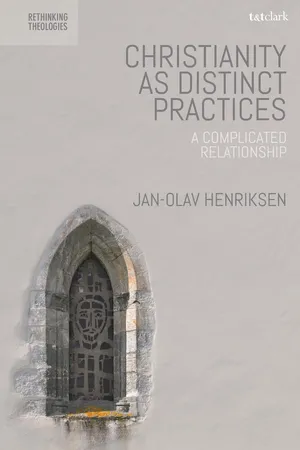
Jan-Olav Henriksen reconstructs and analyzes Christianity as a cluster of practices that manifest a distinct historically and contextually shaped mode of being in the world. Henriksen suggests that these practices imply a complicated relationship between the tradition in which they originate, the community that emerges from and is constituted by that tradition, and the individuals who appropriate the tradition that these communities mediate through their practices. Thus, to think of Christianity simply in terms of belief is misleading and represents an underdetermination of its distinct character.
Henriksen further argues this relationship needs to be described primarily as practices aimed at orientation and transformation. His analysis points to Christianity's similarity to other religions in regard to the functional or pragmatic dimensions it displays. Examining facets such as prayer, the use of scripture, preaching and doctrine, Henriksen emphasizes that the element that makes a practice distinctively Christian is how it relates to and is informed by the Jesus story.
- 216 pages
- English
- ePUB (mobile friendly)
- Available on iOS & Android
eBook - ePub
About this book
Information
Part I
Theory for Understanding Christianity as Practice
The purpose of this part is to present theories about practice to help articulate the practice-dimensions in religion, especially in Christianity.
Chapter 1
RELIGION AS ORIENTATION, TRANSFORMATION, AND LEGITIMIZATION OF HUMAN PRACTICES IN EVERYDAY LIFE
An approach to religion that takes into account the meaning of religion is also a pragmatic understanding of religion, that is, an understanding that interprets religion from the point of view of how it is used and related to human activity. Religious practices contribute to our understanding of what matters and what does not, what is important and what is not in life. Convictions about what “matters” are never without consequences for practice. The implication of this approach to religion is that we can interpret religion as providing resources that orient, transform, and legitimize specific types of human practices.1 They do this by providing and mediating symbolic resources for a specific community. These three dimensions (orientation, transformation, legitimization) have to be understood as closely connected, and can only be analytically distinguished from each other. Let us explore further how to understand religion.
As beings in the world, humans are constantly in need of orientation. Humans orient themselves when they need to cope with specific challenges and when they have to make decisions. They also need to orient themselves by simply finding out what a situation is. Orientation makes people aware of what is more worthy of attention than something else, and so on. It creates the background against which something appears as more significant than other things. It situates them in a world, makes them familiar with it, and provides direction about what should be given attention. Religion provides important, symbolically mediated resources for this task. By mediating knowledge and values important for such orientation, religion becomes part of the human culture as this culture expresses itself in interaction with the social as well as the biological elements shaping human life. It contains statements about what matters, and what matters may have consequences for practice, for what people do.
This approach has two important consequences. First, it allows us to see religion as primarily interwoven with human practices. As a practice, religion is mediated through different types of storytelling, symbols, rituals, and cooperation, but also through different reflective practices. (I will return to several of these elements later.) Thereby, religion may give significance to the everyday in ways that transcend the everyday without leaving it behind. To become religious is to learn how to process interpretations of religious symbols, and to act according to the significance that religious signs and symbols provide, as these open up the experience of the world to more than that which is immediately at hand.
Furthermore, the approach suggested here integrates different features of religion into the wider system of orientation that humans employ to convert the chaos of the world into order. The understanding of religion proposed here implies that religions contribute to resources of orientation that make humans feel more at home in the world and find their place in it, and thus religions contribute to the interpretation of human experiences. Religions, then, may also shape the horizon of significance from where one engages in the world in meaningful ways. As a point of departure, religions may help people experience belonging and differentiate between what is familiar and what is not, what is well known and what is strange, alien, or to be avoided. Thus, it also may shape and enable a specific focus for engaging the world.
From a pragmatic angle, religions do not only prescribe how to act, but also offer different resources to the individual for both social and personal transformation. This point is most obvious in how many religions focus on conversion and salvation—a transformation from one state to another. The transformative element enhances religious engagement and motivates attempts to change the present situation through different practices. It also expresses itself in the development of a given tradition and its practices. Furthermore, the identification of the transformative dimension suggests that it is hardly appropriate to describe religions simply as worldviews. It is so because there is more implied here than simply how one understands the world. The transformative element has both social and personal relevance, and many New Age practices emphasize this element strongly. But the transformative dimension can also be identified in struggles to achieve more insight into personal life and religious traditions, participation in Ignatian practices, and different techniques related to yoga, healing, and meditation. Moreover, we can identify a focus on social transformation in anything from a shift in religious practices, to an opening for the “green” movement and ecological concerns in ethical teachings, and to religiously motivated struggles for justice and against oppression. In any case, the transformative dimension of religion is also primarily to be understood as a practical matter. Recently, Jürgen Habermas2 has pointed to how this dimension in religion is of vital importance as a critical resource for arguments against modern types of naturalism that focus only on short-term goals for human development. Theologian Stanley Hauerwas articulates a Christian awareness of this dimension in an apt formulation that also demonstrates how the symbol “God” is employed in order to address transformation; he writes, “God is the constant possibility of transformation pressing on every occasion, even those that are lost for the lack of human response.”3
What, then, about doctrine and belief? I suggest that we see doctrine as the reflective practice that aims at legitimizing, justifying, and explaining specific types of religious practices of orientation and transformation over against, or in relation to, alternative practices aiming at similar goals. Such reflective practice may also imply a critique of existing or proposed practices. Reflection on doctrine, therefore, is always related to practices of orientation and transformation. Put more strongly: doctrine and religious reasoning are practices that are constituted by their relation to practices of orientation and transformation. However, due to the effects of the Reformation already indicated in the introduction, doctrines have often appeared as the independent, or even as the constitutive element in religions as conceived by theological reasoning. As a consequence, the uses of religion for orientation and transformation indicated above, recede into the background. The foregrounding of the legitimizing dimension of religion that doctrine contributes to thus shapes the perception of religion as (cognitive) belief. Of course, one cannot avoid using doctrine to legitimize the use of religious resources for orientation and transformation. To do so is nevertheless not the same as making the legitimization aspect of doctrine the main component of religion. Legitimization aims at justifying and regulating practices—a point that also makes it understandable how orthodoxy can be perceived as related to power and discipline. However, from a historical point of view, doctrine and “correct faith” increasingly came into focus as authorities sought to articulate religion. After the Reformation, doctrines become necessary to emphasize differences between denominations, and gradually also for defining doctrine in relation to the growing corpus of science that emerged independent of the church. Most importantly, however, the Reformation de-emphasized religious practice and described it as irrelevant to salvation.4 As a consequence of its focus on faith rather than on experience through practice, the idea that Christianity is not a religion but a call to faith in divine revelation as opposed to religion, emerged at the beginning of the twentieth century and was especially mediated by the work of Karl Barth.
Kevin Schilbrack sheds further light on the role of practice as prior to reflection:
Granted, one might participate in a practice and not know why it works. In fact, one might participate in a practice and not even wonder why it works. Practitioners typically develop an explicit justification only when a practice fails or is challenged. Justifying one’s practices is then a second order form of discourse and reflection. But . . . people have beliefs insofar as they take something as true, and they take something as true as soon as they act in any purposive way. Therefore, even in cases in which a religious community has not developed an explicit ontological account that justifies its practices, identifying practices by their ontology is still appropriate. This is so because agents have a pre-reflective understanding of the world in which they operate. It is precisely this pre-reflective engagement with the world that one seeks to make reflective when one’s practices fail or are challenged. We might be able to find a religion that had not developed an explicit ontological justification for a given practice, but we will not find one that does not have even a pre-reflective understanding of the world, an understanding of the world that makes that practice intelligible. For this reason; we can define religion as normative practices that at least implicitly make ontological claims in terms of which the practical norms are authorized.5
It makes sense to end this chapter with Schilbrack’s observation, since much of what goes on in the name of religion, against this backdrop can be seen as not related to its legitimizing aspect, but are instead expressed in immediate and everyday practices that are relatively independent of doctrine.
1.For a more extensive presentation of the theory here employed, cf. Henriksen, Religion as Orientation and Transformation. There I also discuss the similarities between my own contribution and Thomas Tweed’s. See Crossing and Dwelling: A Theory of Religion (Cambridge, MA: Harvard University Press, 2008).
2.Jürgen Habermas, Between Naturalism and Religion: Philosophical Essays (Cambridge, UK; Malden, MA: Polity Press, 2008).
3.S...
Table of contents
- Cover
- Half Title
- Series Information
- Title Page
- Contents
- Acknowledgments
- Introduction
- Part I Theory for Understanding Christianity as Practice
- Part II Christianity Reconstructed: Clusters of Practices Shaped by a Story
- Bibliography
- Name Index
- Subject Index
- Copyright Page
Trusted by 375,005 students
Access to over 1.5 million titles for a fair monthly price.
Study more efficiently using our study tools.
Frequently asked questions
Yes, you can cancel anytime from the Subscription tab in your account settings on the Perlego website. Your subscription will stay active until the end of your current billing period. Learn how to cancel your subscription
No, books cannot be downloaded as external files, such as PDFs, for use outside of Perlego. However, you can download books within the Perlego app for offline reading on mobile or tablet. Learn how to download books offline
Perlego offers two plans: Essential and Complete
- Essential is ideal for learners and professionals who enjoy exploring a wide range of subjects. Access the Essential Library with 800,000+ trusted titles and best-sellers across business, personal growth, and the humanities. Includes unlimited reading time and Standard Read Aloud voice.
- Complete: Perfect for advanced learners and researchers needing full, unrestricted access. Unlock 1.5M+ books across hundreds of subjects, including academic and specialized titles. The Complete Plan also includes advanced features like Premium Read Aloud and Research Assistant.
We are an online textbook subscription service, where you can get access to an entire online library for less than the price of a single book per month. With over 1.5 million books across 990+ topics, we’ve got you covered! Learn about our mission
Look out for the read-aloud symbol on your next book to see if you can listen to it. The read-aloud tool reads text aloud for you, highlighting the text as it is being read. You can pause it, speed it up and slow it down. Learn more about Read Aloud
Yes! You can use the Perlego app on both iOS and Android devices to read anytime, anywhere — even offline. Perfect for commutes or when you’re on the go.
Please note we cannot support devices running on iOS 13 and Android 7 or earlier. Learn more about using the app
Please note we cannot support devices running on iOS 13 and Android 7 or earlier. Learn more about using the app
Yes, you can access Christianity as Distinct Practices by Jan-Olav Henriksen in PDF and/or ePUB format, as well as other popular books in Theology & Religion & Theology. We have over 1.5 million books available in our catalogue for you to explore.