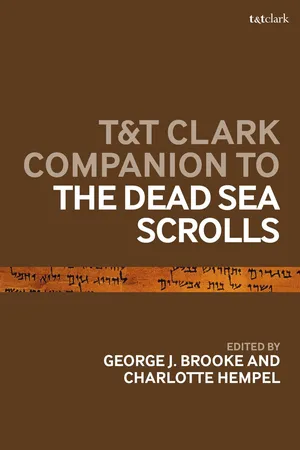
The Dead Sea Scrolls are one of the most important archaeological discoveries of the last century. They have great historical, religious, and linguistic significance, not least in relation to the transmission of many of the books which came to be included in the Hebrew Bible. This companion comprises over 70 articles, exploring the entire body of the key texts and documents labelled as Dead Sea Scrolls.
Beginning with a section on the complex methods used in discovering, archiving and analysing the Scrolls, the focus moves to consideration of the Scrolls in their various contexts: political, religious, cultural, economic and historical. The genres ascribed to groups of texts within the Scrolls- including exegesis and interpretation, poetry and hymns, and liturgical texts - are then examined, with due attention given to both past and present scholarship. The main body of the Companion concludes with crucial issues and topics discussed by leading scholars. Complemented by extensive appendices and indexes, this Companion provides the ideal resource for those seriously engaging with the Dead Sea Scrolls.
eBook - ePub
T&T Clark Companion to the Dead Sea Scrolls
- 672 pages
- English
- ePUB (mobile friendly)
- Available on iOS & Android
eBook - ePub
T&T Clark Companion to the Dead Sea Scrolls
About this book
Information
Part One
Background
1
Discoveries
Hans Debel
According to standard legend, it was a goat gone astray which, around the middle of the twentieth century, set into motion a radical change of course – a revolution, as some prefer to call it – in the study of the Hebrew Bible and of Second Temple Judaism. Even if Sir Frederic G. Kenyon had emphatically stated in his Our Bible and the Ancient Manuscripts, of which the fourth edition appeared in 1939, that ‘[t]here is, indeed, no probability that we shall ever find manuscripts of the Hebrew text going back to a period before the formation of the text which we know as Masoretic,’ fortuitous circumstances led some Bedouin shepherds to a jar that contained a few manuscripts which the noted palaeographer and vice-president of the American Schools of Oriental Research William Foxwell Albright would soon hail as ‘the greatest manuscript discovery of all times.’ In retrospect, these manuscripts turned out to be only the tip of the iceberg, as the fragmentary remains of many more manuscripts dating to late Second Temple times were to surface in the ensuing decade. Even in recent years, some scattered hitherto unknown fragment is occasionally announced, but the ‘golden age’ of discoveries in the Judean Desert has clearly elapsed. In an attempt to separate the actual facts from the many fictional tales surrounding them, the present contribution sets out to describe the remarkable string of events that led to these phenomenal discoveries which biblical scholars had never dared to dream of.
A Handful of Manuscripts from a Deserted Cave
As with other accidental finds of great importance, the actual discovery of the first Dead Sea Scrolls is clouded with so many uncertainties that we find ourselves faced with what could be described, in the nomenclature developed by biblical scholars in the wake of the discoveries, as a pluriformity of variant editions from which no original text can be reconstructed. These rival versions concur that between the fall of 1946 and the spring of 1947, Muhammad, nicknamed ed-Dib (‘the wolf’), entered a cave on the north-western shore of the Dead Sea in which he found a jar with three scrolls. The accounts part company on the precise circumstances that led this young Ta’amireh Bedouin shepherd into the cave, on the role played by his fellows Jum’a Muhammad and Khalil Musa, on the time the Bedouin allowed the scrolls to further deteriorate in their camp, as well as on the presence of a fourth scroll which some children in the camp would have torn to snippets irrevocably gone with the wind. The first established fact in the modern history of the Dead Sea Scrolls is that, in March 1947, three Bedouin were scouring the Bethlehem market in order to make some money out of the three scrolls that would later become known as the ‘great’ Isaiah Scroll (1QIsaa[→26 Authoritative Scriptures: Prophets and Related]), the Rule of the Community (1QS [→47 Serekh ha-Yahad]) and the pesher on Habakkuk (1QpHab [→44 Pesharim]). Hoping that the leather could be recycled into straps for shoes or sandals, they offered them to a local cobbler, Khalil Eskander Shanin (nicknamed Kando), who agreed to act as an intermediary in finding a buyer for the scrolls. He showed them to George Isha’ya, a member of the Syrian-Orthodox church of Jerusalem, who in turn brought the scrolls to the attention of Mar Athanasius Yeshue Samuel, the Metropolitan of St. Mark’s monastery in Jerusalem. Suspecting that the scrolls may be ancient – and thus of great value – the Metropolitan insisted that the Bedouin should show him all the scrolls in their possession, whereupon they returned to the desert and succeeded in unearthing four more scrolls, which are now called the ‘small’ Isaiah Scroll (1QIsab), the War Scroll (1QM [→40 Milḥamah]), the Hodayot (1QH [→37 Hodayot]), and the Genesis Apocryphon (1QapGen [→36 Genesis Apocryphon]).
Despite the generally held assumption that these scrolls were found in the same cave as the three discovered at an earlier date, there is no archaeological evidence supporting the common provenance of the seven first Dead Sea Scrolls, as later excavations in ‘Cave 1’ would only yield additional fragments for the War Scroll and the Hodayot. Somewhat similarly, it remains unclear how these seven scrolls ended up in two groups that do not coincide with their order of discovery: some say that three of the four scrolls discovered on this second occasion – the Genesis Apocryphon not included – never saw the inside of Kando’s shop and were never taken to St. Mark’s because the Bedouin offered them to another antiquities dealer; others maintain that the Bedouin took all seven scrolls to the monastery on 5 July 1947 but were brutally shown the door by a monk who had not been informed of their visit and could not imagine the Metropolitan would be interested in these dirty clumps of leather, after which one of them felt so offended that he decided to sell his three scrolls elsewhere. At any rate, on 19 July 1947 a momentous agreement was reached at St. Mark’s when the Metropolitan decided to purchase the as yet unidentified ‘great’ Isaiah Scroll, the Rule of the Community, the Habakkuk Pesher and the Genesis Apocryphon. The three other scrolls that had been found in the desert disappeared from the radar for a few months, until an Armenian antiquities dealer showed them to Eleazar Lipa Sukenik, Professor at the Hebrew University of Jerusalem, who at the end of November – exactly in the same week as the United Nations voted for the foundation of the State of Israel – agreed to buy them in the name of the university.
An Eventful Week and Its Long-Lasting Consequences
As soon as he had acquired the scrolls, the Metropolitan sought his suspicions on their value to be confirmed by consulting Ignatius Afrem I Barsoum, the Syrian-Orthodox Patriarch of Antioch, and A. Sebastianus Marmadji, Professor of Arabic at the Dominican École Biblique et Archéologique Française in Jerusalem. On his second visit to St. Mark’s, Marmadji was accompanied by the Dutch Dominican Johannes P. M. van der Ploeg, who immediately identified one of the scrolls as a copy of the book of Isaiah, but like the other scholars involved so far was not convinced of its alleged antiquity. Such was also the opinion of some scholars from the Hebrew University, who informed Sukenik of their encounter with the Metropolitan only after he had bought the three other scrolls a few months later. Through the mediation of Anton Kiraz, another member of the Syrian-Orthodox church, Sukenik gained permission to investigate the Metropolitan’s scrolls, but his attempts to purchase them turned out to be of no avail.
Still hoping that some authoritative voice might confirm his suspicions, the Metropolitan had his assistant Butros Sowmy contact the local American School of Oriental Research on 18 February 1948. During a short telephone call with John C. Trever, who was serving as acting director of the School in the absence of Millar Burrows, Sowmy dished up the familiar story of the Syrians – designed to avoid the British law of antiquities, which did not apply to findings made when the territory was still part of the Ottoman empire – that the Metropolitan was seeking advice on some scrolls that had been found forty years earlier in the desert and had recently turned up again in the monastery’s library. When they actually met one another the next day, Trever quickly copied some lines from the Isaiah Scroll, which he and Brownlee were able to identify in the evening as part of Isa 65.1 – a verse that aptly states: ‘I was ready to be sought out by those who did not ask, to be found by those who did not seek me.’ As Brownlee and Trever also realized that the scroll was written in a script similar to that of the Nash Papyrus, dated by Albright to the second century BCE, they decided that swift action was needed before the scrolls would perish in the political turmoil to which the city had fallen prey. Cautious not to repeat Tischendorf’s error and being denied further access to these potentially invaluable manuscripts, they kept the Syrians uninformed of their preliminary observations, but still made the urgent request to be allowed to photograph the scrolls, to which the Metropolitan agreed after some hesitation. From 21 to 24 February 1948, Trever – who was also a skilled photographer – produced a set of photographs of the Isaiah Scroll, the Rule of the Community and the Habakkuk Pesher that would remain one of the most important sources for the study of the scrolls for almost five decades. The Genesis Apocryphon, however, could only be photographed on the outside, because it was too brittle to be unrolled at the time.
Once the Isaiah Scroll and the Genesis Apocryphon had been returned to St. Mark’s, Trever and Brownlee set to work to read the other tw...
Table of contents
- Cover
- Half-Title Page
- Dedication
- Title Page
- Contents
- List of Illustrations
- Notes on Contributors
- Abbreviations
- Introduction
- Part I Background
- 1 Discoveries
- 2 Archaeology of Qumran
- 3 The Manuscript Collections: An Overview
- 4 Acquisition and Publication
- 5 Scholarly and Popular Reception
- Part II Context
- 6 Ethnicity: A Fresh Religious Context for the Scrolls
- 7 The Yahad in the Context of Hellenistic Group Formation
- 8 The Regional Context of the Dead Sea
- 9 Qumran and the Ancient Near East
- 10 Scrolls and Early Judaism
- 11 Scrolls and Early Christianity
- 12 Scrolls and Hellenistic Jewish Literature:
- 13 Scrolls and Non-Jewish Hellenistic Literature
- Part III Methods
- 14 Physicality of Manuscripts and Material Culture
- 15 Scientific Technologies
- 16 Reading and Reconstructing Manuscripts
- 17 Languages: Hebrew, Aramaic, Greek
- 18 Biblical Scholarship and Qumran Studies
- 19 The Dead Sea Scrolls and the Study of the Ancient World
- 20 Historiography
- 21 Social Scientific Approaches:
- 22 Postmodern Questions and Sexuality Studies
- Part IV Key Texts
- 23 Aramaic Job David Shepherd
- 24 Aramaic Levi Vered Hillel
- 25 Authoritative Scriptures: Torah and Related Texts Katell Berthelot
- 26 Authoritative Scriptures: Prophets and Related Texts Roman Vielhauer
- 27 Authoritative Scriptures: Writings and Related Texts Ulrich Dahmen
- 28 Authoritative Scriptures: Other Texts Kelley Coblentz Bautch and Jack Weinbender
- 29 Barkhi Nafshi Daniel K. Falk
- 30 Bar Kokhba Letters Lutz Doering
- 31 Beatitudes Dorothy M. Peters
- 32 Berakhot Daniel K. Falk
- 33 Commentaries on Genesis (4Q252–254) George J. Brooke
- 34 Copper Scroll Jesper Høgenhaven
- 35 Damascus Document (D) Liora Goldman
- 36 Genesis Apocryphon Daniel A. Machiela
- 37 Hodayot (H) Angela Kim Harkins
- 38 Instruction Benjamin Wold
- 39 Messianic Apocalypse Eric F. Mason
- 40 Milh. amah (M) Brian Schultz
- 41 Miqṣat Maʿaśeh ha-Torah (MMT) Hanne von Weissenberg
- 42 Mysteries Samuel I. Thomas
- 43 New Jerusalem Michael Langlois
- 44 Pesharim Shani Tzoref
- 45 Rule of Blessings (Sb) Judith H. Newman
- 46 Rule of the Congregation (Sa) Corrado Martone
- 47 Serekh ha-Yahad (S) Stephen Hultgren
- 48 Songs of the Sabbath Sacrifice Judith H. Newman
- 49 Son of God Text
- 50 Tanḥumim
- 51 Temple Scroll
- 52 Testimonia
- 53 Wiles of the Wicked Woman
- 54 Words of the Luminaries
- Part V Types of Literature
- 55 Bible
- 56 Parabiblical Texts/Rewritten Scripture
- 57 Exegesis and Interpretation
- 58 Halakhah
- 59 Rules
- 60 Poetry and Hymns
- 61 Liturgical Texts
- 62 Calendars
- 63 Wisdom
- 64 Mystical Texts, Magic, and Divination
- Part VI Issues and Topics
- 65 Patriarchs and Aramaic Traditions
- 66 Revelation
- 67 God(s), Angels and Demons
- 68 Eschatologies and Messianisms
- 69 Jerusalem and the Temple
- 70 Purity and Holiness
- 71 The Scribes of the Scrolls
- 72 Forms of Community
- 73 Daily Life
- 74 Ethics and Dualisms
- 75 War and Violence
- Appendices A–F Drew Longacre
- Appendix B: Principal Printed Editions
- Appendix C: Electronic Resources
- Appendix D: Major Reference Works
- Appendix E: Translations
- Appendix F: Introductory Works
- Index of Ancient Sources
- Index of Modern Authors
- Subject Index
- Copyright
Trusted by 375,005 students
Access to over 1.5 million titles for a fair monthly price.
Study more efficiently using our study tools.
Frequently asked questions
Yes, you can cancel anytime from the Subscription tab in your account settings on the Perlego website. Your subscription will stay active until the end of your current billing period. Learn how to cancel your subscription
No, books cannot be downloaded as external files, such as PDFs, for use outside of Perlego. However, you can download books within the Perlego app for offline reading on mobile or tablet. Learn how to download books offline
Perlego offers two plans: Essential and Complete
- Essential is ideal for learners and professionals who enjoy exploring a wide range of subjects. Access the Essential Library with 800,000+ trusted titles and best-sellers across business, personal growth, and the humanities. Includes unlimited reading time and Standard Read Aloud voice.
- Complete: Perfect for advanced learners and researchers needing full, unrestricted access. Unlock 1.5M+ books across hundreds of subjects, including academic and specialized titles. The Complete Plan also includes advanced features like Premium Read Aloud and Research Assistant.
We are an online textbook subscription service, where you can get access to an entire online library for less than the price of a single book per month. With over 1.5 million books across 990+ topics, we’ve got you covered! Learn about our mission
Look out for the read-aloud symbol on your next book to see if you can listen to it. The read-aloud tool reads text aloud for you, highlighting the text as it is being read. You can pause it, speed it up and slow it down. Learn more about Read Aloud
Yes! You can use the Perlego app on both iOS and Android devices to read anytime, anywhere — even offline. Perfect for commutes or when you’re on the go.
Please note we cannot support devices running on iOS 13 and Android 7 or earlier. Learn more about using the app
Please note we cannot support devices running on iOS 13 and Android 7 or earlier. Learn more about using the app
Yes, you can access T&T Clark Companion to the Dead Sea Scrolls by George J. Brooke, Charlotte Hempel, George J. Brooke,Charlotte Hempel in PDF and/or ePUB format, as well as other popular books in Theology & Religion & Biblical Studies. We have over 1.5 million books available in our catalogue for you to explore.