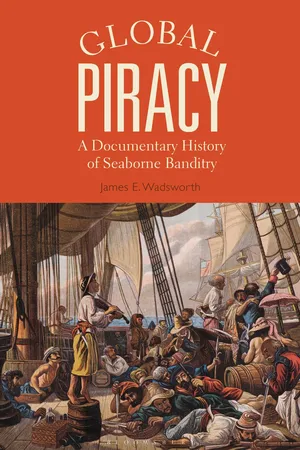
Many people in the western world maintain the contradictory notions that the pirates of old were romantic social bandits while their modern brethren are brutal thugs, thieves, and villains. In Global Piracy, James E. Wadsworth compiles and contextualizes a wealth of primary source documents which illustrate the global phenomenon of piracy through the eyes and voices of those who experienced it: both the pirates or privateers themselves and their victims.
The book allows us to confront our stereotypes by giving us access to "real" pirates in a wide range of historical periods and global regions, from ancient Greece to modern day Nigeria, unfiltered as much as possible by authorial voice or interpretation. Global Piracy seeks neither to romanticize nor vilify pirates, but simply to understand them in the context of their times and the broader world they inhabited. Departing from run-of-the-mill narratives, it selects documents which provide new and fascinating insights into piracy around the globe.
With documents introduced by contextual information, and supplemented by study questions, suggested reading lists, illustrations and maps, this book is an essential companion for anyone studying the history of piracy.
- 344 pages
- English
- ePUB (mobile friendly)
- Available on iOS & Android
eBook - ePub
About this book
Information
CHAPTER ONE
Enemies of All Nations
If you are a student of history, either by inclination or by coercion, you will have encountered pirates. You may even have joined the throngs of children who wielded cardboard cutlasses and sported eye patches and pencilled-in beards on some stage for the benefit of your parents. You may have sung ‘pirate’ songs, which were really nothing more than regular sea shanties all Western sailors sang. You may even have downed a mug of apple juice and called it pirate grog. Pirates also probably populated the cartoons you watched, the books you read and the films you viewed. They may even have found their way onto your pillowcases and bedsheets. Pirates form an essential part of the imaginative childhood experience in many Western countries.
Yet, when Somali pirates began hijacking ships at the beginning of the twenty-first century, most Westerners were shocked and scandalized. This apparently sudden appearance of Somali piracy stimulated a media storm. Western audiences sat enthralled to the coverage of the sensational 2008 hijacking of the Maersk Alabama and the dramatic rescue of Captain Phillips by US Navy SEALs.
These acts of piracy so shocked many in the West because we had convinced ourselves that pirates were a thing of the past. In the United States, we still pat ourselves on the back because we ‘stood up’ to the Mediterranean pirates in 1805 when Thomas Jefferson sent ships to attack Tripoli and then in the 1820s when we ‘eradicated’ pirates from the Caribbean.1 Our collective ignorance and amnesia of ongoing episodes of piracy elsewhere in the world allowed us to fabricate the lie that Western powers had suppressed piracy by the middle of the nineteenth century. We imagined that a temporary regional decline in piracy meant that piracy ceased to exist everywhere in the world. To us, pirates had become semi-fictional, heroic characters that populated our fantasies. They had become innocuous rebels that excited our envy and admiration.
Despite our collective ignorance, the upsurge in piracy in the early twentieth century was no aberration, no departure from normal sea-bound commerce – quite the contrary. Piracy has long been the normal state of affairs for seaborne traffic. The truly global decline in piracy following the Second World War was the real aberration when piracy reached an historical low point. But it was only a decline – a low tide in the history of global piracy. There has never been a time in human history since ocean-going merchants first carried valuable goods in the holds of their ships in which seaborne banditry has not existed. Since this is true, we have to ask ourselves: Where did we miss the boat?
Making heroes out of villains
Pirates crop up everywhere and inhabit our imaginations year round. ‘National Talk-Like-A-Pirate Day’ comes around every September 19 in the United States. On that day, otherwise rational people run around shouting, ‘Ahoy Mate’ and ‘Avast ye land lubber’. Every Halloween, hordes of swashbuckling, eye-patch-wearing and sword-toting pirates swarm our streets to beg for candy. Store shelves bend under the weight of pirate ships, pirate swords, pirate games and pirate figurines. Over 160 pirate films have been produced since 1908. Dozens of comics, video games and books have been written to celebrate pirates. The Pittsburgh Pirates, the Tampa Bay Buccaneers and the Oakland Raiders have capitalized on piracy themes. Everywhere their fans live, crossed swords and bats, earrings, skeletons and bandanas are put on proud display. For $45, you can take a ride on the ‘pirate’ ship Formidable in Boston Harbor. You can take tours in North and South Carolina out to pirate havens such as Ocracoke Island, where Blackbeard reputedly spent his last night alive. The ‘pirate’ ship Revenge, of Beaufort South Carolina, invites us to ‘unleash our inner pirate’ and join them on a cruise.2 For $400, you can send your child to a pirate-themed summer camp. No one seems to catch the irony of a pirate-themed Cub Scout day camp that seeks to ‘help the boys to become a part of another time and place and to be able to play-act in a safe, structured environment’.3 Play-act what, precisely? Hijacking? Kidnapping? Robbery? Murder? And safe? Do we want these activities to be safe? Do we want children to perceive them as play?
The point is that pirates and piracy have infiltrated just about every corner of our popular culture and entertainment industry. Everyone knows what pirates looked like, how they talked, what motivated them, what kinds of weapons they used, etc. – or, at least, they think they do. A Google search will quickly reveal several websites that will teach you ‘pirate speak’ as if all pirates the world over spoke a common language. In fact, the Atlantic and Caribbean pirates who supposedly spoke this way spoke every European language and several Native American and African languages. They even used a distinct maritime pidgin that most Western sailors used. Robert Louis Stevenson, in his book Treasure Island, gave his pirates a Devonshire accent. But the actor Robert Newton, who played Long John Silver in the 1950 Disney film Treasure Island, used a West Country accent. His portrayal was so compelling that the West Country accent still dominates our representations of pirate language.4 This is the form of pirate speech you will most likely find on the web. And yet, pirates spoke a babel of languages, including Greek, Arabic, Latin, Malayalam, Mandarin, Japanese, Somali, Portuguese, Spanish, Turkish, Tausug, Malay, French, English, Dutch, Danish, Finnish, Yoruba, Izon, Ibibio and Tagalog. Likewise, pirates are almost always portrayed in extravagant, fictionalized, late-seventeenth-century European dress – long coats, peg legs, earrings, head bandanas, tattoos, curved knives, missing teeth, scars on the face, eye patches, the ever-present talking parrots and the occasional hook. Though some of this is certainly accurate for late-seventeenth-century Caribbean buccaneers, it is not representative of pirates or pirate cultures everywhere. Most of our ‘knowledge’ about pirates is only loosely based on authentic primary sources. It is almost always filtered through Disneyland, books, movies, toys, birthday parties and sports. Much of the modern Western imagery of pirates originates from Charles Johnson’s 1724 A General History of the Pyrates because this has been the most influential source on pirate lore in the Western world.5 His depictions have been filtered through our popular media so effectively that they have become the standard by which all pirates are measured.
As the pirate myths have evolved, our perceptions have evolved with them. In early-twentieth-century popular culture, pirates were seen either as villainous cutthroats or as comic buffoons. The Second World War generation read books like Treasure Island and watched films like Errol Flynn’s Sea Hawk. They saw pirates as adventuresome and glamorous.6 By the 1950s, pirates became true heroes in the Robin Hood fashion. The baby boomer generation drew inspiration from Disney’s Peter Pan and Treasure Island. They created fraternities that used the skull and crossbones and treasure maps in their initiations. This generation associated pirates with the heroic rescue of beautiful women and perceived them as misunderstood, noble bandits who robbed from the rich and gave to the poor. The belief that pirates were social bandits has been supported by some scholars who have noted that pirates rebelled against the constraints of their oppressive societies and sought vengeance on their oppressors. Though some pirates may have been social bandits in this sense, one is hard-pressed to find a pirate who willingly delivered his ill-gotten gains to the poor.7 The modern college student of the early twenty-first century grew up inundated with pirate-based Disney films, such as Muppet Treasure Island, Treasure Planet and Pirates of the Caribbean. If nothing else, Johnny Depp proved that a permanently half-drunk, crude, womanizing, swaggering, slightly effeminate pirate who cavorts with zombies and mermaids can still make a lot of money for film producers – though Johnny Depp’s statement that pirates were like the rock stars of their times is not accurate.8
Privateers and pirates in the Western world occupied a distinctly ambiguous and complicated space. Those who preyed on someone else could be quite popular among local communities because they often brought in much-needed supplies and money. Their activities were ‘justified on grounds of religion, maritime defense, war, and political independence’.9 They could claim to be patriotic heroes fighting for the fatherland. But when pirates or privateers raided local shipping, they were seen more like modern drug cartels and organized criminals. They became rock stars only to modern audiences.10
The problem with our modern Western stereotypes is that we have taken a very small group of men that operated for only about 300 years in only one part of the world (granted it is a large geographical area), and we have frozen them in time. We have frozen them in a late-seventeenth-century context in terms of technology, dress, culture and politics. In the process, we have acted as if these pirates were somehow distinct from other sailing men of their times. In fact, they were not. Most pirates belonged to the sailing classes of the societies from which they came and moved back and forth from fishing and commerce to piracy with great alacrity. No observer could have distinguished a pirate from a sailor simply by his dress or his speech.11 To put it bluntly, the Atlantic and Caribbean pirates that dominate the Western imagination seem insignificant when compared to the massive fleets of Chinese pirates of the early nineteenth century and with the range, effectiveness and brutality of Southeast Asia pirates of the same era. All of this begs the questions: ‘What happened? How did pirates move into mainstream society as the rehabilitated heroes we laugh at and admire?’
A brief review of the relevant history suggests an answer. In colonial America, pirates and privateers found ready acceptance as suppliers of exotic goods, currency and food. When they returned with shiploads of plunder that infiltrated the local economy, they could enjoy considerable fame. Popular opinion began to shift in the eighteenth century as the government became more intent on reining in private plundering in favour of non-violent trade and as European nations became more effective at imposing their concepts of sovereignty on the high seas.12 This contraction of private plunder and the extension of state sovereignty coincided with the suppression of piracy in the West and the rise of the modern industrialized nation state. European nations began to exert greater control over pirates and privateers of all kinds in the later part of the seventeenth century. By the early nineteenth century, they joined forces to suppress the Barbary corsairs of North Africa. The United States used the Monroe Doctrine to pursue pirates in the Caribbean. Commodore David Porter emp...
Table of contents
- Cover
- Halftitle Page
- Title Page
- Contents
- List of Illustrations
- Acknowledgements
- A Note to Instructors
- 1. Enemies of All Nations
- 2. Bandits of the Wine Dark Sea: Piracy in the Classical World
- 3. Vikings: The Scourge from the North
- 4. English Sea Dogs and the Pillaging of Empire
- 5. Dwarf Pirates: Pillaging the Korean and Chinese Coasts
- 6. Dutch Sea Beggars and the Business of Piracy
- 7. Brethren of the Coast: Caribbean Buccaneers
- 8. Fishers of Men: Piracy and State Formation in Southeast Asia
- 9. ‘Our Sea’: Corsairs of the Mediterranean
- 10. Beneath the Jolly Roger: An Age of Chaos, an Age of Gold
- 11. Maritime Marginals: Piracy in Late Imperial China
- 12. Community of Thieves: Piracy in the Western Indian Ocean
- 13. Terror on the Seas: Piracy in Modern Southeast Asia
- 14. Oil-Soaked Pirates in the Gulf of Guinea
- 15. Saviours of the Sea: Pirates of the Somalia Coast
- 16. Modern Pirate Hunting – What Is to Be Done?
- Glossary
- Selected Bibliography and Further Reading
- Index
- Imprint
Trusted by 375,005 students
Access to over 1.5 million titles for a fair monthly price.
Study more efficiently using our study tools.
Frequently asked questions
Yes, you can cancel anytime from the Subscription tab in your account settings on the Perlego website. Your subscription will stay active until the end of your current billing period. Learn how to cancel your subscription
No, books cannot be downloaded as external files, such as PDFs, for use outside of Perlego. However, you can download books within the Perlego app for offline reading on mobile or tablet. Learn how to download books offline
Perlego offers two plans: Essential and Complete
- Essential is ideal for learners and professionals who enjoy exploring a wide range of subjects. Access the Essential Library with 800,000+ trusted titles and best-sellers across business, personal growth, and the humanities. Includes unlimited reading time and Standard Read Aloud voice.
- Complete: Perfect for advanced learners and researchers needing full, unrestricted access. Unlock 1.5M+ books across hundreds of subjects, including academic and specialized titles. The Complete Plan also includes advanced features like Premium Read Aloud and Research Assistant.
We are an online textbook subscription service, where you can get access to an entire online library for less than the price of a single book per month. With over 1.5 million books across 990+ topics, we’ve got you covered! Learn about our mission
Look out for the read-aloud symbol on your next book to see if you can listen to it. The read-aloud tool reads text aloud for you, highlighting the text as it is being read. You can pause it, speed it up and slow it down. Learn more about Read Aloud
Yes! You can use the Perlego app on both iOS and Android devices to read anytime, anywhere — even offline. Perfect for commutes or when you’re on the go.
Please note we cannot support devices running on iOS 13 and Android 7 or earlier. Learn more about using the app
Please note we cannot support devices running on iOS 13 and Android 7 or earlier. Learn more about using the app
Yes, you can access Global Piracy by James E. Wadsworth in PDF and/or ePUB format, as well as other popular books in History & Military & Maritime History. We have over 1.5 million books available in our catalogue for you to explore.