Design, History and Time reflects on the nature of time in relation to design, in both past and contemporary contexts. In contrast to a traditional design historical approach which emphasises schools and movements, this volume addresses time as a continuum and considers the importance of temporality for design practice and history.
Contributors address how designers, design historians and design thinkers might respond to the global challenges of time, the rhythms of work, and the increasing speed of life and communication between different communities. They consider how the past informs the present and the future in terms of design; the importance of time-based design practices such as rapid prototyping and slow design, time in relation to memory and forgetting, and artefacts such as the archive for which time is key, and ponder the design of time itself.
Showcasing the work of fifteen design scholars from a range of international contexts, the book provides an essential text for thinking about changing attitudes to the temporal.
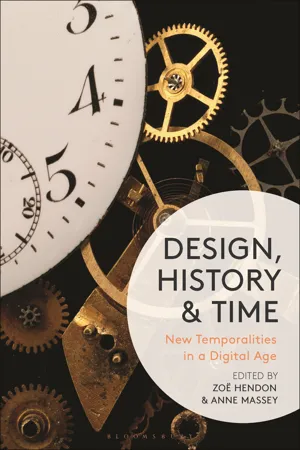
eBook - ePub
Design, History and Time
New Temporalities in a Digital Age
- 216 pages
- English
- ePUB (mobile friendly)
- Available on iOS & Android
eBook - ePub
Design, History and Time
New Temporalities in a Digital Age
About this book
Information
Section 1
Millennia, Centuries
In this section, we consider the broad sweep of time across centuries and into millennia. The three chapters deal with time in the sense of ‘thick time’, events which echo down through hundreds of years and impinge on the understanding, making and history of design. As Jeremy Till has argued, ‘Everyday time is thus thick time, a temporal space that critically gathers the past and also projects the future.’1 For Till, modern architecture has endeavoured to achieve the negation of time through its whitewashing of dirt as the ultimate trace of the rootedness of building in space and the passing of time.
The argument also relates to the history of design. As Barbara Penner and Charles Rice have argued in the case of the interior history of buildings, ‘Interiors exist physically as environments that can be lived in and visited; they also exist in images and objects that travel through space and across time and seed new ideas about decorations, style and inhabitation as they go.’2 Judy Attfield devoted an entire chapter to the subject of time in Wild Things: The Material Culture of Everyday Life published in 2000.3 Attfield argues for a material culture approach to the history of design, which needs to encompass the everyday and well as grand designs. She notes the compression of time and space, elucidated by postmodern scholar David Harvey, and makes a plea for a more subjective understanding of time:
At the conceptual level individuals consciously negotiate their relationship to time through life-choice decisions. But the material world of coffee spoons, clothes, and household goods also keep individuals in touch with life as a sense of time-passing in a day-to-day manner that is not necessarily articulated but just as, if not more, telling.4
It is this trans-temporal, non-linear sense of time, beyond analogue clock time that this section attends to.
In Chapter 1, Seher Erdoğan Ford takes the case study of the representation of stone over millennia as the temporal lens. Ford refers to Till in her analysis of the changing ways in which this material has been represented through time. She takes her discussion from early flint arrow-heads up to the latest in virtual reality technology. The apparent timelessness of stone is therefore challenged, and the time-based nature of its visual depiction for a range of specialisms, including archaeology, attests to the importance of thick time for understanding the history of design. How might our physical and tactile perceptions of the ‘age’ and ‘timelessness’ of the material world be challenged by our experience of Virtual Environments (VEs)?
Sally Anne Huxtable takes the work of designer Phoebe Anna Traquair as her subject. This overlooked artist and designer worked during the Victorian era, when Deep Time was controversially introduced in contention with the biblical understanding of time. Huxtable discusses Traquair’s drawings of ancient fossils and links this with the artist’s understanding of evolution within a Christian context. Her Arts and Crafts work is thus examined by way of a unique creative theoretical framework rather than simply as a follower of William Morris. Here a nuanced reading of a designer’s understanding of ‘time’ (meaning more than simply ‘nostalgia’ or ‘longing for the past’) can lead us to a better understanding of that designer’s work.
In Chapter 3, Anne Burke takes us on a train journey across Australia, with a detailed description in a style reminiscent of Nicholson Baker5 or Iain Sinclair,6 but this is a journey through unfamiliar territory. She skilfully incorporates a discussion of class separation, colonialism and different perceptions of time. Her glimpses of Aboriginal life and Dreamtime are contrasted with those of the colonizers, brought into stark relief by her occupation of the third class – ‘red’ class – of the train carriage. This different approach to considering the history of design succeeds in layering everyday experience with a broad history, with different perspectives on design and its history. Burke explores the negotiation of historical memory, with reference to landmarks of the aboriginal Dreamtime, in the design and laying of the Ghan’s route. The use of photography in Burke’s essay provides a further layer of meaning: photographs capture a fleeting moment of ephemeral time and ‘preserve’ it forever. These contrasting time perceptions bring together the broad sweep of this section, which consider time from a range of unexpected perspectives and, together, form a reminder that time itself is a cultural construction, which changes over time.
Notes
1Jeremy Till, Architecture Depends (Cambridge, MA: MIT Press, 2009).
2Barbara Penner and Charles Rice, ‘The Many Lives of Red House’, in Anne Massey and Penny Sparke (eds), Biography, Identity and the Interior (Aldershot: Ashgate, 2013), 23.
3Attfield, Wild Things: The Material Culture of Everyday Life (London and New York: Berg, 2000).
4Ibid., 235.
5Nicholson Baker, The Mezzanine, (London: Granta Books, 1989).
6Iain Sinclair, London Orbital: A Walk Around the M25 (London: Penguin, 2003).
1Designing Stone: Temporal Representation of a Timeless Material
SEHER ERDOĞAN FORD
The philosopher Karsten Harries notes that architects build against the ‘terror of time’.1 Jeremy Till, the educator and architect, confirms time as the common enemy for those who want total control over their design, and observes architects to be compelled in two directions: those who deny time and those who aim for timelessness.2 One way of dealing with time entails considering and representing the temporal scale during the design process. While typical modes of architectural representation yield ‘frozen’ imagery – either by capturing a specific moment or by creating a veneer of ‘newness’ – new media technologies offer possibilities for built work to appear on a temporal continuum and to be understood in flux, by situating them in their historical and physical context. Time no longer poses a threat for architectural production if the tools and methodologies for representing it are implemented. Going even further, the representation of historical artefacts as projects that are no longer can offer insights into projects that are yet to be. With that, the critical question arises: How do we draw time? What form(s) and media does the temporal representation of architecture take?
In response to this question, I focus on stone and masonry construction, which are typically considered timeless in material culture. Based on ideas dealing with the close relationship between drawing and making, I propose a method of analysis that can span the extended history of an artefact. To understand the possibilities of drawing stone along the temporal scale, I look at historical, analogue examples – and their manipulation of media – to propose how digital environments may deliver a tangible and dynamic sense of time. Emerging virtual environments (VEs), particularly those dealing with architectural heritage sites, can help us reimagine what drawings are: not only a mode of representation but also an act of analysis and interpretation. Considering drawing in VE or VE as drawings or even the act of drawing VE offers new insights into the transformation of how we understand what drawings look like, what they deal with and how they function. These projects, considered as a new type of drawing that yields complex VEs, represent stone as applied in its changing historical context and revealing its own making.
Drawing decay, growth and regeneration
In Architecture Depends, Jeremy Till critiques the modernist architect’s unwillingness to accept the mutability of their design over time.3 In an attempt to freeze the idea, architects disseminate perfectly crafted, calibrated and curated images of their work. How their buildings may change over time in their appearance, use, feel and overall ethos is difficult for architects to grasp. As a result, Till argues that the dichotomy between the intent of the architect and the materiality of architecture grows to the point of dissociation.
Two accounts of stone, one from architectural history and another from cultural anthropology, diminish this conceptual gap between the idea and its execution by relating the material to the traditions and understandings of making. Architect and historian Robin Evans, in the chapter entitled ‘Drawn Stone’ from his seminal book The Projective Cast, discusses the history of stereotomy – referring to the techniques related to cutting stone using geometry and to achieve a three-dimensional configuration – as a direct extension of drawing. Going back to seventh-century France, stereotomic construction implemented drawing templates, called traits, which as a craft practice culminated during Renaissance architecture.4 The traits are essential for the geometric understanding of the complex three-dimensional assembly, but also facilitate the off-site fabrication of components prior to construction. While Evans mentions the possibility that the traits did not document a finality but instead helped solve formal problems and resulted in design revisions, his focus is primarily directed towards the act of translation and interpretation. Traits, in masonry construction, functioned as the medium in which design registered during the collaborative process of fabrication.
Anthropologist Tim Ingold, in Making, extends the purview on the fabrication process to include the sourcing of the natural substance, its tooling and its continued transformation throughout the life of the building.5 From his perspective, no built work is fixed in place or form. Unlike the traditional preoccupation with permanence in architecture, when considered as a material assembly in constant change, the narrative around a building also includes ‘growth, decay, and regeneration’.6 As such, the building is never ‘finished’ except perhaps in a legal sense. Therefore, with Ingold’s broader framing of the idea of ‘building-in-the-making’, the function of drawing also expands to become a dynamic medium communicating an ad hoc and continuous process of change.
When discussing stone and its durability and transformation over time, the discipline of archaeology also offers insights. Chantal Conneller argues in An Archeology of Materials that the study of human activity from a material culture perspective is not only concerned with the functional significance of surviving artefacts but rather encompasses the entire chaîne opératoire – the sequence of social acts around the production, use and disposal of artefacts.7 For example, with regard to a specific specimen of flint stone, the marks found on its surface create a visually interesting texture that are in fact residual from the act of removing fragments to use during various rites. Therefore, the texture represents something about the ritual of sourcing the substance from the earth, the act of manipulating it and its continued use as well. Could we, then, imagine chaîne opératoire as a methodology of studying an architectural artefact? This shift in our focus would suggest a kind of historiography that views materiality as understood through the amalgamation of textures. In turn, the built artefact can be situated not only in its physical context but also its cultural and historical milieu that resulted in the textural marks. The drawing would be not only of the project, but also would be an active process of reimagining the tactile presence of the building relative to its intangible past – an act of drawing forth the permeable and dynamic nature of any cultural invention.
Experiments with media
To answer the question of how we draw time through this emphasis on the tactility of stone, first I take a closer look at several canonical examples of analogue drawing techniques, which manipulate the tactility of their physical medi...
Table of contents
- Cover
- Half Title
- Title Page
- Contents
- List of Figures
- List of Contributors
- Foreword
- Acknowledgements
- Introduction
- Section 1 Millennia, Centuries
- Section 2 Centuries, Decades, Years
- Section 3 Days, Hours, Seconds
- Select Bibliography
- Index
- Copyright Page
Trusted by 375,005 students
Access to over 1.5 million titles for a fair monthly price.
Study more efficiently using our study tools.
Frequently asked questions
Yes, you can cancel anytime from the Subscription tab in your account settings on the Perlego website. Your subscription will stay active until the end of your current billing period. Learn how to cancel your subscription
No, books cannot be downloaded as external files, such as PDFs, for use outside of Perlego. However, you can download books within the Perlego app for offline reading on mobile or tablet. Learn how to download books offline
Perlego offers two plans: Essential and Complete
- Essential is ideal for learners and professionals who enjoy exploring a wide range of subjects. Access the Essential Library with 800,000+ trusted titles and best-sellers across business, personal growth, and the humanities. Includes unlimited reading time and Standard Read Aloud voice.
- Complete: Perfect for advanced learners and researchers needing full, unrestricted access. Unlock 1.5M+ books across hundreds of subjects, including academic and specialized titles. The Complete Plan also includes advanced features like Premium Read Aloud and Research Assistant.
We are an online textbook subscription service, where you can get access to an entire online library for less than the price of a single book per month. With over 1.5 million books across 990+ topics, we’ve got you covered! Learn about our mission
Look out for the read-aloud symbol on your next book to see if you can listen to it. The read-aloud tool reads text aloud for you, highlighting the text as it is being read. You can pause it, speed it up and slow it down. Learn more about Read Aloud
Yes! You can use the Perlego app on both iOS and Android devices to read anytime, anywhere — even offline. Perfect for commutes or when you’re on the go.
Please note we cannot support devices running on iOS 13 and Android 7 or earlier. Learn more about using the app
Please note we cannot support devices running on iOS 13 and Android 7 or earlier. Learn more about using the app
Yes, you can access Design, History and Time by Zoë Hendon, Anne Massey, Zoë Hendon,Anne Massey in PDF and/or ePUB format, as well as other popular books in Diseño & Crítica de la arquitectura. We have over 1.5 million books available in our catalogue for you to explore.