What is an object? How do we look at them? Why do they matter?
This collection presents a lively, timely discussion of natural and artifactual objects, considering the relationship between them from a range of philosophical perspectives, including the philosophy of biology, the metaphysics of space and the philosophy of perception.
Beginning from the starting point that natural objects are bona fide, endowed with some natural border between themselves and everything else, while artifactual objects depend on the observation of tacit conventions and may include the ordinary objects of everyday life, this volume explores, contextualises and interrogates objects. Contributors discuss a variety of objects including physical, scientific and mental ones, as well as things that appear to question the limits of object-hood, including holes, Quinean 'posits' and language.
The very first collection to address this growing topic within analytic philosophy, Natural and Artifactual Objects in Contemporary Metaphysics represents a highly original work, showcasing some of the most important and influential philosophers working in Europe today.
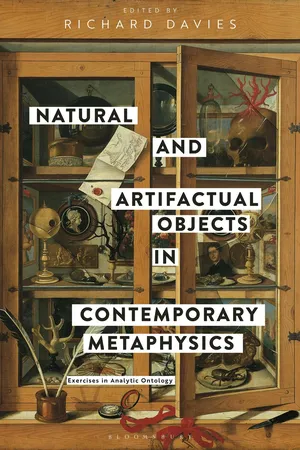
eBook - ePub
Natural and Artifactual Objects in Contemporary Metaphysics
Exercises in Analytic Ontology
- 248 pages
- English
- ePUB (mobile friendly)
- Available on iOS & Android
eBook - ePub
Natural and Artifactual Objects in Contemporary Metaphysics
Exercises in Analytic Ontology
About this book
Information
Part One
Does Nature Carve Itself?
1
Mental Acts, Externalism and Fiat Objects: An Ockhamist Solution
Riccardo Fedriga
Any theory aiming to give an account of human cognitive faculties must reckon with a number of crucial issues, such as the imperfection of our epistemic equipment, the (more or less defined) boundaries between subject and object of knowledge and the nature of the tools that allow connecting and classifying entities of the known reality into classes or subcategories. This chapter inquires into Ockham’s treatment of human cognitive tools and their fallibility. We shall elucidate Ockham’s conceptual framework and examine whether his evidently naturalist epistemology may be described through the conceptual tools provided by the analysis of fiat objects, given that a causalist framework is arguably not suited to exhaustively account for it. The analysis of Ockham’s responses to these epistemological problems shall thus entwine with the analysis of the responses that, according to philosophers and historians, Ockham would have given to contemporary questions. Such an approach will allow us to test Ockham’s position against the background of the externalism/internalism debate, on the basis of Wilfrid Sellars’s criticism to the ‘myth of the given’.
Human knowledge
The foundations of Ockham’s theory of human knowledge
In the mature version of his theory, Ockham envisages a universe constituted exclusively of singulars, in which every thing is either a substance or a quality. Within this framework, mental acts are conceived of as belonging to the category of quality.1 They are divided into two general categories, in accordance to their referring to the sensitive part of the mind (listening, desiring, fearing) or to the intellective part (conceptualizing, reasoning). A further distinction is that between apprehensive and adjudicative acts: both sensitive and intellective faculties are capable of apprehension, but only intellect is capable of judgement. Ockham, however, leaves aside those acts that are merely sensory and focuses on intellective acts.2
Since we can apprehend not only incomplex objects (i.e. singular terms) but also propositions, demonstrations and impossible or necessary objects (i.e. complex, propositional objects), the intellect’s apprehensive acts must occur with respect to both complex and incomplex objects. Adjudicative acts, on the contrary, are about incomplex objects only, for an adjudicative act is the assent or dissent that our mind grants to a proposition. Propositions may be spoken, written or mental. Mental propositions constitute concepts and occupy the semantic space of an intentional act referring to a singular object that exists in reality. Such an act (which is the same concept in term of mental language) is also a linguistic sign that takes the object’s place within the mind and replaces the object in mental propositions. In other words, it is a term that stands for (i.e. supponit) individual objects in the world and substitutes them, directly and with any intermediary, in the mind of the thinker. If we consider the issue in the light of the fiat objects theory, the question arises about whether it is possible to draw a boundary between objects (res), mental acts, mental terms and linguistic acts of reference, and in what way this could be done.3
It is evident that such a space cannot be delimited by (only) a causal nexus, as if the knower were the cause of the known object, insofar as it is known. Rather, the relation between these two ‘objects’ appears to be more fleeting and contingent. In our view, this primarily depends on categorial differences. For, first of all, Ockham assumes only two of Aristotles’s categories, namely substance and quality; and secondly, it is a matter of examining to what extent Ockham’s theory may be defined as externalist or internalist.
Let us examine apprehensive acts first. They can be divided into acts of simple apprehension (notitia intuitiva), which can never have a propositional content, and acts of abstractive apprehension, which can be both propositional and non-propositional. This means that, when a white wall is in front of me, I intuit the wall, or this particular whiteness, or perhaps both these things at once, but I do not intuit that the wall is white. Abstractive propositions, on the other hand, may have a propositional content (e.g. my non-assertive thought that Socrates is white), or not (the occurrence in the mind of a simple concept such as ‘man’ or ‘whiteness’).
In the Ordinatio,4 Ockham deals with the two kinds of abstractive apprehension, that is, that of the universal and that of the singular,5 before advancing his novel and crucial definition of intuitive apprehension. On the one hand, there is abstractive knowledge that relates to something abstracted from many singulars and therefore coincides with knowledge of a universal that can be abstracted from a number of entities. On the other, there is abstractive knowledge that relates to a single thing and abstracts (i.e. is independent) from the thing’s actual existence or non-existence. We shall turn to the latter in due course. Let us now focus on intuitive knowledge:
Intuitive cognition of a thing is cognition that enables us to know whether the thing exists or does not exist, in such a way that, if the thing exists, then the intellect immediately judges that it exists and evidently knows that it exists, unless the judgment happens to be impeded through the imperfection of this cognition. And in the same way, if the divine power were to conserve a perfect intuitive cognition of a thing no longer existent, in virtue of this non-complex knowledge the intellect would know evidently that this thing does not exist.
Ockham, Ordinatio, Prologus, q. 1, art. 16
Summing up, intuitive knowledge is the knowledge by which one knows that a thing exists when it exists, and that a thing does not exist when it does not exist. The act of intuitive cognition allows intellect to access reality, to realize that this or that thing exists, to know it in the immediacy of its existence. Starting from such an apprehension, the intellect may then formulate a judgement about the existence of the intuitively known object (the pen exists, the table exists) or, more generally, a judgement of assent or dissent in relation to a contingent truth.
To give an example: if Socrates is in front of me and is white, I shall have the intuitive knowledge of Socrates and of whiteness, and by virtue of this I shall know with evidence that Socrates is white. On the other hand, abstractive knowledge of the singular (which is what we shall be referring to from now on) does not allow me to know, of a thing that exists, that it exists, nor, of a thing that does not exist, that it does not exist. It is, so to speak, a sort of knowledge that is ‘indifferent to existence’.
For instance, reading a text about Socrates might produce in me a non-propositional representation of Socrates and his whiteness, but such an incomplex abstractive knowledge does not allow me to know whether Socrates exists or not, nor whether he is white or not. Intuitive apprehension allows me to know contingent truths, especially concerning the present; abstractive knowledge does not.
Unlike Scotus, Ockham thinks that intuitive and abstractive knowledge refer to the same object, that is, a singular object, and moreover, that the latter always accompanies the former. There is a difference, however: the intuition that a pen is on my table enables me to produce a judgement of existence of the kind, ‘There is a pen on my table’, but once the pen is removed from the table, my intuitive knowledge of it ceases; I can, however, still think about it. Such a cognitive act is still concerned with a singular object, that is, the pen, but does not allow me to assert, ‘There is a pen on my table’: it is independent from the actual existence or non-existence of the object. These two kinds of knowledge, in other words, have different effects: while intuitive knowledge enables the knower to produce judgements of existence, abstractive knowledge does not.
But, one may ask, how do intuitions come about? Claude Panaccio7 points out that an act of intuitive cognition occurs naturally when a real singular object is placed in an adequate location with respect to the knower (e.g. the object is not too distant, it receives enough light, the knower’s sense organs are correctly disposed, etc.). Such a natural cause is the object of intuition: if my act of intuitive cognition is adequately caused by Socrates, who is located in front of me, then this is an act of intuitive apprehension of Socrates.
Ockham’s theory of intuition
Ockham defines intuition in a purely functional manner, on the basis of the role it has within the cognitive process’s causal chain8 : intuition is caused by some singular object in the world, and, in turn, causes a judgement of assent to a true contingent proposition about that object.
No reference is made to what one feels when one intuits something, nor are intuitions framed as intrinsically recognizable experiences: they seem to be entirely deprived of phenomenal characters. In Panaccio’s view, it follows from this that Ockham’s theory of intuition is undoubtedly externalist. In particular, Ockham’s externalism concerns mental content: namely, two knowing subjects might, in principle, have very similar intuitive states, yet one of the two might be thinking of one thing, the other of an entirely different one.
Let us suppose, for instance, the following situation: there are two individuals; one of the two is observing an egg (call this ‘egg n.1’), while the other is observing another egg, which is extremely similar to the former (call this ‘egg n.2’). Following Ockham’s argument, we should then say that the first individual is intuiting egg n.1 rather than egg n.2, for his current intuitive state is caused by egg n.1 and not by egg n.2. Panaccio grounds his externalist reading of Ockha...
Table of contents
- Cover
- Half-Title
- Series
- Title
- Contents
- Carving Nature at the Joints Richard Davies
- Part One Does Nature Carve Itself?
- Part Two Where Do Limits Lie?
- Part Three Where Do Tools Come From?
- Part Four What Does Mind-Dependency Depend On?
- Abstracts
- Index of Names and Principal Subjects
- Copyright
Trusted by 375,005 students
Access to over 1.5 million titles for a fair monthly price.
Study more efficiently using our study tools.
Frequently asked questions
Yes, you can cancel anytime from the Subscription tab in your account settings on the Perlego website. Your subscription will stay active until the end of your current billing period. Learn how to cancel your subscription
No, books cannot be downloaded as external files, such as PDFs, for use outside of Perlego. However, you can download books within the Perlego app for offline reading on mobile or tablet. Learn how to download books offline
Perlego offers two plans: Essential and Complete
- Essential is ideal for learners and professionals who enjoy exploring a wide range of subjects. Access the Essential Library with 800,000+ trusted titles and best-sellers across business, personal growth, and the humanities. Includes unlimited reading time and Standard Read Aloud voice.
- Complete: Perfect for advanced learners and researchers needing full, unrestricted access. Unlock 1.5M+ books across hundreds of subjects, including academic and specialized titles. The Complete Plan also includes advanced features like Premium Read Aloud and Research Assistant.
We are an online textbook subscription service, where you can get access to an entire online library for less than the price of a single book per month. With over 1.5 million books across 990+ topics, we’ve got you covered! Learn about our mission
Look out for the read-aloud symbol on your next book to see if you can listen to it. The read-aloud tool reads text aloud for you, highlighting the text as it is being read. You can pause it, speed it up and slow it down. Learn more about Read Aloud
Yes! You can use the Perlego app on both iOS and Android devices to read anytime, anywhere — even offline. Perfect for commutes or when you’re on the go.
Please note we cannot support devices running on iOS 13 and Android 7 or earlier. Learn more about using the app
Please note we cannot support devices running on iOS 13 and Android 7 or earlier. Learn more about using the app
Yes, you can access Natural and Artifactual Objects in Contemporary Metaphysics by Richard Davies in PDF and/or ePUB format, as well as other popular books in Philosophy & Analytic Philosophy. We have over 1.5 million books available in our catalogue for you to explore.