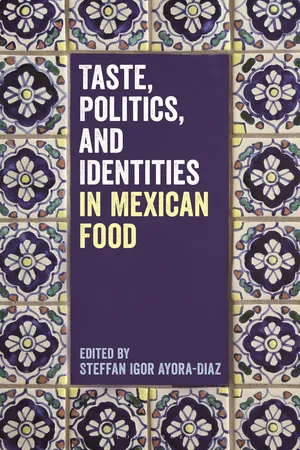
This book examines the history, archaeology, and anthropology of Mexican taste. Contributors analyze how the contemporary identity of Mexican food has been created and formed through concepts of taste, and how this national identity is adapted and moulded through change and migration.wing on case studies with a focus on Mexico, but also including Israel and the United States, the contributors examine how local and national identities, the global market of gastronomic tourism, and historic transformations in trade, production, the kitchen space and appliances shape the taste of Mexican food and drink.
Chapters include an exploration of the popularity of Mexican beer in the United States by Jeffrey M. Pilcher, an examination of the experience of eating chapulines in Oaxaca by Paulette Schuster and Jeffrey H. Cohen, an investigation into transformations of contemporary Yucatecan gastronomy by Steffan Igor Ayora-Diaz, and an afterword from Richard Wilk. Together, the contributors demonstrate how taste itself is shaped through a history of social and cultural practices.
- 240 pages
- English
- ePUB (mobile friendly)
- Available on iOS & Android
eBook - ePub
Taste, Politics, and Identities in Mexican Food
About this book
Information
Part One
Tasting the Past in Mexican Foods
1
A Touch of Pre-Columbian Maya Flavor
Lilia Fernández Souza,
Universidad Autónoma de Yucatán
Universidad Autónoma de Yucatán
Archaeology, food, politics, and the senses
Archaeology is an anthropological discipline that studies the past through material evidence. Through archaeological evidence we can debate subsistence, economic, religious, and political issues, to mention a few of the possible topics of interest about the human past. There are questions yet to be fully answered: can we understand the senses and feelings of ancient people? How close can we get to what people felt, tasted, smelled, enjoyed or chose to eat and drink? Was there a relation between taste and politics? Are these good questions? Does it even matter?
Food has always been intimately involved with politics. Hastorf (2017) affirms that the presentation of food is a way to display differences of power as well as ideological asymmetries. Food may be used to stress inequality, exclusion, and differentiated access to certain products but, on the other hand, banquets and feasts may be occasions to share and negotiate or to create and to reinforce community ties. According to Hastorf (2017: 182), “Class is one of the most common delimiters of culinary rules.” Manners, etiquette, sequence of service, and presentation are some of the ways of marking social, economic, and political differences. Trends are imposed in different ways. For example, Bourdieu (1984) reflects about the construction of “legitimate cultures” that indicate the best-accepted trends to perform practices such as the appreciation of arts and the tastes of food. Individual choices depend both on family social background and on formal education that provide the blueprint about what is considered elegant, cultivated, and culturally legitimate. In certain regards the social origins of individuals are a heavier factor than education, but in any case “This predisposes tastes to function as markers of ‘class’” (Bourdieu 1984: 2).
Hence, complex societies have different sorts of cooking practices and eat according to socio-economic and political differences. Stephen Mennell (2005), based on his study of medieval Europe, discusses the mechanisms where haute cuisines are created. He argues that social stratification is necessary but not sufficient for the emergence of an elaborate culinary taste, adding another required ingredient: long chains of social interdependence. Mennell (2005: 26, 27) argues that when there exists a deep social division and an unequal interdependence between strata, the power and status of the elites is manifested through the quantity of food, not its quality nor the complexity in food preparation. But when social strata get closer and interdependence becomes more equal, there exists more competition and cuisines change to become more elaborate. On the other hand, long interdependence chains also allow access to a wider variety of ingredients. Mennell (2005: 27) defines haute cuisine “by their typical dishes requiring complex sequences of stages and considerable division of labour among kitchen staff,” and suggests that it first emerged in court societies such as that of ancient Egypt. Hence politics impacts culinary practices in several ways: different social strata have distinct access to alimentary products, and the elites find strategies to stress their membership to a legitimate culinary culture and, consequently, to refined and sophisticated tastes of haute cuisine.
Different studies have stressed the fact that in Western tradition taste has been devaluated in favor of vision and hearing (Cárdenas Carrión 2014; Hamilakis 2011: 209; Sutton 2010: 210). Nonetheless, there is a growing number of anthropologists interested in how the senses, and particularly taste, are a fundamental part of human experience. Gustemology, as defined by Sutton (2010: 215), refers to “such approaches that organize their understanding of a wide spectrum of cultural issues around taste and other sensory aspects of food.” Such issues include how and why people decide that something is edible or inedible (Smith 2006: 480); how taste practices define what is appropriate or inappropriate, and become part of the formation of the self and of a group (Hastorf 2017); how food plays an important role in identity processes (Ayora-Diaz 2012); and how good and bad taste intervene in social interaction and negotiation (Stoller and Olkes 1989).
Often, taste is reduced to a chemical reaction of the taste buds, but we must recognize that it is also a multisensorial experience (Sutton 2010: 211). The human sensorium is based on synesthesia, the interactive union of all the senses (Cárdenas Carrión 2014: 35; Hamilakis 2011: 210; 2015; Sutton 2010: 218). As Hamilakis (2015: 205) points out, eating involves more senses than taste and smell: it uses tactility, visual tactility, the sense of emplacement, memory, and intoxication. Food substances, human bodies, artifacts, things, places, and performances, all together create a particular sensorial assemblage (Hamilakis 2015: 205). In their influential work The Taste of Ethnographic Things, Stoller and Olkes (1989: 32) advocate for what they call tasteful fieldwork; meaning that the anthropologists should not only investigate kinship, exchange, or symbolism but also “describe with literary vividness the smell, tastes, and textures of the land, the people, and the food.” This makes sense when we consider that everyday human life is full of a variety of sensual experiences which give meaning to daily activities, choices, and desires, and are imbedded with memory and emotion. So, we should produce tasteful ethnography. However, if what we want is to study ancient cultures, how possible is it to produce tasteful archaeology?
Archaeology has frequently raised questions about food in past societies: were they producers or appropriators? Were they hunters, pastoralists, fishermen, or farmers? Was their diet based on vegetables or meat? Were they egalitarian or hierarchical? Did people of a region take the same dietary decisions as their neighbors? Do dead people still need to eat? Answering these questions will allow us to understand some aspects related to sustenance, social and political organization, gender, world vision, religion, and identity among past cultures. However, as noted by different scholars (Hamilakis 2011: 208; 2015: 205; Hastorf 2017; Smith 2006: 481), archaeological research often focuses on aspects such as diet, production, subsistence systems, economy, logistics, and technology to make food digestible, but rarely on sensorial experiences of eating.
Sensory experiences seem to be ephemeral and intangible, and they may seem the opposite to archaeological evidence. Nonetheless, Hamilakis (2011: 209) claims that “sensory experience is material, it requires materiality in order to be activated, and its past and present material traces are all around us, whether it is the burnt bones of a pig that was sacrificed and then consumed, or the traces left on a rock which was repeatedly hit deliberately to produce sound.” The study of senses in archaeology does not pretend to bring the past sensorial experience to our present, or to make us feel the same taste or emotion that someone else felt in the past: that is an impossible quest, as sensual experiences are culturally and historically situated (Classen and Howes 1996: 87; Comis and Corrado 2009; Hamilakis 2011: 208). Archaeology can analyze sources and material remains that evoke flavors, textures, and aromas. Such is the case of the experimental recreation of Roman garum following both archaeological and historical evidence (Comis and Corrado 2009). As Hastorf suggests (2017: 392–393): “The materiality of food allows us to complete an archaeology of human experience, as both material and emotional aspects of a lived life surround food.”
In this chapter, I offer an approach to Maya pre-Columbian flavors. I discuss the evidence that may bring us close to the taste and aromas on the ancient Maya land, and to the differences between commoners’ and elites’ consumption. To accomplish these goals, archaeology must turn to multiple additional sources, such as botany and ecology (Matos Llanes and Acosta Ochoa 2016; Zimmermann 2008; Zizumbo Villarreal, Flores Silva and Colunga García-Marín 2012; Zizumbo Villarreal, García and Colunga García-Marín 2008); zooarchaeology (Götz 2014); chemical analysis of food residues (Barba, Ortiz and Pecci 2014; Henderson et al. 2007); and epigraphy and iconography to decipher writing and interpret images (Beliaev et al. 2009; García Barrios 2017; García Barrios and Carrasco Vargas 2008; Kantun-Rivera 2010; Kettunen and Helmke 2011; Stuart 2006; Vail 2009). Finally, we must also take into account historic texts, dictionaries, ethnographic records, and the contributions of ethnoarchaeology to complete a multidisciplinary approach (Arzápalo Marín 2003; Barrera Vázquez 1995; Garza et al. 2008).
Ingredients and their history
The most prominent ingredients of the Mesoamerican pre-Columbian diet are the well-known triad of maize, beans, and squash. Far from a simple and monotonous menu, research has unveiled a very complex scenario. These cultigens were neither domesticated at the same time nor in the same place. There is evidence of domesticated squash between 8900 and 7900 BP (Before Present), of corn around 9000 BP, and of common beans (Phaseolus Vulgaris) around 8000 and 6000 BP. Domesticated chili peppers (Capsicum Anuum) have been found at about 6000 BP, and a variety of tubers around the fourth millennia BP (Pohl, Pope and Jones 2000: 259; Zizumbo Villarreal, García and Colunga García-Marín 2008: 93; Zizumbo Villarreal, Flores Silva and Colunga García-Marín 2012: 330).
Corn was the undisputable king of the Mesoamerican diet. According to Clark et al. (2007: 23) and Rosenwig (2006), the importance of maize grew from 1000 BCE when, for some reason, Mesoamerican people chose corn over other cultigens such as tubers (like makal [Xantosoma yucatanense] and sweet potatoes), without excluding the latter from their diet. For the pre-Columbian Maya, archaeological and historical data suggest mainly a vegetarian diet, enriched with game or fish, especially for elite groups in wealthier sites (Garza et al. 2008; Götz 2014). Apparently, at least in some contexts, meat was quite appreciated: the Dresden Codex, a postclassic northern Lowland Maya document, has, among other topics, a description of New Year ceremonies in which food was offered to major gods and goddesses (Vail 2009). Meals and beverages of corn and cacao were ubiquitous, as well as meat dishes; there were tamales stuffed with venison, fish, iguana, turkey and other birds, and also platters of meat and jars full of alcoholic beverages. Early colonial sources, such as Bishop Diego de Landa’s Relación de las cosas de Yucatán, describe similar ceremonies in which the principals of the towns and common people ate delicacies like quails and venison’s hearts. According to Farris (2012: 240), festivities were important occasions, both in religious and social senses. They were the moments in which commoners had access to foods and drinks that were not part of their daily life. After the conquest, pork lard became an especially appreciated delicacy (Farris 2012).
Early colonial sources offer information about the amazing variety of vegetal and animal resources that were consumed by the Yucatec Maya (Garza et al. 2008; Landa 2001; Roys 1972): in addition to corn and different types of beans, squashes, and chili peppers, there were fruits, leaves, seeds, roots, and tubers, as well as mammals, birds, and fishes from the sea and sinkholes (cenotes). There were few domesticated animals—dogs, turkeys, and bees—so most of the meat came from hunting and fishing. Native bees, particularly the Melipona becheii, a stingless bee, produced a priceless honey, which was used both as a sweetener and as the base for most alcoholic beverages. Yucatán was and still is rich in salt from the peninsular coastal salt mines. After the conquest, new animals, vegetables, and other ingredients were imported, although their influence and adoption depended on such factors as the distance from settlements to cities and the limited purchase power of the inhabitants of towns. As argued by Ayora-Diaz (2012, 2017), today Maya food is only one of multiple components of the contemporary Yucatecan kitchen. Some culinary practices can be traced back centuries in time, and several current cooking practices are helpful to understand material evidence from the past.
Flavors, blends, and textures
From around 1000 BCE, corn was one of the pillars of Mesoamerican and Maya meals. Pre-Columbian Maya sources suggest that the tamale was the most common form of preparation. In an influential work, Taube (1989) examined the iconography and texts from Maya pottery and sculpture and found different sorts of tamales: some of them were rounded, with a sort of notch on their top that suggests that they were stuffed. Others looked like rolls, and others were clearly covered with some dripping substance, like a sauce. As mentioned above, in Maya art and texts there are clear examples of meat tamales. In Maya languages, the word for tamale is waaj, which is also used for “tortilla” and other corn meals. In early Yucatecan colonial dictionaries, a translation for waaj was pan, “bread” in Spanish. Some of the mentioned dishes were bakil waaj (meat patty), kayil waaj (fish patty), hak sikil (beans and squash seed bread), thancabal waaj and pim waaj (thick tortillas), and liktzuhil waaj (fresh bread) (Arzápalo Marín 2003: 252). Bishop Landa (2001: 75) describes some other varieties, which included ingredients such as quail meat, egg yolk, venison heart, and “their dissolved pepper” (chili pepper).
Today, tamales are still appreciated in Yucatán, and they are a frequent dish for birthdays and other parties. It is relatively common to find successful street tamale vendors in some corners of Mérida city, because preparation at home is relatively laborious. Tamales or tamale-like dishes are diverse in form, size, flavor, and texture: some are steam cooked, such as vaporcitos, tamales colados (strained tamales) and dzotobichayes (rolled chaya leaf tamale), while others like mucbil pollo (a special dish for the Day of the Dead celebrations) and chachak waajes are baked in an underground oven named pib. In all cases, the base is corn dough, stuffed, and covered or wrapped with maize or banana leaves before cooking. But, depending on the sort of tamale, the dough can be mixed with xpelon beans, chaya leaves, or achiote seeds (Bixa orellana) milled and dissolved in water. The stuffing depends on access to ingredients and individual preference, and it may be made out of lima beans, poultry, or pork. Dzotobichay is made without meat: it is a long roll of corn dough mixed with finely chopped chaya leaves and stuffe...
Table of contents
- Cover
- Halftitle Page
- Title Page
- Contents
- List of Illustrations
- Notes on Contributors
- Acknowledgments
- Introduction: Matters of Taste: The Politics of Food and Identity in Mexican Cuisines
- Part One: Tasting the Past in Mexican Foods
- Part Two: The Identity and Politics of Mexican Foods—and the Politics of Identity
- Part Three: Taste and Displacement: Mexican Food in the World of Consumption
- Postface: Is there Mexican Food? Taste and the Politics of Cultural Identity
- Index
- Imprint
Trusted by 375,005 students
Access to over 1.5 million titles for a fair monthly price.
Study more efficiently using our study tools.
Frequently asked questions
Yes, you can cancel anytime from the Subscription tab in your account settings on the Perlego website. Your subscription will stay active until the end of your current billing period. Learn how to cancel your subscription
No, books cannot be downloaded as external files, such as PDFs, for use outside of Perlego. However, you can download books within the Perlego app for offline reading on mobile or tablet. Learn how to download books offline
We are an online textbook subscription service, where you can get access to an entire online library for less than the price of a single book per month. With over 1.5 million books across 990+ topics, we’ve got you covered! Learn about our mission
Look out for the read-aloud symbol on your next book to see if you can listen to it. The read-aloud tool reads text aloud for you, highlighting the text as it is being read. You can pause it, speed it up and slow it down. Learn more about Read Aloud
Yes! You can use the Perlego app on both iOS and Android devices to read anytime, anywhere — even offline. Perfect for commutes or when you’re on the go.
Please note we cannot support devices running on iOS 13 and Android 7 or earlier. Learn more about using the app
Please note we cannot support devices running on iOS 13 and Android 7 or earlier. Learn more about using the app
Yes, you can access Taste, Politics, and Identities in Mexican Food by Steffan Igor Ayora-Diaz in PDF and/or ePUB format, as well as other popular books in History & Latin American & Caribbean History. We have over 1.5 million books available in our catalogue for you to explore.