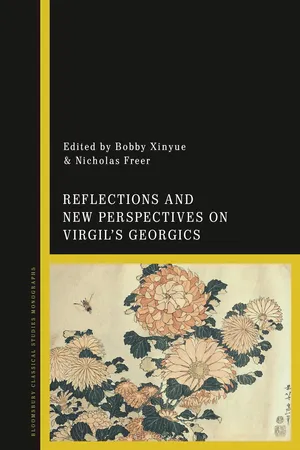
Virgil's Georgics, the most neglected of the poet's three major works, is brought to life and infused with fresh meanings in this dynamic collection of new readings. The Georgics is shown to be a rich field of inherited and varied literary forms, actively inviting a wide range of interpretations as well as deep reflection on its place within the tradition of didactic poetry.
The essays contained in this volume – contributed by scholars from Australia, Europe and North America – offer new approaches and interpretive methods that greatly enhance our understanding of Virgil's poem. In the process, they unearth an array of literary and philosophical sources which exerted a rich influence on the Georgics but whose impact has hitherto been underestimated in scholarship. A second goal of the volume is to examine how the Georgics – with its profound meditations on humankind, nature, and the socio-political world of its creation – has been (re)interpreted and appropriated by readers and critics from antiquity to the modern era. The volume opens up a number of exciting new research avenues for the study of the reception of the Georgics by highlighting the myriad ways in which the poem has been understood by ancient readers, early modern poets, explorers of the 'New World', and female translators of the twentieth and twenty-first centuries.
eBook - ePub
Reflections and New Perspectives on Virgil's Georgics
- 304 pages
- English
- ePUB (mobile friendly)
- Available on iOS & Android
eBook - ePub
Reflections and New Perspectives on Virgil's Georgics
About this book
Information
PART I
READING THE GEORGICS
CHAPTER 1
THE STORY OF YOU: SECOND-PERSON NARRATIVE AND THE NARRATOLOGY OF THE GEORGICS
Robert Cowan
The way I tell ’em: narratology, classical literature and didactic poetry
Narratology is among the most important and widely-deployed tools for the analysis of Classical literature.1 Following the trailblazing work of de Jong on Homer and Winkler on Apuleius, the (for want of a better term) ‘fictional’ narrative genres of epic and the novel have offered particularly fertile ground for narratologists to plough.2 Other narrative genres, such as historiography, and even those which are not conventionally ‘narrative’, such as lyric, drama and elegy, have also proven susceptible to narratological analysis. In contrast, didactic poetry has remained largely untouched by narratologists. In many ways this is unsurprising, since ‘didactic poetry is a genre of discourse, not narrative’.3 When narrative technique is discussed, it tends to focus on the more conventionally narrative sections of the poems, such as Lucretius’s plague or Virgil’s Aristaeus, in short the parts of the poems which are least characteristic of the didactic genre.4 There are a handful of very distinguished exceptions to this tendency.5 Gale on Lucretius, Trépanier on Lucretius and Empedocles, and Fowler on didactic poetry more broadly have all shown how both the Aristotelian antithesis between Homer and Empedocles, and Benveniste’s between narrative and discursive modes can be deconstructed and how Classical didactic poetry can not only be illuminated by modern narratological theory but even at times self-consciously exploit some of its preoccupations.6 All three, though they glance briefly at narrators, narratees and related issues of focalization, concentrate overwhelmingly on plot and its narratological aspects of closure, order, rhythm and repetition. In doing so, they pass over what is, if we take seriously the proposition that didactic can be approached as narrative, its most prominent, distinctive and problematic feature: the identification of narratee and protagonist which makes didactic correspond to the rare and largely postmodern mode of second-person narrative.
Stories of you: second-person narration, didactic poetry and their scholarship
Although the case has been made for earlier instances, and although it is debated whether closely-related narrative phenomena such as epistolary fiction should be included under its heading, second-person narration is generally accepted as having developed in the second half of the twentieth century, taking as its foundational text Michel Butor’s 1957 novel La Modification (English translation retitled Second Thoughts). Notable examples include Edna O’Brien’s A Pagan Place (1970), John Updike’s ‘How to Love America and Leave It at the Same Time’ (1972), Italo Calvino’s Se una notte d’inverno un viaggiatore (If on a Winter’s Night a Traveller, 1979), Jay McInerney’s Bright Lights, Big City (1984), and several stories in Lorrie Moore’s Self Help (1985), as well as the children’s literature genre of ‘Choose-your-own-adventure’ books.7 Narratological scholarship on second-person narration had its own foundational text in Morrissette’s 1965 article ‘Narrative “You” in Contemporary Literature’, but only really underwent significant development in the early 1990s in articles by Richardson, Fludernik and Wiest and above all an agenda-setting special issue of the journal Style edited by Fludernik.8 In the subsequent twenty-five years, there has continued to be a steady stream of research, expanding into areas such as conversational storytelling and above all the new narrative forms of digital and interactive fiction and computer games.9 Except for a brief but stimulating section near the end of Akujärvi’s article on Pausanias and an equally brief entry in de Jong’s comprehensive introduction, the narratology of second-person narrative has not been applied to Classical texts.10
The affinity between didactic poetry and second-person narration is a close one. As Richardson, discussing the ‘literary’ nature of second-person narration with no reference to Classical literature, notes, its ‘non-fictional analogues [are] the pseudo-narrative forms of the cookbook, the travel guide, and the self-help manual’.11 Yet it is not merely on the grounds of distant family resemblance that I propose using the techniques developed to interpret second-person narrative to explore didactic poetry and the Georgics in particular. There are striking parallels, though largely without explicit mutual reference, in the scholarly preoccupations about and approaches to both genres, notably the positionality and authority of the narrator, the indeterminacy of the addressee/narratee and the role of apostrophe.12 It is on the second of these that this chapter will focus, adding also a significant sub-strand in second-person narrative studies: the way in which the narrative mode constructs a dialogue between determinism and individual autonomy.
Much of the scholarship is devoted to establishing precise definitions of what constitutes genuine second-person narrative, but there is a general consensus as to the broad outlines. The key factor is that the narratee is identical to the protagonist (or at least a major actant) of the narrative.13 Second-person narratives do not merely include the occasional aside to a heterodiegetic addressee of the ‘dear reader’ kind, as when Trollope self-referentially invokes the title of his own novel by asking ‘But can you forgive her, delicate reader?’14 As we shall see, the reader qua reader can be a protagonist, in Virgil as in Calvino, but not when she takes no other role in the narrative. DelConte offers probably the most comprehensive, if cumbersome, definition: ‘second-person narration is a narrative mode in which a narrator tells a story to a (sometimes undefined, shifting, and/or hypothetical) narratee – delineated by you – who is also the (sometimes undefined, shifting, and/or hypothetical) principal actant in that story’.15
Of course the equivalence between the Georgics’ farmer-protagonist(s) and the implied reader(s), be he Maecenas, the Young Caesar or a hypothetical educated urban Roman, is by no means unproblematic, any more than are the identities of the subcategories of different types of farmer and of reader.16 Yet, so far from being an issue which sets the poem apart from modern second-person narratives and their narratology, it is one of those in which both the texts themselves and their scholarship show striking similarities and immense potential for mutual illumination. Phelan writes that ‘most writers who employ this technique take advantage of the opportunity to move readers between the positions of observer and addressee and, indeed, to blur the boundaries between these positions’.17 This moving of readers and blurring of boundaries is precisely the sort of move which many readers of the Georgics have detected and which some have challenged. Horsfall writes about a ‘sharp separation between intended reader and imagined addressee’ and admittedly the teacher does often make it explicit, by means of vocatives and the nominative subjects of jussives and other third-person impera...
Table of contents
- Cover
- Half-Title Page
- Series Page
- Title Page
- Contents
- Notes on Contributors
- Preface
- Notes on the Text
- Introduction
- Part I Reading the Georgics
- 1 The Story of You: Second-Person Narrative and the Narratology of the Georgics
- 2 Clearing the Ground in Georgics 1
- 3 Aesthetics, Form and Meaning in the Georgics
- Part II Religion and Philosophy
- 4 Georgica and Orphica: The Georgics in the Context of Orphic Poetry and Religion
- 5 Virgil’s Georgics and the Epicurean Sirens of Poetry
- Part III Politics and Society
- 6 Divinization and Didactic Efficacy in Virgil’s Georgics
- 7 Bunte Barbaren Setting up the Stage: Re-Inventing the Barbarian on the Georgics’ Theatre-Temple (G. 3.1–48)
- 8 From Munera Uestra Cano to Ipse Dona Feram: Language of Social Reciprocity in the Georgics
- Part IV Roman Responses
- 9 ‘Pulpy fiction’: Virgilian Reception and Genre in Columella De Re Rustica 10
- 10 Servian Readings of Religion in the Georgics
- Part V Modern Responses
- 11 The Georgics off the Canadian Coast: Marc Lescarbot’s A-dieu à la Nouvelle-France (1609) and the Virgilian Tradition
- 12 Shelley’s Georgic Landscape
- 13 Women and Earth: Female Responses to the Georgics in the Twentieth and Twenty-First Centuries
- Notes
- Bibliography
- Index of Passages
- Index
- Copyright
Trusted by 375,005 students
Access to over 1.5 million titles for a fair monthly price.
Study more efficiently using our study tools.
Frequently asked questions
Yes, you can cancel anytime from the Subscription tab in your account settings on the Perlego website. Your subscription will stay active until the end of your current billing period. Learn how to cancel your subscription
No, books cannot be downloaded as external files, such as PDFs, for use outside of Perlego. However, you can download books within the Perlego app for offline reading on mobile or tablet. Learn how to download books offline
Perlego offers two plans: Essential and Complete
- Essential is ideal for learners and professionals who enjoy exploring a wide range of subjects. Access the Essential Library with 800,000+ trusted titles and best-sellers across business, personal growth, and the humanities. Includes unlimited reading time and Standard Read Aloud voice.
- Complete: Perfect for advanced learners and researchers needing full, unrestricted access. Unlock 1.5M+ books across hundreds of subjects, including academic and specialized titles. The Complete Plan also includes advanced features like Premium Read Aloud and Research Assistant.
We are an online textbook subscription service, where you can get access to an entire online library for less than the price of a single book per month. With over 1.5 million books across 990+ topics, we’ve got you covered! Learn about our mission
Look out for the read-aloud symbol on your next book to see if you can listen to it. The read-aloud tool reads text aloud for you, highlighting the text as it is being read. You can pause it, speed it up and slow it down. Learn more about Read Aloud
Yes! You can use the Perlego app on both iOS and Android devices to read anytime, anywhere — even offline. Perfect for commutes or when you’re on the go.
Please note we cannot support devices running on iOS 13 and Android 7 or earlier. Learn more about using the app
Please note we cannot support devices running on iOS 13 and Android 7 or earlier. Learn more about using the app
Yes, you can access Reflections and New Perspectives on Virgil's Georgics by Nicholas Freer, Bobby Xinyue, Nicholas Freer,Bobby Xinyue in PDF and/or ePUB format, as well as other popular books in History & Ancient History. We have over 1.5 million books available in our catalogue for you to explore.