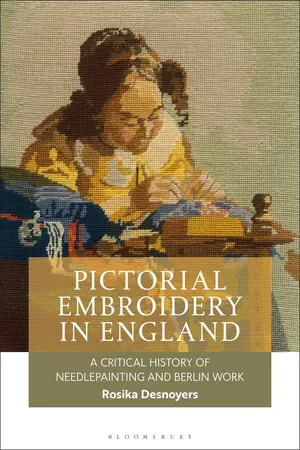
The little-known art of Berlin Work was once the most commonly practiced art form among European women. Pictorial Embroidery in England is the first academic study of both pictorial Berlin Work and its precursor, needlepainting, exploring their cultural status in the 18th and 19th centuries.
From enlightenment practices of copying to the development of an industrial aesthetic and the making of the modern amateur, Berlin Work developed as an official knowledge associated with notions of cultural and scientific progress. However, with the advent of the Arts and Crafts movement and modernist aesthetics, Berlin Work was gradually demoted to a craft hobby. Delving into the social, cultural and economic context of English pictorial embroidery, Pictorial Embroidery in England recovers Berlin Work as an art form, and demonstrates how this overlooked practice was once at the centre of cultural life.
eBook - ePub
Pictorial Embroidery in England
A Critical History of Needlepainting and Berlin Work
- 184 pages
- English
- ePUB (mobile friendly)
- Available on iOS & Android
eBook - ePub
Pictorial Embroidery in England
A Critical History of Needlepainting and Berlin Work
About this book
Information
1
NEEDLEPAINTING IN GREAT BRITAIN
The main source of inspiration for Berlin work was needlepainting, the eighteenth-century practice of copying paintings in silk or wool. This new form of embroidered picture emerged during the second half of the eighteenth century. Within embroidery practices there existed other examples of pictorial embroidery, which often referred to literary and religious texts. Needlepaintings differed from these in that they not only represented the subject matter but reproduced the appearance of the source. Needlepaintings are embroidered pictures in which a combination of long and short stitching in coloured thread is used to copy a given painting. Needlepaintings went so far as to reproduce the appearance of brush strokes and were framed and hung as paintings. Although needlepaintings were given a great deal of press in the late eighteenth century and early nineteenth century, they were nevertheless rare and only a few practitioners were well known. The most prominent needlepainters were the English artists Anne Eliza Morritt (1726–97), Mary Knowles (1733–1807) and Mary Linwood (1755–1845).
In Great Britain in the eighteenth century, needlepainting was considered a fine art and its value as an elite amateur practice was equal to other forms of visual art production, including drawing, painting and sculpture. At that time, the word ‘amateur’ referred to someone who was a lover of the arts and who did not rely on the sale of their art as a source of income. The pejorative sense of amateur as non-professional only arose in the nineteenth century.1 In contrast, the concept of professional referred to an occupational category. It implied someone who was less educated and referred to the ‘mercenary’ work of a labourer rather than the ‘free’ activity of the wealthy. The classification of needlepainting as an elite amateur practice, however, is complicated by the fact that it emerged at roughly the same time as the professionalization of art. In eighteenth-century Great Britain, a new system of art developed, with new art institutions, new audiences for art and new concepts of taste. According to John Brewer, the modern idea of high culture is an eighteenth-century invention that was brought about by transformations introduced during the scientific revolution and shaped by the deliberate efforts of artists to define aesthetic criteria and standards of good taste.2 To grasp the status and meaning of needlepainting during this time, I examine its contexts of production, both intellectual and institutional, its sites of reception, transformations to notions of culture, new institutional forces and constraints, and the influence of gender ideology on women artists.
It would be impossible to discuss needlepainting without giving special attention to Mary Linwood, whose works were highly regarded in her time and who competed with the standards established by her contemporaries in the Royal Academy. Needlepainting, however, is a site of shifting meanings and values, subject to social and cultural transformations. It is without a doubt the source of inspiration for nineteenth-century Berlin work and as such expresses many of the contradictions that would lead not only to the valorization of Berlin work but also to its eventual displacement by modernist aesthetics. By the end of the nineteenth century, needlepainting became anathema to modernist ideals because it was an impure form of intermedial practice, a hybrid of embroidery and painting. Paradoxically, it is this same compound character, the copying of an image into an embroidered medium, that carried the interest in Berlin work well into the twentieth century in the form of needlepoint, a gendered practice associated with repetition and domesticity.3 While it may be that the culture of separate spheres allowed Berlin work to survive to the present day, albeit in altered form, we find that in the eighteenth century such qualifications had yet to be established and were, rather, open to deliberation as notions of art as a skilled activity and as the object of sense perception competed with emergent ideals of art as the expression of a free imagination.
Women artists and art institutions in eighteenth-century England
The cultural contributions of women in eighteenth-century England were dramatically shaped by the rise of the bourgeois class and its economic principles of industrial and mercantile capitalism. Although the three prominent needlepainters of this era, Morritt, Knowles and Linwood, had diverse backgrounds, all of them were influenced by this context in which entrepreneurial activity was closely associated with liberal Enlightenment notions of wealth production as a symbol of political freedom. While women’s contributions to art and literature were celebrated and taken as a measure of Britain’s civilizational achievement, their access to culture was greatly conditioned by bourgeois values of femininity and domesticity. Pseudoscientific theories associated women with specific qualities, such as liveliness, fastidiousness, discernment and enthusiasm.4 According to Garry Kelly, the particular qualities that were falsely associated with upper- and middle-class women – delicacy of constitution, aesthetic perception, moral sensibility – were used to rationalize the disqualification of women from public life.5 The bourgeois cultural revolution refashioned earlier family forms, emphasizing conjugal and parental relations, and leading to a domestication of the arts, manifested in the encouragement of parlour music, drawing, watercolour, reading, gardening and needlework.6 Bourgeois social relations worked to restrain the spheres of women’s creative endeavour. Thus, for example, it was widely believed that women did not have the capacity of abstract thought that was required for the genre of history painting, but were instead more suited to the detailed observation and mimesis required for portraiture.7 On the whole, English women were dismissed as inferior in mental powers and few cultural or political institutions permitted their participation.8
Despite the fact that the Enlightenment is sometimes considered a period of intense patriarchal oppression, women patrons and creators nevertheless contributed to the development of English culture.9 In particular, the influence of female patronage was impressed in England and beyond.10 Of particular significance was the patronage of Queen Charlotte, who fostered the careers of many women artists and was the first monarch to employ women in large numbers. Well-established figures like Angelica Kauffman and Mary Moser benefited from the Queen’s support. Heidi Strobel writes that Charlotte almost certainly played a role in these women artists attaining member status in the founding of the Royal Academy.11 In her patronage, Charlotte did not encourage a hierarchy of genres or media. She encouraged wax work, engraving, miniature painting, marble sculpture, fan painting and embroidery. She also commissioned transparencies from Robert Adams and Benjamin West. These so-called minor arts were traditionally open to women and many were in fact dominated by them. Charlotte was also an avid admirer of music and supporter of theatre, and she selected authors for house appointment.
Whatever gains were achieved by women artists in eighteenth-century England, it was often not without the requisite social standing, patronage and support of men. If patronage was significant in shaping ideas about women’s achievements as artists, more significant in the long run was the development of art associations. The first associations were the Free Society of Artists (FSA), the Society of Artists of Great Britain (SAGB) and the Society for the Encouragement of Arts, Manufacturing and Commerce (SEAMC). These groups did not make any great distinctions between media or genre and exhibited all forms of art production. Women figured prominently in these societies. This is something that changed, however, with the inauguration of the Royal Academy, which was founded through royal patronage in 1768. Judging from his commissions, George III, husband of Charlotte, would have traced a sharp distinction between genres of art, favouring history painting. As a founding patron, the King encouraged history painting through the awarding of prestigious commissions. For example, following the completion of a series of canvases, thirty years in the making, George III acknowledged Benjamin West’s role in ‘carrying the higher department of History Painting into effect.’12 Among the forty founding members of the RA, Kauffman and Moser were the only women. The inclusion of these two women at the moment of the formation of the Academy is noted as somewhat exceptional in comparison with other corporate institutions and learned societies.13 For example, the Roya...
Table of contents
- Cover
- HalfTitle Page
- Title Page
- CONTENTS
- ILLUSTRATIONS
- PREFACE
- ACKNOWLEDGEMENTS
- INTRODUCTION
- 1 NEEDLEPAINTING IN GREAT BRITAIN
- 2 IMITATION AND INNOVATION IN THE LATE EIGHTEENTH CENTURY
- 3 TOWARDS AN INDUSTRIAL AESTHETIC
- 4 THE WRITING OF PICTORIAL BERLIN WORK
- CONCLUSION
- NOTES
- BIBLIOGRAPHY
- INDEX
- PLATES
- Copyright Page
Trusted by 375,005 students
Access to over 1.5 million titles for a fair monthly price.
Study more efficiently using our study tools.
Frequently asked questions
Yes, you can cancel anytime from the Subscription tab in your account settings on the Perlego website. Your subscription will stay active until the end of your current billing period. Learn how to cancel your subscription
No, books cannot be downloaded as external files, such as PDFs, for use outside of Perlego. However, you can download books within the Perlego app for offline reading on mobile or tablet. Learn how to download books offline
Perlego offers two plans: Essential and Complete
- Essential is ideal for learners and professionals who enjoy exploring a wide range of subjects. Access the Essential Library with 800,000+ trusted titles and best-sellers across business, personal growth, and the humanities. Includes unlimited reading time and Standard Read Aloud voice.
- Complete: Perfect for advanced learners and researchers needing full, unrestricted access. Unlock 1.5M+ books across hundreds of subjects, including academic and specialized titles. The Complete Plan also includes advanced features like Premium Read Aloud and Research Assistant.
We are an online textbook subscription service, where you can get access to an entire online library for less than the price of a single book per month. With over 1.5 million books across 990+ topics, we’ve got you covered! Learn about our mission
Look out for the read-aloud symbol on your next book to see if you can listen to it. The read-aloud tool reads text aloud for you, highlighting the text as it is being read. You can pause it, speed it up and slow it down. Learn more about Read Aloud
Yes! You can use the Perlego app on both iOS and Android devices to read anytime, anywhere — even offline. Perfect for commutes or when you’re on the go.
Please note we cannot support devices running on iOS 13 and Android 7 or earlier. Learn more about using the app
Please note we cannot support devices running on iOS 13 and Android 7 or earlier. Learn more about using the app
Yes, you can access Pictorial Embroidery in England by Rosika Desnoyers in PDF and/or ePUB format, as well as other popular books in Design & Fashion Design. We have over 1.5 million books available in our catalogue for you to explore.