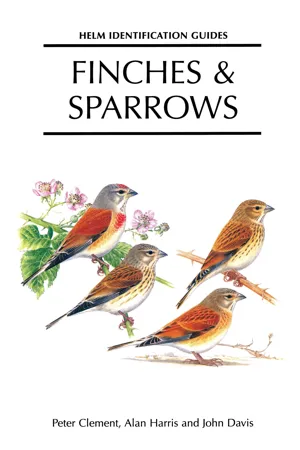
This is a guide to 'true' finches and sparrows illustrating all the species, many races and most sex and age variations, with almost 950 portraits. The maps accompanying the illustrations show breeding and wintering ranges for all species. Although the guide is not primarily intended for cagebird enthusiasts, it will also be useful for those wishing to know more about the species encountered in captivity.
- 512 pages
- English
- ePUB (mobile friendly)
- Available on iOS & Android
eBook - ePub
Finches and Sparrows
About this book
Information
GENUS FRINGILLA
Three species. Robust or sturdy finches with stout bills and a characteristic jerking head movement and shuffling gait. Their distribution is Palearctic, with one species an island endemic. The Brambling is a true migrant and the Chaffinch a partial migrant. They are very similar to Cardueline finches (with which they have been merged in some classifications), but differ in nesting behaviour, feeding of nestlings, and lack of a crop.
1 CHAFFINCH Fringilla coelebs Plate 1
Palearctic
Fringilla coelebs Linnaeus, 1758, Syst. Nat., ed. 10, p. 179, Sweden.
IDENTIFICATION Length of male 14–18 cm, of female 14–17.5 cm (5½–7 in). A medium-sized finch, often appearing quite stocky. The head has a gently peaked crown and the tail is slightly forked; walks with a characteristic jerky hopping gait. Males are very distinctive. Confusion species: The closely related but larger Blue Chaffinch (2) is entirely blue- or slate-grey and lacks white medians or tips to greater coverts. Females and immatures are distinguished at all times from the similarly plumaged Brambling (3) by green or greenish edges to brown rump and uppertail-coverts; Brambling is generally more orange and always shows a large white rump.
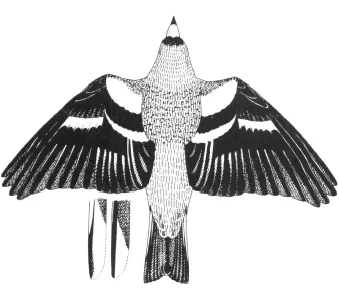

DESCRIPTION Sexes differ. Adult male (all races except North Africa and Atlantic islands) summer plumage: Forehead black or blackish, merging into slaty grey-blue of crown, nape and hindneck; sides of head, lores, area over eye to ear-coverts and cheeks deep pink, tinged deep orange. Mantle and back deep reddish-brown to chestnut, becoming blue-green on scapulars; lower back and rump green or deep green, extending slightly onto uppertail-coverts and becoming blue-grey. Tail has slate-grey centre to otherwise black feathers, all thinly edged green, outer tail feathers white. Median and outer lesser coverts white, inner lesser coverts bluish-grey or green (merging with scapulars); greater coverts black, thinly fringed and broadly tipped white; alula and primary coverts black; flight feathers black or brownish-black, outers (except outermost three) with broad white or yellowish-white bases (shows as small white square on closed wing), all finely edged greenish-yellow; tertials also blackish, broadly edged and tipped chestnut in fresh plumage, but soon becoming pale buff. Chin and throat to breast and flanks deep pink tending to orange, becoming duller on lower breast and belly; ventral region and undertail-coverts white. Bill pale blue-grey (dark tip in summer), becoming yellow or buffish in winter but retaining dark tip. Legs and feet pale pinkish-brown. In winter, a paler or somewhat duller version of summer plumage, especially on head (crown and nape become grey-brown), mantle and underparts; greenish-yellow edges to secondaries become more pronounced. Adult female (all races except North Africa and Atlantic islands) summer plumage: Forehead to nape, mantle, scapulars and back dull earth-brown, tinged slightly grey; sides of head and neck washed smoke-grey, quite pronounced on some, but otherwise lores, cheeks and ear-coverts slightly paler than upperparts. Upperparts as male except for rump, which is green or deep green, deepest in centre and browner at edges. Tail as male but brown instead of slate-grey or black, outer tail feathers white. Wings also as male but more brownish-black. Chin and throat pale or dingy buff, becoming dull buffish-grey on breast and upper belly with a tinge of pale grey (or, on some, pink) on breast; belly paler, more off-white, with whiter undertail-coverts. In winter, very similar, but less grey about sides of head and neck and white in wings not so bright. Bill at all times brown or brownish, darkest at tip, palest at base and on lower mandible. Legs pink or pinkish-brown. Juvenile: Very similar to winter-plumage female, but with conspicuous pale buff patch on nape; rump shows less green, and is more uniform brown with yellowish wash to underparts. On males, mantle is tinged warm brown and cheeks and ear-coverts more buff than brown. Moults July–September: first-winter plumage as adult, but retains juvenile wing and tail feathers and some outer greater coverts and alula; retained tail feathers are narrower than those of adult. Breeds in first summer.
GEOGRAPHICAL VARIATION Very little variation in plumage among races found in Europe and the Middle East, except for some slight differences in the intensity or depth of colour of head and body, usually undetectable in the field. However, males of British race gengleri have brick-red underparts compared with vinaceous-red of nominate race; males of race schiebeli are also similar to nominate but paler on underparts, with pale pinkish throat. Males of North African and North Atlantic island races lack chestnut mantle and upper back, and deep pinkish-orange of face and underparts. North African races africana and spodiogenys have entire head and neck (except chin and throat) bluish-grey, with forehead and upper lores black or blackish (africana has a thin white eye-ring and a small pale or whitish spot behind eye), mantle and back olive-green (deeper and extending to rump on africana), and blue or bluish-grey scapulars, rump (spodiogenys) and uppertail-coverts; spodiogenys also shows (quite broadly on some) white edges to secondaries and tertials, the white in outer two tail feathers has a dark outer web for the terminal half of the feather and white on a large area of inner web of next inner feathers. In both races, chin and throat to belly are pink or washed peach. Those on Gran Canaria, Gomera and Tenerife (tintillon) have black on forehead becoming deep slate-blue on crown to mantle and back, and dull green or yellowish-green on rump becoming deep slate-grey-blue on uppertail-coverts and tail; outer tail feathers have variable amounts of white, with a blackish terminal half to outer webs, and a white spot on the next feather; the wings are generally black, but median coverts and tips of greater coverts are white, secondaries and primaries edged pale green; underparts peachy-buff or pinkish on lower breast and flanks or whitish on belly and undertail-coverts, but some can be heavily washed yellow; bill virtually all black or dark bluish-horn. On the island of Hierro, ombriosa is very similar to tintillon, but has dull green on lower mantle, back and rump, a small white patch at base of inner primaries, and fine yellowish edges to secondaries; underparts are very similar, but the peachy-buff is paler and does not always extend onto flanks. Males on Las Palmas (palmae) differ from ombriosa in having upperparts entirely deep slate-blue and the yellowish-green fringes to inner secondaries, primaries and tertials more pronounced; the central tail feathers are grey; underparts are mostly white, with a light peach or pinkish wash to chin, throat and upper breast, and flanks can be tinged with grey. Birds on Madeira (maderensis) and the Azores (moreletti) closely resemble the North African races, with deep blue on crown and nape (paler on moreletti), green or olive-green across mantle and rump interrupted by blue on lower mantle and back (to the rump on moreletti) and buff or yellow fringes to flight feathers; light pink or peach-buff from face to breast (or tinged with brown on some birds on the Azores), becoming pinkish or white on belly and flanks. All the above races have dark or almost black bills; those on the Canaries (and some of the birds on the Azores) have slightly larger and deeper-based bills. Females of the North African and Atlantic island races are generally paler or grey-brown on the upperparts, with olive or grey-green on the rump and with bluish-grey uppertail-coverts; the chin and throat are pale or dull peachy-buff, with sides of throat and breast washed buffish-brown; the wings are paler or duller than in other races, with white tips to median coverts and pale yellowish-buff tips to greater coverts and edges to secondaries. Females on Madeira (maderensis) have only one white outer tail feather (all other races have two) and have mantle and back slightly darker or browner; on the Azores (moreletti) they are similar to females of the nominate race.
VOICE Call is a distinctive, almost metallic ‘pink’, ‘spink’ or ‘chink’, uttered as either a single or a double note from the ground or perch, also a loud ‘wheet, ‘whit’, ‘tsip’ or ‘tsirrup’ (usually in spring) and a thin high-pitched or wheezing ‘eeese’; in flight a characteristic quiet ‘tap’, ‘chap’ or ‘tsup’ note. Females on the ground utter a quiet soft ‘chip’ or ‘chirrip’. F. c. coelebs has several variations or individual notes such as ‘twit’ or ‘fit’, and also a ‘hooeed’ note not dissimilar in tone to some calls of Willow Warbler (Phylloscopus trochilus) or Chiffchaff (P. collybita); in many areas of Europe the ‘chink’ call is unknown. Atlantic island races have local dialect variations, some of which can be described as variations on ‘chwee’, ‘chee-oo’ or ‘chwoo’; others, e.g those on Tenerife, have one or two notes of their own. Song is a musical rattle of several notes repeated on a descending scale followed by a final rapid flourish, ‘chip chip chip tell tell tell cherry-erry-erry tissi cheweeo’ (W Garstang), usually given from a tree and repeated several times; birds in northern Europe have a distinctive variation to the song (occasionally heard elsewhere from spring migrants), with the normal song phrase followed immediately by a sharp ‘chip’ or ‘chink’ recalling the call of Great Spotted Woodpecker (Dendrocopos major). Local variations and dialects exist throughout the range, particularly in North Africa and the Atlantic islands, but song is unmistakably the same. In spring, females often give a repeated soft or feeble ‘zi’ or ‘si-si-si’.
STATUS, HABITAT AND BEHAVIOUR Common, in places abundant. Found in both conifer (native and non-native) and deciduous woods, forest, heaths, copses, parks, orchards and gardens; often in stubble fields in autumn and winter. Most of the Canary Islands races inhabit forests of laurel or chestnut, except on Palma, Hierro and Madeira where pine forests are preferred. In winter, birds in mainland Europe are often found in mixed flocks of Bramblings (3), Greenfinches (44) and sparrows; also in large flocks comprising males only (coelebs = bachelor) or females and immatures. The bird has a distinctive short shuffling or jerky step with slightly nodding head in a rather crouched walk or hop; often rather shy or nervous, especially when in company of more aggressive species. Flight is bounding and undulating. Food is principally seeds, beechmast, corn, also buds, fruit, spiders, beetles, insects and their larvae; nestlings are fed on caterpillars.
DISTRIBUTION F. c. coelebs: Europe to northernScandinavia, east through Russia (north to the tree line) to Kazakhstan and about 90°E (Krasnoyarsk), western Siberia, occasionally further east (to the Yenisei) in isolated areas; south to the shores of the northern Mediterranean from Portugal and Spain east to Turkey and northern Lebanon, including the Balearics, Sardinia, Corsica, Sicily and Cyprus.
F. c. gengleri: British Isles.
F. c. transcaspica: southern Caucasus and northern Iran (possibly also Turkmenia, Central Asia).
F. c. alexandrovi: northern Iran.
F. c. solomkoi: Crimea and the Caucasus.
F. c. schiebeli: Crete.
F. c. sarda: Sardinia.
F. c. africana: Morocco east to Tunisia and Cyrenaica (Libya) northwest Africa.
F. c. spodiogenys: northern and eastern Tunisia to Libya (Tripoli).
F. c. tintillon: Gran Canaria, Tenerife and Gomera.
F. c. ombriosa: Hierro (Canary Islands).
F. c. palmae: La Palma (Canary Islands).
F. c. maderensis: Madeira.
F. c. moreletti: the Azores.
The nominate race has also been introduced into New Zealand (where it is widespread) and the Cape Town area of South Africa.
Note: breeding birds in the southern Caucasus may be of the races transcaspica, solomkoi or alexandrovi or intermediates, as considerable interbreeding takes place.
MOVEMENTS Sedentary and migratory. Northern breeders of the nominate race move west, southwest or south to winter mostly within the range in central and southern Europe, around the Mediterranean, Cyprus, the Middle East to Israel, southern Iraq and southwest Iran. Those from southern Norway and Sweden together with some from Finland, Poland and the Baltic States move southwest to winter in the British Isles, and birds from Germany and central Europe winter in France and Spain. Breeding birds in northern Iran and the southern Caucasus (solomkoi) move east to winter in Afghanistan, northern Pakistan, Kashmir and Nepal, also occurring regularly in northwest India. It is a scarce or irregular migrant (presumably coelebs) to Libya (in varying numbers annually, occasionally common in coastal areas, also one record from the Libyan desert), Egypt (has occurred in southern Egypt: Aswan, February 1976), and Tunisia. Vagrant to Iceland, Faroe Isles, Saudi Arabia (east to Dharan), Kuwait, United Arab Emirates, Tibet and eastern China — Beidahe, (March–April 1989) Shenyang, Liaoning Province (December 1963), and Beijing (winter 1988/89); birds of race coelebs (or perhaps gengleri) have occurred as vagrants to the Canary Islands.
It has also been recorded in North America: Massachusetts (April 1961), Newfoundland (February 1967), Louisiana (December 1978) and Maine (April 1980). While these probably relate to escapes from captivity, particularly the Louisiana record, the northeast bias in spring also suggests natural vagrancy. Southward migration in autumn begins in mid-September and continues to the middle or end of November; onward or continuing passage is not unusual in January or February, and some populations also move in front of, or at the onset of, periods of severe winter weather. Return mo...
Table of contents
- Cover
- Title Page
- Copyright Page
- Contents
- Introduction
- Acknowledgements
- How to use this Book
- General Notes on Finches and Sparrows and their Relationships
- How to Identify Finches and Sparrows
- Systematic Section
- Glossary of Terms
- Bibliography
- Colour Plates
Trusted by 375,005 students
Access to over 1.5 million titles for a fair monthly price.
Study more efficiently using our study tools.
Frequently asked questions
Yes, you can cancel anytime from the Subscription tab in your account settings on the Perlego website. Your subscription will stay active until the end of your current billing period. Learn how to cancel your subscription
No, books cannot be downloaded as external files, such as PDFs, for use outside of Perlego. However, you can download books within the Perlego app for offline reading on mobile or tablet. Learn how to download books offline
Perlego offers two plans: Essential and Complete
- Essential is ideal for learners and professionals who enjoy exploring a wide range of subjects. Access the Essential Library with 800,000+ trusted titles and best-sellers across business, personal growth, and the humanities. Includes unlimited reading time and Standard Read Aloud voice.
- Complete: Perfect for advanced learners and researchers needing full, unrestricted access. Unlock 1.5M+ books across hundreds of subjects, including academic and specialized titles. The Complete Plan also includes advanced features like Premium Read Aloud and Research Assistant.
We are an online textbook subscription service, where you can get access to an entire online library for less than the price of a single book per month. With over 1.5 million books across 990+ topics, we’ve got you covered! Learn about our mission
Look out for the read-aloud symbol on your next book to see if you can listen to it. The read-aloud tool reads text aloud for you, highlighting the text as it is being read. You can pause it, speed it up and slow it down. Learn more about Read Aloud
Yes! You can use the Perlego app on both iOS and Android devices to read anytime, anywhere — even offline. Perfect for commutes or when you’re on the go.
Please note we cannot support devices running on iOS 13 and Android 7 or earlier. Learn more about using the app
Please note we cannot support devices running on iOS 13 and Android 7 or earlier. Learn more about using the app
Yes, you can access Finches and Sparrows by Peter Clement,Alan Harris,John Davis in PDF and/or ePUB format, as well as other popular books in Biological Sciences & Zoology. We have over 1.5 million books available in our catalogue for you to explore.