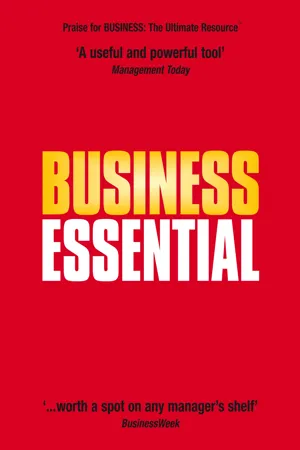
The abridged, updated edition of international bestseller BUSINESS: The Ultimate Resource. This essential guide to the world of work and careers is crammed with top-quality content from the world's leading business writers and practitioners.
Now in a handy paperback format, it is ideal for time-pressed managers, small business owners and students alike. This book includes:
Actionlists: more than 200 practical solutions to everyday business and career challenges, from revitalising your CV to managing during difficult times.
Management library: time-saving digests of more than 70 of the best and most influential business books of all time, from The Art of War to The Tipping Point. We've read them so you don't have to.
Best Practice articles: a selection of essays from top business thinkers.
Business Dictionary: jargon-free definitions of thousands of business terms and concepts.
Gurus: explanations of the lives, careers, and key theories of the world's leading business thinkers
- 704 pages
- English
- ePUB (mobile friendly)
- Available on iOS & Android
eBook - ePub
BUSINESS Essential
About this book
Information
Actionlists
Finding Your Dream Job
FAQS
Isn’t work supposed to be painful? Isn’t that why they call it work?
No, work is not supposed to be painful, even in these challenging times. If you believe that, then you will settle for less and never be completely satisfied. Work is as natural to human beings as breathing. We feel bored, dissatisfied, and empty if we cannot contribute to the world in some meaningful way.
I’m just getting started in my career. Don’t I have to serve my time first before I can find work I really enjoy?
Certainly you shouldn’t expect to jump into the job of your dreams straight out of university. Unless, of course, you started the company! You do need to spend time in a new job learning the ropes and making connections. But don’t ever think of it as ‘serving my time’. This kind of thinking encourages staying in a job that may not really suit you. You should expect to be excited about going to work each day.
I’m getting near retirement. Isn’t it a little late to be thinking about finding my calling?
Many people who are nearing retirement grew up in a culture where work was expected to be a drudge. You may have sacrificed your dreams for most of your life, but now is your chance to take the time to do something you really love. You might consider volunteer work, being a mentor to someone getting started, or finding a company that really appreciates the wisdom of older people.
MAKING IT HAPPEN
Assessment
Begin by assessing your skills and talents. Make a list of all the things you have been good at in your life. On this same piece of paper, make three columns. The first one is labelled ‘Current Job’. In this column put a tick next to all the skills and talents you are currently using. The second column is labelled ‘Joy and Meaning’. Here put a tick next to any skill that brings you joy and a sense of meaning when you are using it. This includes skills that you may not currently be using in your job. The third column is labelled ‘Dream Job’. In this column put a tick next to any skills that you would like to use in a ‘dream job’. As you are doing this exercise, you may think of other skills and you can add them to the list. After completing the ticks, make some notes for yourself about any thoughts and ideas that came up about what a dream job might be.
Be of service
Focus on the principle of service. All vocational callings have a strong element of service in them. Whom do you serve? How can you use your gifts and talents to serve them? What issues in the community, in business, or in society do you care about? Have you ever wished you could make a difference? These are clues to your calling.
Do what you love
In order to be of service to others, we first have to do what we love. So do what pleases you, and you will probably find that you are acquiring knowledge and skills that will help you to be of service to others in the future. And sometimes it is enough just to know that if you do what brings you satisfaction, even if it is not of service to anyone else, the world is a better place.
Make it real
Make your dream real in some concrete way. Write down a description of your dream job. Write in your diary about what ‘calls’ to you. Tell other people about your dream job. You will find that as you get more and more detailed about what you are looking for, opportunities will ‘coincidentally’ appear. Make sure you are paying attention to these opportunities.
Talk to others
Don’t be afraid to tell others about your calling. The more you tell others about your dreams, the more real they become, and the more likely you are to notice opportunities that will help you fulfil your dreams. Also, by telling others about the job you would love to have, you are increasing the chances of finding someone who has the right piece of information, or the right connection for you.
Learn to fly
Remember the rule of the bumblebee. According to the laws of mathematics and aerodynamics, it is physically impossible for bumblebees to fly. Fortunately, no one ever explained that to a bumblebee. Keep in mind that the most successful business people were frequently told that what they wanted to do was ‘impossible’.
Let go
In order to follow your calling, there are always necessary sacrifices that must be made. Before you make the move to another job or to starting your own business, spend some time thinking about what are absolute necessities in your life and work. Is it essential that you have high earnings, or are you willing to earn less money to do work that is more meaningful? Is it essential that you have a steady income, or could you cope with the risk and potential that comes with working for a small start-up organisation? Is it essential that you work with people, or are you content to work alone? What things are absolutely necessary to you in your work, and what can you let go of? Make a list of five things that are necessary and five things that you are willing to let go of.
Look in your own backyard
There’s an old song that goes, ‘If you can’t be with the one you love, love the one you’re with’. This can apply to your job too. Many people cannot easily leave their current working situation. The challenge, then, is how to see your current work as your calling. Once again, the principle of ‘service’ can be very helpful. If you need to stay with your current job, write yourself a brief reminder about how the work you do is of service to others, and keep it somewhere nearby.
COMMON MISTAKES
Many people think that their dream job already exists, and that they just have to look around hard enough until they find it. The truth is that most people who have found their calling have actually created the work that they do. Do not go looking in the classified advertisements for the dream job. You must network, make connections, and tell other people about your dreams.
When you begin to follow your calling, there will always be people who will tell you that you are impractical, unrealistic, idealistic, or selfish. It would be a mistake to listen to them. They are the people who want to tell the bumblebee that it can’t fly. Remember that, just because it’s never been done before, it doesn’t mean that you can’t do it.
Beware of a job that is too good to be true, especially if you are being asked to put in your own money or to work for very low amounts at first. Con men understand the hunger that people have for a dream job, and they can play on that. If you are being offered a job that really seems to fit what you are looking for, make sure that you are going to be paid what you are worth.
Sometimes people get too attached to their idea of what a ‘perfect job’ would look like. Beware of being too picky and of passing up opportunities that could turn out to be even better than the job you are looking for. Keep an open mind, but at the same time don’t settle for something that doesn’t fit your values, or that doesn’t really use your most important skills and talents.
Creating a Career Plan
FAQS
What’s the difference between a career plan and a development plan?
Your career plan maps out long-term objectives, your more immediate objectives, and how you want your life and work to fit together. Your development plan maps out the skills and experience gaps for the different steps along the way and how you will address those. In effect, the development plan enables the career plan to work.
How do I find out what jobs I might be suitable for?
If you are naturally outgoing, start your research by talking to people. Make use of your contacts and ask for names and contact details of people who might be able to help with each of the options you’re considering. This approach not only increases your network but it also gets you the targeted information you need. It may also put you in touch with contacts who can often open doors for you.
On the other hand, you may prefer to get started with some Internet or library research and save the networking until you feel a little better informed about your possibilities. Neither approach is right nor wrong, but people who use both approaches ar...
Table of contents
- Cover
- Title Page
- Contents
- User Guide
- Contributors
- Best Practice
- Actionlists
- Management Library
- Gurus
- Dictionary
- Index
- Credits
- eCopyright
Trusted by 375,005 students
Access to over 1.5 million titles for a fair monthly price.
Study more efficiently using our study tools.
Frequently asked questions
Yes, you can cancel anytime from the Subscription tab in your account settings on the Perlego website. Your subscription will stay active until the end of your current billing period. Learn how to cancel your subscription
No, books cannot be downloaded as external files, such as PDFs, for use outside of Perlego. However, you can download books within the Perlego app for offline reading on mobile or tablet. Learn how to download books offline
Perlego offers two plans: Essential and Complete
- Essential is ideal for learners and professionals who enjoy exploring a wide range of subjects. Access the Essential Library with 800,000+ trusted titles and best-sellers across business, personal growth, and the humanities. Includes unlimited reading time and Standard Read Aloud voice.
- Complete: Perfect for advanced learners and researchers needing full, unrestricted access. Unlock 1.5M+ books across hundreds of subjects, including academic and specialized titles. The Complete Plan also includes advanced features like Premium Read Aloud and Research Assistant.
We are an online textbook subscription service, where you can get access to an entire online library for less than the price of a single book per month. With over 1.5 million books across 990+ topics, we’ve got you covered! Learn about our mission
Look out for the read-aloud symbol on your next book to see if you can listen to it. The read-aloud tool reads text aloud for you, highlighting the text as it is being read. You can pause it, speed it up and slow it down. Learn more about Read Aloud
Yes! You can use the Perlego app on both iOS and Android devices to read anytime, anywhere — even offline. Perfect for commutes or when you’re on the go.
Please note we cannot support devices running on iOS 13 and Android 7 or earlier. Learn more about using the app
Please note we cannot support devices running on iOS 13 and Android 7 or earlier. Learn more about using the app
Yes, you can access BUSINESS Essential by Bloomsbury Publishing in PDF and/or ePUB format, as well as other popular books in Business & Business General. We have over 1.5 million books available in our catalogue for you to explore.