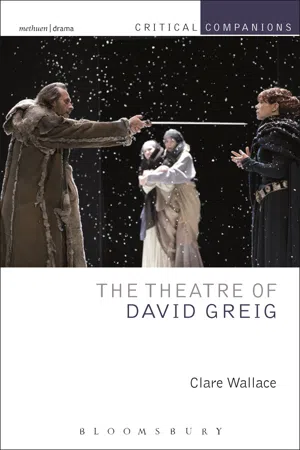
David Greig has been described as 'one of the most interesting and adventurous British dramatists of his generation' (Daily Telegraph) and 'one of the most intellectually stimulating dramatists around' (Guardian). Since he began writing for theatre in the early nineties, his work has been both copious and remarkably varied, defying neat generalisations or attempts to pigeon-hole his work. Besides his original plays, he has adapated classics, is co-founder of the Suspect Culture Theatre Group and is currently Dramaturge for the National Theatre of Scotland.
This Critical Companion provides an analytical survey of his work, from his early plays such as Europe and The Architect through to more recent works Damascus, Dunsinane and Ramallah; it also considers the plays produced with Suspect Culture and his work for young audiences. As such it is the first book to provide a critical account of the full variety of his work and will appeal to students and fans of contemporary British theatre.
Clare Wallace provides a detailed analysis of a broad selection of plays and their productions, reviews current discourses about his work and offers a framework for enquiry. The Companion features an interview with David Greig and a further three essays by leading academics offering a variety of critical perspectives.
- 256 pages
- English
- ePUB (mobile friendly)
- Available on iOS & Android
eBook - ePub
The Theatre of David Greig
About this book
Information
CHAPTER 1
SUSPECT CULTURE
‘The Possibilities for Alternative Theatre’
Although this book is concentrated upon Greig’s work as a playwright, in a crucial sense his path into playwriting is neither direct nor one way. Greig is unusual because he has combined long-term commitment to a collaborative creative group with a steady stream of work outside that group. In the early 1990s Greig and Graham Eatough, both of whom had been students at Bristol University began to make shows together. As Greig describes in an interview with Peter Billingham, at that stage he regarded what he was doing as devising rather than playwriting (2007: 73). Among their first projects were A Savage Reminiscence (1991), The Garden (mentioned later by Philip Howard), And the Opera House Remained Unbuilt and Stalinland (all 1992). The company they formed was Suspect Culture. With a collective structure that evolved around a core creative team – actor and later artistic director Graham Eatough, musician Nick Powell, designer Ian Scott and Greig who wrote many of the company’s texts – plus a group of international associates, Suspect Culture formally secured funding in 1995 and continued until 2008 producing an impressive body of theatre work.
The aspirations and concerns of the group in the 1990s percolate through Greig’s dramaturgy and as will become evident many topics and influences excavated by Suspect Culture continue to be excavated in Greig’s other writings. Their starting point, as company’s archive website notes, was ‘to develop a style of theatre that combined the best of English and European traditions, working with high-quality writing but giving equal weight to visual and musical elements’. Given this objective it would be perverse to try to isolate Greig’s texts as if they could exist separately. At the same time it would be neglectful to ignore the obvious fact that this work is intrinsic to his growth as a theatre-maker. Greig describes Stalinland as the point at which he realized that his interests lay more in writing rather than in directing. That play is very much bound up with Greig’s exploration of Brechtian structures and European identities as opposed to the collaborative journeys undertaken later by Suspect Culture and so is discussed briefly in the following chapter. A more complete picture of the full range of the company’s work is presented in The Suspect Culture Book edited by Graham Eatough and Dan Rebellato (2013). Here, my purpose is necessarily selective. Primarily, the focus is on the core tendencies and motifs in some of the company’s work as embedded aspects of Greig’s development, following Greig’s own assertion that ‘No matter what work we do now it has the ghost of Suspect Culture in its bones’ (Eatough and Rebellato 2013: 45).
One of the early influences on Suspect Culture’s attitudes cited by both Eatough and Greig is British playwright Howard Barker. As Eatough puts it, that influence appears
not just on the writing but on what the shows were setting out to achieve, politically and intellectually. What Barker does, whether or not the plays are successful, [is] he scouts out the possibilities for alternative theatre. He neither points towards a mainstream theatre style but nor is he swept up in current avant-garde movements. . . . And for those who didn’t want to leave playwriting behind Barker was a model for something that could still be radical, which I think was important for David. (2013: 17)
So maintaining a textual point of reference while exploring the physical resources of performance is the starting point for an aesthetic Suspect Culture began to investigate and develop. This involved the amalgamation of various elements: music, movement, design and text in a manner described by Rebellato as ‘intellectual’ and ‘minimalist’ (2003: 62), qualities that have won their work both praise and criticism. While the group’s creative methods were diverse, often involving workshops and brainstorming retreats, as Greig admits the writing itself was not collaborative: ‘What I found was that I liked to work with the actors in the rehearsal room and then I would go away and write at night – I didn’t want their (the actors’) words, I wanted them to help me to try to find the right situation’ (Billingham 2007: 74). I would like to pursue this notion of situation in several senses. First, in terms of how to situate Suspect Culture’s approach, as is evident from Eatough’s description of their early stimuli, there is an attempt to explore the possibilities of aesthetically alternative theatre in a British context. Rebellato has described that approach as utopian, finely tracing the influence of German philosopher Theodor Adorno’s writings (in particular Negative Dialectics [1966]) on Greig and Eatough’s thinking (2003). Utopia for Adorno is a necessary potential that can never be realized – art’s role is to render that paradox perceptible. Rebellato’s evaluation of Suspect Culture up to 2002 concentrates on the political reverberations of the work – an issue I will return to later. Yet since their project bears so many of the formal traces and preoccupations of post-1970s experimental theatre, it may also be understood in relation to the conditions of postmodernity and the aesthetic of the post-dramatic. Both are admittedly contentious, and especially so in the British critical environment as already evident in Amelia Howe Kritzer’s perspective on the politics of post-Thatcher theatre mentioned in the introduction, but they nevertheless provide useful vocabularies to portray the situation of Suspect Culture.
Postmodernity is indeed a challenge to succinctly define. However, if we take it to denote an uneven, developed world, phenomenon denoting a matrix of social, political and cultural vectors that includes the impact of electronic media, mass migration, the erosion of traditional forms of politics and attitudes to place, then its relevance to Suspect Culture’s projects starts to emerge. It is precisely these epochal resonances of postmodernity as it melds with the intensified advance of globalization that recur throughout Suspect Culture’s and David Greig’s work – though not consistently in a post-dramatic fashion. Where the term ‘postmodern’ proves more fruitful than globalization is in the paths it offers for examining the morphing of attitudes to self, spectacle and history in relation to the forces of technology and consumerism. And in a sense this is the era in which members of the company grew up – described with caustic precision by David Pattie later in this volume as ‘a particularly harsh mixture of Victorian values and economic determinism’. It is mapped locally in the ambivalent progress of Thatcherism followed by the transition to the amorphous liberalism of the Blair era and after. More generally, as Hans Bertens suggests, a ‘common denominator’ to the many competing ideas of the postmodern is ‘a crisis in representation’. Whether that crisis is perceived as ‘debilitating’ or ‘enabling’, it is inexorably political (1995: 11). And Suspect Culture’s work emerges from and in reaction to the epicentre of these forces.
Although in Postdramatic Theatre (1999, trans. 2006) Hans-Thies Lehmann rejects the ‘epochal’ character of the term ‘postmodern’ in favour of ‘a concrete problem of theatre aesthetics’ (21), the post-dramatic evidently sits within the cluster of conditions just sketched. Post-dramatic theatre for Lehmann cannot be simply defined, but is rather a cluster of tendencies that move beyond or away from the principles of dramatic theatre and the primacy of the play text. He delineates an aesthetic that offers many tools for understanding some contemporary theatre’s deconstruction of dramatic conventions, specifically in its attitudes to performance, text, space, time, the body and media. Suspect Culture’s work with repetition, fragmentation, sound, gesture and image is richly illustrative of some aspects of the tendencies Lehmann observes (primarily, though not exclusively, in German theatre since the 1970s) and again aligns the company with some continental attitudes to theatre and performance, as well as to experimental theatre in America. Perhaps most critically evocative is the way Lehmann reads this aesthetic in contemporary theatre as engaging with ‘a politics of perception’ (185), and that assertion I would dovetail with Rebellato’s interpretation of Suspect Culture’s achievements. The sections that follow hone in on situation in three linked hubs in the company’s theatre work – place, self and politics – as a means of unravelling some aspects of their engagement with perception in this context.
Psychogeographies and Utopias: One Way Street, Airport and Candide 2000
A second dimension to the matter of situation in Suspect Culture’s projects in the 1990s is how, in addition to their readings of Adorno, both Greig and Eatough found creative stimulus in ideas pertaining to Psychogeography and in particular to Walter Benjamin’s One Way Street (1928) and A Berlin Chronicle (1932). Although it garnered some very specific theoretical designations in the 1960s with the development of the Situationist movement, Merlin Coverley’s account of its broad currents seem better suited to Suspect Culture’s case. In Psychogeography (2006), he identifies its defining qualities as ‘the act of urban wandering, the spirit of political radicalism, allied to a playful sense of subversion and governed by an inquiry into the methods by which we can transform our relationship to the urban environment. This entire project . . . is one that is as preoccupied with excavating the past as it is with recording the present’ (14).
Throughout Suspect Culture’s early shows, place is divested of exact specificity or stability yet is seen to impact upon and condition action in diverse ways. Place is repeatedly envisioned as experiential, a blend of layered realities past and present, as opposed to a stable, objectively known setting. Even as early as Stalinland an interest in the ways places mutate depending on perspective is ideologically charged. With One Way Street (1995) Greig and Eatough created a one-man show that grappled with ‘personal history as geography’. Marilena Zaroulia analyses how One Way Street layers a reference to Benjamin onto responses to the post-Wall Europe derived in part from Greig’s experiences of Inter-railing in the early 1990s, in order to contest notions of place as fixed or stable. Displacement then is pivotal: through citation Benjamin is relocated, the peripatetic protagonist in the show roams through Berlin in search of a lost lover, the guide he is supposed to produce – ‘Ten Short Walks in the Former East’ – wanders off the expected tourist trail into the messy territory of personal associations. It is, as one of Suspect Culture’s long-term artistic associates Mauricio Paroni de Castro so aptly puts it, an exercise in ‘emotional cartography’ (Eatough and Rebellato 2013: 66). It is also rooted in the renegotiation of identity within a changing Europe. At its heart is the potentially divisive process of European reunification. Indeed, the topicality of such concerns led to British Council funding for the show to tour to the former East and the company’s internationalist course was set (Eatough and Rebellato 2013: 21–2). With One Way Street, Joyce McMillan felt that the company
had found the intellectual and emotional content to match [their] style: the political geography of a new Europe that was unifying, converging, removing barriers to movement and communication; and – most importantly – the emerging emotional geography of a world where a new intensity of communication, and similarity of urban experience across the globe, did not seem to deliver love, fulfilment, or a true sense of connection with other people (Eatough and Rebellato 2013: 52).
Although that interest in new Europe waned after the mid-1990s, place and the emotional geography of place continued to be a source of experiment. This is explicit in works such as Airport (1997), Mainstream (1999) and Candide (2000). If, according to Eatough, globalization was not a term they consciously engaged with at that stage (and it is salutary to remember how these terms enter and then seem to dominate popular discourse), then it was already in the wings as they found themselves ‘drawn to the spaces that you’d associate with global economies: retail spaces, entertainment spaces, travel spaces’ (2013: 23). These are much more readily understood in terms of postmodern experience; they are, following anthropologist Marc Augé’s coinage, the non-places of contemporary life – hotel rooms, motorways, airports and shopping centres. Detached from the usual co-ordinates that endow places with significance, non-places of course are not free of meaning, but as Augé puts it, ‘a person entering the space of non-place is relieved of his usual determinants. He becomes no more than what he does or experiences, in the role of passenger, customer or driver’ (1995: 103). These are places where personal identity is loosened, but where behaviour is scripted. And it is this tension that animates Suspect Culture’s exploration of the non-place: ‘We were very interested in the juxtaposition of the surface of modern life and modern environments with the humanity inside them: what people want to achieve, what they are able to achieve, what isn’t permitted in this environment’ Eatough explains (2013: 23). This is overtly and provocatively realized in Candide 2000, a postmodern version of Voltaire’s classic picaresque satire on the philosophy of optimism. Candide’s world-ranging adventure is replaced by a shopping mall setting which, as a consumer paradise, contains the world condensed in simulated forms. The passivity of Candide’s oft-repeated motto that he exists in ‘the best of all possible worlds’ becomes the equally docile ‘that’s what it’s like’ mouthed by the twenty-first century consumer. The potential sterility of the non-place is signalled by the minimalism of the stage designs for these shows – the baggage carousel of Airport, the chrome and plastic furnishings of the hotel in Mainstream, even the exhibition space of Casanova (2001). Yet, as the exchanges between performers simultaneously suggest, they may also be spaces of possibility where scripts are deconstructed and the default settings of identity are tested. As Eatough describes, ‘what these environments give you dramatically is the antagonist, in a sense; they are environments in which it’s very difficult to get a meaningful human exchange, or maybe you do in unexpected, slightly perverse . . . or comic ways’ (2013: 23). And it is this sense of possibility, indeterminate as it may be that underwrites Rebellato’s claim that Suspect Culture’s work is characterized by a utopian dimension.
Anti-Narratives of Self: Timeless, Mainstream and Casanova
Augé’s primary interest in non-places is, of course, in the patterns of human behaviour they solicit; the ways in which the person in these places
surrenders himself [. . . to] the passive joys of identity loss, and the more active pleasure of role playing . . . What he is confronted with, finally, is an image of himself, but in truth it is a pretty strange image . . . The space of non-place creates neither singular identity nor relations; only solitude, and similitude. (1995: 103)
Again this seems particularly well fitted to Suspect Culture repeated assays on the performance of the identity, while the post-dramatic tenor of their work comes to the fore with a focus upon what they do with character, plot and story. In The Death of Character: Perspectives on Theatre after Modernism (1996), Elinor Fuchs has described the effacement of character in much contemporary theatre as indicative of ‘a dispersed idea of self’ (9) that resists singular or coherent representation. After One Way Street Suspect Culture’s work moves away from the conventions of character and towards figures and scenarios derived from the experiences of the group explored through devising and workshopping. In his contribution to The Suspect Culture Book, Greig remembers how
each show was built around a nugget of emotional grit that all four of us shared. ‘Are we all the same?’ ‘What will become of us?’ ‘What would happen if we let go?’ These questions would hover until we found a formal question with which they could marry up – ‘are characters and actors the same?’ ‘Is gesture possible within a text?’ With a question and a form we would set off into the dark. (2013: 45–6)
These creative journeys result in the collage effects that structure Airport, Timeless (1997), Mainstream and Lament (2002). In each of these, the splintering of narrative and action problematizes the whole notion of knowing or even establishing a character. Airport plays with the exchange of national stereotypes as a means of safe, but generically empty, communication of identity while at the same time gesturing towards types of improbably shared memories. The pairing of solitude and similitude in the non-place is at the heart of the piece. As Augé remarks, ‘we have learned to distrust absolute, simple and substantive identities, on the collective as well as the individual level’ (1995: 22). That ambivalence is investigated and tested in Suspect Culture’s work through an interrogation of character, story and, arguably, a post-dramatic turn towards a theatre of states rather than action, structured chiefly by what Lehmann calls a ‘a scenic dynamic’ (2006: 68).
Timeless and Mainstream turn to more intimate emotional terrain than Airpo...
Table of contents
- Cover-Page
- Half-Title
- Series
- Title
- Copyright
- Contents
- Acknowledgements
- Introduction
- 1 Suspect Culture
- 2 Lesson Plays
- 3 Scotland
- 4 Globalization
- 5 East/West
- 6 Perspectives
- Conclusion
- Chronology
- Notes
- Further Reading
- Notes on Contributors
- Index
Trusted by 375,005 students
Access to over 1.5 million titles for a fair monthly price.
Study more efficiently using our study tools.
Frequently asked questions
Yes, you can cancel anytime from the Subscription tab in your account settings on the Perlego website. Your subscription will stay active until the end of your current billing period. Learn how to cancel your subscription
No, books cannot be downloaded as external files, such as PDFs, for use outside of Perlego. However, you can download books within the Perlego app for offline reading on mobile or tablet. Learn how to download books offline
We are an online textbook subscription service, where you can get access to an entire online library for less than the price of a single book per month. With over 1.5 million books across 990+ topics, we’ve got you covered! Learn about our mission
Look out for the read-aloud symbol on your next book to see if you can listen to it. The read-aloud tool reads text aloud for you, highlighting the text as it is being read. You can pause it, speed it up and slow it down. Learn more about Read Aloud
Yes! You can use the Perlego app on both iOS and Android devices to read anytime, anywhere — even offline. Perfect for commutes or when you’re on the go.
Please note we cannot support devices running on iOS 13 and Android 7 or earlier. Learn more about using the app
Please note we cannot support devices running on iOS 13 and Android 7 or earlier. Learn more about using the app
Yes, you can access The Theatre of David Greig by Clare Wallace in PDF and/or ePUB format, as well as other popular books in Media & Performing Arts & Theatre History & Criticism. We have over 1.5 million books available in our catalogue for you to explore.