This dictionary is a key resource for students of Physical Education, School Sport and Sports Science at undergraduate level, facing new concepts and terminology.
Over 100 entries cover all the key topics in this diverse subject area. The A-Z format makes it accessible and essential reading for anyone planning a career in teaching PE. Each entry is 300-500 words and includes practical teaching ideas and tips and further reading suggestions.
All the theoretical concepts of social, political, economic and cultural influences are covered and the dictionary includes updates on recent key issues in Physical Education, including material on gifted and talented teaching, and junior athletic education.
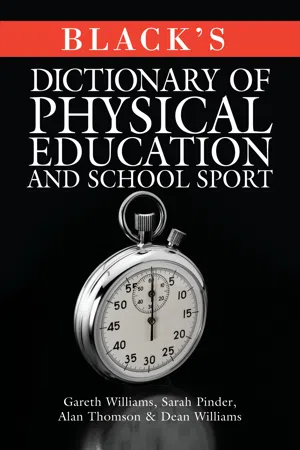
eBook - ePub
Black's Dictionary of Physical Education and School Sport
- 224 pages
- English
- ePUB (mobile friendly)
- Available on iOS & Android
eBook - ePub
Black's Dictionary of Physical Education and School Sport
About this book
Information
a
ACCIDENTS IN PESS
The Oxford English Dictionary defines an ‘accident’ as ‘an unfortunate incident that happens unexpectedly and unintentionally’ or ‘an incident that happens by chance or without apparent cause’. The Health and Safety Executive (HSE) expand on this in their definition: ‘any unplanned event that results in injury or ill-health to people or damages property or materials, but where there was risk of harm.’ Teachers of PE should plan activities with consideration to risk management along with the minimising of potential for injury and harm to pupils. However, due to the nature of the subject and despite rigorous risk assessment and management on behalf of the teacher, accidents will and do happen in PESS. Preventable accidents can occur where the teacher does not plan, prepare or take necessary precautions. Pupils are more prone to injuries in some activities than others.
Severs (2006), in an analysis of 330 PE-related accidents reported to the HSE in a two-year period, found that games provided a high proportion of the injuries, with tackling being the main cause. There were 62 accidents in gymnastics, 17 in trampolining and 14 in athletics. In order to minimise the potential for accidents and harm, teachers need to undertake thorough risk assessments and plan work that is progressive and at the right developmental level for the pupils in question. The teacher must also consider the selection of equipment and the organisation of the group and teaching environment. Where accidents do occur in PESS, the teacher(s) need to be conversant with the accident procedures in place within the school/local authority. Specific considerations need to be given in terms of whether the accident occurred in the gym, sports hall or swimming pool or out on the playing field, but general principles of management of the scene by the teacher can be employed. Katene and Edmonson (in Capel, ed., 2004) suggest that the teacher must remain calm and swiftly assess the situation, ensure that other pupils in the group are safe, attend to the needs of the injured pupil and call for assistance if required. Telephones should be easily accessible in the department, but where this is not possible, for example on the playing field, the teacher can carry a mobile phone to alert the school office or any other identified school contact. Otherwise, two pupils should be sent to summon help.
See also: Accident Reporting and Recording, Risk Assessment/Management
FURTHER READING
Association for Physical Education (AfPE), Safe Practice in Physical Education and School Sport (Coachwise, 2008)
Severs, J., ‘Accidents in Physical Education, an Analysis of Injuries Reported to the Health and Safety Executive’, Physical Education Matters, Summer (2006), pp. 19-21
Severs, J. with Whitlam, P. & Woodhouse, J., Safety and Risk in Primary School Physical Education (Routledge, 2003)
ACCIDENT REPORTING AND RECORDING
Once the initial accident has been dealt with appropriately and any injured parties assessed and treated as necessary, the process of recording and reporting the incident and subsequent actions must take place. All accidents need to be recorded in detail as soon as possible after the event. This is to ensure that necessary factual details are logged while they are still fresh in the minds of those involved. The details should be recorded on an Accident Report Form or in an Accident Book. The requirements and layout of these vary between local authorities and schools, but all should contain some common essential details of the incident such as the name and age of the injured pupil, the date and the time the accident occurred, where it happened, the extent of the injuries sustained, any treatment given and subsequent actions taken. The form will also request the details of any witnesses to the accident and may provide a space for a supporting diagram to be drawn. The Association for Physical Education (AfPE) in their guidance Safe Practice in Physical Education and School Sport (AfPE, 2008), provide standardised and well-documented examples of forms and suggested accident procedures. AfPE emphasise that it is ‘important that all accidents are recorded on the employers’ official report form or accident book as soon as is reasonably possible. This aids the reporting process and is also useful in the event of a liability ‘claim’ (AfPE, 2008, p. 53).
Those accidents which have been documented must be reported in turn to the local authority or the HSE in order to comply with the ‘Reporting of Injuries, Disease and Dangerous Occurrences Regulations’ (RIDDOR, 1995). Reportable accidents include major injuries, defined as ‘any resulting in death or injury requiring hospital treatment for any length of time, or injury that prevents the injured person attending work (or school) for more than three days’ (AfPE, 2008, p. 53). This would also apply to some fractures, unconsciousness from electric shock or lack of oxygen and certain acute illnesses.
Good storage and record-keeping of accident reports is essential as the information they contain may need to be consulted for several years following the incident, for example if there is an ensuing legal case.
See also: Accidents in PESS
FURTHER READING
The Health and Safety Executive (HSE), A Guide to the Reporting of Injuries, Disease and Dangerous Occurrences Regulations 1995 (HSE Books, 2008)
The Health and Safety Executive at www.hse.gov.uk
ACTIVEMARK
This award, along with Sportsmark and Sports Partnership Mark, is given to schools/partnerships for the delivery of high quality physical education and school sport (HQPESS) (see separate entry). Sports Partnership Mark provides recognition for School Sport Partnerships (SSPs) in their commitment to delivering HQPESS. Activemark is awarded to schools with primary-aged children and Sportsmark is awarded to schools that cater for secondary-aged children. All three of these kite marks are awarded to those schools/partnerships who have at least 90 per cent of pupils partaking in at least two hours of HQPESS a week.
Recognition for these awards is assessed via the National School Sports Survey, which collates registers taken by schools for pupil attendance at extra-curricular school sport activities. Another kite mark acknowledged by schools as a vital part of their community programme is Club Mark. This is awarded to external clubs who comply with minimum operating standards involving the appointment of personnel with the correct coaching qualifications. The same clubs are expected to also have effective policies in place for safeguarding children. In order for clubs to achieve accreditation for Club Mark award, they can receive advice from national governing bodies (NGBs) and/or County Sports Partnerships (CSPs) (see separate entry).
FURTHER READING
www.sportengland.org
www.teachernet.gov.uk
www.youthsporttrust.org
ADAPTATION (TO TRAINING)
The main objective of fitness training is to ensure changes occur in one or more of the body systems either through stress or overload, or by making them work harder than usual. The resulting long-term changes in the body are adaptations which in turn prove beneficial in enhancing or improving performance. Training must be continued in order to maintain these accrued benefits and if it is reduced or stopped, then the benefits will gradually be lost in accordance with the principle of reversibility.
The training intensity must be appropriately calculated if the desired training benefits are to be obtained. In terms of cardio-respiratory fitness, this may be achieved by training at a percentage of the V02 max (maximal oxygen consumption), or at a percentage of the average maximum heart rate. Individuals can use age-predicted maximum heart rates to calculate a ‘training sensitive zone’ having a lower threshold of 70 per cent and an upper threshold of 90 per cent of the average maximum heart rate (McArdle et al., 2000). Work within this training zone over a period of time will promote aerobic adaptive responses.
Cardiovascular adaptations associated with endurance-based aerobic training include: cardiac hypertrophy (increase in size) with increases particularly in the left ventricle, increased stroke volume, reduced heart rate during sub-maximal exercise, increased cardiac output, increased blood volume and reduced blood pressure at rest.
There is still some debate surrounding the methods and benefits of living and training at altitude and subsequent performance at sea level (Wilmore & Costill, 2004). Nevertheless, altitude training is still utilised by endurance athletes in order to promote favourable physiological adaptations that aid performance in such events. These adaptations occur due to the reduced partial pressure of oxygen in the atmosphere and include corresponding increases in red blood cell count and the associated levels of haemoglobin. These are especially prominent when returning to compete at sea level.
Athletes in many activities rely on resistance training methods in order to stress the skeletal muscles and cause adaptations of benefit in exerting force or permitting muscles to work for prolonged periods. In order to make gains in strength, high intensity and low repetitions are required. Alternatively, low resistance and high repetitions will develop muscular endurance. The most notable adaptation to resistance training is an increase in the size of the muscle explained through muscle fibre ‘hypertrophy’, though McArdle et al. (2000, p. 412) suggest an increased fibre number (hyperplasia) provides for a suitable ‘complementary hypothesis’; for example, where type II fibres reach maximum size. There is a corresponding strengthening of supporting connective tissues and bone with increases in muscle size and strength in order to protect muscles and joints from injury.
FURTHER READING
McArdle, W.D., Katch, F.I. & Katch, V. L., Essentials of Exercise Physiology (2nd edn, Lippincott Williams and Wilkins, 2000)
Wilmore, J.H., & Costill, D.L., Physiology of Sport and Exercise (Human Kinetics, 2004)
ANCIENT GREEKS
From approximately 1000 BC to 100 BC the Ancient Greeks progressed into a major European civilisation with the elevation of intellectual enquiry at the forefront of its development. Philosophy and religion were prominent throughout, although this was tempered by the need to protect and arm a nation often under threat from neighbours. Within Greece itself city states were at war with each other and so a culture of physicality emerged as young men prepared themselves for battle. This often manifested itself in public events of strength and endurance based on warrior sports. Competition took place at religious festivals alongside a ready association with Greek gods and mythological characters. When the athletes themselves began to assume professional status there was a sharp class divide between the aristocrats who could afford their own trainers and coaches and those from a poorer background who had to rely on city sponsorship and city-owned gymnasia. Sparta emerged as perhaps the most prominent of these states and here the preparation of athletes for festivals such as those at Olympia was taken very seriously.
The Greek philosophers themselves often poured scorn on athletes, denigrating the amount of time spent in training conducted at the expense of personal intellectual and spiritual development. Women were barred from taking part alongside men and also as spectators because this conflicted with Greek ideas about femininity. However, there was no doubting the mass appeal of these events and the legacy left from the festival at Olympia has contributed vastly to modern sport. Moreover, the city states of Sparta, Athena, Corinth and Helena have impacted upon 20th-century sporting language, particularly in English public schools. Kirk (2010) even suggests that Greek use of the term ‘gymnastics’ has historically helped the placement and positioning of this activity in 20th-century PE curriculums. Thus, advocates of gymnastics have not been afraid to call upon this aspect of its cultural heritage in the struggle to maintain its status. Munrow (1963) in particular heralded the Greeks’ involvement with ‘gymnastics’ as a means of education through the body, using Plato’s The Republic as his evidence.
Although the Romans (100 BC to AD 500) were keen to continue the Greek sporting festivals, many of them disintegrated, with the very last one held in AD 426. The new versions were more military based, with an even greater emphasis on preparing soldiers for battle. Soon sport became a means of social control, a way of appeasing the masses, with chariot racing, boxing and athletics prominent. Roman emperors often used the games to court popularity, as epitomised by Nero’s participation and subsequent attempts to cheat. The events became more barbaric, with activities such as bear- and bull-baiting prominent. The demise, caused by the Romans’ increased influence in Greece, was gradual, with the date of the last ancient games estimated to be around the turn of the fifth century. The Greek approach to sporting festivals was only revived in 1896 when, after spending time in England and observing the growing influence of games in the public schools (see Athleticism), French aristocrat Baron de Coubertin instigated the modern Olympic Games.
FURTHER READING
Finley, M.I., The Ancient Greeks (Penguin, 1963)
Finley, M. & Pleket, H., The Olympic Games: The First Thousand Years (Chatto and Windus, 1976)
Munrow, A.D., Pure and Applied Gymnastics (2nd edn, Bell, 1963)
ASSESSMENT
Assessment in schools concerns finding out about the progress that pupils are making, or have made. It is essential for effective teaching as teachers must be aware of the stage that their students have reached in order to plan and deliver the next aspects of the students’ learning.
Assessment always involves making a judgement, and this is based upon an interpretation from a body of work pupils have demonstrated, and can simply range from informal praise to a formal assessment involved in the marking of examination work (Carroll, 1994). Interpretations and judgements are made against criteria and they can give information about pupils’ skill, knowledge and understanding, and their learning needs (Macfadyen & Bailey, 2002).
There are a number of rationales for the use of assessment when teaching. Within the current educational climate it is deemed to be important for communication concerning the level and nature of pupils’ attainment at various points in their education; for example, at the end of specific Key Stages. As student-centred learning has become more of a focus, teachers can identify individual strengths and weaknesses of students, and this will lead to more reliable information when it comes to planning for differentiation. As teachers communicate assessment information to a variety of interested parties, it is essential that teachers have an understanding of what individuals and classes have learned, and what their potential may be. Although teachers may assess pupils to inform them of their progress, this in turn can also allow the pupils to compare themselves against relevant criteria, such as GCSE expectations, and to end of Key Stage Levels requirements. This informs the pupils of what they are required to achieve in order to progress, and as a result it may also serve to motivate them. It should be added, however, that this could also de-motivate pupils (Carroll, 1994).
The types of assessment used in schools often follow opposite pairings (Carroll, 1994; Kyriacou, 1997). Some of these include internal v external (mock GCSE/A Levels v actual GCSE/A Levels); objective v subjective (fact v opinion); and process v product (grading the manner in how something was achieved v the achievement itself). However, assessment procedures in PE are generally not as simple as this, and teachers will often use a variety of assessment types, rather than one against another. The two most often referred to in the Key Stage 3 National Strategy (DfES, 2004) are formative and summative. Formative is when the assessment is ‘ongoing’ and generally takes the form of feedback that serves the dual functions of letting pupils know how they have performed a task, while helping their development, and aiding the teacher’s planning for the next phase of learning. Summative assessment is about recording the pupils’ achievement and progress, and may come from a range of formative assessments. Summative assessment tends to be reported back to interested part...
Table of contents
- Cover
- Title Page
- Dedication
- Contents
- Foreword
- Introduction
- Dictionary
- List of Abbreviations
- Acknowledgements
- Bibliography
- Imprint
Trusted by 375,005 students
Access to over 1.5 million titles for a fair monthly price.
Study more efficiently using our study tools.
Frequently asked questions
Yes, you can cancel anytime from the Subscription tab in your account settings on the Perlego website. Your subscription will stay active until the end of your current billing period. Learn how to cancel your subscription
No, books cannot be downloaded as external files, such as PDFs, for use outside of Perlego. However, you can download books within the Perlego app for offline reading on mobile or tablet. Learn how to download books offline
Perlego offers two plans: Essential and Complete
- Essential is ideal for learners and professionals who enjoy exploring a wide range of subjects. Access the Essential Library with 800,000+ trusted titles and best-sellers across business, personal growth, and the humanities. Includes unlimited reading time and Standard Read Aloud voice.
- Complete: Perfect for advanced learners and researchers needing full, unrestricted access. Unlock 1.5M+ books across hundreds of subjects, including academic and specialized titles. The Complete Plan also includes advanced features like Premium Read Aloud and Research Assistant.
We are an online textbook subscription service, where you can get access to an entire online library for less than the price of a single book per month. With over 1.5 million books across 990+ topics, we’ve got you covered! Learn about our mission
Look out for the read-aloud symbol on your next book to see if you can listen to it. The read-aloud tool reads text aloud for you, highlighting the text as it is being read. You can pause it, speed it up and slow it down. Learn more about Read Aloud
Yes! You can use the Perlego app on both iOS and Android devices to read anytime, anywhere — even offline. Perfect for commutes or when you’re on the go.
Please note we cannot support devices running on iOS 13 and Android 7 or earlier. Learn more about using the app
Please note we cannot support devices running on iOS 13 and Android 7 or earlier. Learn more about using the app
Yes, you can access Black's Dictionary of Physical Education and School Sport by Gareth Williams,Sarah Pinder,Alan Thomson,Dean Williams in PDF and/or ePUB format. We have over 1.5 million books available in our catalogue for you to explore.