- 216 pages
- English
- ePUB (mobile friendly)
- Available on iOS & Android
eBook - ePub
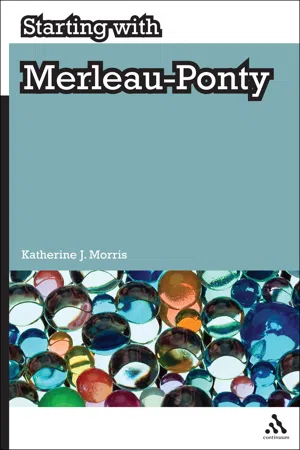
Starting with Merleau-Ponty
About this book
Merleau-Ponty was one of the most important European philosophers of the 20th century, whose work made enormous contributions to the development of phenomenology and the concept of the lived-body. Clearly and thematically structured, covering all Merleau-Ponty's key works and focussing particularly on the hugely important The Phenomenology of Perception, Starting with Merleau-Ponty leads the reader through a thorough overview of the development of his thought, resulting in a more thorough understanding of the roots of his philosophical concerns. Offering coverage of the full range of Merleau-Ponty's ideas, the book firmly sets his work in the context of the 20th century intellectual landscape and explores his contributions to phenomenology, existentialism, empiricism, objective thought and his vision of human reality. Crucially the book introduces the major thinkers and events that proved influential in the development of Merleau-Ponty's work, including Husserl, Sartre, Heidegger and those philosophers and psychologists whom he labelled 'intellectualists' and 'empiricists'. This is the ideal introduction for anyone coming to the work of this hugely important thinker for the first time.
Information
CHAPTER 1
STARTING WITH MERLEAU-PONTY
Anyone hoping to use the Preface to Merleau-Ponty’s PP as a way into the body of the book is likely to face a major obstacle. The Preface consists of 15 very dense pages in which Merleau-Ponty addresses an audience already broadly familiar not only with René Descartes and Immanuel Kant – a familiarity that can safely be assumed at least of most Anglo-American students of philosophy – but also with the phenomenologists Edmund Husserl and Martin Heidegger – a familiarity that cannot be so assumed. Thus, the first task of this chapter (§i) will be to say enough about these phenomenological luminaries to enable the reader to get by.1
With this background, the general purpose of Merleau-Ponty’s preface is straightforward: at least on the face of it, he is attempting a kind of ‘reconciling project’ addressed to those who suppose Husserl’s and Heidegger’s approaches to phenomenology to be at odds with one another. Merleau-Ponty aims to show that if we read Husserl as he thinks we should, then Husserl’s phenomenology is not only compatible with but actually entails Heidegger’s existential philosophy. This project is outlined in §ii.
Intertwined with this reconciling project are glimpses of Merleau-Ponty’s unique positive conception of phenomenology; these are highlighted in §iii.
I end this chapter with a Coda that addresses ‘what phenomenology is not’: it outlines some of the preconceptions which students may have about phenomenology and are liable to get in their way.
i. PHENOMENOLOGY AND EXISTENTIAL PHILOSOPHY: HUSSERL AND HEIDEGGER
Phenomenology is a method of practicing philosophy developed by Husserl.2 Heidegger made phenomenology into an ‘existential philosophy’. Both authors wrote multiple works; for our purposes, the work of Heidegger that is most relevant to the aim of the Preface to PP is his 1927 Being and Time (BT). Husserl is a harder case: many commentators divide his phenomenological corpus, however, contestably, into phases (say, early, middle and late), and since part of Merleau-Ponty’s reconciling project is to try to show the continuity in Husserl’s thinking, we should ideally consider the development of his thought through these phases. For our purposes, however, that would be overkill; we can get most of what we need for understanding Merleau-Ponty’s argument from the (‘middle’) Ideas (1913), where many of Husserl’s best-known concepts and doctrines were most fully elaborated, and two ‘late’ works, the Cartesian Meditations (1931, based on the Paris Lectures delivered in 1929)3 and the Crisis (parts I and II of which appeared in 1936; Merleau-Ponty read the unpublished Part III in 1939), where Husserl signals some of the themes that most gripped Heidegger and Merleau-Ponty, although I will refer to other works from time to time as well.
Edmund Husserl (1859–1938)
Husserl began as a mathematician; he wrote his Habilitationsschrift on the concept of a number under Franz Brentano (best known today for his concept of intentionality, on which more in the following paragraphs), and subsequently under the eminent psychologist Carl Stumpf.4 Husserl developed and modified his conception of phenomenology over the course of a lifetime, beginning in the second volume of his second book Logical Investigations. He told Emmanuel Levinas (a noted phenomenologist in his own right, and a contemporary of Sartre and Merleau-Ponty, who attended Husserl’s last and Heidegger’s first lectures at Freiburg) the story of having been given a pocket-knife as a boy, which he felt insufficiently sharp; he kept grinding it and grinding it until nothing was left of the blade. ‘Seemingly, the adult Husserl felt this episode symbolized his philosophical endeavours’ (Moran 2000: 67; cf. Spiegelberg 1969: 76n.1).
Throughout his writing, Husserl saw himself as following the spirit of Descartes’ philosophizing: this is clear even from the title Cartesian Meditations (although this was based on lectures originally presented to an audience before whom it was virtually obligatory to pay obeisance to the great French philosopher). He characterized that spirit, both ethically and epistemologically, as ‘the ultimate conceivable freedom from prejudice, shaping itself with actual autonomy according to ultimate evidences it has itself produced, and therefore absolutely self-responsible’ (CM 47). Husserl, again like Descartes, always strove for an ideal of rigour not unlike that to be found in mathematics; he wanted philosophy to be, in his terms, a ‘rigorous science’ – or rather, a strenge Wissenschaft, to quote the German title of his 1911 work Philosophy as a Rigorous Science: any rigorous and systematic study counts as a Wissenschaft, which makes it a broader concept than the modern English concept of science. (Ryle seems to have misunderstood this basic point when he says ‘I don’t think that philosophy or any part of philosophy can properly be called a “science” ’, 1971: 168.)5 As we will see, his unswerving adherence to the idea of a ‘strenge Wissenschaft’ may have contributed to his loss of popularity in favour of Heidegger.
The simplest way to introduce Husserl’s phenomenology for our purposes is via the four themes which Merleau-Ponty pursues in his Preface.6
‘To the things themselves’. This is regularly described as the ‘battle-cry’, ‘the war-cry’ or the ‘watchword’ of phenomenology, and was present from the beginning (in the Logical Investigations). By itself, it does little more than characterize the ‘spirit of science’: as someone striving for ‘genuine science’, I ‘must neither make nor go on accepting any judgment as scientific that I have not derived from evidence, from “experiences” in which the affairs and the affair-complexes in question are present to me as “they themselves” ’ (CM 54; cf. Ideas §19).7 It has a positive sense, connecting it to what he calls ‘the principle of all principles’ (Ideas §24) according to which ‘whatever presents itself in “intuition” in primordial form . . .is simply to be accepted as it gives itself out to be, though only within the limits in which it then presents itself ’. It also, however, has an important critical use, against enterprises which claim to be scientific but which fail to respect this basic principle. Thus Husserl uses it against what he calls ‘naturalism’, which supposes that ‘[w]hatever is is either itself physical, belonging to the unified totality of physical matter, or it is in fact psychical, but then merely as a variable dependent on the physical’ (PRS 79), as well as the historicism made popular by thinkers such as Dilthey (PRS 122ff). Merleau-Ponty’s critical use of this ‘watchword’, as we will see, overlaps with Husserl’s; Husserl’s anti-naturalism has echoes in Merleau-Ponty’s critiques of empiricism.
Intentionality. In some sense, phenomenology for Husserl may be called the systematic study of consciousness. We must not, however, confuse it with psychology, which is concerned ‘with consciousness from the empirical standpoint’, whereas phenomenology is concerned with ‘pure consciousness’ (PRS 91). Nor must we confuse it with philosophy of mind, as Ryle does, leading him to wonder why Husserl should accord such a ‘privileged position’8 to philosophy of mind as against all the other branches of philosophy (1971: 181-2). Husserl took from Brentano the basic thesis that consciousness is intentional,9 that is, it has the ‘universal fundamental property’ of being ‘of something; as cogito, to bear within itself its cogitatum’ (CM 72); to perceive or imagine or recollect was to perceive, imagine or recollect something, namely what Husserl called the ‘intentional object’. Thus, the systematic study of consciousness – ‘intentional analysis’ – was twofold: it is not confined to exploring ‘the modes of consciousness (for example: perception, recollection, retention)’ (CM 75), something that it does share with philosophy of mind; it also produces descriptions of the intentional objects ‘as such’, be they material objects, melodies or numbers.10 Moreover, consciousness is not just the subject-matter of phenomenology but also, in the form of ‘pure reflection’, a key to its method.
A central finding is that consciousness ‘constitutes’ its objects, differently for each category of object (CM §20); this deeply troublesome word is intimately linked to two other important Husserlian terms: synthesis and horizon. Together, they are getting at the idea that the subject is active in the constitution of the unity or identity of an object; for example, the identity of a material object such as a die through variations in perceptual perspective:
I see in pure reflection that ‘this’ die is given continuously as an objective unity in a multiform and changeable multiplicity of manners of appearing, which belong determinately to it . . . they flow away in the unity of a synthesis, such that in them ‘one and the same’ is intended as appearing. (CM 77-8)
The sides of the die not currently ‘genuinely perceived’ are nonetheless ‘co-intended’ or ‘also meant’; they are inextricably part of the perception of the ‘seen’ side and form that side’s ‘horizons’ (cf. CM §19).
The phenomenological reduction (epoché).11 Husserl begins by defining what he calls ‘the natural standpoint’, according to which I find the ‘spatio-temporal fact-world’ ‘to be out there, and also take it just as it gives itself to me as something that exists out there’ (Ideas §30). The phenomenological epoché is a matter of ‘bracketing’ or ‘putting out of action’ this general thesis of the natural standpoint. In ‘putting this thesis out of action’, he stresses, ‘I do not then deny this “world”, as though I were a sophist, I do not doubt that it is there as though I were a sceptic’; rather, I simply bar myself ‘from using any judgement that concerns spatio-temporal existence’ (Ideas §32). (The phenomenological reduction is often read as a first cousin to Descartes’ ‘suspension of judgement’ on his ‘preconceived opinions’ at the beginning of the Meditations.) The aim of this enterprise is both negative – avoiding presuppositions – and positive – opening up a new realm for exploration: namely, the intentional objects and the different modes of consciousness implied by the fact that consciousness is intentional.
We philosophers are almost bound to ask: how does Husserl get rid of those brackets? How does he re-establish contact with the ‘external world’ whose existence we assume from the natural standpoint? The answer appears to be that he does not; and on this basis he is often read as asserting some variety of idealism, according to which, all there is is a world of intentional objects ‘constituted’ by consciousness. It is this implication that seems to put Husserl’s philosophy at odds with Heidegger’s and that Merleau-Ponty’s reconciling project seeks to resist, as we will see.
Essences and the eidetic reduction. The phenomenological reduction becomes in Husserl’s hands also an ‘eidetic reduction’ which gets at the essence (eidos, hence the term ‘eidetic’) of these modes of consciousness and intentional objects. This reduction, which gets us from facts to essences (Ideas, Introduction), makes use of the technique of ‘free imaginative variation’ (see Ideas §70), that is, crudely, imagining variations to the object under consideration, and seeing what can and cannot change while the object remains the same object; whatever cannot change without changing the identity of the object is essential.12
There are many other Husserlian themes that resonate throughout PP; I end by simply flagging up two later themes, which play a role in the Preface to PP. One is the life-world (Lebenswelt), which ‘for us who wakingly live in it, is always already there . . . the “ground” of all praxis whether theoretical or extratheoretical’ (Crisis 142) and the linked notion of the Umwelt (‘environment’, ‘environing world’ or ‘surrounding world’: see CM 160ff.).13 In Merleau-Ponty’s view, the whole of Heidegger’s Being and Time ‘springs from an indication given by Husserl and amounts to no more than an explicit account of . . . the “Lebenswelt” which Husserl, towards the end of his life, identified as the central theme of phenomenology’ (PP vii/viii).14 The second is his consideration of ‘the problem of the other’, which occupies the Fifth Cartesian Meditation; as we will see, Merleau-Ponty sees the very fact that Husserl recognizes the existence of other subjects as problematic demonstrates that he is not an idealist.
Martin Heidegger (1889–1976)
Heidegger was educated by the Jesuits and was intended for the priesthood. He came across a book of Brentano’s while a student at the Gymnasium in Constance, and later, studying theology at Freiburg University, read Husserl’s Logical Investigations. Once ill health drove him away from the novitiate, he began studying philosophy in earnest, mostly, at that time, ancient and scholastic philosophy.
Heidegger got to know Husserl in person when the latter assumed the Chair of Philosophy at Freiburg in 1916. Husserl was full of admiration for Heidegger’s ‘clarity of vision, clarity of heart and clear sense of purpose’, and wrote to him: ‘To be young like you! What a joy and a real tonic’ (quoted in Safranski 1998: 84). In 1919, Heidegger became Husserl’s assistant and began lecturing at Freiburg as a Privatdozent. These lectures were critical of ‘Husserl’s prioritisation of the realm of the theoretical over the engaged, lived moment in experience’ and of his ‘flight from historical “factical” existence into transcendental idealism’. He ‘rapidly developed a reputation as an extraordinary teacher . . . To the post-war generation of students he seemed to be defining and confronting the intellectual crisis which they were experiencing in their own lives’. (Moran 2000: 205)
This notion of ‘crisis’ requires comment if we are to understand the backdrop to Heidegger’s ascendancy over Husserl. The term ‘crisis...
Table of contents
- Cover-Page
- Half-Title
- Continuum Studies
- Title
- Copyright
- Dedication
- Contents
- Acknowledgements
- List of Abbreviations
- Preface
- CHAPTER 1: STARTING WITH MERLEAU-PONTY
- CHAPTER 2: ‘INTELLECTUAL PREJUDICES’ IN ANALYSES OF PERCEPTION
- CHAPTER 3: THE BODY
- CHAPTER 4: THE BODY AND THE PERCEIVED WORLD
- CHAPTER 5: OTHERS
- CHAPTER 6: MERLEAU-PONTY VIVANT
- Notes
- Bibliography
Trusted by 375,005 students
Access to over 1.5 million titles for a fair monthly price.
Study more efficiently using our study tools.
Frequently asked questions
Yes, you can cancel anytime from the Subscription tab in your account settings on the Perlego website. Your subscription will stay active until the end of your current billing period. Learn how to cancel your subscription
No, books cannot be downloaded as external files, such as PDFs, for use outside of Perlego. However, you can download books within the Perlego app for offline reading on mobile or tablet. Learn how to download books offline
Perlego offers two plans: Essential and Complete
- Essential is ideal for learners and professionals who enjoy exploring a wide range of subjects. Access the Essential Library with 800,000+ trusted titles and best-sellers across business, personal growth, and the humanities. Includes unlimited reading time and Standard Read Aloud voice.
- Complete: Perfect for advanced learners and researchers needing full, unrestricted access. Unlock 1.5M+ books across hundreds of subjects, including academic and specialized titles. The Complete Plan also includes advanced features like Premium Read Aloud and Research Assistant.
We are an online textbook subscription service, where you can get access to an entire online library for less than the price of a single book per month. With over 1.5 million books across 990+ topics, we’ve got you covered! Learn about our mission
Look out for the read-aloud symbol on your next book to see if you can listen to it. The read-aloud tool reads text aloud for you, highlighting the text as it is being read. You can pause it, speed it up and slow it down. Learn more about Read Aloud
Yes! You can use the Perlego app on both iOS and Android devices to read anytime, anywhere — even offline. Perfect for commutes or when you’re on the go.
Please note we cannot support devices running on iOS 13 and Android 7 or earlier. Learn more about using the app
Please note we cannot support devices running on iOS 13 and Android 7 or earlier. Learn more about using the app
Yes, you can access Starting with Merleau-Ponty by Katherine J. Morris in PDF and/or ePUB format, as well as other popular books in Philosophy & Philosophy History & Theory. We have over 1.5 million books available in our catalogue for you to explore.