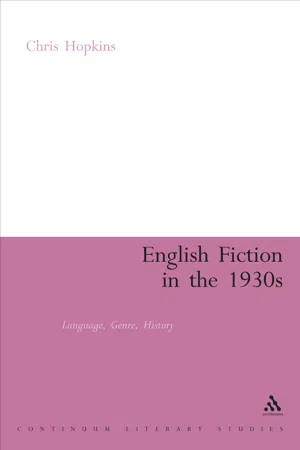
This study approaches the fiction of the 1930s through critical debates about genre, language and history, setting these in their original context, and discussing the generic forms most favoured by novelists at the time. Chris Hopkins uses a series of case studies of texts to draw on, develop or explore the boundaries, contemporary usefulness and complexities of particular prose genres. Generic debates and the political-aesthetic effects of different kinds of representation were live issues as discursive struggles and negotiations took place between modernist and realist modes, between high, middle and lowbrow categorisations of culture, between literature and mass culture, and between different conceptions of the role of the writer, politics and nationality, sexuality and gender identities.
Chris Hopkins draws both on well-known texts and on novels which have only recently begun to be discussed by critics of the thirties - particularly those by women writers whose work has still not been related very clearly to the literary and political debates of the period. Organised in five sections each focusing on major genres, he takes a wide range of novels as case studies and discusses their uses of generic forms, relating them to other examples and to their historical, political and cultural contexts.
- 192 pages
- English
- ePUB (mobile friendly)
- Available on iOS & Android
eBook - ePub
About this book
Information
Part I
Modernism and Modernity
1 Winifred Holtby, Storm Jameson,
Phyllis Bentley: Three Women
Writers and the Crises of Modernity
Even before the terms ‘cultural studies’ or ‘historicizing’ were common currency, the study of writing in the 1930s always proceeded on the assumption that literature and history, writing and culture in a wide sense had to be considered together. However, work on the 1930s has often adopted an approach which prioritizes the immediate cultural context of the decade above any longer term periodization. This kind of approach to the rich contexts of the period is undoubtedly productive, and much remains to be done in this historicizing mode. However, with a few rare exceptions, the contexts of the contexts have not, until recently at least, always been given their due consideration. Thus the relations between the local - if also global - topoi of the decade could usefully be seen particularly in terms of the longer perspectives provided by concepts of modernity and its narratives. The desolating effects of the Depression, for example, are not only a matter of economic collapse after 1927, but are also represented and experienced through the discourses of modernity which had become so dominant during the nineteenth century.
Though every 1930s critic knows automatically that the Great War and unemployment are essential contexts, there may sometimes be a less pronounced sense of the ways in which these events disrupt the modernizing narrative whereby scientific and technological progress promise beneficial and rapid transformation of the world, and realization of self-identity through rational mastery. This narrative underpinned not only variously conservative ideas of, for example, the dominant role of economic and industrial growth, but also many socialist and feminist notions of progress towards greater democracy and individual liberation. It is no coincidence that Walter Greenwood’s Love on the Dole begins with the young Harry’s romantic hopes of personal progress through his apprenticeship at Marlow’s engineering works, and that the bulk of the novel is about the ways in which his - and all other - personal narratives of beneficial change are thwarted. Clearly here, as in many other 1930s novels, modernity has entered a period of crisis in which a whole range of narratives of transformation, including romance, and realization through work, have lost all credibility. Leftist critics in the period - such as Ralph Fox in The Novel and the People (1937)1 - pointed to this loss of faith as the essential symptom of the terminal decay of the bourgeois era. Such critics usually also further asserted the inevitability of socialism’s narrative of actual progress, as opposed to capitalism’s ideological and illusory stories of social and self-achievement: ‘it is the aim of this essay to show that the future of the English novel and therefore the solution to the problems which vex the English novelist lies precisely in Marxism’.2
What impact, though, do these broad contexts have on women and women’s writing in the 1930s? While modernity is a vital context for all the writing of the period, I want to argue that it has a particular and powerful role in women’s writing. Though novels by women identify many of the same crises as novels by men, the various complex narratives of modernity do not offer exactly similar accounts of crisis and identity for men and women.
I will explore the impact of ideas of modernity in women’s writing of the 1930s by looking first at some critical writing by women, and then at novels by Phyllis Bentley, Storm Jameson and Winifred Holtby. A text which offers very clear evidence of engagement with ideas of modernity and gender is Winifred Holtby’s 1934 volume in the Twentieth-Century Library series, called Women and a Changing Civilisation.3 This is quite explicitly a cultural history of women under modernity, tracing the possibilities allowed to women from pre-modernity until the present. Holtby suggests that histories of human cultural change have tended to see women as inherently outside history:
Man, it appears, is concerned with the world he inhabits, its geological structure ... The historians of woman take it for granted that she is primarily concerned, not with geography, but with biology ... Man’s problem is his relationship with the universe, woman’s, they suggest, her relationship to man. (p. 4)
While men are engaged in an active struggle to understand themselves and their world, and to transform both, women are locked into a passive bodily existence upon which only history’s protagonists - men - can act. However, Holtby argues, ‘the only adequate history of women would be a history of humanity and its adventure upon a changing globe’ (p. 4). Clearly she is proposing as a corrective to the long tradition of histories of Man’s progress, a history in which women take their proper part. The idea of separate spheres must be replaced by a ‘universal history’, in which the roles assigned to women are analysed in terms of the relationship to human social and economic organization as a whole. In fact, it is particularly the task of this total history critically to analyse how, in the past, division of labour along class and gender lines has invented differential spheres for men and women.
Thus the book traces European ‘civilization’ through familiar periods -from prehistory through antiquity, the middle ages, the Renaissance to the modern period beginning with the Enlightenment - but always supplying the missing history of women. Part I ‘Hardly Human’ covers the premodern era, Part II ‘The Vindication of Humanity’ the eighteenth to nineteenth centuries, bringing us to the twentieth century in Parts III and IV: ‘The Inconveniences of Transition’ and ‘Backwards and Forwards’. In Part II, women succeed in taking due possession of Enlightenment conceptions of rational self-determination and advance into the public sphere with gains in economic, political and intellectual rights. In Part III there is a focus on recent interruptions to this progressive narrative of emancipation: the Great War, the slump and associated anxieties about gender roles. These are, of course, the crises of modernity which form the specific context of the 1930s. Their impact on both men and women is traced, with a particular emphasis on the recent events, especially the Great War, which have led to both boom and bust in the narrative of linear progress. It is in these recent phenomena that a sharply differential experience of modernization affects men and women. Thus the war is clearly a reversal for men, but at least offered the possibility of liberation in many respects for women - opening the public sphere to their potential. After the war, though, there is a period of conflict between men and women competing for the public space required for the modernizing identities which they both need to inhabit:
After 1928, jobs became not duties which war-time propaganda taught girls that it was patriotic to perform, but privileges to be reserved for potential breadwinners and fathers of families. Women were commanded to go back to the home ... The bitterness began which has lasted ever since - the women keeping jobs and the men resenting it - the men regaining the jobs and the women resenting it. (p. 113)
Holtby sees women as partially inhibited in this contest by many internalized ‘inferiority complexes’ arising from departures from traditional gender identities, but she also represents men as being rendered deeply anxious by their loss of identities. She cites a 1934 newspaper discussion of why modern men were grown so ‘flabby’, and the correspondent who asserts that young women have grown so muscular and independent that men no longer feel able to act as their protectors. ‘Set down in its crude form’, she writes ‘the argument is comical... but it goes deep, it dies hard, and few influences have caused more unhappiness in this period of transition’ (p. 106). Holtby’s history of gender and modern identities is, indeed, a vital long-term context for women’s writing in the 1930s, and something which informs, in more or less conscious ways, much women’s writing about the characteristic themes of the period.
Three novels, by Storm Jameson, Phyllis Bentley and Holtby herself, show in complex ways this kind of sense of the disturbances of modernity, of male losses and, despite all, of female gains from a progressive narrative of modernity. Like Holtby, Bentley and Jameson wrote non-fiction works of various kinds which show their sense of the contemporary crises of the modern world. Thus, Bentley writes in her pamphlet from the end of the period, The English Regional Novel (1941), about the collapse of the regional economies based on nineteenth-century heavy industries in Wales, Scotland and the North of England (though she also argues that this caused a cultural renaissance by stimulating regional writing). Storm Jameson in autobiographical and critical works talks widely about the collapse of any unified European culture, industrial, political and literary:
Above all, a writer needs ... the support of a hierarchy of values. In an age when values are disintegrating, or when any number of separate specialised values (the values of bankers, soldiers, politicians etc) are competing madly for place, the novelist is forced out of his proper growth.4
Jameson is particularly interested, in both her fiction and criticism, in T. S. Eliot’s The Wasteland, seeing it as the central embodiment of the collapse of Western culture and the only text fully able to portray the contemporary modern crisis. When we turn to her novels of the 1930s, and particularly her trilogy, The Mirror in Darkness, The Wasteland - both the text and the concept - is powerfully present. In the central volume, on which I’ll mainly focus, Love in Winter (1935), there are evident allusions to Eliot. Chapter Li’s title, ‘Ebb und Flut’ is distinctly Eliotesque in both topic and style, as is the title of Chapter XXV, ‘The Rats Are Underneath the Piles’. One of the novel’s characters, David Renn, always carries a copy of The Wasteland around in his jacket pocket, complete with his own annotations.5 He and Nicholas Roxby discuss the poem, but Renn is critical, saying that Eliot never really lived in the wasteland, and that Villon is superior since he is ‘really and truthfully Post-War’ (p. 222). The publisher and one-time employer of Hervey, Evelyn Lamb is a figure from ‘A Game at Chess’, complaining ‘My nerves are bad today’ (p. 282) and lamenting in Wasteland rhythms, ‘The new oil I am using is good - if there were oils to feed the mind, if there were only oil for the dry mind and the dry spirit’ (p. 124). These allusions suggest the contemporary relevance of The Wasteland for the novel, and the sense it partially shares with Eliot of the sterility of the modern world.
Sterility is associated not only with Evelyn Lamb, but also even more empahtically with a number of the male characters. William Gary, and Nicholas are both emasculated by the war, one literally, like Hemingway’s Jake in Fiesta, the other psychologically. Thus William Gary eventually tells Georgina Roxby bluntly that a wound has mutilated him and made him impotent (p. 288). Hervey’s lover Nicholas tells her on several occasions that after the war he was unable to satisfy his wife Jenny, and that he will be no good to her in that way. To these may also be added the lamed proto-fascist Julian Swann, who certainly perceives his limp as having a sexual or gendered significance (‘I can still hunt and box ... I detest cleverness’, he explains, as if these things automatically follow, p. 120). The theme of impotence and isolation is a central one in the novel’s representation of modern crisis. We see all the relationships in the narrative damaged or distorted by the war, in several cases from their very beginnings as war marriages.
Moreover, each of these Fisher King figures is shown as having a clear relationship to industrial modernity. In Nicholas Roxby’s case, he has, even before the war, refused to assume the burden of masculine industrial leadership demanded of him, when he declines to take over the direction of Garton’s Shipbuilding from his grandmother. The war exaggerates his diffidence, and it is no coincidence that post-war he makes - or rather fails to make - a living from selling antique furniture, rather than from making ships, from looking backwards rather than forwards, from a feminized aesthetic occupation rather than a traditionally perceived masculine one. He is, as Hervey finds on many occasions, impractical, indecisive and frightened of any change or conflict.
William Gary and Julian Swann are different cases - over-compensating for private bodily impotence or injury in the public sphere. For both, metaphorical phallic power is seen in terms of modernizing discourses of world and self-transformation. Thus Gary thinks together of his wound and of his role as agent of modernity:
Neither have I any sons, nor shall... I remember the doctor’s face and his hands ... I am filled with disgust and a useless anger. I have remade my life. I am reborn, I live to fulfil my own purpose; I have new desires ... I shall have extra cables laid under the sea, roads built in the mountains, young men will fly my aeroplanes over deserts ... I shall sit at the centre of this, the roads and the cables will run through my brain, the aeroplanes will take off and land there. (pp. 190-2)
His desire to transform the world through technological and rational mastery is in the tradition of discourses of modernization, with humans -or specifically Man exerting domination over the natural world. But one notes the way in which the switch of activity from a personal, bodily sphere to the public sphere on a global scale is linked, a displacement. Indeed, Gary’s figuring of global mastery acknowledges that his triumph is, despite the world stage, an internal and egotistical one. The urge for rational mastery of the environment is seen even in his own vision as motivated by the need to repossess personal, psychological power, rather by any abstract ideal of technological improvement or ameliorism.
Julian Swarnn’s fantasy of mastery is recognizably similar, but where Gary’s vision has at least the initial appearance of an impersonal, rationalseeming rhetoric, his has a vein of more open hysteria and histrionics from the beginning:
I am the modern condottiere, he thought: hereby I declare war on all spineless snickering intellectuals, blind-at-birth idealists, liberals, pacifists, shopkeepers. I am intoxicated with life ... Put your shutters up and crouch in your back rooms with the till... we shall bring back the world of danger and glory, the elan vital; all that the sneering half-men have destroyed we restore, we, the whole men, the captains in armour. (p. 122)
The fantasy is a mixture of Nietzsche and Bergson, perhaps via the French prophet of violence, Georges Sorel. Despite the shared theme of mastery, there is not so much here a concern with an end-point, as with a desire for destructive force as an end in itself.
Both Julian Swann and Gary are placed by the novel in the same way: identifying themselves through rhetorics of modernizing power. Each is seen as actually unable to inhabit that rhetoric in an integrated way which unifies their personal and public desires. Thus Gary, for all his assertion of self-control, ends his vision with a moment of anxiety so intense that he slips and turns away from his egocentric celebration of self- and world transformation towards the reader, reluctantly seeking reassurance or company: ‘Men in my state - did you see it? My hand jerked, the fingers sprawling: my imagination is not yet under control’ (p. 192). Julian Swann is surprised by two schoolboys while enjoying his fantasy of world domination in the Dome of St Paul’s, and, the narrator bathetically observes, ‘Before he had reached the ground, he had run out of breath and illusions and had begun to think about his dinner’ (p. 123). It seems clear that Gary and Swann despite apparent differences from Evelyn Lamb are, in fact, equally hysterical, unable to connect deed and desire in the unreal city. The modernizing active men are seen to live through unsatisfying fantasy as much as the woman whose life is one of rituals lacking in belief (each night she arranges the candlesticks on her dressing table in the shape of a star, and places three pillows on her bed in the form of the letter H - ‘for an unfathomed reason’, p. 126).
Opposed to these hollow people is the eminently solid Hervey Russell, the novel’s central character. She is notably self-controlled and self-reliant, able to persuade others, to plan for the future and to make money from writing novels (something she markedly regards as hard work rather than an aesthetic activity). She is contrasted with Evelyn, who e...
Table of contents
- Cover
- Title Page
- Copyright
- Dedication
- Contents
- Acknowledgements
- Introduction: Novel Politics: Language, Genre and History in English Fiction of the 1930s
- Part 1: Modernism and Modernity
- Part 2: Documentary and Proletarian Pastoral
- Part 3: History and the Historical Novel
- Part 4: Thrillers and Dystopias
- Notes
- Bibliography
- Index
Trusted by 375,005 students
Access to over 1.5 million titles for a fair monthly price.
Study more efficiently using our study tools.
Frequently asked questions
Yes, you can cancel anytime from the Subscription tab in your account settings on the Perlego website. Your subscription will stay active until the end of your current billing period. Learn how to cancel your subscription
No, books cannot be downloaded as external files, such as PDFs, for use outside of Perlego. However, you can download books within the Perlego app for offline reading on mobile or tablet. Learn how to download books offline
Perlego offers two plans: Essential and Complete
- Essential is ideal for learners and professionals who enjoy exploring a wide range of subjects. Access the Essential Library with 800,000+ trusted titles and best-sellers across business, personal growth, and the humanities. Includes unlimited reading time and Standard Read Aloud voice.
- Complete: Perfect for advanced learners and researchers needing full, unrestricted access. Unlock 1.5M+ books across hundreds of subjects, including academic and specialized titles. The Complete Plan also includes advanced features like Premium Read Aloud and Research Assistant.
We are an online textbook subscription service, where you can get access to an entire online library for less than the price of a single book per month. With over 1.5 million books across 990+ topics, we’ve got you covered! Learn about our mission
Look out for the read-aloud symbol on your next book to see if you can listen to it. The read-aloud tool reads text aloud for you, highlighting the text as it is being read. You can pause it, speed it up and slow it down. Learn more about Read Aloud
Yes! You can use the Perlego app on both iOS and Android devices to read anytime, anywhere — even offline. Perfect for commutes or when you’re on the go.
Please note we cannot support devices running on iOS 13 and Android 7 or earlier. Learn more about using the app
Please note we cannot support devices running on iOS 13 and Android 7 or earlier. Learn more about using the app
Yes, you can access English Fiction in the 1930s by Chris Hopkins in PDF and/or ePUB format, as well as other popular books in Literature & Literary Criticism. We have over 1.5 million books available in our catalogue for you to explore.