eBook - ePub
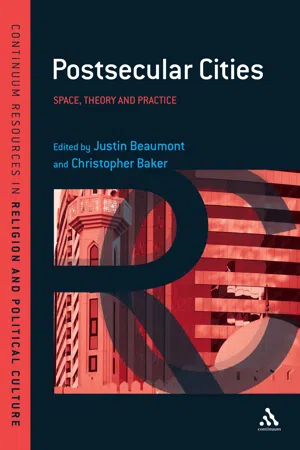
Postsecular Cities
Space, Theory and Practice
- 296 pages
- English
- ePUB (mobile friendly)
- Available on iOS & Android
eBook - ePub
Postsecular Cities
Space, Theory and Practice
About this book
This book reflects the wide-spread belief that the twenty-first century is evolving in a significantly different way to the twentieth, which witnessed the advance of human rationality and technological progress, including urbanisation, and called into question the public and cultural significance of religion. In this century, by contrast, religion, faith communities and spiritual values have returned to the centre of public life, especially public policy, governance, and social identity. Rapidly diversifying urban locations are the best places to witness the emergence of new spaces in which religions and spiritual traditions are creating both new alliances but also bifurcations with secular sectors. Postsecular Cities examines how the built environment reflects these trends. Recognizing that the 'turn to the postsecular' is a contested and multifaceted trend, the authors offer a vigorous, open but structured dialogue between theory and practice, but even more excitingly, between the disciplines of human geography and theology. Both disciplines reflect on this powerful but enigmatic force shaping our urban humanity. This unique volume offers the first insight into these interdisciplinary and challenging debates.
Information
Part I
Mapping the Theoretical Terrain
1 Postsecular Cities and Radical Critique: A Philosophical Sea Change?
Gregor McLennan
Introduction: paradigm lost
This chapter offers an analysis of some ways in which the ‘problematic’ of critical social theory has altered in the (purported) mood swing from secular to postsecular concerns. Since I am not an urbanist as such, the discussion is deliberately held at a general level. But equally, it can readily be seen that shifts of emphasis within radical approaches to the contemporary city have followed broader theoretical trends. And the key questions for current theorists, whether operating at the general philosophical or the specifically urbanist level, are whether a dramatic sea change in our metaphysical proclivities really is taking place, and whether this is a good and necessary thing for radical understanding and action. Now, these questions themselves can be addressed in two significantly different registers. According to one of these, the basic storyline of modernist self-comprehension, perhaps unexpectedly, is being sharply reversed. Whether viewed as a matter of historical reality or as the self-fulfilling mythology of atheistic intellectuals, the last two centuries in the West have constituted the epoch in which secular(ist) norms of enquiry, forms of political agency and social institutions replaced religious ones. But now things look, supposedly, very different again, because what Charles Taylor (2007) has called the ‘malaise’ of the modern social and moral imaginary has been fully exposed, resulting, if not in an all-round and uncritical ‘revival of religion’ exactly, then certainly in the kind of postsecularism that has no hesitation in being seriously anti-secularist in direction and intent.
The second take on the central questions is more ‘continuist’, certainly more ‘agonistic’, than it is straightforwardly ‘reversalist’. According to this, crude secularism – whether couched in moral, sociological or methodological terms – is undoubtedly problematical and in need of (self)critical deconstruction. But postsecularism here is not a matter of turning back the clock or simply opening ourselves up anew to the all-embracing joys of the religious life and spiritually driven enquiry. Rather, it is a matter of applying to secularism the sort of probing and sceptical analysis previously meted out to religious apologetics whenever the latter was thought excessively to govern empirical or philosophical understanding. In that sense, postsecular questioning can be viewed more as reflexively intra-secular(ist) rather than anti-secular(ist) as such (see McLennan 2010a, 2010b). And in that light, one would be as disposed to note the commonalities as much as the disjunctures between secularist and religious outlooks with respect to certain values and procedures. For example, there is a manifest conjoint worry about the almost calculated superficiality of certain (ultra-pluralistic, modestly descriptivist) styles of thinking that have developed in the wake of postmodernism and poststructuralism. Later, I cite Ash Amin’s recent depiction of the city as prone to such accusations from both sides.
Meanwhile, let’s remind ourselves of the impressive way that David Harvey’s Social Justice and the City exemplified the theoretical genre that dominated radical urbanism through the 1970s and 1980s. Harvey sought to embed the cultural and spatial specificities of urban life within a totalizing framework of capital formation and historical transformation. A keen observer of empirical trends and proximate connections, Harvey’s explanatory posture was unreservedly structuralist, insisting that the visible metropolis could only properly be comprehended by bringing the higher levels of abstraction into play, notably ‘an ontological and epistemological position akin to that held by Marx’ (Harvey, 1973: 301). Harvey articulated that benchmark in ‘critical realist’ terms, before that label had gained full currency within the radical philosophy movement of the time. Thus, the prescribed method was naturalistic, approaching all social phenomena in terms of their place in an open-textured but determinate totality of internal connections and emergent structures (Harvey, 1973: 288–90). Like the Althusserians, Harvey sought to analyse social life in its configuration of general relations, and relations between relations, so his approach was far from mechanical or reductionist. But equally it was taken for granted that the favoured philosophical conspectus pertained to an exclusively material world. And a certain scientism marked Harvey’s insistence that when it came to transformative urban practice, only an epistemologically informed politics of justice would suffice, not a ‘merely’ ethical or spiritual motivation, however well meant. While respecting the value commitments that people worked from, and noting the myriad forms of moral ‘reciprocity’ that sustained associations in the city, only ‘socialist formulations’ of redistribution would do (1973: Part Two), guided by a revolutionary ‘synthesis’ of structural theory and transformative practice (Part Three).
Harvey’s general outlook is not only philosophically realist, but in some central way also clearly secularist. The index of Social Justice in the City lists no named religion, and the word itself only appears under the (pejorative) subhead ‘ideology’. In the course of his mode-of-productionist overview, Harvey explained the historical specificity of ‘theocracy’ in terms of urban–countryside relations in past agrarian societies and revisited the affinities between various denominations and early regimes of capitalist accumulation. But otherwise, and despite the recentness, then, of debates around Harvey Cox’s The Secular City, there was nothing at all on the role of faith in modern urban activism or on the status of religion in contemporary society more generally. Undoubtedly, the generic structuralism and anti-humanism of the early 1970s played its part in this ‘silence’. Both Cox and the many Leftists who became interested in liberation theology and the like were absorbed by the sort of liaisons between humanism and existentialism that the Althusser generation then categorically denounced. But today, in turn, the excesses of hubristic scientism and the hypostatization of impersonal structural forces have themselves thoroughly been critiqued, making the absence of all reference in Harvey to religion and its resources – at least, given our increasingly postsecular sensibility – notable indeed. In order to trace how the secular problematic as represented by Harvey has come under pressure from (radical) postsecular thought, I engage with challenges mounted around three core concepts: the real, the good and (more briefly) the radical.
The real
Critical realism, especially as framed by Roy Bhaskar (1975, 1979), was pitched against an empiricist mainstream according to which knowledge is captured in universal generalizations derived from constantly conjoined observable events. Bhaskar’s alternative ontology was stratified into three domains or levels: the real, the actual and the empirical. Of the three, the real is conceived as the deepest, comprising a large number of (sometimes cross-cutting) causal powers and generative tendencies that are only ever partially realized, if at all, at the level of the actual and only ever partially evidenced, if at all, at the level of the empirical (i.e. the one that involves direct human perception). This realist scenario not only yields a richer sense of the constitution of the world, it alone is thought to explain how the ‘flat’, ‘thin’ ontology of empiricism itself comes to be plausible. This is because, in some experimental scientific practices, the open and complex entities and interactions of nature can be artificially isolated, and exceptionless generalizations between factors produced. However, far from showing, as empiricists held, that exceptionless generality obtains in the world, and can be spotted as such, all it signifies is that closure can (sometimes) be scientifically produced and (some) real dispositions identified. The natural and social worlds themselves remain, as before, teeming, contradictory, moving processes that simply do not exist in that regularized way and cannot be held steady. The fallacy of empiricism, then, is to regard only one dimension of scientific practice as paradigmatic of the whole, and to elevate epistemology – the quest for universally valid, testable knowledge claims – above ontology.
The scientific realist perspective was quintessentially philosophical – metaphysical, even – in two main senses. First, the resort to ontology in order to overturn the dominant meta-theory of science started from a ‘transcendental’ argument in answer to the question, What must the world be like if it is to include and explain successful science? Second, within those many branches of natural and social science in which experimental closure was either unmanageable or unwanted, the power of conceptual abstraction had to take precedence over the data of observation, and retrospective explanation had to supplant the previous emphasis on prediction.
Many radical philosophers and sociologists subsequently took up the realist cause, so that by around 2007 the publisher Routledge alone had produced numerous ‘studies’ and ‘interventions’ in critical realism. Most of these volumes remained secular–Leftist in character, but they included three texts – From East to West, by Bhaskar (2000), On Christian Belief, by Andrew Collier (2003), and Transcendence, by Margaret Archer, Collier and Douglas Porpora (2004) – that signalled a dramatic ‘religious turn’ in critical realism, defined by the proposition that it was high time we became ‘realist about God’. The central theme was that critical realism not only requires a ‘transcendental’ argument which allots priority to ontology over epistemology and enables the basic stratification of the domains of the real to be sketched; critical realism also confers legitimacy on the very idea of the transcendent, and indeed enables insight into transcendental reality. Moreover, the routine assumption that realism entails a thoroughgoing cosmic materialism, thus ruling out belief in God, is regarded as mistaken. To grasp this point, we must recall that, for most critical realists, a hefty degree of epistemological relativism is inescapable, even though we can legitimately reason to an ‘intransitive’ ontological realm beyond the particular construal of our current schemes of knowledge and evidence. Why then couldn’t it be that our scientific and ideological commitment to materialism – which might well have ‘local’ epistemic advantages – is more relative than we think, and fails to capture the underlying nature of ultimate reality? For one thing, scientistic materialism systematically screens out or actively delegitimates types of evidential reasoning (those based on unique experiential testimony, for example) that may well be perfectly valid from a more encompassing perspective. For another, the ‘integrative pluralism’ that realism tends to advocate as an account of the world’s complexity is responsive to the idea that the causal mechanisms characteristic of one order of being might turn out to be dependant upon, and interactive with, higher-level generative mechanisms of an altogether different sort. Overall, then, philosophical realism is necessarily metaphysical in certain respects, requiring a range of extra-scientific assumptions and possibilities, and ontological realism is in principle entirely compatible (if fallibly so) with belief in God, conceived in realist terms. Finally, none of this implies that realism about God is any less socially radical or any less committed to scientific rationality (in its place) than non-believing critical realism.
Roy Bhaskar’s own pursuit of postsecular spirituality has been couched in such idiosyncratic and inflated terms (the ‘Ultimatum’, the ‘Absolute Simpliciter’ and suchlike), that friend and foe alike have felt it to be rather dubious as philosophical argumentation. The conjoined project of Archer et al. is more carefully wrought, so it is their version of religious realism that I will focus on for our purposes. However, it is worth noting that whether cogently sustained or not, Bhaskar’s general stance is perhaps more fully aligned with postsecularism Take II than that of Archer et al. This is partly because Bhaskar has a more ‘immanentist’ notion of the ‘ingredience’ that higher levels of reality purportedly contribute to lower levels as a matter of ontological necessity. And it is also because he is ambivalent about whether it is God specifically that constitutes the ‘categorial structure of the world’ and the transcendent hope and healing that is central to a proper ‘philosophy of Self-realisation’, or whether, instead, ‘God’ is just a convenient shorthand for those self-sustaining generalities (see, e.g. Bhaskar, 2002: 150).
Archer, Collier and Porpora are convinced that, even if they seek to provide a more properly religious version of realism than Bhaskar, the original tenets of his realism are not being forsaken. They are also keen to stay identified, ethically and politically, with the Left, even if they want to challenge its unthinking secularism. For these reasons, Archer et al. limit themselves to establishing a ‘level playing field’ between atheistic realists and believer realists, the latter now ‘coming out’ in significant numbers (Archer et al., 2004: x, 6). Interestingly, these Christian realists have little time for traditional ontological/cosmological arguments for God or deductions of His existence from the marvels of nature – apologetics of that sort can only remain, they say, thoroughly inconclusive. Alternative defences of faith that highlight its principally emotional, moral or ‘mythological’ nature are unacceptable too; in effect, these concede to atheism by evading the fact that claims about God are cognitive, that is, adjudicable in principle and amenable to rational argument. Religious belief does not clash with science, but this is not because the game of faith is entirely separate from the game of truth. On the contrary, if religions cannot make good their truth claims in broadly realist terms, such that God is a being ‘who pre-existed and is independent of all human minds and material things’ (Collier, 2003: xv), then faith has no credible foundation at all. The task, therefore, is twofold: on the one hand, to strengthen believers’ commitment to realist modes of understanding, and, on the other hand, to quell unbelieving realists’ alarm at the notion that revelation (Collier), or at least religious experience (Archer), yields a legitimate and objective form of knowledge. The strategy used to achieve those twin goals is one that prioritizes the need for symmetry in the appraisal of secular and religious perspectives.
On the positive side of symmetry, so to speak, both secular and religious critical realism oppose Wittgensteinian, social constructionist, and postmodernist trends in social understanding. For any sort of realist, even if our grasp of objective reality is filtered through the norms and rules of our ‘forms of life’, even if it is generated in relation to social functions and ideologies, and even if its texture is necessarily discursive, questions of truth and objectivity are not exhausted by their contextual and expressive mediations. In fact, realism itself insists that, epistemically, our grasp of the real is always only partial and changing. Nevertheless, it is only by anticipating that changing views and differing perspectives are attempts to grasp an independent and common reality that we can make sense of enquiry at all and avoid a paralysing descent into subjectivism.
Second, secular and religious realism are thought to concur in that although we come through science and experience, to regard certain items of belief as ‘alethic’ in character – that is, so firmly based that we take them to be the incontrovertible truth of reality ‘in itself’ – knowledge of God is not exactly of that sort. Rather, reiterated episodes of ‘judgmental rationality’ are required to clarify God’s being (Archer et al., 2004: 3). Taking these two positive points together, we get a third: realism about God has to be couched fallibly. Thus, ‘God might be one of those things that exists independent of our knowledge of it’, but it is ‘something about which we might (always) be mistaken’. God’s existence and nature do have objective ontological answers, but we might never be sure what they are (Archer et al., 2004: 1–3). Then again, most of what secular realists believe, including the non-existence of God, falls outside the realm of ‘alethic’ truth as well. So, atheistic and believing stances alike are not only equally subject to rational debate, but are equally rational, and in their different ways equally objective, too (2004: 3).
Third, science no less than faith takes on trust the words and actions of recognized authorities, accepting the validity of their conclusions in the round, and based on little more than hearsay. This is to diminish neither science nor hearsay, only to upgrade religious belief, since that too is based on the general – though never conclusive – reliability of testimony and expertise, and it also involves careful scrutiny of vital evidence. If that evidence seems thin to secularists, then the same applies to evidence for certain scientific hypotheses, and for many estimable beliefs about society (socialism, e.g. (2004: 15)). Secular realists may think that the systematic and public nature of scientific evidence differentiates it decisively from personal reports of revelation. But even here we might query whether scientific evidence, quite apart from its invariably partial nature, is precisely replicable as such, or ‘public’ in the sense of being entirely open to the presuppositionless and experience-free observation of all. Surely this notion of repeated, neutral, conclusive sensory witness is precisely what realism – and post-positivism generally – has exposed as an empiricist myth?
Re-placing objective accounts within the larger context of (variable) experience, Christian realists maintain that lack of belief in God constitutes as mu...
Table of contents
- Cover
- Title
- Introduction: The Rise of the Postsecular City
- Part I Mapping the Theoretical Terrain
- Part II Competing Experiences of Postsecular Cities
- Part III Postsecular Policies and Praxis
- Part IV Theological and Secular Interpretations
- Afterword: Postsecular Cities
- General Index
- Index of Names
Trusted by 375,005 students
Access to over 1.5 million titles for a fair monthly price.
Study more efficiently using our study tools.
Frequently asked questions
Yes, you can cancel anytime from the Subscription tab in your account settings on the Perlego website. Your subscription will stay active until the end of your current billing period. Learn how to cancel your subscription
No, books cannot be downloaded as external files, such as PDFs, for use outside of Perlego. However, you can download books within the Perlego app for offline reading on mobile or tablet. Learn how to download books offline
We are an online textbook subscription service, where you can get access to an entire online library for less than the price of a single book per month. With over 1.5 million books across 990+ topics, we’ve got you covered! Learn about our mission
Look out for the read-aloud symbol on your next book to see if you can listen to it. The read-aloud tool reads text aloud for you, highlighting the text as it is being read. You can pause it, speed it up and slow it down. Learn more about Read Aloud
Yes! You can use the Perlego app on both iOS and Android devices to read anytime, anywhere — even offline. Perfect for commutes or when you’re on the go.
Please note we cannot support devices running on iOS 13 and Android 7 or earlier. Learn more about using the app
Please note we cannot support devices running on iOS 13 and Android 7 or earlier. Learn more about using the app
Yes, you can access Postsecular Cities by Justin Beaumont, Christopher Baker, Justin Beaumont,Christopher Baker in PDF and/or ePUB format, as well as other popular books in Social Sciences & Politics. We have over 1.5 million books available in our catalogue for you to explore.