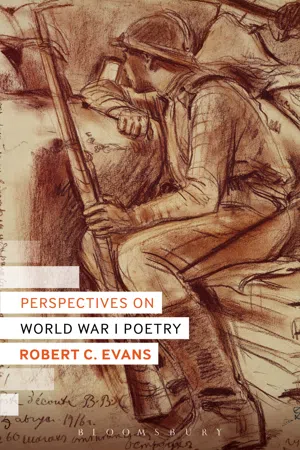
Introducing students to the full range of critical approaches to the poetry of the period, Perspectives on World War I Poetry is an authoritative and accessible guide to the extraordinary variety of international poetic responses to the Great War of 1914-18. Each chapter covers one or more major poets, and guides the reader through close readings of poems from a full range of theoretical perspectives, including:
• Classical
• Formalist
• Psychoanalytic
• Marxist
• Structuralist
• Reader-response
• New Historicist
• Feminist
Including the full text of each poem discussed and poetry from British, North American and Commonwealth writers, the book explores the work of such poets as: Thomas Hardy, A.E. Housman, Alys Fane Trotter, Eva Dobell, Charlotte Mew, John McCrae, Edward Thomas, Eleanor Farjeon, Margaret Sackville, Sara Teasdale, Siegfried Sassoon, Rupert Brooke, Teresa Hooley, Isaac Rosenberg, Leon Gellert, Marian Allen, Vera Brittain, Margaret Postgate Cole, Wilfred Owen, E.E. Cummings and David Jones.
- 240 pages
- English
- ePUB (mobile friendly)
- Available on iOS & Android
eBook - ePub
Perspectives on World War I Poetry
About this book
Information
1
Thomas Hardy (1840–1928): “Channel firing”; “In time of ‘the breaking of nations’”
CHANNEL FIRING
That night your great guns, unawares,
Shook all our coffins as we lay,
And broke the chancel window-squares,
We thought it was the Judgment-day
And sat upright. While drearisome [5]
Arose the howl of wakened hounds:
The mouse let fall the altar-crumb,
The worms drew back into the mounds,
The glebe cow drooled. Till God called, “No;
It’s gunnery practice out at sea [10]
Just as before you went below;
The world is as it used to be:
“All nations striving strong to make
Red war yet redder. Mad as hatters
They do no more for Christés sake [15]
Than you who are helpless in such matters.
“That this is not the judgment-hour
For some of them’s a blessed thing,
For if it were they’d have to scour
Hell’s floor for so much threatening. . . . [20]
“Ha, ha. It will be warmer when
I blow the trumpet (if indeed
I ever do; for you are men,
And rest eternal sorely need).”
So down we lay again. “I wonder, [25]
Will the world ever saner be,”
Said one, “than when He sent us under
In our indifferent century!”
And many a skeleton shook his head.
“Instead of preaching forty year,” [30]
My neighbour Parson Thirdly said,
“I wish I had stuck to pipes and beer.”
Again the guns disturbed the hour,
Roaring their readiness to avenge,
As far inland as Stourton Tower, [35]
And Camelot, and starlit Stonehenge.
“Channel Firing” was published several months before the actual start of World War I. Humorous and macabre, it imagines some dead folk, buried in a country churchyard, who hear gunnery practice in the English Channel and who assume from the booming noise that the Final Judgment is at hand. The booms shake the coffins of the dead (2), break windows near the altar of the nearby church (3), and startle various kinds of nonhuman creatures. Dogs howl (6), a mouse drops crumbs (perhaps from the consecrated communion bread [7]), worms head underground (8), and a cow drools as it stands on a small piece of land (a “glebe”) owned by the church.
Eventually, however, God himself reassures the corpses that the sounds do not signal Judgment Day. Speaking in a surprisingly colloquial tone, he tells them that the world is “just as it used to be” (12) and that humans are still as warlike and as indifferent to Christianity as before (13–16). For some of the living (God continues), it is best that Judgment Day has not yet come; otherwise they might suffer in hell for their belligerence (17–20). Judgment Day lies still in the future (if in fact it ever occurs, since humans need eternal rest [21–4]). Thus reassured, the corpses lie down, and one of them asks whether humans will ever be more rational than they were when the corpse himself died, during an apathetic era (25–8).
In response, many skeletons shake their heads, and a dead parson lying nearby wishes that he had spent his life enjoying sensual pleasures rather than preaching the gospel (29–32). As the poem ends, the guns boom again and can be heard inland at famous places associated with increasingly distant periods of English history (33–6).
Because LONGINUS admires humans who pursue lofty ideals and shun base materialism, he might value this poem’s pervasive irony. Clearly the poem implicitly mocks the shallow values of most human beings, both past and present. People have long ignored elevated ideals, consumed instead by hatred, blood lust, and vengeance. Their guns may be “great” or huge (1), but they themselves are far from spiritual greatness. Instead, they actually destroy the very symbols (such as the chancel windows) associated with loftier values (3). Although we often consider animals inferior to humans in intellect and moral stature, the animals here behave sensibly. They have every reason to fear mankind (6–9). Yet the reference to the “worms” drawing back into “mounds” (perhaps graves?) implies that ultimately people become merely food for worms. In the long term, wars seem petty and unimportant.
Although God assures the poem’s corpses that Judgment Day is still far off, the poem itself judges humans appropriately, at least from a Longinian point of view. Humans, according to Longinus, rarely live up to high spiritual standards. God, in this poem, symbolizes the spiritual loftiness Longinus prized (although God here speaks more colloquially than Longinus may have wished). The poem definitely shows how people fall short of lofty moral expectations and their real ethical potential. Those who fail to raise themselves spiritually while they live will (the poem implies) ultimately fall to the depths of hell. Longinus might therefore admire this poem for using irony to endorse, by implication, the worthy values the dead parson openly preached about for years (29–32). If open preaching does not work, perhaps sardonic irony can have some slight positive impact.
A TRADITIONAL HISTORICAL critic might try to determine such matters as the poem’s time of composition, its date of initial publication (May 1, 1914 in the Fortnightly Review [Brooks, p. 10]), and especially the significance of its various historical allusions. Its allusions to the Bible would especially interest such a critic, and so would the rather cavalier tone of God’s words. That tone suggests that God could seem less lofty, less exalted, more familiar in Hardy’s time than he was typically imagined, for instance, when John Milton wrote Paradise Lost. Hardy’s poem might interest a traditional historical critic, then, partly for what the poem suggests about the ways God, war, and human history itself could be imagined in 1914. A historical critic might also examine how the poem reflects details of Hardy’s own life, including his loss of religious faith, his intimate familiarity with rural England, and his tendency to write as a specifically English poet. All these facets of Hardy’s life arguably affected the poem’s phrasing. Although situated, historically, in a particular time and place, the poem also implies that humans have not changed much over the centuries. Finally, a traditional historicist might also explore the poem’s various revisions. In the earliest printing, for instance, God says “no, no” rather than “ha, ha” (21). In the later version, God sounds more mocking (and less reassuring) than in the original poem (Brooks, p. 10).
FORMALIST critics are concerned with the “close reading” of literature and with such matters as a work’s beauty, its possible unity, and the potential relevance of even the slightest details of phrasing, meter, syntax, and structure. Therefore, literally every word and syllable of Hardy’s poem would potentially interest a formalist, beginning with the opening phrase—“That night” (which implies precision and specificity)—as well as with the next phrase (“your great guns,” with its strongly accented monosyllables and its emphatic alliteration). A formalist would also appreciate the surprise revealed by the second line, and also the symbolism of the third line’s reference to a church damaged by preparations for war.
The abrupt transition from stanza one to stanza two—emphasized by “enjambment” (lack of punctuation at the end a line)—would also impress a formalist: Hardy’s readers are caught by surprise just as the corpses have been. Effective assonance and alliteration appear in “howl,” “hounds,” and “mouse” and also in “let fall” and “altar” (6–7), and line 7 is effectively realistic, ironic, and irreverent. A formalist would also admire the appropriate stress on “in” in “into” in line 8, the effectively colloquial tone of “It’s” in line 10, the clever use of euphemism (“went below”) in line 11, and the implied references to blood and the double use of assonance in line 14. In line 15, “Christés” (rather than “Christ’s”) sounds evocatively medieval (and thus reminds us of Christianity’s long history), while the shift in line 25 balances the similar shift in line 5. Cleanth Brooks, a leading American formalist, noted the somewhat comic tone of line 19 (describing skeletons shaking their heads), and indeed Brooks’s explication of this poem is an exemplary formalist analysis (see “Works cited”). As Brooks shows, formalists are intrigued by effective writing down to the level of the smallest individual details.
DIALOGICAL critics are interested in the different “voices” works contain, as well as in the potential “dialogue” between a given work, its readers, and other texts. Thus Hardy’s poem is “in dialogue” with the Christian Bible and Christian traditions. The Bible and those traditions present God much less colloquially than Hardy does. In “Channel Firing,” God speaks in various tones, sounding sometimes dryly informative (10), sometimes sarcastic (14, 21), and sometimes compassionate (16). Hardy makes these voices interact. The entire poem itself is also in a kind of dialogue with the whole previous English poetic tradition, which had rarely presented God as irreverently in this work. “Channel Firing” is so effective partly because its tones are so different from what Hardy’s readers did (and probably still do) expect.
Finally, MULTICULTURAL critics would also find much of interest in “Channel Firing.” The poem reflects or alludes to various cultures, including Christian culture (3), rural culture (9), international culture (13), and medieval culture (15). It also implies differences between and even within cultures, since it suggests the possibility of war between different nations and within the supposedly common culture of Christendom. War, in fact, is a chief means by which one culture attempts to impose its will on other cultures, and during World War I Germans were often seen as explicitly fighting on behalf of a “Kultur” that their enemies rejected. Different kinds of culture are implied in the poem’s final lines (35–6), each increasingly remote in time. Yet ultimately this poem, like much of Hardy’s work, seems a clear reflection of specifically English culture, partly because God speaks like a no-nonsense Englishman.
IN TIME OF “THE BREAKING OF NATIONS”
Only a man harrowing clods
In a slow silent walk
With an old horse that stumbles and nods
Half asleep as they stalk.
Only thin smoke without flame [5]
From the heaps of couch-grass;
Yet this will go onward the same
Though Dynasties pass.
Yonder a maid and her wight
Come whispering by: [10]
War’s annals will cloud into night
Ere their story die.
This poem, first published in 1916 (when the war was in its third year), alludes in its title to Jeremiah 51.20: “Thou art my battle axe and weapon of war: for with thee will I break in pieces the nations, and with thee I will destroy kingdoms.” The poem offers three vignettes of rural life. Stanza one describes a man plowing a field with an old, half-asleep horse (1–4). Stanza two suggests that rural activities such as burning weeds in fields will endure much longer than the dynastic power of ruling families (5–8). Finally, stanza three points (in deliberately archaic language) to a young woman and her male suitor who converse quietly while walking. The poem ends by suggesting such courtship will endure long after any particular war has ended. In short, the poem suggests that wars are merely temporary and seem comparatively insignificant when contrasted with the basic, persistent activities of human life.
HORATIAN critics, influenced by or in sympathy with the ancient Roman poet Horace, value simplicity, unity, clarity, and moderation in literary works. They might therefore admire Hardy’s lyric, which is unified partly because three different examples all illustrate the same basic point. The poem’s diction is also exceptionally clear and plain. A regular rhyme scheme contributes further unity, and that rhyme scheme is itself highly conventional—another factor Horace would have prized because literary conventions, for him, merely codify custom. Conventions reflect the kind of writing that has appealed to past audiences, and the need to satisfy one’s audience is the need Horace especially emphasizes. Hardy’s poem was easy for its first audiences to appreciate, and the same is true today. Few readers might immediately know the meaning of “couch-grass,” but despite this one very slight exception the poem possesses the kind of clarity Horace valued so highly.
ARCHETYPAL critics are especially interested in any traits most people share (including common desires and fears). They are also interested in anything enduring and fundamental to a shared “human nature.” Hardy’s poem would interest them because it emphasizes aspects of life (such as planting crops, harvesting crops, and romantic courtship) that seem to have existed everywhere and almost always. Indeed, the poem implies that such activities will endure long after the present war is merely a distant memory. Humans, the poem suggests, will always need to cultivate the land, and sexual attraction will endure as long as humans do. Hardy’s poem (an archetypal critic might argue) emphasizes activities and feelings that are (and always will be) important, regardless of differences in such matters as race, religion, ethnicity, nationality, gender, class, and so on.
MARXIST critics are especially concerned with conflicts between economic classes, especially between classes with real economic power (such as the wealthy and the middle classes) and classes that are poor and oppressed (such as workers and peasant farmers). Certainly the farmer presented in Hardy’s poem seems anything but wealthy: only one horse is mentioned, and the farmer must plow the fields himself rather than pay anyone else to do so. Presumably he also burns away weeds, while the conversing couple seem anything but wealthy, especially since they are described as “a maid and her wight” (9)—deliberately archaic phrasing suggesting that they are peasants. (“A lady and her love” would imply something entirely different.) The peasant, plowing the fields with his horse, might resemble the horse in the eyes of Marxists: both man and animal have to work hard, and, just as the horse has little control over his life, the same might be said of the peasant. It is people like this peasant who must fight the wars started by the wealthy and powerful—wars that benefit the wealthy and powerful. The lifestyle of peasants and workers may ultimately endure longer than the power of royal “Dynasties” (8), but royals in the meantime enjoy comforts and privileges that peasants can only imagine. Yet a Marxist might argue that English peasants and workers in Hardy’s day were still far better off, economically, than peasants and workers in the colonies owned and exploited by the British empire. In various ways, this poem can therefore be read, from a Marxist point of view, as complicit in upholding the power structure of its day. It may in a sense celebrate the peasant class, but it does nothing to help improve their real material conditions.
NEW HISTORICIST critics, like Marxists, are often concerned with issues of social power and especially with groups who seem relatively powerless and marginalized. But new historicists are less likely than Marxists to advocate for any specific political and economic change. They are more likely to study social conditions of the past than to seek, explicitly, to alter social conditions of the present. New historicists often emphasize the ways powerful people may be less powerful than they seem, and also the ways powerless people may be more powerful than they at first appear. In these respects, Hardy’s poem seems tailor-made for new historical analysis. The peasants it describes seem relatively powerless, yet their lifestyle (Hardy suggests) is more powerful and enduring than royal dynasties. In one sense the poem is arguably naïve: peasants in continental Europe during World War I (especially French peasants in northern France) knew just how destructive war could actually be—how much it could obliterate the landscape, kill noncombatants, and totally disr...
Table of contents
- Cover
- Half-title
- Introduction
- 1 Thomas Hardy (1840–1928): “Channel firing”; “In time of ‘the breaking of nations’”
- 2 Alys Fane Trotter (1863–1961): “The hospital visitor”
- 3 Charlotte Mew (1869–1928): “May, 1915”
- 4 Edward Thomas (1878–1917): “Tears”; “Rain”
- 5 Margaret Sackville (1881–1963): “A memory”
- 6 Siegfried Sassoon (1886–1967): “They”; “The rear-guard”; “The glory of women”; “Atrocities”
- 7 Rupert Brooke (1887–1915): “Nineteen fourteen: The soldier”; “Nineteen fourteen: The dead”
- 8 Isaac Rosenberg (1890–1918): “Break of day in the trenches”; “Louse hunting”; “Returning, we hear the larks”
- 9 Marian Allen (1892–1953): “The wind on the downs”
- 10 Wilfred Owen (1893–1918): “Anthem for doomed youth”; “Arms and the boy”; “Disabled”; “Dulce et Decorum Est”; “Futility”; “Strange meeting”
- 11 E. E. Cummings (1894–1962): “I sing of Olaf”; “My sweet old etcetera”
- 12 The kinds of questions different critics ask
- Works cited
- Further reading
- Permissions
- Index of theories and applications
Trusted by 375,005 students
Access to over 1.5 million titles for a fair monthly price.
Study more efficiently using our study tools.
Frequently asked questions
Yes, you can cancel anytime from the Subscription tab in your account settings on the Perlego website. Your subscription will stay active until the end of your current billing period. Learn how to cancel your subscription
No, books cannot be downloaded as external files, such as PDFs, for use outside of Perlego. However, you can download books within the Perlego app for offline reading on mobile or tablet. Learn how to download books offline
Perlego offers two plans: Essential and Complete
- Essential is ideal for learners and professionals who enjoy exploring a wide range of subjects. Access the Essential Library with 800,000+ trusted titles and best-sellers across business, personal growth, and the humanities. Includes unlimited reading time and Standard Read Aloud voice.
- Complete: Perfect for advanced learners and researchers needing full, unrestricted access. Unlock 1.5M+ books across hundreds of subjects, including academic and specialized titles. The Complete Plan also includes advanced features like Premium Read Aloud and Research Assistant.
We are an online textbook subscription service, where you can get access to an entire online library for less than the price of a single book per month. With over 1.5 million books across 990+ topics, we’ve got you covered! Learn about our mission
Look out for the read-aloud symbol on your next book to see if you can listen to it. The read-aloud tool reads text aloud for you, highlighting the text as it is being read. You can pause it, speed it up and slow it down. Learn more about Read Aloud
Yes! You can use the Perlego app on both iOS and Android devices to read anytime, anywhere — even offline. Perfect for commutes or when you’re on the go.
Please note we cannot support devices running on iOS 13 and Android 7 or earlier. Learn more about using the app
Please note we cannot support devices running on iOS 13 and Android 7 or earlier. Learn more about using the app
Yes, you can access Perspectives on World War I Poetry by Robert C. Evans in PDF and/or ePUB format, as well as other popular books in Literature & World War I. We have over 1.5 million books available in our catalogue for you to explore.