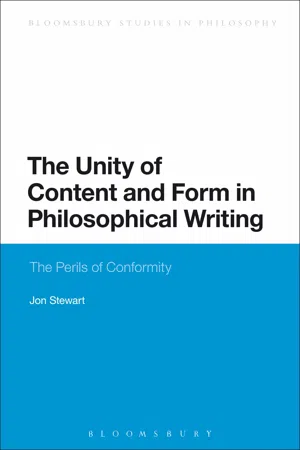
In The Unity of Content and Form in Philosophical Writing, Jon Stewart argues that there is a close relation between content and form in philosophical writing. While this might seem obvious at first glance, it is overlooked in the current climate of Anglophone academic philosophy, which, Stewart contends, accepts only a single genre as proper for philosophical expression. Stewart demonstrates the uniformity of today's philosophical writing by contrasting it with that of the past.
Taking specific texts from the history of philosophy and literature as case studies, Stewart shows how the use of genres like dialogues, plays and short stories were an entirely suitable and effective means of presenting and arguing for philosophical positions given the concrete historical and cultural contexts in which they appeared.
Now, Stewart argues, the prevailing intolerance means that the same texts are dismissed as unphilosophical merely due to their form, although their content is, in fact, profoundly philosophical. The book's challenge to current conventions of philosophical is provocative and timely, and will be of great interest to students and scholars of philosophy, literature and history.
Trusted by 375,005 students
Access to over 1.5 million titles for a fair monthly price.
The Platonic dialogues have long been beloved texts that have served as introductions for beginners in philosophy, and one of the reasons for this is certainly their literary form. Generations of young readers have been intrigued by Socrates’ clever destruction of the confident views of his interlocutors. While students are invariably captivated by the spell of Plato, professional philosophers often scoff at what they regard as his naïve way of writing. There is a kind of condescension that regards Plato’s work as a charming, yet ultimately rather silly, attempt at real philosophy. His dialogues contain elements of Greek poetry, drama, and mythology that, it is thought, have no place in a genuine philosophical work. Thus, some regard his dialogues more as works of literature than philosophy. For this reason, much of Plato scholarship takes place in departments of literature and classical studies instead of philosophy.
Most philosophers do not reflect much on why Plato chose to write in dialogue form.1 They seem to assume that he, as a good student, simply wished to transcribe his teacher’s important discussions and present them as an accurate record for posterity. The idea is that he was in effect a loyal and devoted pupil taking notes from his teacher, which he later reworked and wrote up in more detail in the same way that, for example, Hegel’s students collected and collated their lecture notes to his courses for publication. According to this view, if Plato had a modern device such as an audio recorder, he would have used it. It is thus naïvely assumed that Plato’s presentation of Socrates is historically veridical and need not be critically examined by means of a comparison with other sources.2 But there were perhaps other good reasons for him to portray his beloved teacher as he did in the form of a dialogue. In this chapter, I wish to place the Platonic dialogues in their historical context in order to gain an understanding of these reasons. First, I will argue that it was of cardinal importance for Plato to distinguish Socrates from the Sophists. This was best done by presenting his philosophical activity in the form of dialogues. Second, I wish to claim that the very nature and content of Socrates’ thought were closely tied to the dialogical form and could not be easily separated from it.
It should be pointed out that there is a certain disanalogy with Socrates and the other figures treated in the following chapters of this study; specifically, we only know of Socrates through the works of Plato and other authors, but we do not have any text from Socrates himself. Thus, while it makes sense to talk about the self-conscious use of genre in writers such as Seneca, Erasmus, Kierkegaard, Borges, and Sartre, this is somewhat problematic when one is discussing Socrates. If there is a question of Socrates’ intentional use of the dialogue as a philosophical tool, then this can only be known second-hand through the portrayals of it by others. Indeed, the question has been raised to what degree Plato’s representations of Socrates and his activity are attempts to present a historically accurate picture and to what degree they are idealized or even fictional. These discussions are, however, largely irrelevant for the point I wish to make about the nature of the philosophical dialogue presented by Plato. The argument here does not hang on the historical accuracy of Plato’s portrayal of Socrates in all its details. To be sure, certain historical circumstances about the nature of philosophical writing in ancient Greece are relevant for my claim, but these are so general as to be unproblematic. The genre of the philosophical dialogue arose with the figure of Socrates. Given that many different authors who were his students portrayed Socrates’ philosophical activity in terms of a dialogue, it seems only natural to assume that this was at least one aspect of the kind of philosophical investigation that he was known for and associated with. While, to be sure, we have no independent evidence of Socrates, the historical person, to compare with these writings, the onus of proof is on the skeptic to demonstrate that his philosophy took an entirely different form than that of the dialogue, but for this there is no evidence. In the following, I will thus focus on the Socrates as presented by Plato and explore his reasons for presenting Socrates’ thought and method as he did. I will thereby set aside the question of the true historical figure of Socrates.
I Plato and presocratic philosophy
Before one can properly evaluate the use of the dialogue, it is important to determine what genres of writing were commonly used by other philosophers at this time when philosophy was still in its infancy. What was the status of philosophical expression when Socrates and Plato came onto the scene? Based on surviving fragments and ancient accounts of works now lost, it can be ascertained that there were two main genres of philosophical writing that enjoyed currency in presocratic philosophy: the philosophical treatise and the poem.
Anaximander of Miletus is usually claimed to be the first author of a philosophical treatise. His student Anaximenes is also said to have written a prose work, in which he forwarded his famous thesis that everything is the infinite or
. Heraclitus authored a book that he placed in the temple of Artemis; from the surviving fragments, it is clear that this was a prose work, written in a style famous for its obscurity. So also Zeno of Elea, the pupil of Parmenides, is said to have written a book in which he set forth his famous paradoxes which were intended to refute the possibility of movement or plurality.
Xenophanes of Colophon wrote several poems with philosophical content, of which a number of fragments survive. These fragments are in both hexameters and elegiac meter. Some ancient sources claim he was the teacher of Parmenides, who also wrote his philosophy in the form of a didactic poem in hexameters, a fairly large part of which survives. Parmenides portrays how he came on a chariot to the goddess who revealed the truth to him, thus ascribing the knowledge presented in the work to the divine and not to himself as author. So also two poems in hexameter verse are ascribed to Empedocles: On Nature and Purifications. In the first of these, he presents a philosophy of nature, while the second articulates a theory of transmigration of souls, known from Pythagoras.
In a sense, Socrates was in a polemical relation with these previous thinkers since he did not believe that philosophy should be written either as a poem or as a treatise. Indeed, he did not think that it should be written at all. In the Phaedrus, Plato has Socrates explicitly argue for the superiority of the oral discussion over the written word.3 Books and treatises can only remind the readers of what they already know, but they do not create new knowledge. Moreover, written works cannot engage the individual in the same way as is done in a genuine dialogue. Books cannot choose their readers and often fall into the hands of the wrong people who simply misunderstand them. Likewise, there is no true back-and-forth interaction with a book since the movement is only in one direction: from the written word to the reader. Socrates compares books with paintings.4 When one wishes to pose a question to someone portrayed in a painting, the painted figure simply remains silent. So also when one wishes to ask a book or written treatise a question, it simply repeats itself forever without ever necessarily addressing the question asked. Socrates thus argues that the skill of dialectical reasoning that is characteristic of philosophy is best exercised by means of a spontaneous oral discussion and not a written text.
Given his predecessors mentioned above, it would have been perfectly conceivable that Plato could have portrayed the thought of his teacher in the form of either a poem or a straightforward prose treatise. But due to Socrates’ rejection of these traditional forms of philosophical writing and indeed his objections to writing philosophy at all, Plato was faced with a dilemma. Instead of following in the footsteps of his predecessors, Plato chose an entirely different genre that had no real established philosophical precedent: the dialogue. Since it mirrored the spoken word and presumably the actual interaction of Socrates with his interlocutors, the dialogue allowed Plato to capture the nature and spirit of Socratic philosophical enquiry despite the fact that it was committed to writing.
Some of Plato’s considerations on this matter can be seen at the beginning of the Theaetetus. The dialogue opens with a brief discussion between two friends Terpsion and Euclides. Socrates had once recounted to Euclides a dialogue that he had with Theaetetus and some other people, and Euclides subsequently wrote down this discussion. The actual dialogue is merely a reading from this transcription. Euclides shows his work to his friend:
This is the book, Terpsion. You see how I wrote the conversation—not in narrative form, as I heard it from Socrates, but as a dialogue between him and the other persons he told me had taken part. . . . I wanted to avoid in the written account the tiresome effect of bits of narrative interrupting the dialogue, such as “and I said” or “and I remarked” wherever Socrates was speaking of himself, and “he assented” or “he did not agree,” where he reported the answer. So I left out everything of that sort, and wrote it as a direct conversation between the actual speakers.5
The idea is clearly that the essence of Socratic thought lies in the dialogical exchange itself. The other elements of the staging are of secondary importance. Through the figure of Euclides, Plato seems to be telling his reader indirectly that he has attempted to present the dialogue in a form that captures the nature of Socratic thought and has thereby refrained from adding any additional theatrical elements.
It should of course be noted that there were other Greek writers prior to Plato who made use of dialogues in one form or another, but these tended not to be philosophical authors. For example, the Greek historians Herodotus and Thucydides inserted dialogues into their narratives of historical events, for example, when they report on important political debates that took place in the assembly of an important city-state about a given course of action. Needless to say, dialogue was also a key element in Greek drama of the time, although the role of the chorus and the meter rendered this an artificial form of discourse that no one would ever mistake for a real discussion. One could even argue that there is a form of dialogue is some passages in Homer, for example, when the Greek and Trojan heroes address each other in combat. Works of this kind might have provided Plato with the model for the philosophical dialogue that he went on to develop.
There were other students of Socrates who also wrote Socratic dialogues: Antisthenes, Aeschines, Eucleides, Phaedo, and Xenophon.6 Unfortunately, of these, only the works of Xenophon survive in anything more than fragmentary form. These writers were presumably inspired by the same insight as Plato, namely, the realization that Socrates’ thinking was closely wed to the dialogue form. In any case, it would be too strong to say that Plato invented the dialogue as a philosophical genre, but he can certainly be said to have perfected it.
It might be objected that Plato in fact follows the lead of his poetic or prosaic predecessors since Socrates occasionally quotes works of poetry and gives long monologues that could just as well be presented as independent treatises. While it is true that Socrates does occasionally cite poetry, the works that he refers to are invariably from well-known Greek poets and not his own original products. Moreover, while Socrates does indeed occasionally give a long speech, this is more the exception than the rule. For example, when he presents a speech at his trial in the Apology, this is obviously due to the dictates of the legal proceedings. Yet even in the course of his speech, he appeals occasionally to his accusers to respond to his questions in a way that introduces dialogical elements into the speech. Thus it is indeed important to point out that while the Platonic dialogues are very rich and contain elements of different genres, there can be no doubt that the dialogical form is the dominant characteristic of Plato’s writings and his portrayal of the thought of Socrates.
Apart from Socrates’ negative view of writing and formal treatises, what were Plato’s other reasons for breaking with tradition with regard to the literary genre of philosophy? The first important reason I wish to explore was Plato’s urgent desire to distinguish Socrates from the Sophists.
II Socrates and the Sophists
By all accounts, Socrates was something of an odd character. He spent his time going around Athens and speaking with different kinds of people: craftsmen, poets, politicians, etc. At first, he was well received since his interlocutors were flattered by his interest in them and his belief that they knew something important that he did not. They were only too happy to try to enlighten him where they could. However, this positive disposition turned negative when they were exposed to the Socratic elenchus or cross-examination and found themselves caught up in contradictions and misunderstandings. Instead of appearing as knowledgeable and intelligent as they assumed, they came off looking rather silly and confused. This situation was made even more embarrassing due to the fact that there were usually onlookers and young people present, who were zealous to follow the discussion. These people witnessed and presumably took delight in the humiliation of Socrates’ often arrogant discussion partners. In the end, many of the people whom Socrates sought out became irritated with him and broke off the conversation in order to escape from him.
Socrates’ behavior was well known to the Athenians generally since many of them had had the pleasure or displeasure of speaking with him personally in this way or were witnesses to his merciless examination of their fellow citizens. Often his interlocutors tell him that they have heard of his reputation for confusing people.7 In the eyes of the Athenians, Socrates’ comportment was difficult to make sense of, and there was, generally speaking, a fair amount of confusion about it. Some people regarded him as meddling in people’s private affairs, corrupting the morals of the youth of the city, or generally making a public nuisance of himself by pestering respectable citizens. This is clear from many of the things that are said about him at his trial as portrayed in the Apology.8
One point of confusion was clearly the association of Socrates with the Sophists, the teachers of rhetoric and other fields who made their living in Athens at the time.9 As is clear from, for example, Aristophanes’ comic portrayal of Socrates in The Clouds, it was generally believed that Socrates was one of the Sophists. The Sophistic movement included figures such as Protagoras of Abdera, Hippias of Elis, Prodicus of Ceos, Gorgias of Leontini, Thrasymachus, Critias, Antiphon, and Callicles.10 It was known that, like these men, Socrates had students with whom he spent much of his time. Moreover, Socrates did not seem to have any other form of livelihood, and so it was naturally assumed that, like the Sophists, he was receiving payment for the instruction that he was imparting, although this is something that he consistently and vigorously denies.
Another point of similarity in the minds of many Athenians concerned Socrates’ stubborn and apparently polemical refutation of his fellow citizens. By reducing every argument or definition to absurdity and contradiction, Socrates seemed to be on a mission to refute every claim to knowing. To all appearances he wanted to undermine any firm belief in traditional values or religion. To many observers this looked like the views of the Sophists, who were associated with skepticism and relativism. Protagoras’ famous claim that “man is the measure of all things” was taken to be a straightforward statement about the relativity of values or truth claims. In other words, there is nothing abs...
Table of contents
Cover-Page
Half-Title
Series
Title
Copyright
Contents
Acknowledgments
Introduction: The Problem of Philosophical Writing
1 The Platonic Dialogue and the Sophists
2 Paradox and Oxymoron in Seneca’s Epistulae Morales
3 Satire as Philosophy: Erasmus’ Praise of Folly
4 The Enlightenment and Religion: Hume’s Dialogues
5 Philosophy and Drama: Lessing’s Nathan the Wise
6 Kierkegaard’s Use of Genre in the Struggle with German Philosophy
7 Borges’ Refutation of Nominalism in “Funes the Memorious”: The Short Story as a Philosophical Argument
8 Borges’ Refutation of Idealism: A Study of “Tlön, Uqbar, Orbis Tertius”
9 Language, Conceptual Schemes, and Immortality: Borges’ Use of the Short Story as a Philosophical reductio ad absurdum in The Aleph
10 Sartre and Existential Theater: Bariona and The Flies
11 Philosophy, Literature and Rorty: Concluding Reflections
Notes
Bibliography
Index of Persons
Index of Subjects
Frequently asked questions
Yes, you can cancel anytime from the Subscription tab in your account settings on the Perlego website. Your subscription will stay active until the end of your current billing period. Learn how to cancel your subscription
No, books cannot be downloaded as external files, such as PDFs, for use outside of Perlego. However, you can download books within the Perlego app for offline reading on mobile or tablet. Learn how to download books offline
Perlego offers two plans: Essential and Complete
Essential is ideal for learners and professionals who enjoy exploring a wide range of subjects. Access the Essential Library with 800,000+ trusted titles and best-sellers across business, personal growth, and the humanities. Includes unlimited reading time and Standard Read Aloud voice.
Complete: Perfect for advanced learners and researchers needing full, unrestricted access. Unlock 1.5M+ books across hundreds of subjects, including academic and specialized titles. The Complete Plan also includes advanced features like Premium Read Aloud and Research Assistant.
Both plans are available with monthly, semester, or annual billing cycles.
We are an online textbook subscription service, where you can get access to an entire online library for less than the price of a single book per month. With over 1.5 million books across 990+ topics, we’ve got you covered! Learn about our mission
Look out for the read-aloud symbol on your next book to see if you can listen to it. The read-aloud tool reads text aloud for you, highlighting the text as it is being read. You can pause it, speed it up and slow it down. Learn more about Read Aloud
Yes! You can use the Perlego app on both iOS and Android devices to read anytime, anywhere — even offline. Perfect for commutes or when you’re on the go. Please note we cannot support devices running on iOS 13 and Android 7 or earlier. Learn more about using the app
Yes, you can access The Unity of Content and Form in Philosophical Writing by Jon Stewart in PDF and/or ePUB format, as well as other popular books in Philosophy & Creative Writing. We have over 1.5 million books available in our catalogue for you to explore.