Rethinking religion and literature in a series of chapters by leading international scholars, Reading the Abrahamic Faiths opens up a dialogue between Jewish, Christian, Islamic and Post-Secular literary cultures.
Literary studies has absorbed religion as another interdisciplinary mode of inquiry without always attending to its multifacted potential to question ideologically neutral readings of culture, belief, emotion, politics and inequality. In response, Reading the Abrahamic Faiths contributes to a reevaluation of the nexus between religion and literature that is socially, affectively and materially determined in its sensitivity to the expression of belief.
Each section – Judaism, Christianity, Islam and Post-Secularism – is introduced by a specialist in these respective areas to introduce the critical readings of the texts and discourses that follow.
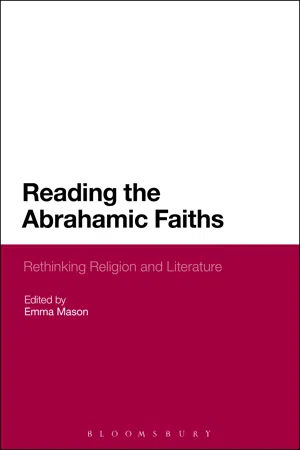
- 288 pages
- English
- ePUB (mobile friendly)
- Available on iOS & Android
eBook - ePub
About this book
Information
Part One
Religion and Literature
1
Rethinking Religion and Literature
University of Warwick
Holy forgiveness! mercy! charity! faith! Holy! Ours! bodies! suffering! magnanimity!
Holy the supernatural extra brilliant intelligent kindness of the soul!
Allen Ginsberg
A spectre is haunting the Western world – the spectre of religion. All over the country we hear that after an extended absence, it has now returned and is among the people of the modern world, and that one would do well to reckon seriously with its renewed presence.
Peter Sloterdijk
I begin with the poet Allen Ginsberg (2006, p. 8, l. 127) and cultural theorist Peter Sloterdijk (2013, p. 1) because both effectively resist a sacralizing of the literary to think religion instead as a way of imagining an experiential and political reading practice. For both, religion is serious and urgent: it should not be fetishized as aesthetics or escapist scenarios of wonder; nor dismissed as naïve simplicity or sinister ideology. Religion is frequently assumed to be the latter in western secularist academia, demystified by Marx, Nietzsche and Freud, and often understood through a history of organized religion as a repressive and dictatorial structure of national and colonial power. Compelling examples to the contrary abound. Mike Davis’s work on slum life, for example, reveals that the impact of Pentecostalism in Third World urban economies has served as much to reinvent a context for political action (‘organizing self-help networks for poor women’, ‘providing recovery from alcoholism and addiction’ and ‘insulating children from the temptations of the street’) as it has to enforce ideological governance (Davis, 2004, p. 33; 2006, pp. 192, 195). Likewise, Richard Kearney’s Guestbook Project has attempted to rethink religion’s potential for hospitable reconciliation between divided communities (Kosovo, Derry/Londonderry, Jerusalem, Bangalore, Dokdo and the Mexican-American border) by inviting young members of opposing neighbourhoods to ‘witness and work through their ongoing histories of hospitality and hostility’ in and through conversation (Kearney, 2008). While they write from diverse viewpoints, Davis and Kearney, as well as Ginsberg and Sloterdijk, are all willing to explore the meanings that arise from the specifics of religious practice in context, favouring a hermeneutics of trust rather than of suspicion (Ricœur, 1970) that defends a reading of the local and particular alongside the global and different.
The wider field of ‘religion and literature’ has not always enabled such trust, alienating readers of all faiths and none by elevating religion as either a privileged way into the literary, or as a bubble within which to magically access ‘truth’. I do not think that religion, practiced or textual, helps us to read ‘better’, and find the characterization of ‘bad’ readers as secular, manic consumers of ideological meaning, and ‘good’ readers as faithful lingering attenders of soul-improving divine books profoundly unhelpful (see Lewis, 1961; Griffiths, 1999). Nor do I believe in conservative models of faith in ‘literature’ or the ‘value of the humanities’, both of which inevitably lead to the veneration of certain texts and discourses over others. My premise here is that in reading sacred texts and engaging with the history of religious thought we are reminded of the importance of emotionally connecting with all beings and texts beyond their aesthetic, historical or economic value. This is not a new argument and echoes the Marxist politics of liberation theology that religion can sharpen our capacity for care and compassion and in doing so, allow for a direct intervention in a world scarred by mass poverty, human inequality and ecological collapse. Other disciplines do this too, of course, but I privilege religion as that which is uniquely willing to license an experience of something unthought – the hopeful unknown – that serves ‘the lowly and despised of the world’ (1 Corinthians, 1.28) over those invested in ambition, exceptionalism and acquisition. I follow Kearney in his argument that because we know ‘virtually nothing about God’, religion frees us into a moment of ‘not-knowing’ that allows for a ‘radical openness to the strange’ (Kearney, 2010, 5). For Kearney this is ‘anatheism’, a creative not-knowing of God that opens a space to imagine the impossible, from the birth of Isaac to the St Andrews Agreement (2006) in Northern Ireland. Religions like the Abrahamic faiths this volume focuses on enable an imagining of the impossible and unknown by offering the reader an affective and non-hierarchizing mode of approach to people and their worlds. This affective way into thinking rejects a search for textual ‘merit’ (aesthetic, intellectual, economic, soul-saving or moral) to encourage a care-full relationship with and reading of all things that goes beyond justifications for such care.
In their poetic, philosophical and social writing, both Ginsberg and Sloterdijk operate this kind of affective thinking, attentively reading and reinterpreting western and eastern religions to call for an embrace of the disenfranchised. Ginsberg’s promotion of mantra chanting to ‘discover the guru in our own hearts’ (2000, p. 130) and Sloterdijk’s call for a ‘non-religious interpretation’ of ‘the realm of the transcendent or holy’ (Sloterdijk, 2009, p. 4), for example, both focus on the reader as a figure who is emotionally ‘changed’, not by religious literature, but by religious reading. Ginsberg’s poetics of peaceful revolution, for example, hailed in part from his reading (and visions) of William Blake, sparked a personal engagement with Judaism, Islam, Christianity, Buddhism and the Hare Krishnas that contextualize both Howl (1955–6) and the 1967 ‘Gathering of the Tribes for a Human Be-In’ (based on the Kumbh Mela Hindu pilgrimage of faith) he helped lead. Sloterdijk also accesses religion’s capacity to enable an intimate reading mode in both his sociological and ‘literary’ works (he describes his current trilogy, Sphären, as a series of novels; Kirsch, 2013), but does so in order to forcefully critique religion and dogma. Despite the nuance of Ginsberg and Sloterdijk’s religious reading, its potential for a radical approach to the world remains unsettling for many critics. Undeterred by the affective turn, the efficacy of care and attention as the basis of reading holds little weight with a literary critical field won over by empirical models of analysis. I intentionally write ‘field’ here to differentiate ‘real’ readers from the ‘discipline’ of literary criticism: human beings are abundantly careful and respectful with texts, and yet broader theorizations of what we do tends to underplay this element of discernment. Franco Moretti’s ‘distant reading’ (2013) is a pertinent example, a methodology that proposes the use of computational modelling and quantitative analysis to aggregate data on vast numbers of literary ‘works’ that are explicitly not read. Moretti cannot help but draw on religious language in his critique of close reading, a mode that, ‘in all of its incarnations’, he writes, becomes a ‘theological exercise’, a ‘very solemn treatment of very few texts taken very seriously’ (Moretti, 2000, p. 57). The essays in this volume do take a few examples of Abrahamic literature seriously, not to exclude other examples or other religions, but to express a care for the nuances of the texts that contributors have read. Moretti’s parody of the theological as solemn and earnest blocks attention to the particulars of any given text, of the nuances of its cultural, religious and ethical meanings and ultimately of the ‘serious’ reflection and emotional investment readers might have in it and redirect back into society as sociability and kindness.
Despite my focus on care and kindness, I do not assume any carefree connection between religion and positive feelings about texts. Rather I uphold a mode of reading in which we might give a little more than we get and in doing so imagine a thinking, rather than criticism of, the interconnectedness of religious ideas, commitments and imaginings through a spectrum of literary forms. The response readers have to all texts, and especially those that relate to religion, is simply not adequately expressed in an abstract, empirical or judgemental criticism. Split from the literary to free float in philosophy, for example, religion can become little more than wordplay, as several of the ‘return of religion’ theories attest; and as ammunition in the arena of politics, religion can be twisted beyond recognition as it was in Sarah Palin’s grotesque declaration that, if she were ‘in charge’, the Muslim world ‘would know that waterboarding is how we baptize terrorists’ (Palin, 2014). Palin’s speech, greeted with ecstatic applause by the National Rifle Association at a 2014 rally in Indiana, not only demeans the Christian sacrament of baptism as an image of forced conversion via torture, but it also incites a terrifying Christo-fascism based on a weak and cruel thinking of Abrahamic religion. Equally aggressive is the ‘new atheism’, repeatedly contemptuous of Christianity and increasingly dismissive of Islam; Richard Dawkins’s tweet ‘All the world’s Muslims have fewer Nobel prizes than Trinity College, Cambridge’ is a notorious example (Meikle, 2013). Dawkins and Palin’s deliberate distancing strategies from any subtlety in reading Islam or Christianity is endlessly echoed in the media, leading to tangible instances of ignorance, intolerance and violence. By contrast, religious reading might provide direct forays into the promotion of care for all texts, humans and non-humans, the planet and the cosmos.
In short, I argue that a thinking of religion enables a compassionate reading of texts to access hopeful unknowns. This has three implications in the context of this volume. First, it authorizes a religious reading that offers an inclusive and politicized alternative to the interdiscipline of religion and literature in its exclusive and inward-facing form; second, that such thinking and reading does not have to equate to religious texts, but rather provides the basis for the interpretation of all texts through a care for the known and unknown; and third, that it spurs an approach distinct from other modes of care and wonder in that its consistent aim, materialized through the particularities of Abrahamic and Dharmic religions, is to aid the poor and powerless (‘science’, for example, which also lays claim to the imagining of the unknown, can, but does not always, direct its gains at the poor). The thinkings of religion that comprise this volume are grouped into four sections, Judaism, Christianity, Islam and Postsecularism, which seek to open up these religions (and ask if Postsecularism should be included as such) to a readership interested in writers who creatively negotiate a world in which people believe with and beyond dogma. The rest of this chapter reflects on the idea of religious thinking and reading in the context of both the on-going ‘religion and literature’ debate; and also in relation to the disputable categories of ‘inter-faith dialogue’ and ‘world religion’ (which, as is apparent in Tony Blair’s dream of a global religious democracy, blend up particularities into an inter-faith soup). Against Blair’s inter-faith soup, one that privileges uniform democracy over the affective specificities of religion, I posit Ginsberg’s ‘animal soup’, a phrase he employs at the end of the first part of Howl to introduce a religious discussion of forgiveness, friendship and love. I conclude with a brief note on Charles Taylor’s attempt to redirect the study of religion and literature back into politics, and suggest that his particular resort to public virtue ends up re-moralizing religion. I find a closer affinity with Sloterdijk, Georg Simmel and Giorgio Agamben, whose commentaries on spiritual practice and ‘forms of life’ have helped me to conceptualize and argue for a religious reading of the world through care.
‘Religion and literature’
Critics who seek to pursue a religious idea in a literary text or assess the literary aesthetic of a religious idea now find themselves in a thriving community served by journals, companions, readers and monograph series (see, for example, Branch, 2012–; Mason and Knight, 2010–; and Monta, 2008–). The field has sparked a renaissance in historical work detailing the contexts in which specific moments of belief are represented; a profusion of critical and philosophical reflections on the nature of the religious and the spiritual; and animated political contestations over the relationship between the secular and the religious, including the term ‘postsecularism’ (controversially apathetic towards many major religions). Whereas the religious was once relegated to the status of esotericism or irrelevance in literary studies, one would be hard pushed to find any period or methodology that does not now recognize its importance, even if such recognition is sometimes negative or critical. At the same time, the ‘return of religion’ within critical theory and philosophy has prompted many critics to once again become suspicious of religion, in particular in relation to transcendence and immanence. Those who work on religion and literature have sought to nuance this dualism through specificity, turning in particular to the monotheistic Abrahamic faiths, connected as they are in their focus on a main sacred text: the Hebrew Bible, the Christian Bible and the Qur’an. ‘World religion’, as Tomoko Masuzawa (2005) argues, tends to be avoided by scholars aware of its invention by Europeans eager to find a category for the social and cultural practices of peoples across the world.
Research into the relationships between Abrahamic and Dharmic faiths nevertheless promises to garner ways of thinking, listening and reading that surpass modes of interpretation locked within one tradition or text. For example, literary discussions of ‘revelation’ tend to be considered within the framework of a monolithic male G...
Table of contents
- Cover
- Series Page
- Title Page
- Contents
- Contributors
- Acknowledgements
- Part One Religion and Literature
- Part Two Judaism
- Part Three Christianity
- Part Four Islam
- Part Five Postsecularism
- Index
- Copyright
Trusted by 375,005 students
Access to over 1.5 million titles for a fair monthly price.
Study more efficiently using our study tools.
Frequently asked questions
Yes, you can cancel anytime from the Subscription tab in your account settings on the Perlego website. Your subscription will stay active until the end of your current billing period. Learn how to cancel your subscription
No, books cannot be downloaded as external files, such as PDFs, for use outside of Perlego. However, you can download books within the Perlego app for offline reading on mobile or tablet. Learn how to download books offline
Perlego offers two plans: Essential and Complete
- Essential is ideal for learners and professionals who enjoy exploring a wide range of subjects. Access the Essential Library with 800,000+ trusted titles and best-sellers across business, personal growth, and the humanities. Includes unlimited reading time and Standard Read Aloud voice.
- Complete: Perfect for advanced learners and researchers needing full, unrestricted access. Unlock 1.5M+ books across hundreds of subjects, including academic and specialized titles. The Complete Plan also includes advanced features like Premium Read Aloud and Research Assistant.
We are an online textbook subscription service, where you can get access to an entire online library for less than the price of a single book per month. With over 1.5 million books across 990+ topics, we’ve got you covered! Learn about our mission
Look out for the read-aloud symbol on your next book to see if you can listen to it. The read-aloud tool reads text aloud for you, highlighting the text as it is being read. You can pause it, speed it up and slow it down. Learn more about Read Aloud
Yes! You can use the Perlego app on both iOS and Android devices to read anytime, anywhere — even offline. Perfect for commutes or when you’re on the go.
Please note we cannot support devices running on iOS 13 and Android 7 or earlier. Learn more about using the app
Please note we cannot support devices running on iOS 13 and Android 7 or earlier. Learn more about using the app
Yes, you can access Reading the Abrahamic Faiths by Emma Mason in PDF and/or ePUB format, as well as other popular books in Letteratura & Teoria della critica letteraria. We have over 1.5 million books available in our catalogue for you to explore.