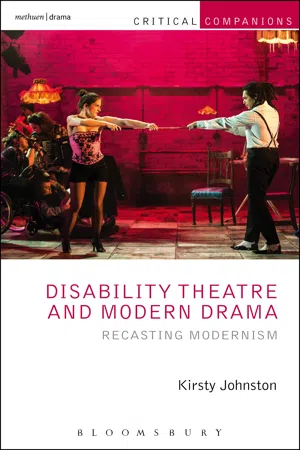
Bertolt Brecht's silent Kattrin in Mother Courage, or the disability performance lessons of his Peachum in The Threepenny Opera; Tennessee Williams' limping Laura Wingfield in The Glass Menagerie and hard-of-hearing Bodey in A Lovely Sunday for Creve Coeur; Samuel Beckett's blind Hamm and his physically disabled parents Nagg and Nell in Endgame – these and many further examples attest to disability's critical place in modern drama. This Companion explores how disability performance studies and theatre practice provoke new debate about the place of disability in these works. The book traces the local and international processes and tensions at play in disability theatre, and offers a critical investigation of the challenges its aesthetics pose to mainstream and traditional practice.
The book's first part surveys disability theatre's primary principles, critical terms, internal debates and key challenges to theatre practice. Examining specific disability theatre productions of modern drama, it also suggests how disability has been re-envisaged and embodied on stage. In the book's second part, leading disability studies scholars and disability theatre practitioners analyse and creatively re-imagine modern drama, demonstrating how disability aesthetics press practitioners and scholars to rethink these works in generative, valuable and timely ways.
- 240 pages
- English
- ePUB (mobile friendly)
- Available on iOS & Android
eBook - ePub
About this book
Information
PART I
CRITICAL SURVEY OF DISABILITY THEATRE AESTHETICS, POLITICS, AND PRACTICES
CHAPTER 1
WHAT IS DISABILITY THEATRE?
The questions concerning disability theatre and modern drama that drive this book emerge in the wake of several decades of Western-based disability activism, disability studies scholarship, and artistic innovation. Disability theatre is one branch of a wider international disability arts and culture movement which seeks to address and redress the very idea of disability in the modern arts and, by extension, society. Undermining stereotypes and stigma on the one hand, and pressing the boundaries of aesthetic convention on the other, disability theatre is thus both activist and artistic in orientation. To make sense of the term disability theatre, we begin here by exploring its place in the disability arts and culture movement, and illustrating some of the ways in which diverse artists have appealed to and created disability theatre practices and aesthetics. Recognizing that words and terminology matter, we conclude the discussion by explaining a series of neologisms which are widely used in disability arts, culture, and studies but which may remain obscure to others. It is best to start, however, by examining the key concept at the heart of this endeavor—disability.
Disability has a long and complex cultural history that raises fundamental questions about identity, definitions of normalcy and the social conditions of everyday life. Although some argue that disability “has existed throughout human history, cutting across time and space,” others would locate its emergence as an idea in western modernity.1 Drawing on Michel Foucault’s lectures about the “abnormal,” Sharon L. Snyder and David T. Mitchell argue that disability’s origins may be found in the eighteenth century when the emergence of a notion of an abnormal body coincided with the development of networks of knowledge and power which classified, measured, and imposed cultural diagnoses on bodies.2 In a related but different vein, Lennard Davis insists that any understanding of the disabled body must take into account the concept of the norm or normal body and he highlights the “rather remarkable fact that that the constellation of words describing this concept—‘normal,’ ‘normalcy,’ ‘normality,’ ‘norm,’ ‘average,’ ‘abnormal’—all entered the European languages rather late in human history … It is possible to date the coming into consciousness in English of an idea of the ‘norm’ over the period 1840–1860.”3 As the idea of a normal person emerged, Davis suggests, degrees of abnormality could also be considered, even measured. With the rise of the eugenics movement in the late nineteenth century, abnormality came to be considered as a sign and cause of wider social dysfunction in which medical science was misdirected “to the designation of pathology as a transmissible characteristic of human biology.”4 This provided the rationale, Snyder and Mitchell contend, for a shift from curative to more coercive and “custodial” practices of a pervasive “diagnostic regime” to discipline disability.5 Pointing to the countless ways in which people are measured and disciplined according to norms from birth to death, Davis demonstrates how the idea of the normal “permeates our contemporary life”; the product of a historical moment, it “is part of a notion of progress, of industrialization, and of ideological consolidation of the power of the bourgeoisie. The implications of the hegemony of normalcy are profound and extend into the very heart of cultural production.”6
While tracing the concept of the normal helps to explain the emergence and evolution of disability as a cultural idea, it is also important to recognize that contemporary activist understandings of disability emerged from a relatively recent period of political struggle and organization. Although one can trace advocacy for particular disability experiences to the early twentieth century through such organizations as institutes for the Blind or organizations for the handicapped, a wider spectrum of disability identity and political interest emerged in western countries in the late 1960s and 1970s. Modeled partly on contemporary civil rights campaigns from which it drew inspiration, a modern disability movement emerged which identified common cause across different disability communities and experiences. In the United States, for example, the independent living movement, founded by Ed Roberts in Berkeley in the early 1970s, argued for the right of persons with disabilities to control the conditions of their own lives and expressed a basic belief that persons with disabilities should wrest control over their circumstances from charities, experts, and institutions. At the national level disability activists argued for the extension of civil rights to persons with disabilities in important pieces of legislation, such as the 1973 Rehabilitation Act in the USA. In the same period, the Union of the Physically Impaired Against Segregation organized in the UK as a strong voice for disability advocacy, lobbying for a new social perspective on impairments as physical conditions which were made disabling by inaccessible environments and exclusionary attitudes and policies.7 Disability activism in this period thus sought to express common cause among different impairment communities and advocate for social and political change.8
In variegated fashion, different governments conceded ground to disability rights advocates—taking their views into consideration in major moments of constitutional evolution in Canada in the early 1980s, for example, and passing legislation to support independent living for persons with disabilities in the UK and USA in the 1990s. Two landmark pieces of legislation, the Americans with Disabilities Act (1990) and the UK’s Disability Discrimination Act (1995), addressed disability at national levels and provided education and employment supports for persons with disabilities.9 Internationally, the United Nations provided a focus for discussions about disability during the International Year of Disabled Persons in 1981 and recognized disability rights through the Convention on the Rights of Persons with Disabilities in 2008.10 While the funding of services for persons with disabilities has been an ongoing battle, legal and diplomatic changes such as these marked a fundamental shift in the cultural and legal articulation of disability.11
As in other civil rights movements, disability activists have focused thoughtfully on society’s language for hailing disabled people, wresting back words from ableist understanding. For example, in Beyond Victims and Villains: Contemporary Drama by Disabled Playwrights, Victoria Ann Lewis explores how the movement and the plays in her collection champion the term “disabled.” She points to the activist work in the 1970s at Berkeley, “when a group of significantly disabled young people, calling themselves the ‘Rolling Quads,’ decided to throw off the invisibility cloak of shame and reclaim the negative term ‘disability’ as a badge of pride and power.”12 Reclaiming the terms “disability” and “disabled,” Lewis argues, against such euphemisms as “differently-abled,” “handi-capable,” or “special,” was a self-conscious strategy: “Disability oppression, advocates argue, will not be erased by a more sensitive etiquette, but rather by a recognition of the social and economic conditions that characterize life lived with a disability.”13 Whether using the term “disabled people” or “people with disabilities,” the word “disability” itself has therefore been remobilized by advocates for its power to reference disabling social and economic conditions, building connections among an otherwise strikingly diverse and vast complement of people through their shared experience of oppression.
Disability activism also left its mark on academic research and gave rise to the field of disability studies. Just as disability activists argued for new ways of understanding disability and impairment experiences, disability studies scholars began to define new ways to conceive of disability as a social and cultural phenomenon. Much of this work developed against what came to be called “the medical model,” an understanding of impairment that “renders disability as a series of physiological, psychological, and functional pathologies originating within the bodies of individuals.”14 Coming from a range of different perspectives, disability studies scholars argued that the medical model problematically treated disability as an individual condition while ignoring the social and cultural context in which it existed. From this critique emerged the highly influential social model, which distinguishes impairment from disability, connecting the former with the individual, private body and the latter with the structural and public body.15 Mike Oliver explains the fundamental difference between these conceptions: “Models are ways of translating ideas into practice and the idea underpinning the individual [or medical] model was that of personal tragedy, while the idea underpinning the social model was that of externally imposed restriction.”16 Like gender, race, and class, disability is thus understood as a social category, one that historian Paul K. Longmore ascribes to “deep-seated, pervasive cultural devaluation and systemic institutionalized discrimination.”17 The recognition among some disability activists of a shared common experience, particularly, as Longmore argues, in the US context, also prompted the development of a minority model of disability.
Signaling the connection to other civil rights campaigns, the minority rights model argued that the social experience of disability led to political action that in turn produced a shared identity. In Disability Theory, Tobin Siebers explains that, “[t]ired of discrimination and claiming disability as a positive identity, people with disabilities insist on the pertinence of disability to the human condition, on the value of disability as a form of diversity, and on the power of disability as a critical concept for thinking about human identity in general.”18 While important distinctions were made between the focus on the social conditions of disablement in the social model and the positive identification of disability identity in the minority rights model, Longmore rightly notes that both “paradigms shift[ed] the focus from individuals and pathologies to institutions and ideologies.”19
After the turn of the century, new questions began to be raised about the usefulness of these social claims about disability from within the field itself. In 2001, for example, Tom Shakespeare and Nicholas Watson provocatively entitled a critical essay “The social model of disability: An outdated ideology?”20 They raised questions about the kinds of dualisms that circulated within the field between disablement and impairment and called for a more critical approach to the meaning of embodiment. Others emphasized the need for a more complex reading of disability identity, rent by other forms of identity, difference, and inequality, as well as culturally and historically diverse embodiments. These critical questions ultimately turned on notions of embodiment and identity, giving rise to a new cultural model of disability.
In Cultural Locations of Disability, David Mitchell and Sharon Snyder note that proponents of the social model have long distinguished “between disability and impairment, arguing that the latter term is a neutral designator of biological difference while the former represents a social process termed ‘disablement.’”21 Seeking to blur this clean distinction between the terms, Snyder and Mitchell align themselves with Sally French, Simi Linton, Susan Wendell, and other scholars who “recognize d...
Table of contents
- Cover
- Half title
- Series Page
- Title Page
- Contents
- Acknowledgments
- Introduction
- Part I: Critical Survey of Disability Theatre Aesthetics, Politics, and Practices
- 1 What is Disability Theatre?
- 2 Critical Embodiment and Casting
- 3 Staging Inclusion
- 4 Inherited Plays and New Approaches
- Part II: Critical Perspectives
- 5 “Every Man his Specialty”: Beckett, Disability, and Dependence
- 6 Reclaiming the Ordinary Extraordinary Body: Or, The Importance of The Glass Menagerie for Literary Disability Studies
- 7 Access Aesthetics and Modern Drama: An Interview with Jenny Sealey on Graeae Theatre Company’s The Threepenny Opera and Blood Wedding
- 8 Shattering the Glass Menagerie
- Notes
- Bibliography
- Notes on Contributors
- Index
- Copyright
Trusted by 375,005 students
Access to over 1.5 million titles for a fair monthly price.
Study more efficiently using our study tools.
Frequently asked questions
Yes, you can cancel anytime from the Subscription tab in your account settings on the Perlego website. Your subscription will stay active until the end of your current billing period. Learn how to cancel your subscription
No, books cannot be downloaded as external files, such as PDFs, for use outside of Perlego. However, you can download books within the Perlego app for offline reading on mobile or tablet. Learn how to download books offline
Perlego offers two plans: Essential and Complete
- Essential is ideal for learners and professionals who enjoy exploring a wide range of subjects. Access the Essential Library with 800,000+ trusted titles and best-sellers across business, personal growth, and the humanities. Includes unlimited reading time and Standard Read Aloud voice.
- Complete: Perfect for advanced learners and researchers needing full, unrestricted access. Unlock 1.5M+ books across hundreds of subjects, including academic and specialized titles. The Complete Plan also includes advanced features like Premium Read Aloud and Research Assistant.
We are an online textbook subscription service, where you can get access to an entire online library for less than the price of a single book per month. With over 1.5 million books across 990+ topics, we’ve got you covered! Learn about our mission
Look out for the read-aloud symbol on your next book to see if you can listen to it. The read-aloud tool reads text aloud for you, highlighting the text as it is being read. You can pause it, speed it up and slow it down. Learn more about Read Aloud
Yes! You can use the Perlego app on both iOS and Android devices to read anytime, anywhere — even offline. Perfect for commutes or when you’re on the go.
Please note we cannot support devices running on iOS 13 and Android 7 or earlier. Learn more about using the app
Please note we cannot support devices running on iOS 13 and Android 7 or earlier. Learn more about using the app
Yes, you can access Disability Theatre and Modern Drama by Kirsty Johnston in PDF and/or ePUB format, as well as other popular books in Media & Performing Arts & Theatre History & Criticism. We have over 1.5 million books available in our catalogue for you to explore.