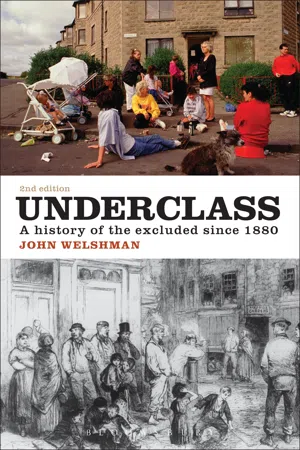
Who are those at the bottom of society? There has been much discussion in recent years, on both Left and Right, about the existence of an alleged 'underclass' in both Britain and the USA. It has been claimed this group lives outside the mainstream of society, is characterised by crime, suffers from long-term unemployment and single parenthood, and is alienated from its core values.
John Welshman shows that there have always been concerns about an 'underclass', whether constructed as the 'social residuum' of the 1880s, the 'problem family' of the 1950s or the 'cycle of deprivation' of the 1970s. There are marked differences between these concepts, but also striking continuities. Indeed a concern with an 'underclass' has in many ways existed as long as an interest in poverty itself. This book is the first to look systematically at the question, providing new insights into contemporary debates about behaviour, poverty and welfare reform.
This new edition of the pioneering text has been updated throughout and includes brand new chapters on 'Problem Families' and New Labour as well as 'Troubled Families' and the Coalition Government. It is a seminal work for anyone interested in the social history of Britain and the Welfare State.
- 288 pages
- English
- ePUB (mobile friendly)
- Available on iOS & Android
eBook - ePub
About this book
Information
1
Regulating the residuum
The period 1880–1914 was an age of classic social investigation, with such well-known figures as Charles Booth and Benjamin Seebohm Rowntree. Less commented on, perhaps, is the existence of a parallel concern with an underclass or social residuum. This is partly because early historians tended to concentrate on those elements of policy, such as old age pensions, free school meals, and unemployment insurance, that appeared to prefigure the welfare state of the 1940s.1 They assumed that the approach to social policy before 1914 was overwhelmingly empirical, and neglected its wider ideological context. With some important exceptions, it is only more recently that historians have begun to look closely at the moral assumptions that often lay behind policy. The focus has shifted towards those other, more illiberal, elements. They include such issues as proposals for labour colonies, policy in the field of mental deficiency, eugenics, and plans for the sterilization and segregation of ‘defectives’. In part, this reflects the decline of the classic welfare state, and wider changes in attitudes towards the relative roles of the statutory, private, and voluntary sectors.
David Ward’s work indicates that, in the United States in this period, there was a similar preoccupation with the size and situation of the lowest stratum of urban society. Many housing reformers believed that there was a stratum of the poor, a ‘submerged residuum’, that would not respond to improved housing. For this reason, they recommended municipal lodging houses. This debate was refined following the publication of Booth’s work on London. Ward claims that by 1900, reformers had modified their view of the slum to incorporate the social isolation and environmental deprivation of the poor. Thus there was then a more sustained attempt to improve the social environment, and to ensure social justice.2 Interestingly, in the United States, Booth’s structural interpretation was more influential than his behavioural analysis. The American case was different to the British context, in that the situation of the immigrant poor was more prominent. Nevertheless the experience of the United States would in turn have an important influence on British debates – especially with regard to the culture of poverty in the 1960s, and the underclass of the 1980s.
Here, we look again at the phenomenon of the social residuum in the period 1880–1914 in the light of various arguments that have been put forward by historians. The impact of his social surveys meant that Charles Booth was arguably the most influential writer on the social residuum in the 1880s. But it was a theme that also appeared in other contemporary writing, including that by H. M. Hyndman, secretary of the Social Democratic Federation; Samuel A. Barnett, Warden of the East London settlement of Toynbee Hall; the founder of the Salvation Army, William Booth; and by Helen Bosanquet. More generally, the term ‘residuum’ can be found in a wide range of Parliamentary papers. These include the reports and evidence of the Royal Commission on Housing (1885); the Select Committees on Distress from Want of Employment (1894–96); the Interdepartmental Committee on Physical Deterioration (1904); the Royal Commission on the Care and Control of the Feeble Minded (1904–08); and the Royal Commission on the Poor Laws (1905–09).
In this chapter, we look first at the way that historians have interpreted the sudden interest in the residuum in the 1880s. Second, we explore the longer term history of the theme of the undeserving poor, as expressed by writers as diverse as Thomas More and Thomas Malthus, and also at related ideas such as the Marxist concept of the lumpenproletariat, and the contemporary concern with the dangerous classes. We then turn to look in more detail at how the concept of the social residuum was used in the 1880s, by Charles Booth, Helen Bosanquet, and a wide range of other writers. In subsequent chapters we will seek to examine how the social residuum remained an important influence on later concepts, most obviously in the case of the unemployable in the early 1900s, and the social problem group in the 1930s. Overall, we are concerned with how the notion of the social residuum has influenced successive re-inventions of the underclass since the 1880s.
Although the theme of the undeserving poor has a long history, it appears nevertheless that in the 1880s the idea re-emerged with particular force, through the concept of the social residuum. Gareth Stedman Jones represents an important exception to the general rule that historians have tended to focus on liberal rather than illiberal social policies. In Outcast London (1971), Stedman Jones provided a powerful analysis of perceptions of the residuum in the 1880s and 1890s. Whereas contemporary observers drew comforting pictures of London in the 1870s, by the following decade it was thought that the residuum formed a significant proportion of the working class. Stedman Jones has argued that the concept of the residuum was central to the crisis of the 1880s, and was present in the thinking of every group, from the Charity Organisation Society (COS) to the Social Democratic Federation. It was dangerous, not only ‘because of its degenerate nature, but also because its very existence served to contaminate the classes immediately above it’.3 The fear was that if this situation continued, the residuum would in time contaminate and subsume the respectable working class. Although the New Liberals wooed the respectable working class, they also advocated a more coercive and interventionist policy towards the residuum, which was too great a threat to be left to natural forces and to the Poor Law. Thus both Samuel Barnett and Alfred Marshall advocated labour colonies – Marshall in response to the housing crisis, and Barnett as a solution to unemployment.4 Stedman Jones argued that the subjective psychological defects of individuals featured larger than before. The problem was not structural, but moral, and the evil to be combated was not poverty but pauperism.5 Stedman Jones has argued that new theories of ‘degeneration’ influenced the debate and served to switch the focus from the moral inadequacies of the individual, to the effects of the urban environment. This let middle-class people see poverty as the endemic condition of large masses of the population, rather than the product of exceptional improvidence or misfortune on the part of individuals. Even so, the distinction between the deserving and undeserving poor remained, and was simply recast in new language borrowed from Charles Darwin.
Stedman Jones suggested that the dock strike of 1889 marked a crucial turning point, since its effect was to establish, in the eyes of the middle class, a clear distinction between the respectable working class and the residuum. After the strike, the residuum was regarded as a much less serious problem – a ‘nuisance to administrators rather than a threat to civilisation’.6 Stedman Jones suggested that this new distinction was amplified by the writings of Charles Booth, since Booth divided the residuum into two classes. He claimed that there was a consensus among experts that it was desirable to segregate and eliminate the residuum, but also conceded that none of these proposals passed into legislation. Moreover, Stedman Jones argued that the advent of full employment during World War I showed that the residuum had been a social rather than a biological creation. Their lifestyle had not been the effect of some hereditary taint, but the results of poor housing, inadequate wages, and irregular work. Once employment opportunities became more widely available, those previously deemed unemployable could not be found.7 In fact, concluded Stedman Jones, ‘they had never existed, except as a phantom army called up by late Victorian and Edwardian social science to legitimise its practice’.8
In an analysis of Booth’s contribution to social theory, Peter Hennock has argued that the Stedman Jones interpretation needs to be modified. In particular, he has claimed that there are important elements of continuity with the 1860s that make it difficult to regard the 1880s as a period of significant theoretical innovation. Whereas Stedman Jones stressed that writers in the 1880s took a new line in separating the residuum and the respectable working class, Hennock pointed out that these issues had been debated before, in the Reform Bills of 1866–67. He suggested that the connections between the ideas of the 1860s and 1880s are too close to be ignored.9
Jose Harris noted that the residuum has been identified as a key concept in Victorian social science, and a component in the shift from the rationalistic hedonism of the New Poor Law to the ‘Social Darwinism’ of the age of imperialism. Its emergence has been located in the 1880s. However, Harris argued that the term was used in many different ways, and a demarcation between the respectable and degenerate poor long pre-dated the 1880s. The debates of the 1880s showed continuity with this earlier era in that they were partly fuelled by fears that the residuum would be given the vote. She characterized the 1880s as an era both of economic crisis and of popular democracy.10 Moreover, theories of the residuum had other sources in political and social thought, apart from the application of Darwinism. They were fuelled as much by issues to do with extending the suffrage to the working class, as with biological degeneracy. Finally Harris argued that in Britain at least, there is little evidence that those who used the term ‘residuum’ necessarily had any wider commitment to a framework of ‘natural selection’ or ‘hereditary degeneration’.11 Harris concluded therefore that the residuum issue of the 1880s and 1890s was as much a political as a sociological phenomenon, and ‘at least as much an expression of certain ancient moral and constitutional ideas as of new-fangled notions of science and social evolution’.12 The debate about social reform in the 1880s and 1890s was influenced by evolutionary language, but this should be seen as ‘emblematic verbiage rather than precise social science’.13 It was invoked by many different commentators, and did not preclude support for draconian social policies. In fact, the only area of policy where a ‘Darwinian’ model took hold was in the treatment of mental deficiency.
This secondary literature has been illuminating on the debate about the residuum in the 1880s. However, it has weaknesses in two respects. First, it tends to concentrate on Booth and neglect the many other commentators who wrote on the residuum in this period. Second, while good on the 1880s, it is much weaker on the period after 1900, and on continuities between the concerns about the residuum and related debates about the unemployable. Marc Brodie’s study of the political and social attitudes of the poor of Victorian and Edwardian London underlined the importance of assessment of individual, personal, and moral character in working-class political judgements.14 Nevertheless while questioning the extent of poverty in the East End, Brodie does not deal directly with the concept of the residuum.
It is important to recognize that underclass stereotypes have always been part of discussions of poverty, and certainly pre-dated the upsurge of interest in the social residuum of the 1880s. In Britain, the broad idea of an underclass dates back at least as far as the seventeenth-century Poor Law, with its concerns about vagrancy, and desire to distinguish between deserving and undeserving claimants. The 1598 Poor Law Act stated that parents and children should maintain poor people, that children should be set to work, and also reflected concerns about public order. Similar anxieties were expressed by contemporary writers. Thomas More’s Utopia, for example, published in 1516, reveals a contemporary concern with the ‘lusty beggar’ that echoes much more recent debates about single parents.15
Similar concerns were evident in the late eighteenth century, when moral judgements were based on the labour-market relevance of different claimants. The period 1790–1834 saw important changes in poor relief, and it was argued that these had led to the ‘demoralisation’ of the poor. One such writer was Thomas Malthus (1766–1834). In his ‘Essay on the Principle of Population’, published in 1798, Malthus argued that the Poor Laws had not helped deal with distress even with an expenditure of £3m. In his view, it had increased the population without increasing the amount of food available for its support. Moreover the provisions consumed in the workhouse reduced the amount for the ‘more industrious and more worthy members’. Parish laws had increased the price of provisions and lowered the real price of labour. Malthus wrote:
It is also difficult to suppose that they have not powerfully contributed to generate that carelessness and want of frugality observable among the poor, so contrary to the disposition frequently to be remarked among petty tradesmen and small farmers. The labouring poor, to use a vulgar expression, seem always to live from hand to mouth. Their present wants employ their whole attention, and they seldom think of the future. Even when they have an opportunity of saving they seldom exercise it, but all that is beyond their present necessities, goes, generally speaking, to the ale-house.16
Malthus argued therefore, that the Poor Laws diminished the will to save, and weakened incentives to sobriety, industry, and happiness. As we shall see, many aspects of his interpretation – the effects of welfare on behaviour; the alleged focus of the poor on the present; their failure to make adequate preparation for the future; and their tendency to spend money on enjoyment rather than saving – were to be echoed by much more recent commentators.
It was a theme that was picked up by other writers. In 1798, for example, Jeremy Bentham, in his Outline of a Work Entitled Pauper Management Improvement, emphasized the defective ‘moral sanity’ of the dependent poor, their economic unproductiveness, and the gulf between them and the ordinary working class.17 Similar anxieties underlay the 1834 Poor Law Amendment Act, which removed subsidies on low wages and created workhouses. The principle of ‘less eligibility’ was adopted, and it was believed that the bulk of social evils were to be found among the poor. As Bill Jordan has written:
The real enemy was still seen as the moral depravity of the poorest class, and the real solution as a system of relief which dealt with this depravity and confined it as narrowly as possible to this near-incorrigible group, thus saving the much larger poor but industrious class from contamination.18
Although the Poor Law Amendment Act of 1834 appeared to make no distinction between different grades of the able-bodied poor, this lack of discrimination was never completely acceptable to popular opinion.
There were signs of similar anxieties in the 1860s. Henry Mayhew had drawn on related ideas, although he did not actually use the phrase ‘residuum’.19 Jennifer Davis has suggested that the garrotting panic of 1862 in London led to a moral panic – one of those periods when public anxieties, especially as expressed by newspapers and the government, served to ‘amplify deviance’ and promote new measures for its control. Following the Habitual Criminals Act of 1869, a particular group of law-breakers were defined as distinct from the rest of the population – a ‘criminal class’ – which was useful in justifying the creation of a police force and its extension into working-class areas.20 A further influence came across the Channel, from France. Here the writings of Balzac and Victor Hugo, along with bourgeois opinion, had helped to create the notion of the dangerous class. Bourgeois opinion was concerned about where the dangerous class was recruited from, whether it had similar characteristics to the labouring classes, and whether both groups were governed by similar imperatives.21 Ideas about a dangerous class drew support from contemporary beliefs about the physionomy of c...
Table of contents
- Cover-Page
- Half-Title
- Title
- Contents
- Acknowledgments
- Introduction
- 1 Regulating the residuum
- 2 A Trojan Horse: The concept of the unemployable
- 3 In search of the social problem group
- 4 The invention of the problem family
- 5 Chasing the culture of poverty
- 6 Sir Keith Joseph and the cycle of deprivation
- 7 Uncovering the underclass – America
- 8 Uncovering the underclass – Britain
- 9 Social exclusion and the Labour Governments
- 10 Troubled families and the Coalition Government
- Conclusion
- Notes
- Select Bibliography
- Index
- Copyright
Trusted by 375,005 students
Access to over 1.5 million titles for a fair monthly price.
Study more efficiently using our study tools.
Frequently asked questions
Yes, you can cancel anytime from the Subscription tab in your account settings on the Perlego website. Your subscription will stay active until the end of your current billing period. Learn how to cancel your subscription
No, books cannot be downloaded as external files, such as PDFs, for use outside of Perlego. However, you can download books within the Perlego app for offline reading on mobile or tablet. Learn how to download books offline
Perlego offers two plans: Essential and Complete
- Essential is ideal for learners and professionals who enjoy exploring a wide range of subjects. Access the Essential Library with 800,000+ trusted titles and best-sellers across business, personal growth, and the humanities. Includes unlimited reading time and Standard Read Aloud voice.
- Complete: Perfect for advanced learners and researchers needing full, unrestricted access. Unlock 1.5M+ books across hundreds of subjects, including academic and specialized titles. The Complete Plan also includes advanced features like Premium Read Aloud and Research Assistant.
We are an online textbook subscription service, where you can get access to an entire online library for less than the price of a single book per month. With over 1.5 million books across 990+ topics, we’ve got you covered! Learn about our mission
Look out for the read-aloud symbol on your next book to see if you can listen to it. The read-aloud tool reads text aloud for you, highlighting the text as it is being read. You can pause it, speed it up and slow it down. Learn more about Read Aloud
Yes! You can use the Perlego app on both iOS and Android devices to read anytime, anywhere — even offline. Perfect for commutes or when you’re on the go.
Please note we cannot support devices running on iOS 13 and Android 7 or earlier. Learn more about using the app
Please note we cannot support devices running on iOS 13 and Android 7 or earlier. Learn more about using the app
Yes, you can access Underclass by John Welshman in PDF and/or ePUB format, as well as other popular books in History & 20th Century History. We have over 1.5 million books available in our catalogue for you to explore.