eBook - ePub
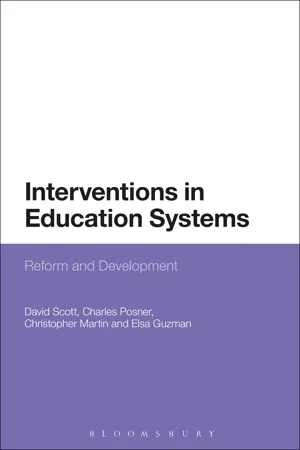
Interventions in Education Systems
Reform and Development
- 208 pages
- English
- ePUB (mobile friendly)
- Available on iOS & Android
eBook - ePub
Interventions in Education Systems
Reform and Development
About this book
Interventions in Education Systems draws on research conducted in England, Mexico, Singapore and Finland to illuminate reform processes to education systems in a range of contexts, to develop a better understanding of intervention processes and to promote the development of more sophisticated models for reforming education systems. The authors compare policy implementations and interventions in countries with different socio-economic profiles and different levels of development, highlighting how these processes in practice all too frequently are side-tracked and distorted, often unintentionally, by political, economic and social forces.
Information
1
Implementation Myopia
Following the end of World War II, the need for economic reconstruction in Europe and the requirements of national liberation movements in Africa and Asia encouraged the view that education was a key component of national development and nation building. Not only was the ethos one that lent itself readily to notions of human capital theory, but academia, schooled in its common sense assumptions, was also drafted in to provide better systems of curriculum, pedagogy and evaluation. This was accomplished through the development of new programmes and policies fostered by official institutions, designed to achieve those ends. From that time we see a proliferation of national, multinational and international bodies dedicated to providing the research that was required to develop relevant policies and programmes. However, the process of implementation, or, in the eyes of the architects of the new education, the lack of implementation, was a very serious problem.
As long ago as 1988 George Psacharopoulos (1988) writing about East Africa bemoaned the failure of a number of policy initiatives ranging from combining education and production at the primary level to the financing of higher education. He wrote that they had been barely, or emphatically not, implemented. He suggested that the reasons for non-implementation included a poor statement of aims, poorly worked out financial implications and an ‘empirically unsustainable theoretical relationship between instruments and outcomes’ (ibid.: 46). He pleaded for the formulation of ‘more concrete, feasible and implementable policies based on documented cause-effect relationships’ (ibid.).
Two years later Seymour Sarason (1990) in The Predictable Failure of Educational Reform, focusing largely on education in the United States, argued that schools were intractable to change and unable to attain their designated goals. The reason for this, he maintained, was the inability of reformers to confront the reasons for this intractability and a failure to learn from the past. The Centre for Research on Education, Diversity and Excellence (Datnow et al. 1998) lamented that it was the underpinning framework behind the top-down approach to education that was responsible for programmes not being implemented. Implementation, it argued, required an interactive or co-responsible model. Morris and Scott (2003), reflecting on attempts to reform education in Hong Kong, noted the same failure and argued that reforms designed to improve the quality of schooling had been more rhetorical than real in their impact on the organization of schools and classrooms.
These are just a few examples drawn from the literature of what Ivor Goodson (2007: 1) labelled ‘implementationist myopia’. He and other observers maintain that in all the cases described above the policy to be implemented is assumed to be unproblematic. However, the process of constructing the policy is restricted to the experts, and it does not involve those who will be affected by it. Those who are responsible for its introduction and maintenance in the classroom were denied participation in the process. Hence, when it became impossible, for whatever reason, to put the policy into practice, the problem according to its originators was due to the recalcitrance of the teachers and their schools rather than the central authorities being insufficiently mindful of the process of implementation itself.
What these varied criticisms have in common is the fact that little attention is paid to the process as opposed to the problem of implementation. If this was purely an academic issue, the more than 30 years of debate about the question might just be tolerable, but given that we are concerned with how to develop and put into practice educational policies to improve the life chances of pupils, the continued reliance on processes that exclude implementation is not only worrying but also positively disempowering, in the sense that it damages the recipients and can inure them to further policy changes.
As the Canadian Council on Learning (2011: 56) has recently declared:
The implementation of large-scale school reforms often takes time, is met with resistance or controversy, and faces systemic barriers. Educational change is a slow process that requires adequate time and resources, but decision-makers often wish to see rapid results. Educational reform efforts have typically moved through pendulum-like cycles, swinging back and forth between different ideologies. As a result, critics have argued that reforms are based on educational trends rather than evidence, are implemented too hastily, and are without effective assessment systems. As well, reform attempts are often criticised for excluding teachers from the decision-making process.
This can also be taken as a description of the problems being encountered by one such organization with enormous influence in the educational world and especially in poorer countries desperate to increase their cultural capital. Here we meet the international organization that over recent years has been at the forefront of the development of educational policies and reforms, the OECD. We will encounter the OECD at many points in the following pages of this book. For the moment we wish only to point out the problems it has had to confront and its attitude towards implementation.
In 2007 a team from the University of London was commissioned by the OECD to work closely with the Ministry of Education, in Mexico (SEP) to produce a report, which was eventually called A Review of the Mexican School System in the light of PISA 20061 (Hopkins and Posner 2007). As part of the conclusions to the report, a list of recommendations was produced, many of which focused on the need to improve the implementation of reforms, projects and programmes, and, in the light of the findings, avoid the top-down approach referred to above. The response of the OECD was that no report under its name should make recommendations. The Undersecretary for Education in Mexico did not agree and to the fury of the OECD the Minister published the recommendations. Indeed, the Mexican government went further, commissioning the University of London to assemble a team to help them develop one of the key recommendations, the production of curriculum standards for basic education, and later they extended the brief to cover implementation issues. To this end the university team was asked to suggest a set of guidelines for implementation that could then be modified and amended by their Mexican counterparts, and put into effect. The implementation project was never carried out, meaning that it joined a host of earlier attempts at reform in the educational graveyard.
Indeed, in a very recent OECD blog, there is barely a word about the process of implementation itself. Behind it lies the unarticulated supposition that the mechanisms, the proverbial usual channels, exist for successfully, reliably and sustainably introducing reforms. There is not a hint that the usual channels could well play a major part in sabotaging the reforms. The assumption is that if one gathers together a coherent and expert team tasked with developing a reform all that remains is for the usual channels to be activated. The model comprises a linear, unidirectional (top-down), mechanical and supposedly rational process. All that is required is that key agencies and agents take the required actions. The concept of co-construction mentioned above never enters the picture although the OECD, as we will see, continuously pays lip service to a ‘down-up’ approach. It is surprising that no one ever suggested that the main problem could be the assumption made about the usual channels for reforming education systems (i.e. the state and its agencies and agents) and, for that matter, about how they function.
There is a growing awareness of the seriousness of this problem. In a recent inaugural presentation the current Undersecretary of State for Basic Education in Mexico (Alba Martínez Olivé, 3 May 2013, Undersecretariat Conference) made a seemingly obvious but often forgotten point. She drew a pyramid, the upper part of which was the new reforms and the base was the minimum operational conditions for schools to function as learning centres. She said that without such a solid base reforms would be unworkable. Among the key elements of this base were properly nourished children, trained teachers, basic infrastructure and materials, as well as appropriate conditions of work.
The operational conditions receive far less attention than the other elements from governments and international agencies. Perhaps this is because they touch on the more intangible practices of teachers and their superiors as well as those of communities. But no amount of texts, well-trained teachers and healthy children will generate learning, unless the basic operational procedures, such as punctuality, goal orientation, respect among the stakeholders, and reasonable and coherent demands on teachers are in place. In the effective school literature all of these come under the heading of school ethos (e.g. Sammons and Bakkum 2011), which, though difficult to define, is fundamental for school success and the key to the acceptance of and commitment to reform.
The Mexican Undersecretary of State suggested that one of the principal problems in the functioning of schools was the paradoxical combination of excessive and contradictory demands on them along with the virtual abandonment of the teachers by the authorities, both centrally and in the states. The same is true in many developing and developed countries throughout the world. If the operational conditions of the school are important so is the wider context, and here too there is a tendency to consider that if the technical aspects of policy are based on sound research and practice, they can be rolled out in an uncomplicated way to produce educational improvements. Once again, this view is misguided in that it pays little attention to the social context and gives the prime role to the state.
For these reasons we need to explore the argument that understanding the discursive and institutional structures in which reforms are embedded and the social responses at all levels to such education reforms can help us better comprehend the chances of implementation success. It is not that policies are unimportant, and indeed the type of intervention that is proposed has an influence on how it can be implemented, but we also need to study, improve and adapt them to the settings in which we would like to see them working. But like our Undersecretary’s pyramid, they cannot work unless we dedicate more effort to understanding context and circumstance. Our purpose here is to highlight these few examples, and we could have easily presented many more, in order to demonstrate that, after three decades of expanding activities, both national and international agencies have not only failed to respond to the points and questions raised about implementation, but have even signally failed to undertake comparative work to locate the reasons for this continued and continuous failure. How is it possible that so much money and human resources have been dedicated in developing educational policies, programmes and reforms when the process of implementation receives so little attention and no attempt has been made to develop adequate models for interventions?
Presentation of the problem
Our immediate purpose is to underline the importance of, and the urgency for, in-depth consideration of how to move from proposal to practice. Our intention is to explore the nature and ramifications of this immense practical and theoretical problem. One hopes that our discussion here can lead to a better understanding of the relationship between systems of social apprenticeship (the term developed by Émile Durkheim [1895] (1982), meaning not only learning a specific text but also the rules for the appropriation of knowledge) and societies, thereby opening up the possibility for a more viable and reliable process of implementation. We are conscious of the fact that one cannot be too critical in a negative sense. It is important to recognize the labour of practitioners and researchers working in this area and absorb their experiences without forgetting that the objects of their study, national systems of education, are no more than 150 years old and most are still in their infancy.
Behind the need to identify causes lurks the important theoretical problem that has bedevilled the social sciences and its attempts to describe and explain the relationship between systems and practices of social apprenticeship and the social entities that develop them. Hence, what guides our presentation of the country cases in the following chapters is the need to consider how educational change and by extension innovation and social ambiance are related to each other, remembering that theoretical inquiry has to be contextualized by the practical concern of developing a coherent strategy. In the following sections of this chapter we will describe this problem in more depth, and we will look at how it has been dealt with by both those who devise reform programmes and those who reflect on the contextualization of these programmes and the processes of their implementation.
In summary, we contend that our judgement of the quality of proposals and programmes for educational reforms depends on more than the supposed excellence of these proposed changes, their coherence and their technical robustness. It also hinges on successful enactment and application. What counts, perhaps even more than the production of a programme that can potentially solve the problems it is confronted with, is how and to what extent these proposals are implemented. Concretely, we must ask how well does a proposed reform work within school-level learning conditions, including those experienced by teachers, parents and pupils, and even more so, how well does it deal with the educational apparatus governing these schools. Unfortunately, as we will see, implementation of even the best proposals is far from guaranteed.
Epistemological bases
It is clear that our speculation about the failure to carry projects through to their implementation needs to concentrate on examining the body responsible for administering the range of institutions that govern all aspects of life in modern societies, the state and its relations to what is now called civil society. That is, we need to examine carefully the organizations responsible for drawing up education reforms and to delineate with circumspection their role in the difficulties encountered in moving from the initial articulation of reforms to their implementation. That is why our starting point must be to look at the state, the collection of institutions responsible for administering key aspects of life in modern societies, and equivalent international bodies, and how they come to be almost universally, and perhaps unthinkingly, assumed to be, and accepted as, neutral sites capable of such activities.
In the literature we find almost no dissent to the idea of the state being a site of power (cf. Durkheim [1895] (1982); and Weber [1905] (2002)). Both functional and conflict models of the state make this assumption, leaving little room for other ways of thinking. In our everyday lives and in our roles as educationalists we are so accustomed to the state being seen as a benign and useful set of institutions negotiating compromises for the good of society, that it is sometimes forgotten that the modern state is a direct result of the growing complexity of the social division of labour that hallmarked the urban and industrial revolutions and is thus a relatively recent phenomenon.
The vast array of administrative and bureaucratic arrangements that first developed in European and Anglo-Saxon countries has little antiquity. With the advent of the democratization of representative organizations, of state systems of education, social security and the defence of human rights, it was naturally assumed that these institutions acted dispassionately. That the state fulfilled such a role became the received wisdom, encapsulated as it was in the writings of academics and researchers dedicated to human capital theory and other expansionary views of the role of education. State education is a product of the nineteenth century and the perceived need for social homogeneity, learning within a controlled environment and forms of learning that fit with the workforce needs of the new social order. Its more direct relation to economic and social development and involvement with increases in economic productivity occurred only in the middle of the twentieth century.
In order to understand how it is that the state is seen as historically transcendent we need to revisit the ideas of those who first dealt with the problem of the rise of the modern state. Confusion about the role of the state is lodged in the ideas of the founding fathers of the theory and applications of the social sciences – Émile Durkheim [1895] (1982), Max Weber [1905] (2002), the English Pragmatists (e.g., Herbert Spencer [1842] (1993)) and the Marxists (e.g., Friedrich Engels [1845] (1975)). They shared a common view of the state. For Émile Durkheim [1895] (1982) the role of the state through the provision of education was designed to hasten the development of a society based on the principles of mechanical solidarity and natural cooperation and the demise of organic solidarity that blocked the progressive and positivistic development of the natural forces of the division of labour. This might strike us as naïve today but one should not forget that national systems of education grew up during Durkheim’s life time, as did the changes in the mode of production leading to an industrial and urban society that seemed to offer the possibility of greater cooperation based upon shared values and a new moral order. Properly developed education systems were thought of as the instrument to develop the new co-operative society that Durkheim favoured and thought was inevitable.
For Max Weber [1905] (2002), the state apparatus of the newly found German Empire with its Prussian overtones was a guarantor of social order, and its role was to prevent those opposed to the present order of society, the Social Democrats as they were then, from upsetting the status quo that had led to the unification of Germany as a single state and economic powerhouse. Weber could easily support the extension of state control into areas such as the provision of social insurance, social security and the setting up and running of educational institutions, because these institutions made concessions to the working classes that ma...
Table of contents
- Cover-Page
- Half-Title
- Series
- Title
- Contents
- Acknowledgements
- Introduction: Education Reforms
- 1 Implementation Myopia
- 2 Internal Changes and the Workings of Education Systems
- 3 A History of International Organizations in Education
- 4 Corporative Change in Mexico
- 5 Experiments and Interventions in the English Education System
- 6 Statism and the Singapore Model
- 7 Finland’s Educational Revolution
- Conclusions: How Education Systems Work
- Notes
- References
- Author Index
- Subject Index
- Copyright
Trusted by 375,005 students
Access to over 1.5 million titles for a fair monthly price.
Study more efficiently using our study tools.
Frequently asked questions
Yes, you can cancel anytime from the Subscription tab in your account settings on the Perlego website. Your subscription will stay active until the end of your current billing period. Learn how to cancel your subscription
No, books cannot be downloaded as external files, such as PDFs, for use outside of Perlego. However, you can download books within the Perlego app for offline reading on mobile or tablet. Learn how to download books offline
Perlego offers two plans: Essential and Complete
- Essential is ideal for learners and professionals who enjoy exploring a wide range of subjects. Access the Essential Library with 800,000+ trusted titles and best-sellers across business, personal growth, and the humanities. Includes unlimited reading time and Standard Read Aloud voice.
- Complete: Perfect for advanced learners and researchers needing full, unrestricted access. Unlock 1.5M+ books across hundreds of subjects, including academic and specialized titles. The Complete Plan also includes advanced features like Premium Read Aloud and Research Assistant.
We are an online textbook subscription service, where you can get access to an entire online library for less than the price of a single book per month. With over 1.5 million books across 990+ topics, we’ve got you covered! Learn about our mission
Look out for the read-aloud symbol on your next book to see if you can listen to it. The read-aloud tool reads text aloud for you, highlighting the text as it is being read. You can pause it, speed it up and slow it down. Learn more about Read Aloud
Yes! You can use the Perlego app on both iOS and Android devices to read anytime, anywhere — even offline. Perfect for commutes or when you’re on the go.
Please note we cannot support devices running on iOS 13 and Android 7 or earlier. Learn more about using the app
Please note we cannot support devices running on iOS 13 and Android 7 or earlier. Learn more about using the app
Yes, you can access Interventions in Education Systems by David Scott,C. M. Posner,Christopher Martin,Elsa Guzman in PDF and/or ePUB format, as well as other popular books in Education & Educational Policy. We have over 1.5 million books available in our catalogue for you to explore.