As an actor, awareness of your movement is the key to transformation. By making deliberate physical choices, you can fully and articulately embody different ways of being: you can become someone or something else. Laban's Efforts give you a way of identifying and making these choices. Working with them helps the actor to create wholly present and physically ambitious performances.
This book outlines Ewan's practical process, which allows the actor to understand their own movement and that of others by exploring one key part of Laban's work: the 'Efforts of Action Drive'.
This complete, stage-by-stage, working process has been developed through more than thirty years of work with actors in the studio. Clear instructions for practical exercises are woven throughout the book, as well as exciting ways to apply the work in rehearsal, performance and on set. This allows the actor to learn and apply Laban's Efforts for themselves. Full video and audio resources allow the reader to experience the practical work in action.
eBook - ePub
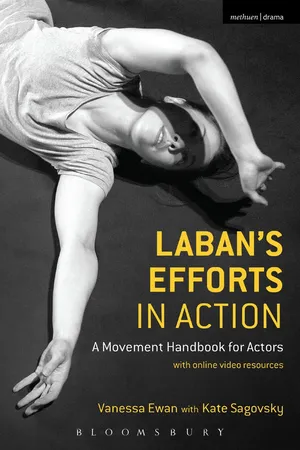
Laban's Efforts in Action
A Movement Handbook for Actors with Online Video Resources
- 304 pages
- English
- ePUB (mobile friendly)
- Available on iOS & Android
eBook - ePub
Laban's Efforts in Action
A Movement Handbook for Actors with Online Video Resources
About this book
Information
CHAPTER 1
MOVEMENT AND THE ACTOR
Movement is a common word, so it is easy to assume that we all know what it means. Yet pinpointing its meaning and articulating its relationship to the actor’s craft is complex. A shared understanding of some of the key concepts which underpin this work is vital for grasping its true meaning and potential. So interrogating the concepts of ‘movement’, ‘effort’, and ‘action’ is the place to start.
WHAT IS MOVEMENT?
//Everything moves; movement is expression
Movement is ‘the basic experience of existence’.1 Who we are, how we are and what we want is all felt through the body moment by moment. As it is felt, we move and it is expressed. Movement is such a vital part of expression that it could be argued movement is expression. We most often think of the verbal as different to the physical. Yet all words spring from the movements of breath and body. Words are only one part of human expression, all of which depends on movement as a vehicle. Even thoughts and feelings have their own ‘rhythm’: a certain sensation which is physical and which we refer to as the ‘movement’ of our thoughts and feelings.
//The body speaks silently as clearly as it does with words
We often assume words are our most active and effective way of expressing ourselves. Yet we actually communicate far more with our bodies, and even the relationship between our physicality and our words has meaning. Sometimes our body says the same thing as our words, and sometimes it contradicts them. Sometimes we may choose not to speak using words, but our body is broadcasting what we think or feel just as clearly as if we had spoken audibly. The body is always communicating, whether we want it to or not. The body will speak and if it is not guided it will not say what the actor is trying to communicate. Just as the playwright chooses the words of the text, the actor must make deliberate choices regarding their physical expression.
//When words fail us, the body speaks
Physical expression also surpasses what we are able to say with words. When we cannot communicate our inner experience verbally, movement is ‘the language in which our highest and most fundamental inspirations are expressed’.2 When we experience deep emotion, we speak of being ‘moved’ – our response is in the realm of the physical. Even the word ‘emotion’ comes from a root meaning ‘out of movement’.3 A touch, a gesture, a look can all express what is otherwise inexpressible.
//Movement is more than identifiable physical skill-sets
Actors often have to learn particular physical skills for a production, such as period dance, stage combat, choreographed études, etc. These lead to easily identifiable sections of physical action within the performance. So an observer might well believe that learned skills like these are the main kind of physicality in acting. In fact, movement in performance is so much more than this: ‘the art of movement embraces the whole range of bodily expression’.4
//Movement reveals and communicates who we are
How we move expresses who we are. By changing their physical expression – moving differently – the actor can become someone other. Movement expresses who someone is both in the present moment as they respond to their context and as a result of ongoing character traits: ‘it can characterise momentary mood and reaction as well as constant features of personality’.5 Movement allows the actor to convey different characters.
//Movement is the basis of the actor’s craft; the basis of theatre
The art of theatre is the art of movement. The actor cannot act without movement. The actor is transformed not only by speaking a character’s words but by creating and embodying the character’s physical experience. Physical choices, manifested in movement, are how the actor communicates meaning. So ‘human movement, with all its physical, emotional, and mental implications, is the common denominator of the dynamic art of the theatre’.6
WHAT IS ACTOR MOVEMENT?
//Actor Movement explores physical expression
The term ‘Actor Movement’ refers to the field of expertise which involves the study and development of movement processes specifically for actors.7 Actor Movement cultivates an embodied understanding of the world. The actor observes and analyses their own physical expression, and then makes choices about how to shift it in order to express something different. Altering their physical expression brings the potential to entirely transform their way of being to that of another person, animal, object or thing. They can thereby create the imagined world of any play.
//Actor Movement is not a style of performance
Many people assume that a focus on movement means that abstract physical expression will be performed in the end work. This is not the case. Actor Movement work uses movement in a way that is applicable to all acting. The tools, techniques and processes of Actor Movement can be applied in different ways to any style of performance. It is a mistake to confuse it with ‘Physical Theatre’ (i.e. the use of creative movement as an expressionist performance style for theatre).
//Actor Movement informs the actor’s instinct
For an actor each part of a process starts with instinct and ends with instinct, with all the observing, analysing, experimenting, examining, reflecting and crafting in between. The actor can inform and train their actor’s instinct by developing curiosity, observing the world and questioning ‘why?’ and ‘how?’ about everything. In this way, they gain the capacity to respond intuitively at every stage to all the practical and creative demands of the actor’s job.
//Actor Movement draws on existing movement practices
Movement practices such as Alexander Technique, Feldenkrais, Pilates, T’ai Chi and Yoga are widely used during training for performance. Yet often they are taught in exactly the same way for training actors as they are for self-improvement or for therapy. Actor Movement draws on a wide range of movement practices but in such a way that the work is specifically adapted for the actor. Actor Movement work is designed to ensure that movement training is always directly relevant to the actor’s craft.
//Actor Movement is not dance
The true actor loves all types of physical embodiment. They do not strive to be virtuosic in one physical form but able to transform into anyone or anything. Actor Movement uses many different processes to work towards this aim of transformation. Dance tends to use more narrowly defined techniques to work towards very particular physical forms. The actor may dance during a performance, but their transformed being is fully present in the dance (i.e. even when dancing they remain in character, or within the context of the world of the play). Nowadays, the definition of dance is broadening to include a wider range of movement. Yet there is still an identifiable difference in focus. It could be said that Actor Movement employs physical expression, dance emphasizes it.
//Actor Movement is invisi...
Table of contents
- Cover
- Half Title
- Dedication
- Title Page
- Contents
- List of Illustrations and Tables
- Foreword Andrew Garfield
- Preface
- Acknowledgements
- Introduction
- PART A: THE BIGGER PICTURE
- 1 Movement and the Actor
- 2 Unlocking Movement Potential
- PART B: BUILDING BLOCKS
- 3 Weight, Time, Space
- 4 Embodying the Motion Factors
- PART C: DISCOVERING THE EFFORTS
- 5 About the Discovery Process
- 6(a) The Discovery Process with Floating
- 6(b) Discovery Process Inserts: The Other Seven Efforts
- Part D : The Efforts at Play
- 7 The Eight Effort Archetypes
- 8 The Effort Weave
- 9 Effort Duos
- Part E: Applying the Efforts
- 10 Advanced Explorations
- 11 Efforts in Rehearsal
- Appendices
- Glossary
- Bibliography
- Video and Audio Resources
- Index
- Copyright
Trusted by 375,005 students
Access to over 1.5 million titles for a fair monthly price.
Study more efficiently using our study tools.
Frequently asked questions
Yes, you can cancel anytime from the Subscription tab in your account settings on the Perlego website. Your subscription will stay active until the end of your current billing period. Learn how to cancel your subscription
No, books cannot be downloaded as external files, such as PDFs, for use outside of Perlego. However, you can download books within the Perlego app for offline reading on mobile or tablet. Learn how to download books offline
Perlego offers two plans: Essential and Complete
- Essential is ideal for learners and professionals who enjoy exploring a wide range of subjects. Access the Essential Library with 800,000+ trusted titles and best-sellers across business, personal growth, and the humanities. Includes unlimited reading time and Standard Read Aloud voice.
- Complete: Perfect for advanced learners and researchers needing full, unrestricted access. Unlock 1.5M+ books across hundreds of subjects, including academic and specialized titles. The Complete Plan also includes advanced features like Premium Read Aloud and Research Assistant.
We are an online textbook subscription service, where you can get access to an entire online library for less than the price of a single book per month. With over 1.5 million books across 990+ topics, we’ve got you covered! Learn about our mission
Look out for the read-aloud symbol on your next book to see if you can listen to it. The read-aloud tool reads text aloud for you, highlighting the text as it is being read. You can pause it, speed it up and slow it down. Learn more about Read Aloud
Yes! You can use the Perlego app on both iOS and Android devices to read anytime, anywhere — even offline. Perfect for commutes or when you’re on the go.
Please note we cannot support devices running on iOS 13 and Android 7 or earlier. Learn more about using the app
Please note we cannot support devices running on iOS 13 and Android 7 or earlier. Learn more about using the app
Yes, you can access Laban's Efforts in Action by Vanessa Ewan,Kate Sagovsky in PDF and/or ePUB format, as well as other popular books in Media & Performing Arts & Acting & Auditioning. We have over 1.5 million books available in our catalogue for you to explore.