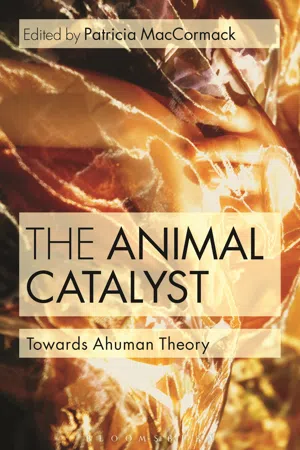
The Animal Catalyst deals with the 'question' of 'what is an animal' and also in some instances, 'what is a human'? It pushes critical animal studies in important new directions; it re-examines basic assumptions, suggests new paradigms for how we can live and function ecologically, in a world that is not simply "ours." It argues that it is not enough to recognise the ethical demands placed upon us by our encounters with animals, or to critique our often murderous treatment of them: this simply reinforces human exceptionalism. Featuring contributions from leading academics, lawyers, artists and activists, the book examines key issues such as:
- How "compassion" for animals reinforces ideas of what distinguishes human beings from other animals.
- How speciesism and human centricity are built into the legal system.
- How individualist subjectivity works in relation to animals who may not think of themselves in the same way.
- How any consideration of animal others must involve a radical deconstruction of our very notion of the "human."
- How art, philosophy and literature can both avoid speciesism and deliver the human from subjectivity.
This volume is a unique project which stands at the cutting edge of both animal rights philosophies and posthuman/artistic/abstract philosophies of identity. It will be of great interest to undergraduates and researchers in philosophy, ethics, particularly continental philosophy, critical theory and cultural studies.
- 224 pages
- English
- ePUB (mobile friendly)
- Available on iOS & Android
eBook - ePub
About this book
Information
PART ONE
New Abolitionist Approaches
CHAPTER ONE
The War on Compassion
Carol J. Adams
In our lifetime, what was not supposed to happen ‘ever again’ – genocide – has instead happened again and again. As Samantha Power shows in A Problem from Hell (2002), her study of genocide in the twentieth century, the perception of genocide is all in the framing. Governments acting against a minority want the violence to be perceived as civil war or tribal strife, as quelling unrest and restoring order, as a private matter that does not spill over into the international community. Other governments weigh their own national interests against the needs of those being killed. After watching the movie Hotel Rwanda and as I began reading A Problem from Hell, among the many disturbing questions that surfaced for me, besides the obvious one – ‘How could we have let this happen?’ – was the question, How can we get people to care about animals when they do not even care when people are being killed? But as this question came to mind, I realized that it was the wrong one because it accepts a hierarchy of caring that assumes that people first have to care about other people before they care about animals and that these caring acts are hostile to each other. In fact, violence against people and that against animals is interdependent. Caring about both is required. While I could not read about genocide without thinking about the other animals and what humans do to them, I am sophisticated enough to know that this thought is experienced as an offense to the victims of genocide. However, I am motivated enough to want to ask more about the associations I was thinking about and sensing because human and animal are definitions that exist in tandem, each drawing its power from the other in a drama of circumscribing: the animal defining the human, the human defining the animal. As long as the definitions exist through negation (human is this, animal is not this, human is not that, animal is that – although what is defined as human or animal changes), the inscription of human on something, or the movement to be seen as human (for example, Feminism is the radical notion that women are human), assumes that there is something fixed about humanness that ‘humans’ possess and, importantly, that animals do not possess. Without animals showing us otherwise, how do we know ourselves to be human?
Despite all the efforts to demarcate the human, the word ‘animal’ encompasses human beings. We are human animals; they, those we view as not-us, are non-human animals. Discrimination based on colour of skin that occurs against those above the human–animal boundary is called racism; when it becomes unspeakably murderous, it is called genocide. Discrimination by humans that occurs against those below the human–animal boundary is called speciesism; when it becomes murderous, it is called meat eating and hunting, among other things. The latter is normalized violence. Is it possible that speciesism subsumes racism and genocide in the same way that the word ‘animal’ includes humans? Is there not much to learn from the way normalized violence disowns compassion? When the first response to animal advocacy is, ‘How can we care about animals when humans are suffering?’, we encounter an argument that is self-enclosing: it re-erects the species barrier and places a boundary on compassion while enforcing a conservative economy of compassion; it splits caring at the human–animal border, presuming that there is not enough to go around. Ironically, it plays into the construction of the world that enables genocide by perpetuating the idea that what happens to human animals is unrelated to what happens to non-human animals. It also fosters a fallacy: that caring actually works this way. Many of the arguments that separate caring into deserving/undeserving or now/later or first those like us/then those unlike us constitute a politics of the dismissive. Being dismissive is inattention with an alibi. It asserts that ‘this does not require my attention’ or ‘this offends my sensibility’ (that is, ‘We are so different from animals, how can you introduce them into the discussion?’). Genocide, itself, benefits from the politics of the dismissive. The difficulty that we face when trying to awaken our culture to care about the suffering of a group that is not acknowledged as having a suffering that matters is the same one that a meditation such as this faces: ‘How do we make those whose suffering does not matter, matter?’
False mass terms
All of us are fated to die. We share this fate with animals, but the finitude of domesticated animals is determined by us, by human beings. We know when they will die because we demand it. Their fate, to be eaten when dead, is the filter by which we experience their becoming ‘terminal animals’. The most efficient way to ensure that humans do not care about the lives of animals is to transform non-human subjects into non-human objects. This is what I have called the structure of the absent referent (Adams 2000: 51). Behind every meal of meat is an absence: the death of the non-human animal whose place the meat takes. The absent referent is that which separates the meat eater from the other animal and that animal from the end product. Humans do not regard meat eating as contact with another animal because it has been renamed as contact with food. Who is suffering? No one.
In our culture, meat functions as a mass term (Quine 1960; Adams 1994: 27), defining entire species of non-humans. Mass terms refer to things like water or colours; no matter how much of it there is or what type of container it is in, water is still water. A bucket of water can be added to a pool of water without changing it. Objects referred to by mass terms have no individuality, no uniqueness, no specificity, no particularity. When humans turn a non-human into ‘meat’, someone who has a very particular, situated life, a unique being, is converted into something that has no individuality, no uniqueness, no specificity. When five pounds of meatballs are added to a plate of meatballs, it is more of the same thing; nothing is changed. But taking a living cow, then killing and butchering that cow, and finally grinding up her flesh does not add a mass term to a mass term and result in more of the same. It destroys an individual. What is on the plate in front of us is not devoid of specificity. It is the dead flesh of what was once a living, feeling being. The crucial point here is that humans transform a unique being, and therefore not the appropriate referent of a mass term, into something that is the appropriate referent of a mass term. False mass terms function as shorthand. They are not like us. Our compassion need not go there – to their situation, their experience – or, if it does, it may be diluted. Their ‘massification’ allows our release from empathy. We cannot imagine ourselves in a situation where our ‘I-ness’ counts for nothing. We cannot imagine the ‘not-I’ of life as a mass term.
To kill a large number of people efficiently, the killers succeed when they have made the people they are targeting into a mass term. Philip Gourevitch, writing of the genocide in Rwanda, explains: ‘What distinguishes genocide from murder, and even from acts of political murder that claim as many victims, is the intent. The crime is wanting to make a people extinct. The idea is the crime. No wonder it’s so difficult to picture. To do so you must accept the principle of the exterminator, and see not people, but a people’ (1998: 202).
Gourevitch says that ‘the idea is the crime’. The victims are seen as a mass term by their oppressors: ‘not people, but a people’. When a group is regarded as a people, not as being composed of individual people, certain conventions of thought and stereotypes take over. The claim is made that the people can be defined as a group, through racial, ethnic or species characteristics: in Germany in the 1930s and 1940s, what Jews are like and what Jews do; in Rwanda in the 1950s and forward, what Tutsis are like and what Tutsis do. These characteristics heighten the idea of their existence as being a threat to others or as being dirty. Then the false characteristics become fixed through their existence as a metaphor.
The presumptions and mistakes of racial biology reiterate similar presumptions and mistakes in ‘species’ biology. Humans think they can know ‘cows’ or ‘birds’ and use adjectives drawn from this assumption: cowlike, birdbrain. Susanne Kappeler observes that
Western theories of racism attained proper ‘scientific’ status in the nineteenth and twentieth centuries in the guise of medicine, psychiatry, eugenics, anthropology, demography, and so forth. They stand in direct continuity with the theories that categorize non-human animals in species, and living beings into humans, animals, and plants – categories modelled on the paradigms of the natural sciences. These included attempts to established classifications of ‘kinds’ of people based on ‘typical’ data – be it measurements of bodies and body parts, genetic data, or behavioral features. (1995: 327)
Gourevitch (1998) writes, ‘The idea is the crime’, seeing a people, not people. One explanation for the appalling indifference of those of us who live in the United States, Europe, Great Britain, Australia and New Zealand to mass killings is that we, like their oppressors, may see the targeted victims as a mass term. When people are not experienced in their individuality, their deaths may not feel immediate. During the genocide in Rwanda, one American officer explained the calculations they were doing: ‘one American casualty is worth about 85,000 Rwandan dead’ (quoted in Power 2002: 381). The ‘massification’ of beings permits the dilution, the diminution of our attention. The more of a mass term they become, the less concern they need provoke. It is like an hourglass: the sands of our compassion drain into the bottom. How do we flip the hourglass? How do we revive or awaken compassion?
Mass terms are linked to subjects being diminished. In their diminishment, as I pointed out in The Sexual Politics of Meat (2000), all that is left for them is to become metap...
Table of contents
- Cover
- Halftitle Page
- Title Page
- Dedication Page
- Contents
- Notes on Contributors
- Acknowledgements
- Introduction
- Part One: New Abolitionist Approaches
- Part Two: Animal Mediators: Philosophy, Film, Literature
- Part Three: Ahumanity: A Liberation of Life
- Bibliography
- Index
- Imprint
Trusted by 375,005 students
Access to over 1.5 million titles for a fair monthly price.
Study more efficiently using our study tools.
Frequently asked questions
Yes, you can cancel anytime from the Subscription tab in your account settings on the Perlego website. Your subscription will stay active until the end of your current billing period. Learn how to cancel your subscription
No, books cannot be downloaded as external files, such as PDFs, for use outside of Perlego. However, you can download books within the Perlego app for offline reading on mobile or tablet. Learn how to download books offline
Perlego offers two plans: Essential and Complete
- Essential is ideal for learners and professionals who enjoy exploring a wide range of subjects. Access the Essential Library with 800,000+ trusted titles and best-sellers across business, personal growth, and the humanities. Includes unlimited reading time and Standard Read Aloud voice.
- Complete: Perfect for advanced learners and researchers needing full, unrestricted access. Unlock 1.5M+ books across hundreds of subjects, including academic and specialized titles. The Complete Plan also includes advanced features like Premium Read Aloud and Research Assistant.
We are an online textbook subscription service, where you can get access to an entire online library for less than the price of a single book per month. With over 1.5 million books across 990+ topics, we’ve got you covered! Learn about our mission
Look out for the read-aloud symbol on your next book to see if you can listen to it. The read-aloud tool reads text aloud for you, highlighting the text as it is being read. You can pause it, speed it up and slow it down. Learn more about Read Aloud
Yes! You can use the Perlego app on both iOS and Android devices to read anytime, anywhere — even offline. Perfect for commutes or when you’re on the go.
Please note we cannot support devices running on iOS 13 and Android 7 or earlier. Learn more about using the app
Please note we cannot support devices running on iOS 13 and Android 7 or earlier. Learn more about using the app
Yes, you can access The Animal Catalyst by Patricia MacCormack in PDF and/or ePUB format, as well as other popular books in Philosophie & Esthétique en philosophie. We have over 1.5 million books available in our catalogue for you to explore.