What is the meaning of life? Does anything really matter? In the past few decades these questions, perennially associated with philosophy in the popular consciousness, have rightly retaken their place as central topics in the academy. In this major contribution, Nicholas Waghorn provides a sustained and rigorous elucidation of what it would take for lives to have significance. Bracketing issues about ways our lives could have more or less meaning, the focus is rather on the idea of ultimate meaning, the issue of whether a life can attain meaning that cannot be called into question.
Waghorn sheds light on this most fundamental of existential problems through a detailed yet comprehensive examination of the notion of nothing, embracing classic and cutting-edge literature from both the analytic and Continental traditions. Central figures such as Heidegger, Carnap, Wittgenstein, Nozick and Nagel are drawn upon to anchor the discussion in some of the most influential discussion of recent philosophical history. In the process of relating our ideas concerning nothing to the problem of life's meaning, Waghorn's book touches upon a number of fundamental themes, including reflexivity and its relation to our conceptual limits, whether religion has any role to play in the question of life's meaning, and the nature and constraints of philosophical methodology.
A number of major philosophical traditions are addressed, including phenomenology, poststructuralism, and classical and paraconsistent logics. In addition to providing the most thorough current discussion of ultimate meaning, it will serve to introduce readers to philosophical debates concerning the notion of nothing, and the appendix engaging religion will be of value to both philosophers and theologians.
eBook - ePub
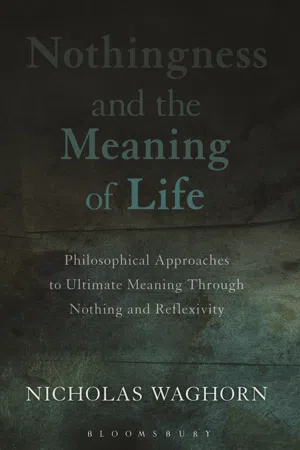
Nothingness and the Meaning of Life
Philosophical Approaches to Ultimate Meaning Through Nothing and Reflexivity
- 320 pages
- English
- ePUB (mobile friendly)
- Available on iOS & Android
eBook - ePub
Nothingness and the Meaning of Life
Philosophical Approaches to Ultimate Meaning Through Nothing and Reflexivity
About this book
Information
Part One
Getting Us Nowhere – The Geography of Nothingness
1
Heidegger and the Evolution of das Nichts
By homely gift and hindered Words,
The human heart is told
Of Nothing—
‘Nothing’ is the force
That renovates the World.
Emily Dickinson
1.1 Introduction
Questions concerning nothingness and kindred notions such as nothing, negation and negativity have drawn constant interest throughout the history of philosophy, Eastern and Western. It is my initial intuition that the persistence of, yet lack of real progress on, these questions is due to much the same factors that Martin Heidegger felt explained why the question of Being ‘has today been forgotten’.1 That is, everyone takes it that they already understand the meaning of ‘nothing’, and regards anyone who inquires into it as exemplifying ‘an error of method’.2
The type of ‘error of method’ made in inquiring into nothingness is usually deemed to be a lack of understanding of how quantification works, or of reference failure. A paradigm case of the former accusation can be found in Rudolf Carnap’s criticism that Heidegger’s statement ‘The nothing itself noths’ is a pseudo-statement – a criticism that we will be looking at later.
This is the story for a large part of past philosophy concerning nothingness. However, chiefly owing to Heidegger and his subsequent influence on a number of ‘Continental’ and postmodernist philosophers in the past half century, the area of fundamental ontology has garnered renewed interest. Heidegger is a helpful nexus of the strands of interest in nothingness, and so an interpretation of his work can be used as a key to access and lay out the notions in question when nothingness is examined.
An examination of paradigmatic analytic dismissals of ‘nothingness’ can be approached via the debate with Carnap. In addition, the subtleties of Wittgenstein’s philosophy (in both its early and late forms) can be linked to the nothingness debate via what Wittgenstein has to say on Heidegger’s notion of Angst, and indeed on ‘nothing’ explicitly. Eastern philosophy’s sustained focus on sunyata, ‘emptiness’, which has certain parallels with Western work on nothingness, is an interest that both Heidegger and his commentators have aligned themselves with.
For these various reasons then, I choose Heidegger as a key for unlocking the debates concerning nothingness.
1.2 Heidegger: ‘Early’ and ‘late’
Selecting a single figure to access a conceptual area, a ‘key’, has both pros and cons. My main interest here is in the (for want of a better word) ‘conceptual’ aspects of the questions concerning nothingness, rather than the interpretative aspects. Heidegger is notoriously difficult to interpret in any case, so while I am anxious to outline a comprehensive account of the philosophical moves in the debates concerning nothingness, I will unavoidably have to make some contentious moves as regards interpretation.
What I have been calling ‘nothingness’ thus far I wish to equate with Heidegger’s ‘the nothing’ (das Nichts); Heidegger’s major piece of explicit work on this topic is his lecture ‘What Is Metaphysics?’ Outside of this lecture, mentions of ‘the nothing’ are less frequent, especially as Heidegger’s thought progresses, but this is deceptive, insofar as Heidegger acknowledges in that lecture that ‘Being and the nothing do belong together’.3 As Heidegger’s philosophy was arguably totally dedicated to rediscovering the question of Being,4 his work bears much wider implicit relevance to debates concerning nothingness than explicit mentions suggest. So, although ‘What Is Metaphysics?’ is taken to be representative of the emphases characteristic of earlier Heideggerian thought, if we relate its content concerning Being and the nothing to the alteration of focus as regards Being in Heidegger’s later work, we should be able to reconstruct more comprehensively what the later Heidegger may have thought about the nothing also. Indeed, in the introduction to his translation of the lecture, Krell notes that ‘Heidegger’s preoccupation with the nothing becomes an important theme that bridges his early and later work’. Certainly ‘What Is Metaphysics?’, delivered in 1929, marks a transitional time between Being and Time (1927), which belongs firmly with the early works, and the perceived change of focus in the early thirties that characterizes Heidegger’s later thought.5
1.3 ‘What Is Metaphysics?’: Context
Heidegger had spoken of ‘nothing’ before 1929. It occurs in his work as early as 1921–22 to indicate aspects of ‘ruination’, a precursor to the more developed notion of ‘falling’ found in Being and Time.6 It then reappears, with a very different meaning, in Being and Time itself. There, ‘nothing’ and ‘nullity’ are associated with certain affective components of ‘Dasein’ – Heidegger’s term for a subject that is always already in the midst of interaction with the world in which it lives – that make Dasein’s life seem uncanny. In both of these cases, ‘nothing’ is interpreted as ‘the nothing of . . .’, whether that be, say, ‘the Nothing of hopelessness’ in 1921–22, or, say, ‘the nothing of the world’ in Being and Time. Only by the time of ‘What Is Metaphysics’ is ‘nothing’ explicitly thematized on its own terms, as ‘the nothing’, das Nichts, rather than ‘the nothing of . . .’.
This is an entirely natural progression. Being and Time was left incomplete on its own terms,7 Divisions I and II dealing only with the task of investigating the Being of Dasein in relation to temporality. Dealing with the question of Being itself, in relation not directly to Dasein but to temporality, was the task of Division III, and this theme is elaborated in Heidegger’s The Basic Problems of Phenomenology, also of 1927. The planned remainder of Being and Time, a historical inquiry that would have revealed Kant’s presuppositions to see how he relied on Descartes, and Descartes’ to see how he relied on Aristotle, is spread over The Basic Problems of Phenomenology (Aristotle, Descartes) and 1929’s Kant and the Problem of Metaphysics (Kant). It is possible now to see ‘What Is Metaphysics?’ as sharing a similar focus with The Basic Problems of Phenomenology, insofar as both pursue their inquiries – into ‘nothing’ and ‘Being’, respectively – less through an investigation of Dasein and its analytic and more by thematizing these notions directly. So given that this was always the plan for Division III of Being and Time, my use of the term ‘progression’ at the beginning of this paragraph should be seen in that light.
So this brief glance at context indicates both that ‘What Is Metaphysics?’ grows from the soil of Being and Time as it stands (Divisions I and II), and so an understanding of it will necessitate familiarity with the terms and ideas of Being and Time, but that equally ‘What Is Metaphysics?’ is no mere rehashing of ideas from Being and Time. Not only did Heidegger have more to say even while writing Being and Time, which excess will necessarily inflect our reading of the 1929 lecture, but even as he was circulating this further thought (in the texts cited above) his thinking was making genuine progress (as we will see in our discussion of certain terms below).
Taking up the first of these hermeneutic caveats, let us define a few important terms and issues drawn from Being and Time that will be useful in following ‘What Is Metaphysics?’ I have already indicated that Heidegger’s central issue was the issue of Being and the meaning of Being. The literature usually discerns two discrete questions here. First, the ‘guiding question’: the question about what it means for beings to be, what characterizes beings ‘as such’ – this is a question concerning the Being of beings (‘das Sein des Seienden’). Secondly, the ‘basic question’, which Michael Inwood identifies with the ‘forgotten’ question that opens the Introduction to Being and Time. This is the question of the essence of Being, the fundamental happening ‘that first enables us to have access to the Being of beings and thus makes it possible for beings to display themselves as such’.8 To refer to this happening, Heidegger uses the archaic Seyn as opposed to the Sein of the Being of beings. To emphasize the distinction, I will translate Seyn as ‘Beyng’.9 I will use Being (Sein) for the Being of a specific entity (e.g. Dasein) or as an umbrella term for the issues concerning the ‘guiding’ and ‘basic’ questions. Such an umbrella term is important as in his early and middle work Heidegger frequently runs together issues concerning the ‘guiding’ and ‘basic’ questions, so a neutral term is needed.
It is controversial to introduce this notion of Beyng (Seyn) into our interpretation of Being and Time and ‘What Is Metaphysics?’ It may be felt to be anachronistic, as the term Seyn was not introduced until the 1930s. But this does not mean that the idea of Beyng was not present earlier. We have seen that Inwood identifies the ‘forgotten’ question that opens Being and Time with the question of Beyng. Furthermore, even if we do not accept this, we must recognize that Being and Time as it stands is incomplete, and latter parts may have contained the seeds of what I am calling ‘the basic question’. Certainly Heidegger felt confident enough that ‘What Is Metaphysics?’ gelled with his later thought about Beyng that he could write both a Postscript (1943) and an Introduction (1949) to it, showing its continuity with that thought.10 More direct evidence comes when Heidegger considers the revelation that beings are beings – and not nothing – in ‘What Is Metaphysics?’ The acknowledgement of nothing ‘makes possible in advance the revelation of beings in general’, that is to say, the nothing ‘brings Da-sein for the first time before beings as such’.11 This seems to be a raising of the ‘basic question’ (via the ‘transitional question’, discussed below).12 My intention is not to suggest this as a definitive interpretation, but merely a plausible one.
Finally, a fuller explanation of the term ‘Dasein’. It was Heidegger’s desire to move away from the myth of a disembodied subject, a ‘Cartesian ego’, to a view of the subject as necessarily being in the world, as a Being-in-the-world (his terminology: ‘Dasein’).13 The idea, in brief, is that human beings are never disinterested observers of the contents of the world, but always have something to do with the world and its contents: the world reveals itself to us as an array of objects that we can use and interact with. Objects are ‘ready-to-hand’ – items that we utilize (and always already do utilize), rather than merely ‘present-at-hand’ – items that just exist plainly, and which we can then focus on to speculate about philosophically.14 This should not be taken as saying that ‘readiness-to-hand’ exhausts the level of human interactions in the world, but rather that even when we regard objects as ‘present-at-hand’, we are still enmeshed in a world of concerns15; hence the essential unity of Dasein’s Being as ‘care’ (Sorge).
1.4 ‘What Is Metaphysics?’: Content
Having laid the ground, let us examine what Heidegger is trying to achieve in ‘What Is Metaphysics?’ As I indicated before, this is an early example of the nothing being addressed as ‘the nothing’ rather than ‘the nothing of . . .’. It is important not to overplay the significance of this. After a review of the different aspects of ‘nothing’ and ‘nullity’ in Being and Time, Richard Polt claims that ‘[s]o far one might think Heidegger has invoked “Nothing” only for anthropological purposes’. He then goes on to suggest that ‘nothing’ in Being and Time characterizes the finitude of Dasein, whereas ‘nothing’ in ‘What Is Metaphysics?’ characterizes the finitude of Beyng.16 The word ‘anthropological’ is unfortunate here, suggesting a Kantian flavour that Heidegger would wish to avoid, and the opposition of the projects of Being and Time and ‘What Is Metaphysics?’ is perhaps too marked. Nevertheless, I agree with the spirit of Polt’s remarks; Heidegger is approaching the question of Being more directly, rather than through an analytic of Dasein. In particular, he approaches these issues through a consideration that takes its departure from our ordinary ways of speaking about ‘nothing’, and this is where we join the lecture.
It was perhaps inevitable that Heidegger should go on to draw the ire of a member of the Vienna circle such as Carnap, given the alignment of many members of that group with a methodology for philosophy patterned on the sciences. Heidegger sets himself against this in ‘What Is Metaphysics?’, first by claiming that science (in the broader German sense of ‘Wissenschaft’, which encompasses some of the humanities) ‘wants to know nothing of the nothing’.17 However, Heidegger maintains that despite this, science ‘has recourse to what it rejects’18 – and thus an investigation must be framed around the question ‘How is it with the nothing?’19
Why does Heidegger draw the conclusion that science has recourse to the ...
Table of contents
- Cover-Page
- Half-Title
- Series
- Title
- Contents
- Acknowledgements
- Introduction: A Crisis in Meaning
- Part 1 Getting Us Nowhere – The Geography of Nothingness
- Part 2 Think Nothing Of It – The Conceptuality of Nothingness
- Part 3 Nothing To Do With Me – The Application of Nothingness
- Notes
- Bibliography
- Index
- Copyright
Trusted by 375,005 students
Access to over 1.5 million titles for a fair monthly price.
Study more efficiently using our study tools.
Frequently asked questions
Yes, you can cancel anytime from the Subscription tab in your account settings on the Perlego website. Your subscription will stay active until the end of your current billing period. Learn how to cancel your subscription
No, books cannot be downloaded as external files, such as PDFs, for use outside of Perlego. However, you can download books within the Perlego app for offline reading on mobile or tablet. Learn how to download books offline
Perlego offers two plans: Essential and Complete
- Essential is ideal for learners and professionals who enjoy exploring a wide range of subjects. Access the Essential Library with 800,000+ trusted titles and best-sellers across business, personal growth, and the humanities. Includes unlimited reading time and Standard Read Aloud voice.
- Complete: Perfect for advanced learners and researchers needing full, unrestricted access. Unlock 1.5M+ books across hundreds of subjects, including academic and specialized titles. The Complete Plan also includes advanced features like Premium Read Aloud and Research Assistant.
We are an online textbook subscription service, where you can get access to an entire online library for less than the price of a single book per month. With over 1.5 million books across 990+ topics, we’ve got you covered! Learn about our mission
Look out for the read-aloud symbol on your next book to see if you can listen to it. The read-aloud tool reads text aloud for you, highlighting the text as it is being read. You can pause it, speed it up and slow it down. Learn more about Read Aloud
Yes! You can use the Perlego app on both iOS and Android devices to read anytime, anywhere — even offline. Perfect for commutes or when you’re on the go.
Please note we cannot support devices running on iOS 13 and Android 7 or earlier. Learn more about using the app
Please note we cannot support devices running on iOS 13 and Android 7 or earlier. Learn more about using the app
Yes, you can access Nothingness and the Meaning of Life by Nicholas Waghorn in PDF and/or ePUB format, as well as other popular books in Philosophy & Existentialism in Philosophy. We have over 1.5 million books available in our catalogue for you to explore.