The notion of Interreligious Studies signals a new academic perspective on the study of religion, characterized by a relational approach. Interreligious Studies defines the essential features of interreligious studies compared with alternative conceptions of religious studies and theology. The book discusses pressing and salient challenges in interreligious relations, including interreligious dialogue in practice and theory, interfaith dialogue and secularity, confrontational identity politics, faith-based diplomacy, the question of interfaith learning in school, and interreligious responses to extremism.
Interreligious Studies is a cutting-edge study from one of the most important voices in Europe in the field, Oddbjørn Leirvik, and includes case study material from his native Norway including interreligious responses to the bomb attack in Norway on 22nd July 2011, as well as examples from a number of other national and global contexts
Expanding discussions on interreligious dialogue and the relationship between religions in new and interesting ways, this book is a much-needed addition to the growing literature on interreligious studies.
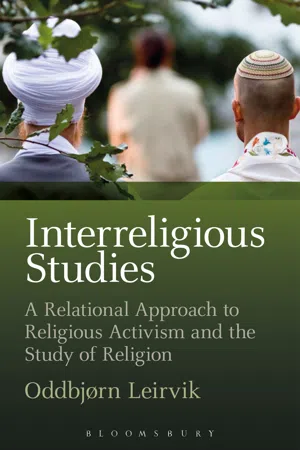
eBook - ePub
Interreligious Studies
A Relational Approach to Religious Activism and the Study of Religion
- 192 pages
- English
- ePUB (mobile friendly)
- Available on iOS & Android
eBook - ePub
Interreligious Studies
A Relational Approach to Religious Activism and the Study of Religion
About this book
Information
1
A Relational Approach to the Study of Religion
Interreligious studies . . . What’s in a name?
The term ‘interreligious studies’ is a relative novelty and hard to trace before the late 1990s. Since then, the term has been used to designate an increasing number of chairs, centres, research projects and study programmes in various academic contexts. To cite some examples from the first decades of the new millennium, from different parts of the world: the Claremont School of Theology in California offered an MA in Interreligious Studies and the University of Birmingham, in the United Kingdom, another in Inter-religious Relations. In Yogyakarta, the Indonesian Consortium for Religious Studies – a joint venture of one secular, one Christian, and one Islamic university – offered an international PhD programme in Interreligious Studies.
The University of Oslo has had a chair named ‘Interreligious Studies’ from 2005. In the same year, a European Society for Intercultural Theology and Interreligious Studies (ESITIS) was formed, thus connecting the well-established notion of intercultural theology with the relatively new one of interreligious studies. As one might expect, in ESITIS ‘interreligious’ constructs tend to be ever expanding, including for instance the notion of ‘interreligious hermeneutics’ which was also the title of the Society’s biannual conference in 2009.
As an academic discipline, interreligious studies relates to the praxis field of interreligious (or interfaith) dialogue, as reflected for instance in a new chair in ‘Comparative Theology and the Hermeneutics of Interreligious Dialogue’ established in 2013 at the Free University of Amsterdam. But the scope of interreligious studies is broader, as interfaith relations may just as well mean confrontation and conflict as dialogue and cooperation (diapractice).
As for the notion of interreligious studies, precise attempts to define the term are hard to find. The easiest thing to define is the prefix ‘inter’, which refers of course to something in between. But between what, or whom? Between texts, traditions or people? The phenomenon of intertextuality is relatively easy to analyse, since we are dealing here with a relation between relatively stable entities; namely texts. When living traditions and people come into the picture, everything becomes more complicated. People cannot be separated into neatly defined religious camps, with a certain ‘relation’ or ‘space’ between them. At the level of individual identities, the phenomenon of dual religious belonging (to Christianity and Islam, Buddhism and Christianity, etc.) adds to the complexity.
In pluralistic societies marked by fluidity and constant change, it is hard to see how Christianity, Islam, Buddhism or anything else could ever be fixed as stable points in the landscape, with corresponding spaces in between. Faith as represented by people means a complicated mix of religion, culture and (identity) politics, and the fields of tension are just as often to be found within the religions as between them. A salient example is gender models, as acted out in gendered practices that vary strongly across cultural and religious traditions.
Interreligious or transreligious?
Such recognitions have led some theorists to suggest that the prefix ‘inter’ should be replaced with ‘trans’ and that constructs such as ‘transreligious’ better capture the fluidity and multi-polarity of current religious encounters, and mutual influences across religious boundaries. For instance, in a course description from 2008, Roland Faber defined ‘transreligious discourse’ as ‘an approach to interreligious studies that is interested in processes of transformation between religions with regard to their ways of life, doctrines, and rituals’.1
Building on the German theologian Anders Nehring’s (2011) critical discussion of the notions of ‘intercultural’ comparison and encounter, which might seem to imply that cultures are as static entities, the Norwegian theologian Anne Hege Grung suggests that the expressions ‘intercultural’ and ‘interreligious’ should be replaced with ‘transcultural’ and ‘transreligious’. In her analysis of a dialogue group of Christian and Muslim women she notes that
faiths and cultures are in themselves diverse, meaning that transreligious/transcultural encounters are not only happening across religious and cultural representations but among different representations of allegedly the same religion or culture. (Grung 2011a: 29)
On this basis, she develops two models for dialogue. One (interreligious?) model is based on religious difference as constitutive, leaving other differences related to culture, class, gender, etc. more or less in the shadow. The other (transreligious?) model does not treat religions as stable entities. In tune with the analytical perspective of cultural complexity (Hylland Eriksen 2009), other differences related to gender, cultural background, social position and political power are taken seriously as part of the context for religious dialogue. Instead of seeing religious difference as constitutive, a broader array of differences are taken as a challenge for dialogue which in this mode may become more power-critical and more open to change (Grung 2011a: 61ff.; cf. Grung 2011b).
At the level of prefixes, there is of course also another distinction to be made; namely that between inter and intra. The term intercultural (as in intercultural theology) refers conventionally to intra-religious interaction across different cultures, which can be both strenuous and enriching. Anything interreligious is doubly complex, since inter- or transreligious encounters are often also inter- or transcultural ones.
Relational studies
In this book, I will stick to the notion of interreligious since the prefix ‘inter’ – more clearly than ‘trans’ – points at dynamic encounters that take place between people of complex belongings.
Making sense of the term interreligious studies, as a distinct type of approach to the study of religion and theology, requires a clarification of what the intended object of study would be. We could of course say that the object of study is interreligious relations or, more precisely, the encounter between religious cultures, and between people of different faiths. In relation to the well-established field of comparative religion, interreligious studies are ‘more expressly focused on the dynamic encounter and engagement between religious traditions and persons’ (Hedges 2013: 1077).
But that is not enough to define the academic field. We also need to clarify whether we are dealing with a purely descriptive and analytical study or a more constructive one akin to systematic theology in the Christian tradition.
In my view, there is something essentially relational with interreligious studies that make them different from religious studies in the conventional sense and from confessional theology. In my understanding, the notion of interreligious studies refers both to the object of research, and to the subject who is carrying out the research (i.e. the researcher and the way in which the research is done). Taking both aspects into account, I would suggest that interreligious studies are relational in three different senses: (1) the object of study is interreligious relations in the broadest sense, including – I would suggest – the relation between religion and non-religion. Rather than researching one particular tradition, interreligious studies investigates the dynamic encounter between religious (and non-religious) traditions and the space that opens or closes between them. (2) With regard to the subject (the researcher) I would contend that interreligious studies are by nature interdisciplinary, as the multidimensionality of interreligious relations can only be grasped by a combination of cultural analytical, legal, social science-, religious studies- and theological approaches.2 (3) I would also suggest that interreligious studies – at least in the theological sense – can only be meaningfully done in conversation between different faith traditions, in an effort at interreligious (i.e. relational) theology.
From a theory of science perspective, interreligious studies can only be meaningfully undertaken in a willingness to reflect critically on one’s own position in the spaces between. When studying a separate tradition, it makes sense – to some extent – to state that you yourself need not be implicated yourself in the object of study. Not everyone doing research on Islam is a Muslim and not all those who study Christianity are Christians. But, in the case of interreligious studies, it is hard to see how anyone could say that he or she is not a part of the studied field – especially if we include those complex spaces between religion and secularity that in my understanding are a constitutive part of interreligious studies. Who is not part of the spaces between religions, cultures and secularities? Who is not already a positioned agent in those spaces, when undertaking a particular study? With a view to the many tensions between the religions, and not least between religion and non-religion, interreligious studies thus become studies of conflicts that you are already part of.
If doing interreligious studies means being implicated as an agent in the field of study, it should be no surprise that this emerging field or discipline has evolved from theology rather than from religious studies. Emphasizing the agency perspective, Scott Daniel Dunbar (1998) argues that what he calls ‘interfaith studies’ in the academia should be experiential and prescriptive, not just descriptive. However, as David Cheetham (2005) has emphasized, the new field needs the critical outsider perspective of religious studies in order not to be controlled by dialogue insiders who are well aware of their role as agents but perhaps not always able to see themselves from a critical distance. In a recent reflection, Paul Hedges suggests that ‘interreligious studies’ may actually be seen as ‘an interface between a more traditionally secular Religious Studies discipline, and a more traditionally confessional theological discipline’ (2013: 1077).
Defining features
Summing up and elaborating the above reflections a little more, I see three defining features of interreligious studies as an academic field or discipline:
1Interreligious studies is something essentially relational, in that it focuses on what takes place between religious traditions and their living representatives, on a scale from acute conflict to trustful dialogue. As indicated, my working definition of the space between includes the relation between religion and secularity. Linking up with Charles Taylor’s (2007) understanding of the term, secularity itself could in fact be seen as the non-hegemonic condition for interaction between citizens adhering to different religions, confessions and non-religious life philosophies (cf. Chapter 3).
2Interreligious studies recognizes the researcher’s, the teacher’s and the student’s role as agents in the spaces between. Agency means being implicated in negotiations of power, both within the religious traditions and between them. It is hard to see how anyone doing interreligious studies could not be part of this power play. Hence, self-critical reflection on one’s own agency is called for. Actually, the same could be argued with respect to religious studies in the more traditional sense, since the very choice of research objects and perspectives privileges certain strands of a given tradition, and neglects others. Who is not a potential agent of change, then, in the study of religions in today’s world?
3Recognizing one’s role as an agent means also to tackle the issue of normativity in a transparent way. The normative aspect of the study of religion has to do with the contemporary relevance of religious traditions and how they can be meaningfully translated into new contexts. What makes this work of translation an inter- or transreligious exercise, is the search for meaning and obligation across traditions, through what we conventionally call interreligious dialogue.
As an academic discipline, interreligious studies may investigate the theoretical foundation and practical implementation of different forms of interfaith dialogue. But, just as importantly, interreligious studies – when institutionalized in academia – create another arena for dialogue. If based in a secular university, people involved in interreligious dialogue will also have to translate their concerns into a commonly understandable language which includes non-believers in the conversation. In relation to pressing ethical and political issues, normativity is of course just as much a matter of concern for secular-minded colleagues as for religious ones.
With reference to the practice of Scriptural Reasoning, David Ford (2006) has distinguished between conversations in houses, tents and campuses respectively. In addition to the different religions’ separate ‘houses’ of interpretation, ‘tents’ may occasionally be pitched to frame interreligious conversations about sacred texts and common challenges. In comparison, Ford observes, ‘campuses’ may offer a more durable and solid structure for interfaith dialogue, if the academy opens up to such activities.
A contextual approach
My reflections above have a particular contextual background; namely, attempts to establish interreligious studies in a particular campus. My campus is the Faculty of Theology, which is a full member of the University of Oslo – a secular state university in the Northern European academic tradition but which also serves the educational needs of the churches (and increasingly, those of other faith communities). In what follows, I will exemplify how interreligious studies is pursued here, in particular, and in other, similar contexts – with reference to (1) ordinary study programmes and courses with an interreligious horizon, (2) tailor-made courses for religious leaders, and (3) the introduction of Islamic theology alongside Christian theology (a development currently seen in many European faculties of theology).
(1) The most common form of interreligious studies, offered by an increasing number of theological faculties and departments of religious studies all over the world, are study programmes and courses focusing on interreligious relations. The common recognition behind such courses is that no religion can be studied meaningfully unless in relation to and interaction with other living traditions. A regular course in our faculty, called ‘Islam, Christianity and the West’, would be a typical example of courses that are largely analytical and descriptive but also includes elements of dialogical reflection. The same would be true of courses that tackle the issue of faith and politics in an interreligious perspective. In other courses, the dialogical and constructive perspective is more outspoken. Examples that could be cited from my faculty include ‘Philosophy of dialogue’, ‘Interreligious hermeneutics’ (focusing on joint challenges in biblical and qur’anic interpretation) and a course on ‘Jesus, Muhammad and modern identities’. In the last-named course, the questions of the historical Jesus and the historical Muhammad are linked with normative questions about the modern meaning of their messages (as reflected, for instance, in recent biographies, but also in the students’ own perceptions). With regard to religion and secularity, students in programmes that include interreligious courses are also required to study humanism and the modern critique of religion.
Some would perhaps ask what makes such courses different from a traditional comparative study. In my view, the difference lies in the orientation towards a third element which may constitute a shared challenge. For instance, the above-mentioned course about Jesus and Muhammad has aimed not so much at comparing the two as trying to understand how current understandings of the foundational figures relate to the common question of modern identity. The same reference to a common third could be seen in a course offered by Union Theological Seminary in New York in 2013, about ‘Paul and Buddha: Modeling Inter-religious Dialogue’.
Likewise, studying ‘Islam, Christianity and the West’ means investigating how the two religions respond to shared challenges in contemporary Western societies (including a modern critique of religion).
(2) The second example that could be cited from my faculty is a tailor-made course for religious leaders including imams, pastors, Catholic nuns, Buddhist monks, Sikh leaders, etc. in a continuing education programme about ‘Being a religious leader in Norwegian society’. The course has built on the agency of established leaders, with the aim of developing their dialogical competence in a pluralistic society. The modules have dealt with religion, law and human rights; topics such as value pluralism and interreligious dialogue; and the issue of moral and spiritual counselling. My experience indicates that this type of interreligious learning functions as an arena for interfaith dialogue, with much of the same qualities of communication that one conventionally associates with dialogue. Facilitated by the academy as a space between, trust i...
Table of contents
- Cover
- Half-title
- Introduction: Religious Activism, Interfaith Dialogue and Interreligious Studies
- 1 A Relational Approach to the Study of Religion
- 2 Philosophies of Interreligious Dialogue: Practice in Search of Theory
- 3 Interreligious Dialogue and Secularity
- 4 The Image of the Other and Othering Discourses
- 5 Faith-based Diplomacy and Interfaith Activism: Dialogue from Above and Below
- 6 Tolerance, Conscience and Solidarity: Globalized Concepts in Ethical and Religious Education?
- 7 Interreligious Hermeneutics and the Ethical Critique of the Scriptures
- 8 The Sacred Space between: A Relational Theology in Dialogue with Islam
- 9 Interreligious Studies and Interfaith Dialogue, in Academia
- Postscript: United against Extremism?
- Appendices: Three Christian-Muslim Statements
- Notes
- Bibliography
- Index
Trusted by 375,005 students
Access to over 1.5 million titles for a fair monthly price.
Study more efficiently using our study tools.
Frequently asked questions
Yes, you can cancel anytime from the Subscription tab in your account settings on the Perlego website. Your subscription will stay active until the end of your current billing period. Learn how to cancel your subscription
No, books cannot be downloaded as external files, such as PDFs, for use outside of Perlego. However, you can download books within the Perlego app for offline reading on mobile or tablet. Learn how to download books offline
Perlego offers two plans: Essential and Complete
- Essential is ideal for learners and professionals who enjoy exploring a wide range of subjects. Access the Essential Library with 800,000+ trusted titles and best-sellers across business, personal growth, and the humanities. Includes unlimited reading time and Standard Read Aloud voice.
- Complete: Perfect for advanced learners and researchers needing full, unrestricted access. Unlock 1.5M+ books across hundreds of subjects, including academic and specialized titles. The Complete Plan also includes advanced features like Premium Read Aloud and Research Assistant.
We are an online textbook subscription service, where you can get access to an entire online library for less than the price of a single book per month. With over 1.5 million books across 990+ topics, we’ve got you covered! Learn about our mission
Look out for the read-aloud symbol on your next book to see if you can listen to it. The read-aloud tool reads text aloud for you, highlighting the text as it is being read. You can pause it, speed it up and slow it down. Learn more about Read Aloud
Yes! You can use the Perlego app on both iOS and Android devices to read anytime, anywhere — even offline. Perfect for commutes or when you’re on the go.
Please note we cannot support devices running on iOS 13 and Android 7 or earlier. Learn more about using the app
Please note we cannot support devices running on iOS 13 and Android 7 or earlier. Learn more about using the app
Yes, you can access Interreligious Studies by Oddbjørn Leirvik in PDF and/or ePUB format, as well as other popular books in Theology & Religion & Religion. We have over 1.5 million books available in our catalogue for you to explore.